News

News

Maryland Neighborhood Rocked After Six Shot During Chaotic Juneteenth Weekend

Authorities in Maryland are investigating a shooting that left six people injured, including two children, in Anne Arundel County early Saturday morning, as reported by The Post Millennial.

According to the Anne Arundel County Police Department, officers responded to reports of an “unknown disturbance” at approximately 4:49 a.m. in a suburban neighborhood outside Baltimore.

When officers arrived at the scene, they encountered a large crowd and discovered an adult male suffering from a gunshot wound.

Emergency medical personnel transported the victim to a local hospital, where he was treated for injuries that were not considered life-threatening.

As investigators worked to determine what had occurred, police learned that several additional victims had arrived at three different hospitals in the area seeking treatment for gunshot wounds.

Authorities said a total of six people were injured during the incident. The victims included four adults and two juvenile males.

In a statement released on social media, the Anne Arundel County Police Department provided details about the injuries sustained by the victims.

“One female victim with a gunshot wound to an extremity, two juvenile males with lower extremity injuries, and an adult male and female victim with lower extremity injuries were admitted to area hospitals, all with non-life-threatening injuries,” the department said.

Police indicated that all six victims survived and were receiving medical care.

Investigators have not yet determined what events led up to the shooting. Authorities said detectives are continuing to interview victims and gather evidence as they work to establish the circumstances surrounding the incident.

“Detectives are conducting interviews with the victims to determine what occurred during this event,” the department added.

“This investigation is active, and further details will be released once the investigation concludes.”

No suspects were immediately identified, and police did not announce any arrests as of Saturday.

The investigation remains ongoing as authorities seek information about what triggered the violence and whether additional witnesses may be able to assist investigators.

The Maryland shooting occurred during a violent Juneteenth holiday weekend that saw multiple shootings reported in major cities across the country.

On Friday, a separate shooting on Chicago’s South Side left at least 12 people wounded. The incident drew national attention and prompted comments from President Donald Trump regarding crime in Chicago and the response of state leadership.

Following the Chicago shooting, Trump criticized Illinois Governor JB Pritzker for not requesting federal assistance to help address violent crime in the city.

“Why isn’t Governor Pritzker calling me for help?” Trump posted on Truth Social.

“I could make Chicago a safe City in ONE MONTH, in ONE YEAR, it would be one of the safest!!! D.C. went from one of the worst to one of the safest cities in the U.S.”

Law enforcement officials in Maryland have not indicated whether the Anne Arundel County shooting was connected to any other incidents reported during the holiday weekend.

Authorities are continuing to investigate and said additional information will be released as detectives complete interviews and review evidence collected from the scene.
News

U.S. and Japan Flex Allied Naval Muscle in Early Start to Massive Valiant Shield Drill

U.S. and Japanese naval forces wasted no time showing off the kind of maritime dominance that keeps the Indo-Pacific stable and adversaries uneasy.

Over the weekend, warships from both nations steamed together in the Philippine Sea, kicking off the latest and most ambitious iteration yet of exercise Valiant Shield.

The move sent a clear message that America’s arsenal, paired with Japan’s growing might, is a wall that no communist regime can easily scale.

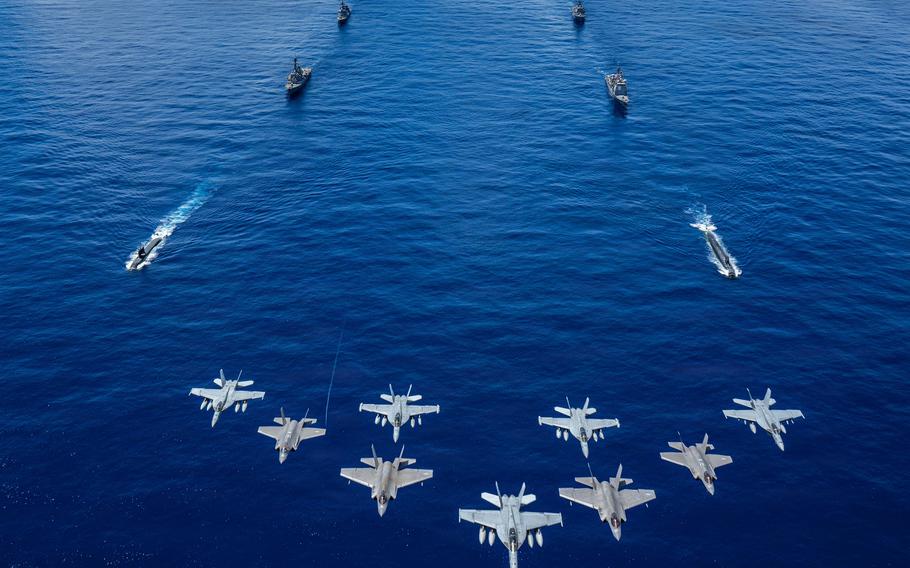
The aircraft carrier USS George Washington and its escorts joined Japan’s Maritime Self-Defense Force for early operations ahead of the official start date, putting jets in the sky and ships in formation before most Western media even took notice.

The images released by the Navy’s visual service weren’t just pretty pictures—they were power statements.

Now in its 11th edition since 2006, the Valiant Shield exercise unites all six branches of the U.S. military in coordinated drills across the western Pacific.

This year’s training stretches around Guam, Japan, and the Northern Mariana Islands—territories that form the front line of deterrence against China’s ambitions and North Korea’s volatile threats.

“Valiant Shield demonstrates our enduring commitment to a free and open Indo-Pacific,” said Adm. Steve Koehler, commander of the U.S. Pacific Fleet.

“Exercising advanced multidomain capabilities with our allies ensures we continue to seamlessly innovate and operate together, project combat power together, and prevail over any challenge—together.” For all the admiral’s usual formality, the message was unmistakably sharp: America and its allies are not backing down.

The George Washington strike group isn’t operating alone. Joining the carrier are guided-missile destroyers USS Benfold and USS Shoup, along with the guided-missile cruiser USS Robert Smalls and the fast-attack submarine USS Virginia.

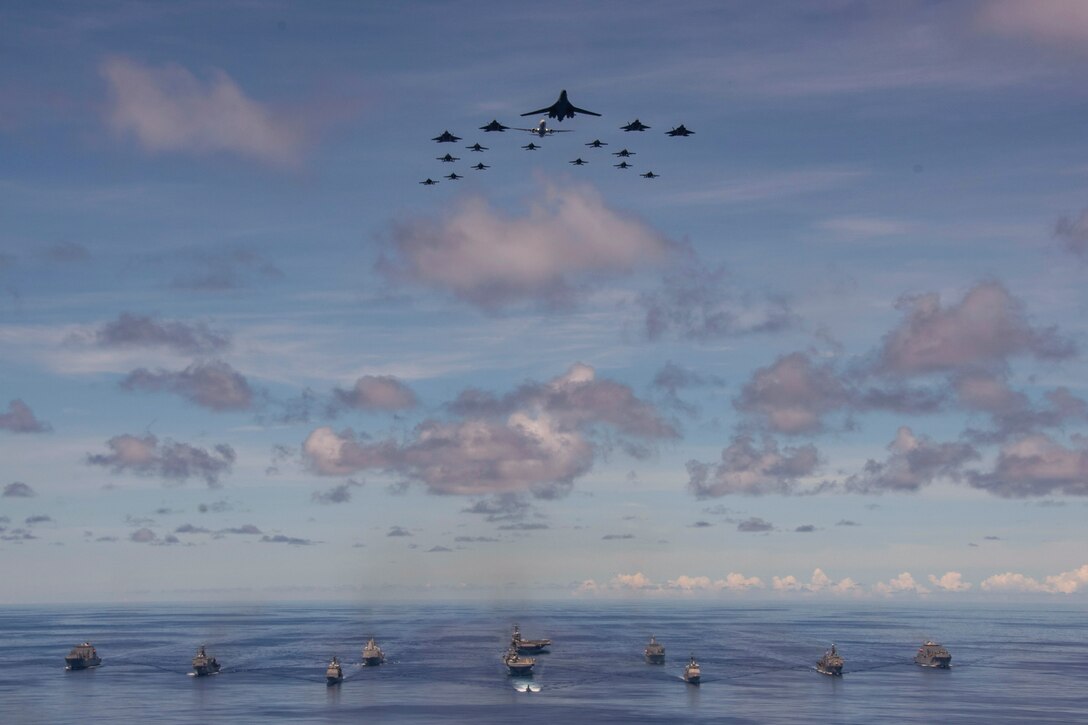
U.S. And Japan Flex Allied Naval Muscle In Early Start To Massive Valiant Shield Drill
Left to right: The USNS Charles Drew, the USS Comstock, the USS Shiloh, the USS New Orleans, the USS Chicago, the USS America, the USS Ronald Reagan, the USNS John Ericsson, the USS Antietam, the USS Germantown and the USNS Sacagawea sail in formation with Navy and Air Force aircraft during Valiant Shield in the Philippine Sea, Sept. 25, 2020. The exercise is designed to focus on integration of joint training in a blue-water environment among U.S. forces.

Together, they represent a lethal force capable of responding quickly to any flashpoint in the region.

Japan, stepping up its regional role under growing pressure to counter communist China, deployed an impressive fleet of its own.

The helicopter destroyer JS Kaga, guided-missile destroyer JS Fuyuzuki, and attack submarine JS Jingei sailed with the U.S. formation—showing that Tokyo is more than ready to move from self-defense to serious power projection.

This marks only Japan’s second appearance in the Valiant Shield series, following its 2024 debut. The nation’s Air and Ground Self-Defense Forces are also participating, a sign of Tokyo’s expanding military capability and willingness to integrate with U.S. forces in multidomain operations.

Roughly 4,100 Japanese troops, 150 vehicles, and 60 aircraft are participating this year, according to Japan’s Joint Staff. That’s no symbolic effort—it’s a serious investment in readiness.

For a country that long hesitated to flex its military muscle, this level of involvement underscores that Japan is done playing the pacifist spectator.

The George Washington group had arrived in Guam on June 16 after leaving its homeport of Yokosuka, Japan, on May 10. The visit to Guam was both a breather and a reminder of why the island remains a critical hub for the U.S. Navy’s carrier operations. “Guam remains a critical nexus for the Navy’s carrier strike groups,” said Capt.

Nicholas DeLeo, the ship’s commanding officer. “These Sailors have been working very hard, and I’m excited they have the opportunity to recharge here in Guam before we return to sea, ready to support our mission here in the Indo-Pacific.”

Even while anchored, the George Washington’s crew didn’t just sit idle. Sailors joined community events, including cleanup projects at Naval Station Guam and local beaches.

U.S. And Japan Flex Allied Naval Muscle In Early Start To Massive Valiant Shield Drill
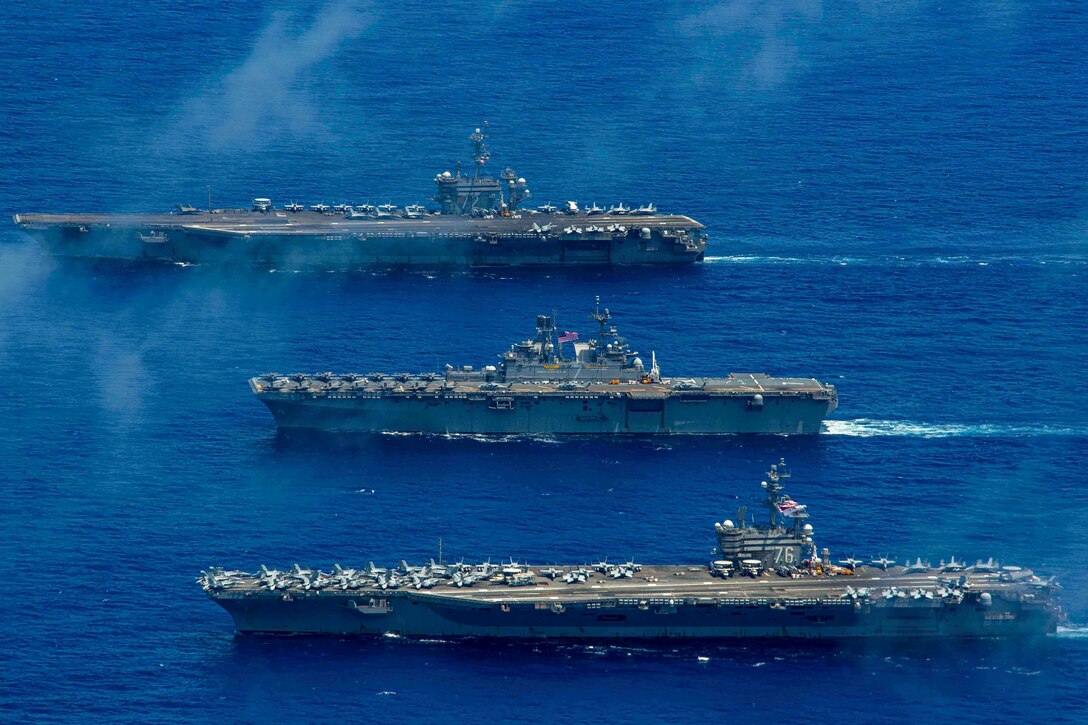
The USS Ronald Reagan, USS Tripoli and USS Abraham Lincoln steam in formation in the Philippine Sea, June 12, 2022, during Valiant Shield, a field training exercise.

It’s the kind of grassroots engagement that showcases America’s professionalism abroad—and the same discipline that keeps our Navy the best in the world.

Valiant Shield’s early underway period served as an unmistakable preview of what’s coming for the next ten days. The U.S. Pacific Fleet’s strategy is clear: stay ready, stay present, stay dominant.

Every operation in the Philippine Sea drives home the same truth—the Pacific belongs to free nations willing to fight for it.

With 2026 shaping up as another year of heightened tensions from Beijing’s aggressive moves in the South China Sea and Taiwan Strait, this year’s exercise carries extra weight.

The show of allied firepower is not just about drills—it’s about deterrence. It tells any adversary lurking in the shadows that if they gamble on challenging the United States and its allies, they’ll lose that bet fast.

These exercises are exactly the kind of forward-deployed readiness initiatives President Trump championed during his first term and that War Secretary Pete Hegseth continues to support with renewed energy. A strong Navy, a confident alliance, and a crystal-clear message: peace through power.

As the George Washington and her strike group cut through the Pacific, flanked by Japan’s finest, the message carries across the horizon.

In an era where weakness invites aggression, Valiant Shield reminds the world that America still leads from the front, and those who sail with her do so under the promise of strength and freedom.

News

New Commander Takes Helm of Europe’s Expanding Air Shield

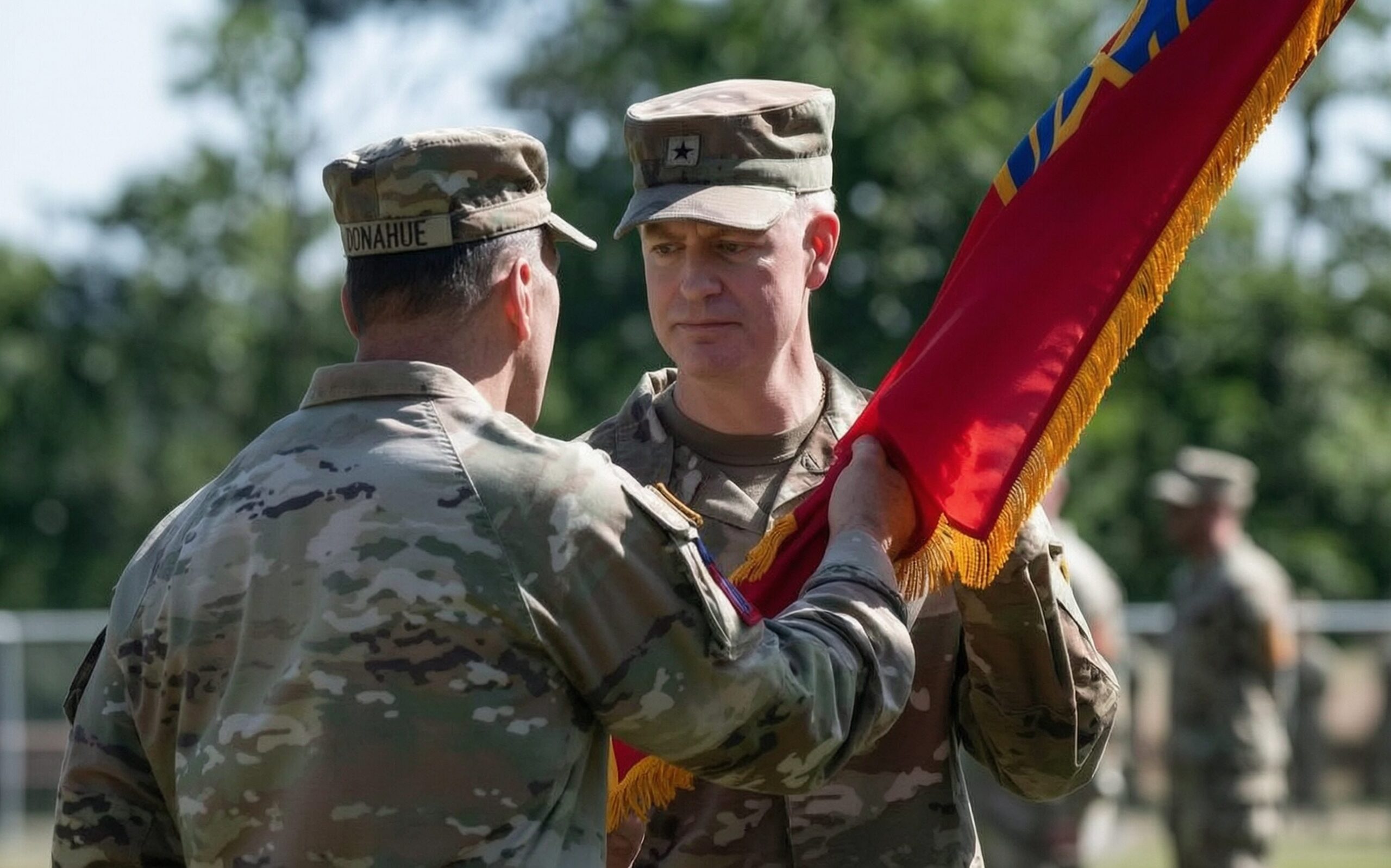
A new chapter opened for the U.S. Army’s air and missile defense mission in Europe as Brig. Gen. Glenn Henke assumed command of the 10th Army Air and Missile Defense Command during a ceremony at Sembach Kaserne, Germany.

The timing is hardly symbolic—Europe’s skies haven’t been this tense since the Cold War, and the 10th AAMDC is right at the heart of keeping them secure.

Henke took the reins from Brig. Gen. Curtis King, who led the command through an era of nonstop operational expansion.

Under King’s leadership, the unit extended America’s air defense reach from the Arctic circle to the Horn of Africa, deploying rapidly to NATO’s eastern flank as Russian hostilities intensified and Iran stirred trouble in the Middle East.

Gen. Christopher Donahue, commander of U.S. Army Europe and Africa, presided over the ceremony and made it clear that the 10th AAMDC had set the gold standard for modern air defense readiness. He lauded King for proving that the United States can shift air-defense assets across continents in days, not months, a feat he described as “unheard of in air defense history.”

Among those swift missions was the deployment of the U.S.-made Merops counter-drone system to Poland and Romania. Those countries, sitting on NATO’s fragile eastern front, were seeing constant drone incursions blamed squarely on Russia.

Thanks to America’s muscle and the innovation of its systems, those incursions were met with a capable shield that Europe had been sorely lacking.

King’s command also supported air defense forces sent briefly to U.S. Central Command’s area of responsibility during Operation Epic Fury against Iran.

Although officials were tight-lipped on the details, it was clear that the 10th AAMDC’s assets were integral to defending coalition forces. Donahue also noted that troops were sent to Turkey to bolster protection along NATO’s southern flank as Iran’s aggression simmered on the horizon.

The command doesn’t just operate in Europe—it extends into Africa, where forces in Djibouti continue to protect critical American and allied assets in a strategically vital region often overlooked by civilian policymakers in Washington.

The scale of these operations proves why the 10th has evolved from a support command into a combat-ready force built for the 21st century.

In his farewell speech, King underscored the urgency of his mission to adapt to new-age warfare defined by swarms of drones and high-velocity missiles.

He described the creation of the Eastern Flank Deterrence Initiative, aimed at uniting manned and unmanned defense systems under a common intelligence network capable of instantly relaying battlefield data. The initiative, he said, was meant to ensure NATO could not just defend, but dominate.

“The mission is clear,” King told the assembled soldiers.

“To counter mass by defeating one-way attack drones, cruise missiles, ballistic missiles, to enable the offense to inflict overwhelming violence on the enemy.” It was a plainspoken statement reflecting the clarity of purpose the Army needs in a new age of high-tech war.

That clarity is precisely what Henke inherits. A combat veteran of Iraq, Henke reminded attendees that when he left Europe two decades ago, the Army had just deactivated its last Bradley Stinger Fighting Vehicle battery.

Back then, the experts claimed air threats to ground troops were a thing of the past. “We all know that is now our present and our future,” he said, acknowledging the hard truth of today’s battlefield realities.

Henke’s background is fit for the fight ahead. As the former military deputy director of the Pentagon’s Joint Counter–Small Unmanned Aircraft Systems Office, he brings a wealth of knowledge on combating the very drone technologies transforming modern warfare.

His goal now is to ensure that the 10th AAMDC can detect, track, and destroy airborne threats before they can endanger allied forces or sovereign lands.

The timing of Henke’s appointment couldn’t be more consequential. The War Department is refocusing on Europe’s security architecture after years of neglect under weak leadership in Washington.

Thankfully, with strong military voices like Secretary of War Pete Hegseth and the steady backing of President Trump’s America First national defense posture, commands like the 10th are equipped, motivated, and politically unshackled to do what’s necessary to keep the peace from a position of undeniable strength.

As Patriot missile launchers framed the change-of-command ceremony, the symbolism was striking. The soldiers standing at attention in the German morning air represented more than tradition—they embodied readiness.

From Poland to Romania and Turkey to Djibouti, they are America’s sentinels, ensuring no adversary ever again mistakes NATO’s resolve for weakness.

With Henke now in command, the mission continues relentlessly.

Europe’s skies are crowded and contested, but thanks to America’s warriors and the leadership of men like Henke and Hegseth, they remain under the protection of the most powerful military the world has ever seen.

News

Global Military Brass Unites in Hawaii to Plan the Future of Coastal Warfare

Military leaders from 25 nations met this week in Waikiki at the Asia Pacific Center for Security Studies, uniting under the U.S. Marine Corps’ guidance to sharpen strategies for coastal warfare in a world where land, sea, and technology now blend into one battlespace.

Around 300 service members assembled for the 12th Pacific Amphibious Leaders Symposium, hosted by U.S. Marine Corps Forces Pacific, in what has become an essential forum for rehearsing the future of global littoral conflict.

The annual summit rotates across key Pacific locations, and this year, Hawaii served as the hub—a fitting location given its status as the nerve center for U.S. military operations in the Indo-Pacific region.

Lt. Gen. James Glynn, the top Marine in the Pacific, opened the gathering with words that captured both the gravity and history of the moment. “Trying to get to Hawaii’s a long way from everywhere, which puts it right in the middle of everything at a time when it’s needed most,” he told attendees.

Glynn’s point was clear: from this island stronghold, America projects power across the entire Pacific, deterring adversaries and reassuring allies.

Glynn drew parallels between ancient Hawaiian warriors guarding their coastline and the modern realities of amphibious and coastal warfare today.

He reminded the visiting officers that the line where ocean meets land has always been a contested frontier—then as now, both a zone of trade and of confrontation.

For the United States, that frontier has once again become critical as tensions continue to rise with Beijing over the South China Sea and Taiwan.

U.S. Army Quietly Stages Rotation in Philippines as Washington Expands Pacific Partnerships
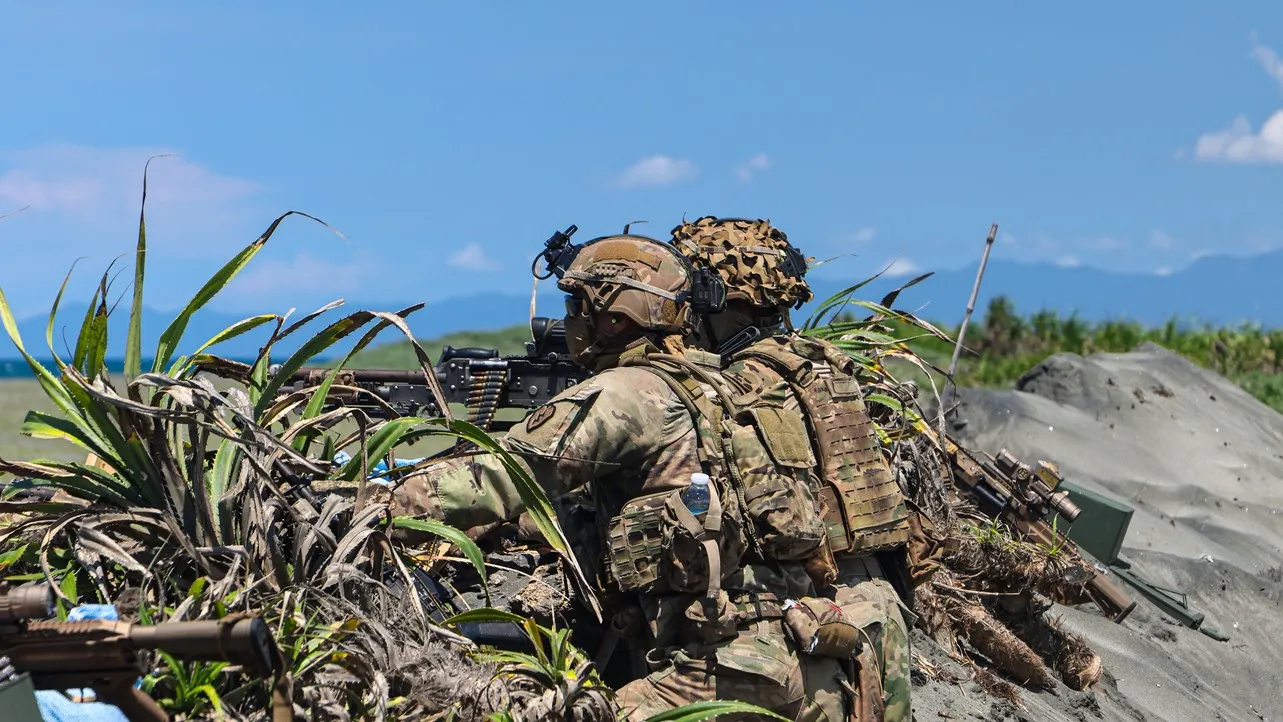
U.S. Army soldiers with the 25th Infantry Division train in the Philippines as part of exercise Balikatan 25. Army photo by Staff Sgt. Brenden Delgado.

Washington’s renewed interest in such partnerships reflects the urgency of maintaining open sea lanes and freedom of navigation against China’s endless territorial aggression.

While Glynn, like any seasoned Marine, chose his words carefully, his message was unmistakable: regional alliances are becoming indispensable as adversaries like China push boundaries and provoke instability.

Behind closed doors, discussion centered on coordination, readiness, and logistics for rapid-response amphibious operations anywhere from the Philippines to the Bering Strait.

The symposium highlighted recent joint training efforts under the massive Exercise Balikatan in the Philippines.

Experts Call to Stop Okinawa Drawdown as China’s Rise Tests Pacific Deterrence
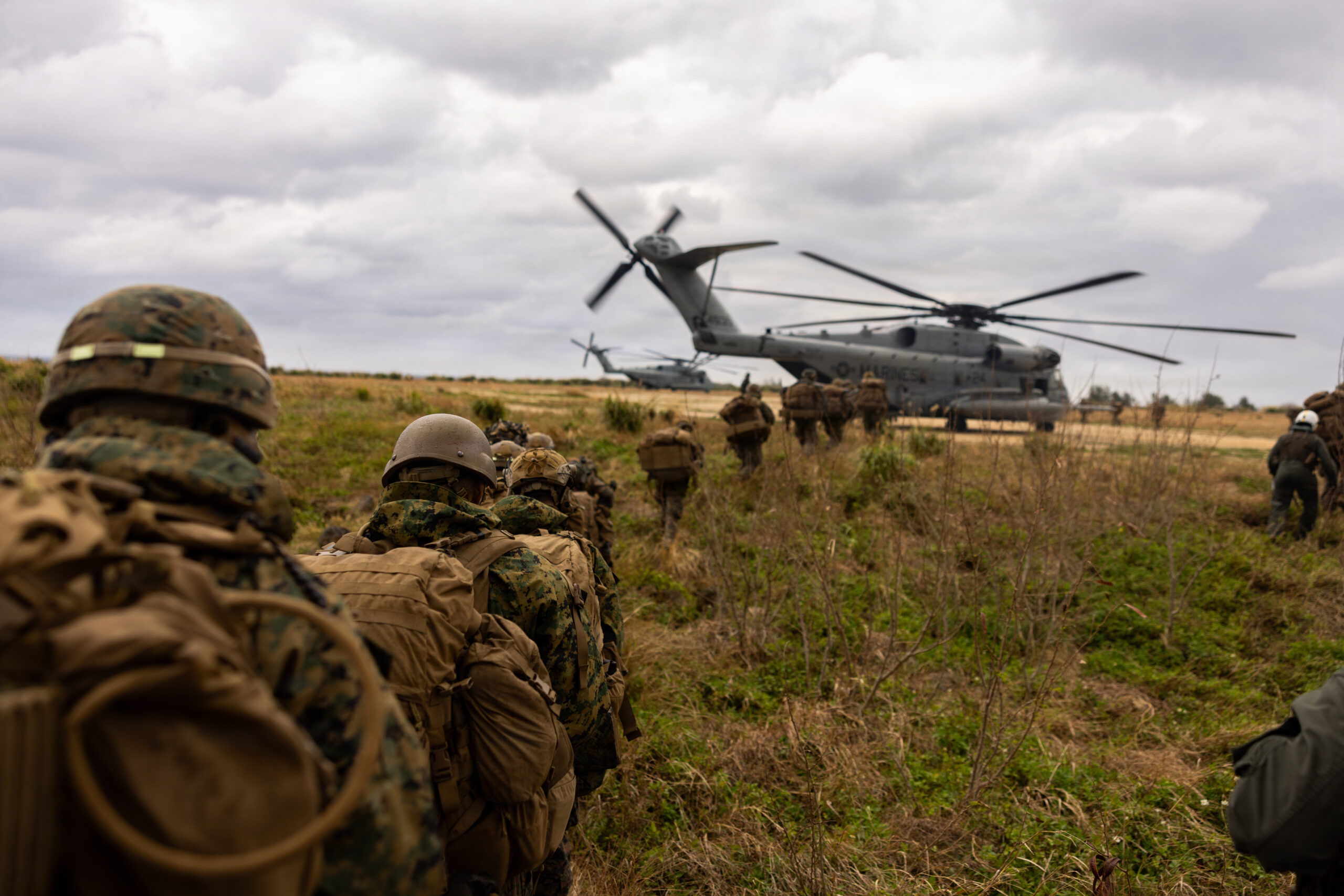
U.S. Marines with 2nd Battalion, 7th Marines, forward deployed to 3rd Marine Division, 4th Marine Regiment as part of the unit deployment program, load onto CH-53E Super Stallions after conducting a helicopter raid as part of a combined Marine Corps Combat Readiness Evaluation on Ie-Shima, Okinawa, Japan, Jan. 27, 2026. The MCCRE is a formal evaluation of 4th Marine Regiment, 3d Reconnaissance Battalion, and 3rd Marine Division’s Headquarters Battalion to confirm combat readiness for each unit. (U.S. Marine Corps photo by Cpl. John Simpson)

Glynn described the exercise as “consequential,” with Marines from nations including Australia, Japan, France, and Canada conducting live operations on sites edging contested waters. Not surprisingly, these are the very same regions China attempts to claim as “sovereign.”

China’s disregard for international rulings and its blatant militarization of the South China Sea continue to raise alarms.
Despite a 2016 international court ruling affirming the Philippines’ rights, Beijing has forged ahead with base construction, intimidation of fishermen, and military posturing designed to bully its neighbors.

During Balikatan, Marines from Hawaii’s own 3rd Marine Littoral Regiment exercised new anti-ship missile systems alongside Philippine forces just 100 miles from Taiwan—a not-so-subtle reminder that American reach remains strong and that aggression in the region will be met with credible deterrence.

Navy Chief Pushes Leaner, Faster Response with Tailored Fleets Over Carrier Centric Tactics
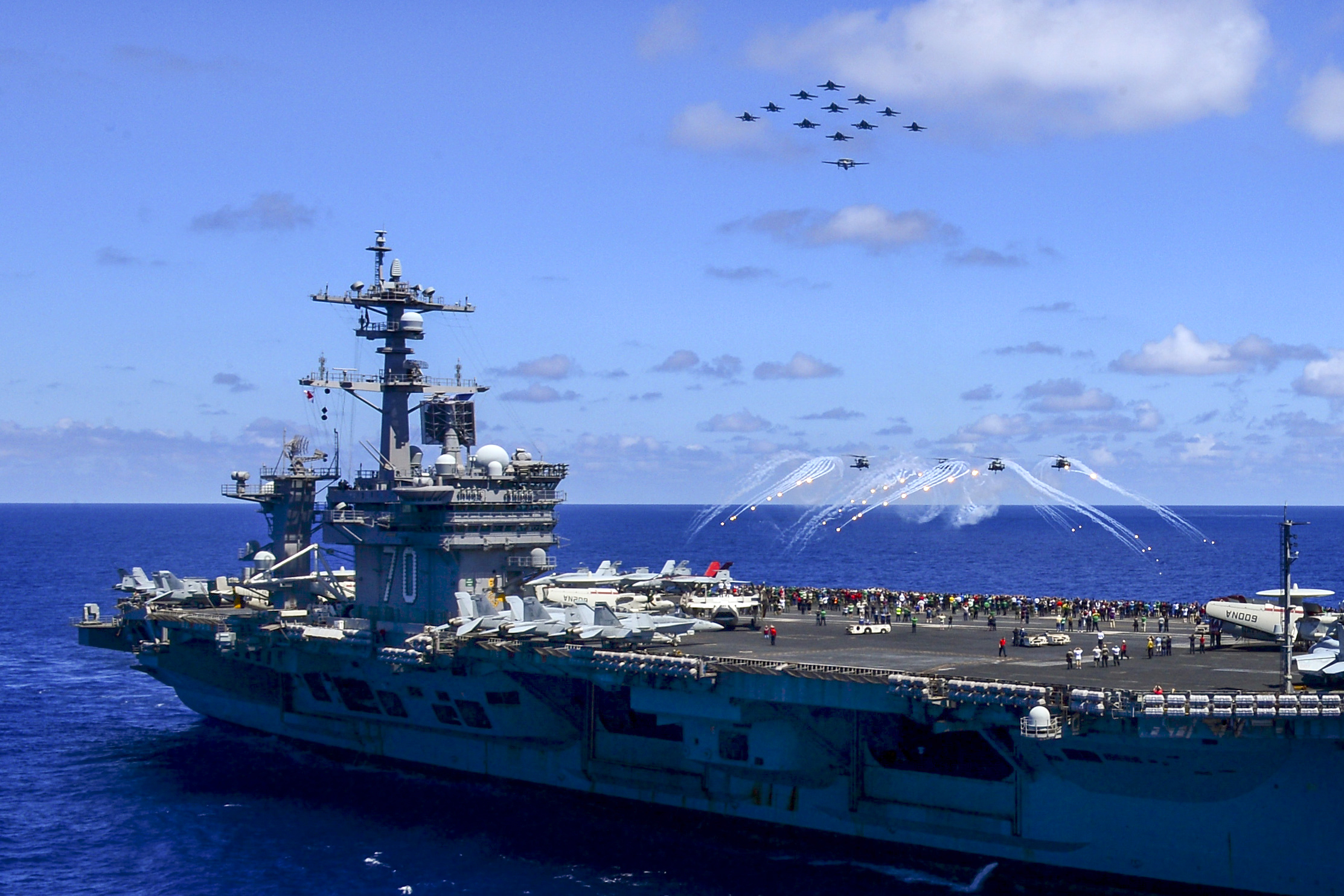
150531-N-GW139-2550 PACIFIC OCEAN (May 31, 2015) Aircraft assigned to Carrier Air Wing (CVW) 17 fly in formation during an air-power demonstration above aircraft carrier USS Carl Vinson (CVN 70). Carl Vinson and its embarked air wing, Carrier Air Wing (CVW) 17, are in the 3rd Fleet area of operations returning to homeport after a Middle East and Western Pacific Deployment. (U.S. Navy Photo by Mass Communication Specialist 3rd Class Eric Coffer/Released)

Although Glynn avoided naming China directly, the context of every discussion made it clear that the Chinese Communist Party and its expansionist ambitions loomed large in the background.

Interestingly, this massive Pacific war-planning conference came only weeks after President Trump’s trip to China to meet Xi Jinping, where he reaffirmed his commitment to peace through strength and fair trade without compromising America’s security interests.

Conflict across the globe—from Iran’s missile attacks on regional oil infrastructure to Russia’s aggression in Ukraine—provided additional case studies for the participants.

Each scenario underscored the same truth: the modern battlefield is multi-domain, layered across air, sea, space, and cyber. Glynn noted, “Longer-range weapons require deeper sensing, and deeper sensing extends into space and cyber.” The implication was plain: victory now depends on mastering information dominance as much as battlefield positioning.

At the heart of the U.S. Marines’ evolving strategy is Force Design 2030, a bold reorganization emphasizing flexibility, mobility, and coastal warfare supremacy.

The plan dissolves old formations, including tank battalions, to build agile units centered on anti-ship missile batteries and high-tech reconnaissance. While some critics claim it’s an untested gamble, battlefield realities from the Persian Gulf to the South China Sea seem to affirm its necessity.

U.S. Army Reorganizes for Multi-Domain Operations in the Pacific to Deter China
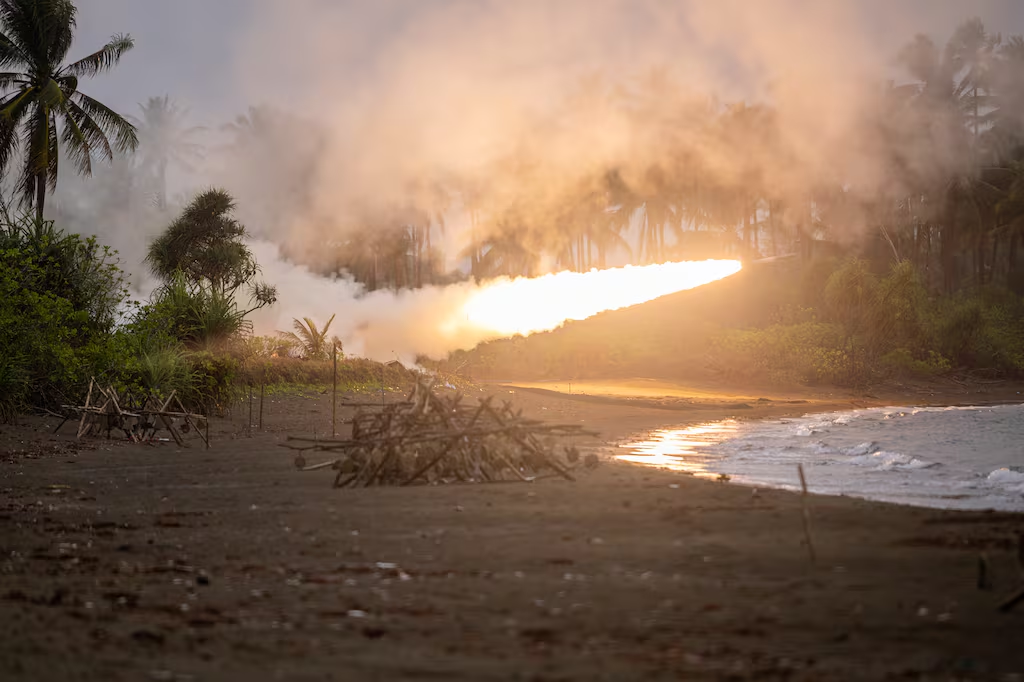
A U.S. HIMARS, seen here being fired by U.S. soldiers during the Balikatan military exercise in Rizal, Philippines, May 2, 2024. (Cpl. Kyle Chan/Marine Corps)

Glynn used the recent Iran conflict as an example of modern firepower’s reach and asymmetrical danger, pointing out that cheap precision drones and missiles prove why the Marines’ transformation is essential.

“The proliferation of long-range, cheap, destructive means has demonstrated the utility of the Force Design concept,” Glynn said, emphasizing that resilience, repairability, and sensor networks are now vital to survival and victory alike.

This Waikiki gathering served as more than just another meeting—it signaled the strengthening of a Pacific partnership web, one designed to ensure that no shoreline or sea lane falls quietly under the shadow of authoritarian expansion.

For America and its allies, projecting strength from the islands of Hawaii to the edges of Asia is not merely a strategic choice. It’s a necessary reminder that freedom still has guardians watching the tides.

News

Los Angeles Chokes On Smoke As Newsom And Bass Sleepwalk Through Another Crisis [WATCH]

A massive warehouse fire that began in Los Angeles’ Boyle Heights neighborhood on June 17 continued burning into the weekend, prompting emergency declarations, air quality concerns, and questions about the response from state and local officials, as reported by Red State.

The fire erupted at a Lineage cold food storage facility on South Los Palos Street, just east of downtown Los Angeles. According to officials, the blaze appeared to be concentrated on the roof and within the building’s solar panel system.

Despite extensive firefighting efforts, the fire remained active several days later.

Authorities initially issued a shelter-in-place order covering the area south of the 101 Freeway to Washington Boulevard and east of Soto Street to Indiana Street. The order was later lifted around 8:45 p.m.

The Los Angeles Police Department said approximately 70 people were evacuated from two nearby streets. Officials also reported that an ammonia line was compromised during the incident, but was later secured.

As the fire continued, the Los Angeles Police Department issued a citywide tactical alert to increase the number of available officers.

The warehouse had experienced a similar solar panel-related fire in August 2024, according to reports.

Los Angeles Fire Department Chief Jamie Moore described the blaze as unusually difficult to combat due to the building’s construction and contents.

The 500,000-square-foot facility houses approximately 85 million pounds of frozen food products.

Moore said the structure functions “like a giant cooler,” with corrugated steel walls containing dense foam insulation that continued burning and producing smoke despite ongoing helicopter water drops.

Fire officials said the hazardous materials concerns had largely been addressed, allowing crews to focus on issues related to spoiled food products inside the facility.

As the fire burned through multiple days, residents across Los Angeles County reported smoke odors, haze, and deteriorating air quality.

Complaints surfaced from neighborhoods including the San Gabriel Valley, Northeast Los Angeles, Glendale, Burbank, and downtown Los Angeles.

The smoke also became visible near Dodger Stadium. Social media posts from reporters at the ballpark showed the stadium surrounded by haze from the nearby fire.

“The smoke from the nearby Boyle Heights warehouse fire has enshrouded Dodger Stadium in an acrid, nasty haze. Not sure I’d want to sit here and watch as a fan, much less play the game, unless conditions improve,” reporter Ben Bolch wrote on X.

Officials estimated that roughly 85 million pounds of food, including meat, poultry, and bread products, could be affected as the prolonged fire complicated response efforts.

Four days after the fire began, Governor Gavin Newsom proclaimed a state of emergency related to the incident.

The declaration came as firefighting operations continued and concerns grew over the fire’s duration and impact on surrounding communities.

The ongoing emergency also became the subject of political criticism. Former Los Angeles mayoral candidate Spencer Pratt alleged on X that Mayor Karen Bass was not in the city when the fire began.

“Karen was sipping cocktails in Chicago when the Boyle Heights Fire erupted, just as she was sipping cocktails in Ghana when our Palisades Fire erupted,” Pratt wrote.

Former California State Senator Gloria Romero also questioned the city’s response.

“So once again, she was out partying and failed to act quickly when East LA caught fire?” Romero wrote on X.

Meanwhile, former California Assemblywoman and current State Senate candidate Wendy Carrillo directed criticism toward Los Angeles County Supervisor Hilda Solis over the impact of smoke on nearby communities.

Carrillo also stated, “The Boyle Heights fire is one block / across the street from East Los Angeles, and it is a disgrace that you have not done more to help East LA families who are inhaling toxic smoke.”

Firefighters remained on scene through the weekend as crews continued efforts to fully extinguish the blaze and address ongoing environmental and public health concerns.

News

Jasmine Crockett’s Petty Meltdown Exposes Total Democrat Unity Disaster [WATCH]

Democrats in Texas are finding out the hard way that their problems are not just with Republican opponents but with themselves.

Representative Jasmine Crockett, the outspoken progressive congresswoman from Dallas, has made sure of that by taking a few sharp swipes at her party’s newly anointed Senate candidate, James Talarico.

Her remarks have set off a political firestorm inside Texas Democratic circles, only months before the general election.

Talarico already faces an uphill climb. Democrats had convinced themselves that he would present a more electable image to Texas voters than Crockett, who is known more for theatrics than diplomacy.

Yet, as it turns out, his own record is now being combed through, exposing a pile of questionable statements that his campaign is trying frantically to “clarify.”

That rarely works.

A candidate who suddenly starts rewriting his own past usually looks untrustworthy, and voters sense that faster than any campaign manager does.

Adding insult to injury, Crockett has made clear she will not be falling in line to promote her former rival’s campaign.

She told the Dallas Morning News that she had no interest in supporting Talarico at the state convention or anywhere else.

According to her, Talarico called and left a voicemail asking her to give a keynote address at the upcoming Democratic Party convention.

Her response was icy. She did not even bother to listen to the message and brushed it off as an “afterthought invite.”

In other words, Crockett feels snubbed.

Democrats were hoping to show a united front, but instead, the bad blood between the two is festering in public view.

Her open irritation casts doubt on whether Talarico can rally his own party, let alone reach Texans who lean independent or conservative.

When pressed about the possibility of campaigning for him in the fall, Crockett was blunt.

“I have no idea. I am more focused on down ballot races in general,” she said, dismissing the idea as something not worth her energy.

It sounded less like political calculation and more like resentment.

Her comments did not stop there. Crockett hinted that Talarico may face deeper problems with a key Democratic base, black voters.

“I’ve not heard a bunch of kumbaya,” she said when asked about his support within the black community. Translation: enthusiasm is low, and she knows it.

She added that “people don’t seem to be convinced at this point,” though she left herself a small escape hatch by noting that “there’s a lot of time between now and November.”

In Texas politics, every vote matters, and Democrats cannot afford to lose a fraction of their reliable turnout among black voters.

If Talarico cannot mend fences with Crockett or her supporters, he risks further alienation from the very base his party depends on.

The fact that Crockett herself has taken her grievances public tells voters that there is real division gnawing at the Democratic Party in the state.

While Crockett made sure to stress that she will never vote for a Republican and has no love for Attorney General Ken Paxton, her bitterness was unmistakable.

She even mocked the notion that she owed Talarico any support, asking why no one was demanding that Janet Mills campaign for Graham Platner after losing to him in Maine.

The message could not be clearer: if she is being asked to bend the knee, she will not.

Crockett added, “I will say it for the record, I am not currently running for US Senate, and therefore you will not see me on the trail as if I am running for US Senate. I will be helping down ballot candidates. But you all are still focused on me.”

That comment sounded less like political strategy and more like a public scolding to her own party and the press.

And then she hammered the point home by adding, “There is one person that is guaranteed not to become the next senator in the state of Texas, and that’s Jasmine Felicia Crockett.”

WATCH:

Her irritation may have been directed at reporters, but it is Talarico who will pay the price.

Texas Democrats are trying to avoid another electoral collapse similar to past cycles, yet here they are letting their internal squabbles dominate headlines.

Instead of rallying around their nominee, they are watching a meltdown in slow motion, thanks to Crockett’s loud refusal to play along.

Meanwhile, Republicans in Texas are more than happy to watch the implosion from the sidelines.

Ken Paxton, who weathered every attack the left could throw at him, now faces a divided Democratic challenge that appears ready to eat itself alive.

Talarico needs unity and enthusiasm, but what he has is a feud that refuses to cool down.

And with Crockett’s star power among progressives, her withholding of support could bleed energy away from Talarico’s already rocky campaign.

If this kind of infighting continues, Democrats may be looking at another painful election night.

Texas remains a red state, but Democrats like to imagine that one day it will flip.

The problem is, when even their own candidates cannot stand each other, that dream looks more like a fantasy.

For now, Jasmine Crockett seems content to let her party’s presumptive nominee twist in the Texas heat.

News

Horror on the Freeway as Semi Truck Crashes Across Lanes Killing One and Injuring Dozens [WATCH]

A devastating scene unfolded on the 210 Freeway in Irwindale, California, after a semi truck lost control, slamming into multiple vehicles and leaving behind a trail of twisted metal and heartbreak.

The crash claimed the life of a 58 year old woman and injured at least 32 others, including 10 people who were hospitalized.

Six of the hospitalized victims were children, according to the California Highway Patrol.

Dashcam video obtained by Eyewitness News captured the horrifying moments leading up to the crash.

The footage showed the big rig veering dangerously onto the right shoulder before suddenly crossing the center divider.

In a matter of seconds, it collided with several vehicles, jackknifed, and shut down lanes in both directions.

The accident scene, captured by passersby and shared on the Citizen app, revealed debris scattered as far as the eye could see, with first responders racing to extract survivors.

Authorities confirmed that at least three vehicles were directly involved in the collision, though the total number may be higher given the widespread chaos of the crash impact.

For the families involved, the day began as any other Saturday morning.

In a matter of seconds, it turned into tragedy.

Witnesses described the shock of watching the multi ton truck cross the divider and plow through vehicles like dominoes.

The sound, they said, was deafening.

WATCH:

The crash brought traffic on the 210 Freeway to a complete standstill for hours.

Emergency personnel worked nonstop to treat the wounded and investigate the cause of the wreck.

Images from the scene looked more like a war zone than a freeway, with vehicles mangled and parts of the road scorched from the friction of the crash.

This deadly pileup is the second major semi truck disaster to strike Southern California in the last few months.

Just last October, three people were killed when another truck driver barreled into vehicles on a freeway in Ontario, California.

That fiery collision involved eight vehicles, including four big rigs, and left several more people severely hurt.

In that case, investigators identified the driver as Jashanpreet Singh, who was reportedly traveling at a high rate of speed before crashing.

Singh was later arrested on suspicion of driving under the influence of drugs.

Witnesses recalled a massive fireball rising into the sky as cars exploded upon impact, capturing one of the most harrowing wrecks in recent memory in the region.

These repeated truck catastrophes raise questions about highway safety enforcement and whether commercial drivers are being properly monitored.

California’s freeways have grown increasingly dangerous, not only from heavy traffic but from reckless or impaired driving by those in charge of heavy cargo vehicles.

The sheer weight and momentum of a big rig, when mishandled, can turn a routine commute into a mass casualty event within seconds.

Irwindale residents expressed anger and sorrow as details of the crash surfaced.

Many questioned how such accidents keep happening on supposedly well monitored stretches of freeway that should have protections against reckless driving.

Some drivers said they no longer feel safe sharing the highway with commercial trucks that often speed, weave through lanes, and ignore safety distances.

California Highway Patrol officers continue to investigate what caused the most recent driver to lose control.

Early reports suggest speed, distraction, or a mechanical failure may have played a role, though an official cause has not yet been confirmed.

For now, grieving family members and traumatized survivors are left waiting for answers, demanding accountability and tougher oversight of trucking operations.

The aftermath has reignited calls for stricter screening procedures for truck drivers, as well as mandatory rest times and mechanical inspections.

Critics argue that California’s transportation authorities have been too focused on environmental regulations and not nearly focused enough on practical road safety.

Meanwhile, ordinary citizens keep paying the price.

This tragic crash is another reminder that while politicians in Sacramento waste time virtue signaling about climate goals and green fuel mandates, real safety issues go unaddressed.

When massive trucks are barreling down freeways packed with families, that misplaced focus can have deadly consequences.

The public deserves full transparency about what happened, why it happened, and whether it could have been prevented.

For the 58 year old woman who lost her life and the dozens lying in hospital beds tonight, answers cannot come soon enough.

News

Kamala Harris Signals Support for Dem Plan to Override Flyover Country with Blue Cities [WATCH]

Kamala Harris is once again singing from the progressive hymnbook, this time calling for a “discussion” about eliminating the Electoral College.

Her comments came only weeks after her decisive loss to President Donald Trump, a defeat that saw him capture a commanding 312 electoral votes to her 226.

It appears that when Democrats cannot win by the rules, their solution is to try to rewrite them.

During a podcast appearance with Don Lemon, Harris echoed sentiments from far-left voices who want to fundamentally transform American institutions.

Lemon had referenced a conversation with Representative Ro Khanna, who called for expanding the Supreme Court to thirteen justices should Democrats regain power.

Harris enthusiastically agreed, claiming the current Court has “destroyed” constitutional principles.

That kind of talk makes it clear that Democrats see the Constitution as something to be bent whenever it gets in their way.

When the topic turned to the Electoral College, Harris did not skip a beat.

“I think we need to look at that, too. Yes. Yes, I do,” she told Lemon.

That phrase, “look at that,” is Washington speak for letting radical activists take the wheel.

Lemon jumped in with the typical left-wing talking points, claiming America is governed by a “minority” and that “most people aren’t as extreme as those who are MAGA.”

He also warned that the nation is sliding toward “Christian nationalism,” a term now used to smear conservatives who dare to hold traditional values.

Instead of disputing Lemon’s caricature of half the nation, Harris nodded along.

“There is some real shaking up that we have to do of the rules and the structure,” Harris agreed.

When Lemon pressed further, asking if that included getting rid of the Electoral College, she said, “I think that should be a discussion that we should have.”

WATCH:

It was one of those moments where a politician’s words confirm exactly what critics have warned about for years.

The timing could not be more telling. Fresh off a stinging loss, Harris appears eager to undermine the very system that handed her defeat.

The Electoral College was designed by the Founders to protect smaller states from being steamrolled by massive population centers.

It ensures that all Americans, not just people living in coastal cities, have a voice in choosing the president.

Democrats, however, have grown increasingly hostile to the system as their dominance in big blue hubs fails to translate into national victories.

In fact, Harris has less ground to complain than Hillary Clinton did in 2016.

Not only did she lose the Electoral College, she also lost the nationwide popular vote by more than two million votes, trailing Trump by roughly one and a half percentage points.

There is no statistical quirk to blame here, only the political reality that Trump’s message resonated more broadly with working and middle-class voters across the country.

For decades, Democrats benefited handsomely from the same system they now deride.

Yet as their coalition becomes concentrated among wealthy metropolitan elites and activist-driven blocs, they have grown bitter about the fact that votes in Wyoming, Ohio, or Iowa carry weight equal to those in California or New York.

Their cries for “fairness” sound less like concern for democracy and more like frustration that they can no longer steamroll the rest of America.

The push to eliminate the Electoral College also reveals a deeper discomfort with federalism itself.

The left wants centralized power in Washington, where unelected bureaucracies and activist judges can impose their will on every corner of the country.

Abolishing the Electoral College would take another sledgehammer to the balance between the states and the people that the Constitution so carefully crafted.

There is also a clear pattern in Harris’s remarks.

Whether it is packing the Supreme Court, eliminating the filibuster, or scrapping the Electoral College, the Democratic instinct is to change the rules so they never lose again.

This mindset treats the Constitution not as a guiding document, but as an obstacle to permanent political control. It is no wonder so many Americans increasingly view the left as hostile to the republic’s founding values.

Harris’s comments drew swift criticism from conservatives who view her statements as proof that Democrats will not stop until they have dismantled every guardrail of the republic.

The Electoral College has survived civil war, world wars, and decades of political upheaval.

It continues to serve its purpose by ensuring that the voices of small towns matter as much as those of major cities.

The American people still seem to understand that.

Polls consistently show the public divided on the issue, but among conservatives and independents, there is strong support for keeping the current system intact.

The Founders knew exactly what they were doing when they built checks and balances into the framework of choosing a president.

If Harris and her allies get their way, future elections would be fought in the same handful of dense urban centers, and rural America would become invisible.

The entire balance upon which this country was built would vanish.

When Democrats cry “democracy,” what they really want is dominance.

Their latest campaign to “discuss” the Electoral College is not about fairness. It is about power, plain and simple.

News

Dem Whistleblower Promises To Name Party Elites Who Hid Biden’s Cognitive Decline [WATCH]

Lindy Li, a former Democratic National Committee fundraiser who later left the Democratic Party, says her upcoming book will identify individuals she believes were aware of concerns surrounding former President Joe Biden’s cognitive condition during the 2024 election cycle but did not publicly acknowledge them, as reported by Fox News.

In an interview with Fox News Digital, Li discussed her forthcoming book, Unburdened, which is scheduled for release later this year.

Li said the book will detail internal discussions within Democratic circles, polling data, and concerns she says were present long before Biden ultimately ended his 2024 reelection campaign.

“Whatever was out there, it wasn’t the truth. They wanted him to go, and also in my book, I will be telling people exactly who was aware of Biden’s cognitive decline but pretended otherwise,” Li told Fox News Digital during a phone interview.

Li, who previously worked as a fundraiser connected to a wide range of Democratic Party figures, said she was surprised by the number of prominent Democrats who privately expressed concerns about Biden while continuing to defend him publicly.

Among those she referenced was Senator Adam Schiff of California.

“I remember getting a text from Schiff,” Li said, referring to Adam Schiff, then a Democratic candidate for Senate and a leading House Democrat.

“I have it in my book. Basically, Adam Schiff was — I can’t remember what he said on TV, but I’m telling you right now that behind the scenes he very much wanted [Biden] to go.”

A spokesperson for Schiff disputed the significance of the claim, pointing out that the senator’s concerns became public after Biden’s performance during a 2024 debate.

The spokesperson noted that Schiff later publicly called on Biden to step aside in July 2024.

“The Senator’s concerns and call on President Biden to not run was very public, so none of this is news,” the spokesperson said.

Li argued that concerns about Biden extended beyond Schiff and involved other party figures who were reluctant to challenge the president publicly.

“They didn’t want to get ostracized by the party. It’s like the axiom: you come at the king; you better not miss. Everyone would have missed,” Li said.

According to Li, internal polling reinforced the belief that Biden remained difficult to challenge despite concerns about his condition.

“There are many candidates who polled themselves against Biden and then realized that they couldn’t beat him in a primary. It wasn’t a matter so much of anti-Trumpism. It was self-interest,” Li said.

“I’ve seen the polling data, and I also include that in my book — polling no one has seen before.”

Li also claimed internal polling showed Vice President Kamala Harris was not viewed as the strongest potential successor within Democratic circles before Biden exited the race.

“She was the weakest candidate in the field,” Li said.

“I also have polling data right before Kamala ascended. We stacked her against Buttigieg, Newsom, Shapiro, Whitmer — all of them,” Li said, referring to several prominent Democratic figures.

Beyond political calculations, Li said she believes Biden’s longstanding relationships within the party created a level of personal loyalty that made public criticism difficult for many allies.

“He had decades of loyalty — his bond with people like James Clyburn,” Li explained, referring to one of Biden’s longtime supporters and allies.

“There’s something about Joe Biden. He was incredibly kind,” Li said.

Li also told Fox News Digital that she believes the Democratic Party has struggled since the 2024 election and described the organization as being in “shambles” and “completely rudderless” following its electoral defeat.

Her book is expected to provide additional details about internal Democratic Party discussions, polling, and strategy decisions surrounding Biden’s reelection campaign and the events leading up to his withdrawal from the 2024 race.

News

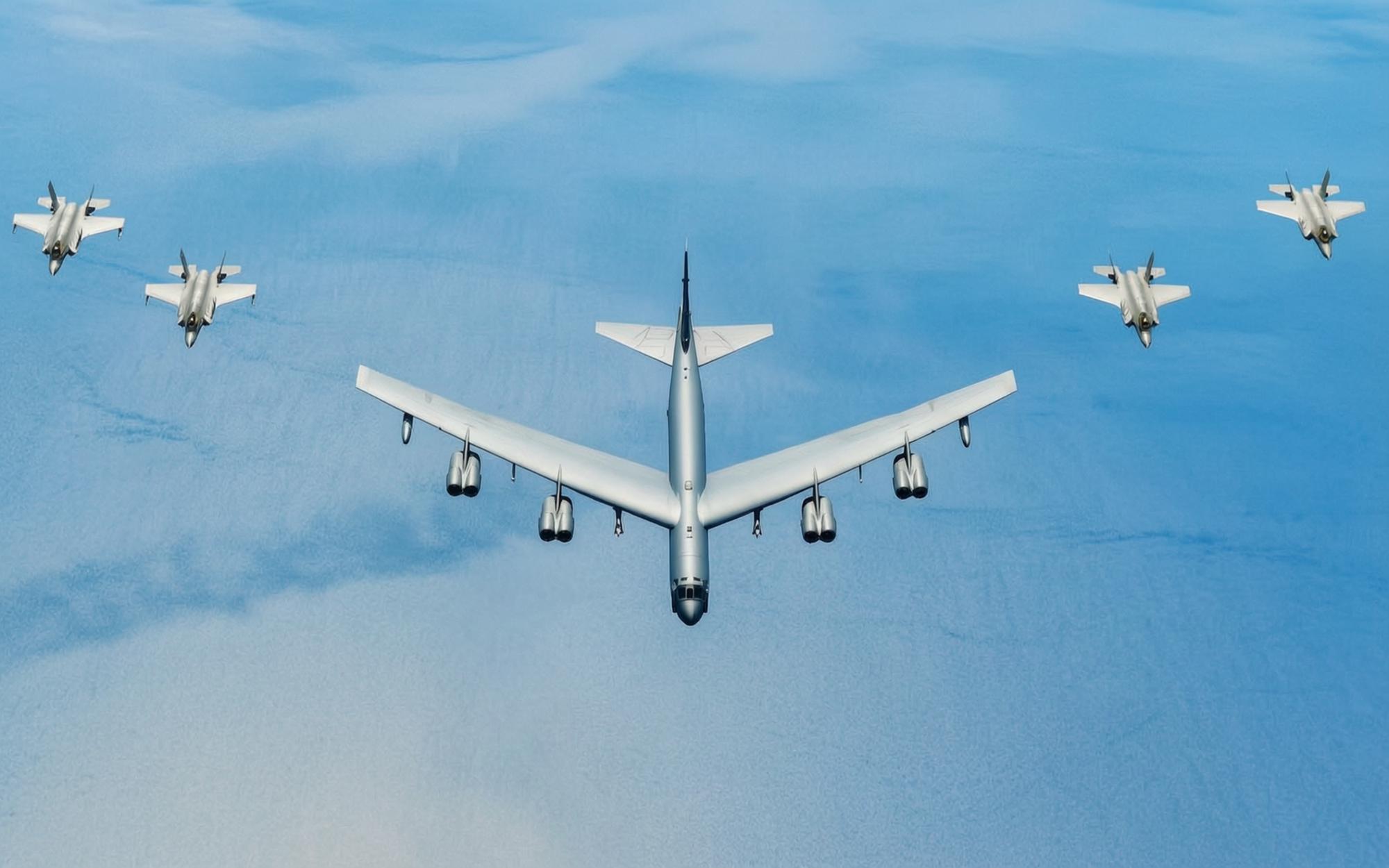
B-52 Crash Sparks Tough Questions About Future of America’s Legendary Bomber

The B-52 Stratofortress has long stood as one of the most recognizable and formidable symbols of American airpower.

Towering over the skies since the 1950s, the massive bomber remains a pillar of U.S. military strategy—a weapon of endurance, strength and deterrence.

But after a tragic crash at Edwards Air Force Base this week claimed eight lives, questions are intensifying over whether this Cold War icon can keep flying confidently into the next century.

The Air Force has expressed full intent to extend the operational lifespan of the B-52 fleet well into the 2050s, supported by new technology and ongoing modernization projects.

Yet the crash is forcing a hard look inside a fleet that has faithfully served through every major American conflict for seven decades—from Vietnam to Iraq to the recent war with Iran.

Initial reports from Edwards AB confirm the crash occurred shortly after takeoff during what was described as a routine test mission. The plane was part of the Radar Modernization Program, an effort to update the bomber’s radar capabilities with state-of-the-art systems.

Tragically, the routine sortie ended with catastrophic failure and a devastating fireball, claiming all eight aboard, including U.S. Air Force crew and Boeing contractors.

An Interim Safety Investigation Board has begun assessing the wreckage, collecting evidence, and preparing to pass findings to a final Safety Investigation Board made up of top-tier experts in Air Force aviation.

Unlike civilian crashes, there is no National Transportation Safety Board involvement; this is a military matter through and through—handled internally within the Air Force structure. It’s what the War Department insists on: accountability within the ranks.

Analysts like Douglas Birkey from the Mitchell Institute for Aerospace Studies caution that while the B-52 fleet has performed remarkably well, structural fatigue is a real concern.

“When you do the math, that’s Cold War hardware we’re flying in a 21st-century battlespace,” Birkey noted. The engineering resilience of the B-52 is proven, but even fine-tuned workhorses can only be rebuilt so many times before fatigue finds its way into the frame.

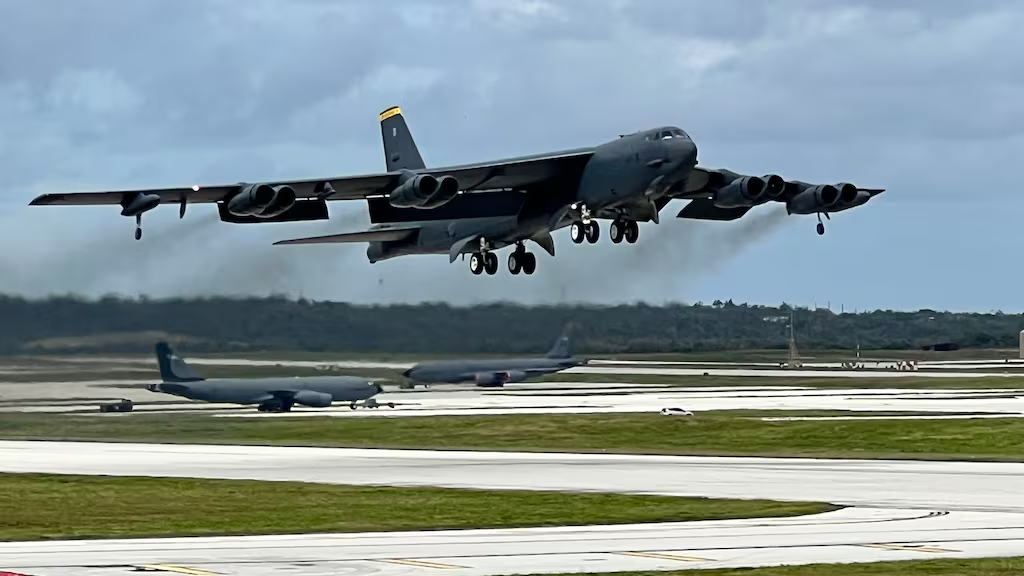
Eight Tragically Killed in Fiery B-52 Crash at Edwards Air Force Base
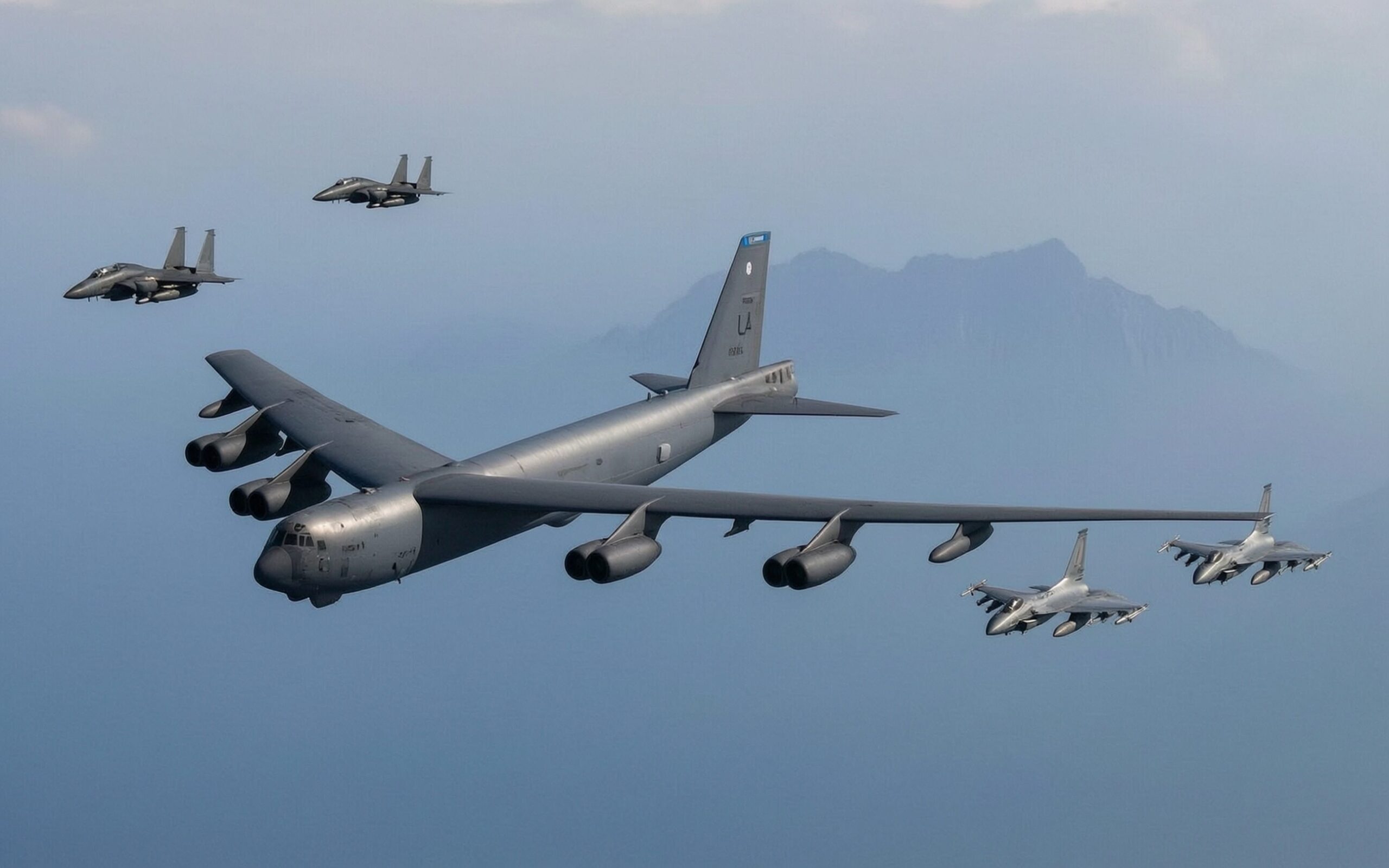
A B-52H Stratofortress from Edwards Air Force Base, California, departs for an evening test mission on Aug. 7, 2025. Air Force photo by Todd Schannuth.

The Air Force, however, believes modernization will keep these bombers alive and potent. Current plans include complete engine replacements, a new radar system, and improved computer systems to integrate with modern warfare networks.

In other words, while the B-52 may be old, it’s far from obsolete—especially when guided by capable leadership seeking to keep American military deterrence strong.

Still, the accident raises a familiar dilemma: at what point does upgrading a classic turn into overextending it? Aviation expert Ross Aimer put it bluntly. “Reimagining and changing an old airplane—it’s like putting chrome wheels on a ’70s Honda Civic.

It’s still a Honda Civic.” Aimer, a retired airline captain and consultant, underscored that aging frames can create new mechanical mysteries, no matter how much new tech is bolted onto them.

Historically, the B-52’s safety record has been impressive for such an old and heavily deployed aircraft. In an era where other aircraft types have long since retired, the B-52 has remarkably few recorded incidents.

The last fatal crash before this week’s happened in Guam in 2008. That longevity speaks to both the design genius of the Boeing engineers who built it and the vigilant maintenance by America’s airmen.

B-52 Bomber Upgrade Clears Key Design Hurdle, Set to Begin Powerhouse Engine Overhaul

At the same time, critics of endless modernization argue that the Air Force is reluctant to invest in a fresh bomber platform simply because of cost. Developing a completely new long-range strategic bomber program from scratch would demand staggering sums.

Instead, the service has chosen to stretch the B-52’s lifespan through iterative upgrades.

It’s a practical decision—one that aligns with the fiscal discipline favored by President Trump’s vision for a strong but smart military rebuild, reinforced by War Secretary Pete Hegseth’s emphasis on efficiency without sacrificing combat power.

As for the current crash investigation, experts believe it will not only review the immediate causes—mechanical, human, or procedural—but also analyze patterns across the entire B-52 fleet.

“They’re going to have to do a very thorough inspection of the fleet,” Birkey said. “If they think it’s something structural or mechanical, it could cause extra inspection.” That means the results could influence operational readiness for months, or even years to come.

Meanwhile, modernization efforts continue. Testing of the new radar system is already underway, with the updated engines scheduled for testing in 2027.

These projects are aimed at keeping the Stratofortress viable in a world increasingly dominated by stealth platforms and unmanned systems. Yet, as Aimer admits, the very future of the B-52 may depend not on its hardware, but on how the nature of warfare evolves.

Air Force Clarifies B-52 Flyover Incident Near Minot Airport, Says Crew Unaware of Passenger Jet
The Air Force said a B-52 crew that had a near-miss with a passenger aircraft last Friday told air traffic controllers at the Minot International Airport of their plans for a flyover of a nearby fairgrounds, but were not told a commercial airliner was on the way as well. (Capt. Stephen J. Collier/U.S. Air Force)

For now, the Air Force is committed to keeping this warhorse in the air. The plane represents far more than an aging design—it’s an enduring promise of American resolve and reach.

Veterans and pilots who’ve served aboard the Stratofortress continue to describe it as a “living legend” and a reminder that strength doesn’t always need a new nameplate to stay lethal.

If the investigation shows the crash was an isolated mechanical failure, the B-52 will likely continue its long march into a new era. If deeper problems appear, policymakers may have to weigh tough options.

Either way, the bomber that has carried American power across the globe won’t be grounded quietly. It’s lasted seventy years because it works—and because the men and women behind it refuse to let age define American might.


Scroll to Top