News

News

Senator Launches Push to End VA Clawbacks from Disabled Veterans

An Arizona senator is renewing a push to stop the Department of Veterans Affairs from clawing back military separation pay from disabled veterans, sometimes decades after they left active duty.

The proposal targets a practice that can suddenly wipe out disability checks veterans rely upon for housing, transportation, food, and medical expenses.

Sen. Ruben Gallego, an Arizona Democrat, introduced legislation Thursday that would bar the VA from collecting voluntary or involuntary separation pay from veterans approved for disability compensation. Gallego is a former Marine who served in the Iraq War.

The bill would also protect veterans who later qualify for military retirement pay from being forced to repay more money than they actually received.

Those veterans would remit the net separation payment placed in their pockets, rather than the larger gross amount calculated before taxes.

Gallego previously introduced similar legislation in the House alongside Rep. Gus Bilirakis, a Florida Republican. That proposal stalled in committee, leaving the government’s collection machinery running while veterans continued receiving unpleasant notices.

The senator argues that disability compensation and separation payments exist for fundamentally different purposes. Disability compensation functions much like workers compensation, while separation pay recognizes “time served” and serves as a force management tool for the War Department.

“It is ridiculous to claw back money from a veteran who has put life and limb on the line, just because later in life they qualify for disability benefits,” Gallego said in a statement.

For veterans blindsided years later, ridiculous may be putting it politely.

Between 2013 and 2023, the VA recovered $2.44 billion in separation payments and bonuses from 112,834 veterans. The department points to federal law prohibiting disability compensation for veterans who received covered separation payments unless that money is repaid.

The VA has been required to recover these funds since the 1940s, while the War Department must warn departing service members that future recoupment is possible. Yet veterans still report receiving surprise collection letters many years, and occasionally several decades, after leaving uniform.

One retired Air Force officer received $30,000 in separation pay in 1990, only to receive a VA letter in 2024 announcing that his entire disability check would be withheld until repayment was complete.

The sudden action placed him at risk of losing both his living quarters and his vehicle.

“I fail to comprehend how or why they intend to cut me off for several months without even negotiating a lesser but [survivable] monthly contribution. I also fail to understand why it took 34 years for VA to come up with this [scheme]. Why now?” retired Air Force Maj. Raymond Thomas, 75, told Military.com.

Current law permits the VA to withhold monthly disability compensation from veterans who previously received readjustment pay, severance payments, special separation benefits, or voluntary or involuntary separation pay. In some cases, the government can seize the entire disability check until the claimed balance is satisfied.

The recoupment campaign reached its recent peak in 2018, when 17,066 veterans repaid more than $396 million.

Those numbers illustrate how an obscure policy can produce a very real financial hammer for military families already managing service connected disabilities.

Gallego’s Restore Veterans Compensation Act would also reduce the collection rate for military retirees who remain subject to repayment. Instead of taking 40% of their checks, the VA would be limited to collecting 25%, easing the monthly financial blow.

Disabled American Veterans supported the earlier Gallego and Bilirakis proposal in 2022.

The organization said withholding disability compensation because a former service member received a separation benefit “must end.”

Sen. James Risch, an Idaho Republican, introduced a separate measure Wednesday called the Veterans Earned Benefits Access Act.

His bill would preserve the VA’s ability to collect separation pay but cap monthly withholding at 25% of a veteran’s disability compensation.

“My [bill] ensures that veterans can receive the disability benefits they need while repaying their separation pay,” Risch said in a release. Either proposal would offer more predictability than the current system, which can take every dollar from a veteran’s disability check with little regard for immediate consequences.

The competing bills take different approaches, but both recognize that disabled veterans should not be financially ambushed by Washington’s decades old bookkeeping.

Congress now has another opportunity to replace bureaucratic shock treatment with a policy that respects service, disability, and basic fairness.

News

JD Vance: We Found $230 Billion in Fraud. Guess Who Doesn’t Want It Stopped? [WATCH]

Vice President J.D. Vance said the Trump administration’s fraud task force has identified approximately $230 billion in fraud since its creation, while preventing tens of billions of dollars in fraudulent government payments that otherwise would have gone to bad actors.

Speaking alongside administration officials, Vance highlighted the task force’s work combating fraud across federal programs and argued that its efforts have already produced significant savings for taxpayers.

At the same time, he warned that many of those reforms could be reversed by a future administration unless Congress passes legislation making them permanent.

Vance credited members of the administration for helping build what he described as an effective anti-fraud operation.

“All stars of the Trump administration, we have been able to identify 230 billion dollars of fraud just since the fraud task force was set up, and that’s frankly by conservatively estimating it,” Vance said.

He explained that administration officials deliberately chose to use a cautious estimate when presenting the findings to the public.

“Andrew and I had a meeting in my office last week, and he said, ‘Do you want to estimate it conservatively or do you want to estimate it aggressively?’ And I said, ‘Well, I kind of want to estimate it aggressively, but then all you people will criticize us. So let’s estimate it conservatively, so that we can give the American people the most rock-solid explanation of how this task force is working to protect their money.'”

According to Vance, the task force has not only identified fraudulent activity but has also stopped billions of dollars in improper payments before they were distributed.

“We’ve been able to stop $56 billion in fraudulent payments that would have otherwise gone to fraudsters rather than to the people who need them, and in the process, we’ve saved obviously the American people a lot of money.”

Vance said preventing those payments ensures taxpayer dollars are directed toward eligible recipients instead of individuals or organizations attempting to exploit government programs.

He characterized the effort as one of the administration’s major accomplishments but cautioned that executive action alone cannot guarantee the reforms will survive future administrations.

“But as much as we’ve done, and as much as we’ve had great successes, and this brings me to my final point before I kick it over to Andrew, this effort will fundamentally always have a limitation unless our colleagues in the House and the Senate are working with us.”

Vance argued that Congress must act to place the administration’s anti-fraud measures into federal law rather than relying solely on executive authority.

According to the vice president, doing so would make it more difficult for future administrations to reverse the policies that have been implemented.

“We don’t want the next administration, whoever you know, God forbid, you’re going to have President El Sayed in three years. We don’t want him to undo all the incredible work that we’ve been doing when we’ve been taking out the fraudsters and saving the American people money.”

He said the administration’s long-term objective is to ensure the fraud prevention measures remain in place regardless of who occupies the White House in the future.

“And in order to make this really work, we need our colleagues in Congress to really codify some of this stuff to make sure that it becomes law,” Vance said.

He concluded by noting the political makeup of those attending the event while expressing hope that lawmakers would support the administration’s legislative priorities.

“And again, this is the sort of thing where while I you know I see only Republicans surrounding us today.”

WATCH:

The administration has repeatedly highlighted efforts to reduce waste, fraud, and abuse in federal programs as part of its broader fiscal agenda.

Vance’s remarks emphasized both the reported results achieved by the fraud task force since its creation and the administration’s push for Congress to enact permanent statutory changes aimed at preserving those anti-fraud initiatives beyond the current administration.

News

VA Restores Phones and Rideshare Lifelines for Homeless Vets

The Department of Veterans Affairs is restoring practical assistance that can help homeless veterans remain connected to doctors, housing officials, employers and family members.

Under a newly announced rule, eligible veterans may receive smartphones, tablets, disposable phones, service plans and transportation support.

For veterans living on the street, losing contact with an outreach worker can mean losing a housing opportunity or missing a critical medical appointment. A simple phone and a ride can make the difference between entering a program and remaining stranded outside it.

“It’s not uncommon for veterans to be qualified into programs, but then for the outreach worker to struggle to find them for weeks,” said Kathryn Monet, CEO of the National Coalition for Homeless Veterans.

“That is a big and seemingly preventable struggle. Surely there should be a way if we can find people to get them the benefits that they’re entitled to.”

The new rule restores benefits previously offered through a COVID era program. Veterans qualify when they would be “unable to maintain contact” with VA services without the assistance, ensuring resources are directed toward those who genuinely need help staying connected.

The authority comes from the Senator Elizabeth Dole 21st Century Veterans Healthcare and Benefits Improvement Act. The broad law addresses VA health care, benefits and support programs, including services for veterans who do not have permanent housing.

The law also permits the VA to provide basic items needed for “safety and survival,” including food, clothing and blankets. According to the notice, these services and resources will remain available to eligible veterans through Sept. 30, 2027.

Transportation assistance may also be provided “as necessary” through public transit vouchers or contracted rideshare companies such as Uber and Lyft. The goal is to help homeless veterans reach medical appointments, court hearings, grocery stores, legal service meetings and housing placement appointments.

The rideshare component has already proved its value on a large scale. During the pandemic, more than 44,000 veterans used the program for 494,000 rides, demonstrating that transportation is not some minor convenience when veterans are trying to rebuild stable lives.

Monet said the new law gives the VA the same flexible authority and funding that had been available during the pandemic.

She said it “took way too long” to restore resources that coalition officials believe address “logistical problems that stand between a veteran and available housing,” including transportation to appointments and reliable communication with landlords.

“It really is an authority that was designed to close some of the gaps that you see when you’re out doing outreach to veterans,” Monet said. Those gaps can look small from inside a federal office, but they become enormous for someone without a car, an address or a working telephone.

There is no single homelessness figure accepted by every veterans advocate, although federal data provide a useful national picture.

The latest Department of Housing and Urban Development point in time count identified 32,495 homeless veterans on one night in January 2025.

The National Coalition for Homeless Veterans noted that the figure was the lowest recorded since 2009.

Even so, veterans represented about 5 percent of all adults experiencing homelessness that night, roughly matching their share of the overall United States population.

The VA reported permanently housing 51,936 veterans nationwide during calendar year 2025.

That progress matters, but the remaining numbers show why officials cannot afford to let basic communication and transportation failures block veterans from housing that is already available.

Phones can also become lifesaving equipment during hurricanes, floods, wildfires and sudden weather events. Emergency alerts that most Americans take for granted may never reach an unsheltered veteran who has no television, dependable internet connection or permanent address.

“In a hurricane, when you have a cell phone, you get an alert saying ‘The weather’s gonna change, go inside.’ Or you see it on the TV. But if you’re an unsheltered veteran and you’re out in a ravine in Arizona, you might not know that the weather’s gonna change, and the water can be really detrimental,” Monet said.

“There are some basic common sense things, but there are also these other extremes when you think about the weather disasters and what it really means to be able to be in touch with the world around you.”

After years of bureaucratic delay, restoring these tools gives outreach teams a better chance to connect veterans with the assistance they earned through service.

News

Fauci Looks Miserable as Wife Flips the Bird After Contempt Vote [WATCH]

Dr. Anthony Fauci looked thoroughly defeated Thursday, just hours after a Senate committee voted to hold him in contempt of Congress over his refusal to answer questions about his management of the COVID 19 pandemic.

The former government health official was photographed wearing a deep frown while rolling a recycling bin toward the curb outside his Washington, DC, residence.

It was hardly the triumphant image once cultivated by liberal media outlets.

Fauci shares the $2.4 million home with his wife, Christine Grady, a Georgetown University colleague.

His routine household chore came shortly after senators referred the contempt matter to the Justice Department for possible prosecution.

The sour mood apparently extended beyond Fauci. When the couple later departed the upscale neighborhood by vehicle, Grady made her displeasure with the nearby photographer unmistakably clear.

Grady flipped off the camera before driving away, while Fauci sat in the passenger seat and stared blankly through the window.

For a couple accustomed to establishment praise, the sudden public scrutiny did not appear especially welcome.

Earlier Thursday, the Senate Homeland Security Committee voted eight to five along party lines to hold Fauci in contempt.

The vote followed his testimony last week, when he invoked his Fifth Amendment rights 111 times.

Republicans have spent years demanding answers about Fauci’s pandemic decisions, government research funding, and public statements concerning the origins of COVID 19.

Those questions became more urgent as evidence and official assessments challenged the narratives aggressively promoted during the pandemic.

If convicted of misdemeanor contempt of Congress, Fauci could face as much as one year in prison and a $1,000 fine.

The Justice Department will now become central to determining whether the referral develops into an actual criminal prosecution.

Republican senators argue Fauci cannot use the Fifth Amendment as a universal shield after delivering an opening statement and receiving a sweeping pardon from former President Joe Biden.

That pardon covered potential crimes committed from January 2014 through January 2025.

Sen. Josh Hawley challenged the legal basis for Fauci’s repeated refusal to respond.

“The assertion of a Fifth Amendment privilege only adheres to those instances where the witness has a reasonable fear of future prosecution, and it must be tailored to any such fear,” Hawley said.

The Missouri Republican’s point goes directly to the growing dispute.

Senators are questioning whether Fauci identified legitimate risks attached to individual questions or simply invoked constitutional protection as a blanket strategy to avoid scrutiny.

WATCH:

Senate Homeland Security Committee Chairman Rand Paul subpoenaed Fauci to testify.

The Kentucky Republican has long accused the former director of the National Institute of Allergy and Infectious Diseases of concealing information about the origins of COVID 19 and misleading Americans about the disease.

Paul has repeatedly pressed Fauci about research funding and whether taxpayer money supported dangerous coronavirus work overseas.

Fauci has denied wrongdoing, but his refusal to answer scores of questions has done little to satisfy lawmakers seeking a complete public record.

The Biden pardon has also intensified suspicion rather than quieting it.

Biden granted Fauci broad protection before leaving office, covering more than a decade in which Fauci held enormous influence over federal health policy and pandemic decisions.

Three state attorneys general have separately subpoenaed Fauci through a joint investigation involving the former COVID czar.

That expanding legal attention suggests the Senate fight may be only one part of a much larger examination of his conduct.

For years, Fauci enjoyed glowing coverage, celebrity treatment, and near total deference from Washington’s political class.

Now the cameras are capturing a different scene, complete with a contempt vote, unanswered questions, a trash bin, and one very angry hand gesture.

Americans who endured sweeping mandates, closed businesses, disrupted schools, and shifting government claims still want accountability.

Fauci may prefer silence, but Congress and state investigators appear increasingly determined to keep asking questions.

News

FBI Knew 633,000 Arizona Voter Files Were Hacked Days Before 2020 Election, Prosecuted Nobody [WATCH]

The White House has released a series of newly declassified documents related to the 2020 election, including records detailing a cyber intrusion involving the Maricopa County Recorder’s Office in Arizona that exposed hundreds of thousands of voter records and prompted an FBI investigation.

According to a letter from FBI Director Kash Patel to the White House Task Force on Government Transparency, a hacker obtained approximately 633,000 Maricopa County voter records.

The documents state that the data included information on 930 voters that was not publicly available, including records involving domestic abuse victims.

The newly released material also includes information from a November 2020 FBI interview with an individual whose name has been redacted.

WATCH:

During that interview, the individual reportedly told investigators he believed he had extracted between 1 million and 2 million files, representing approximately four gigabytes of data.

According to the interview summary, the individual said the information was obtained by using a PowerShell script to exploit the Maricopa County Recorder’s website.

The documents state that Maricopa County reported the intrusion through the Arizona Counter Terrorism Information Center on Nov. 2, 2020.

By Election Day on Nov. 3, information about the incident had been circulated among federal election security officials.

The records also describe efforts by the suspect to destroy evidence before federal agents executed a search warrant.

According to the documents, the subject attempted to remove both locally stored and remotely stored copies of the data before the FBI carried out its search.

In a separate interview with investigators, the suspect reportedly acknowledged anticipating contact from law enforcement and described deleting evidence beforehand.

According to the released records, the individual told the FBI that he knew law enforcement would likely visit him, prompting him to delete and reformat his hard drives and erase data stored in Google Cloud.

The interview summary indicates the suspect acknowledged destroying evidence while also appearing to recognize that a crime had been committed.

Despite the investigation, the documents state that prosecutors declined to pursue criminal charges.

According to the records, the U.S. Attorney’s Office for the District of Arizona, the Arizona Attorney General’s Office, the Maricopa County Attorney’s Office and the Pinal County Attorney’s Office all declined to prosecute the suspect despite the existence of evidence and what the documents describe as a confession.

The case appears to correspond with a December 2020 incident previously reported by The Gateway Pundit involving an FBI search of the home of Elliot Kerwin, then a 56-year-old information technology specialist.

At the time, Forbes reported that federal investigators were seeking evidence related to “a cyberattack on an unnamed organization and stolen voter data.”

Although the newly declassified documents do not identify Kerwin by name, one report appears to describe an incident involving a residence in Fountain Hills, Arizona, a town located within Maricopa County.

Following the FBI search in 2020, questions remained about the extent of the intrusion into Maricopa County’s voter registration infrastructure.

Public reporting at the time stated there had been no access to election management systems or vote tabulation systems and that the voter information obtained consisted of publicly available records.

The newly declassified documents indicate that investigators concluded approximately 633,000 voter records were obtained, including 930 records containing information that was not publicly available.

WATCH:

The release of the documents has also prompted renewed attention to how government agencies communicated about election security during and after the 2020 election.

According to the records, federal election security officials were aware before Election Day that an intruder had exploited a Maricopa County website and obtained hundreds of thousands of voter records.

The source material states that no contemporaneous public acknowledgement of this specific incident by the Cybersecurity and Infrastructure Security Agency (CISA) has been identified.

Following the 2020 election, then-CISA Director Chris Krebs stated that the election was “the most secure in American history.”

The newly released records do not state that election systems or vote tabulation equipment were compromised, nor do they conclude that election results were altered.

Instead, the documents focus on the cyber intrusion into voter registration records, the subsequent FBI investigation, the suspect’s reported destruction of evidence, and the decisions by multiple prosecutorial offices not to pursue criminal charges.

The release has renewed questions surrounding the public disclosure of the breach, including why an incident involving approximately 633,000 voter records, including hundreds of non-public records, did not receive broader public attention at the time and why the suspect identified in the investigation ultimately was not prosecuted, according to the source material.

News

Stephen A. Smith Turns on Fauci: I Did Exactly What He Told Me, It Almost Killed Me [WATCH]

Stephen A. Smith has built his career on thunderous opinions, colorful arguments, and unapologetic confidence.

But while discussing Anthony Fauci and the COVID pandemic, the ESPN personality showed a deeply personal side shaped by fear, anger, and a brush with death.

Smith said he followed the guidance promoted by Fauci and other government health authorities, only to contract COVID anyway.

“We were told, ‘Hey, you ain’t gonna get Covid if you do that.’ And I GOT COVID!” he exclaimed.

The illness was not a mild inconvenience for Smith. “And damn it, it almost killed me!” he continued, revealing that he entered a hospital shortly before New Year celebrations began as 2021 gave way to 2022.

Smith recalled his doctor delivering a warning nobody wants to hear.

“We’ve been at this for three plus weeks. You got double pneumonia. You look really bad. If this antibiotic and this steroid do not work, Mr. Smith, I’m sorry, we’re gonna have to call your family. Looks that bad…’”

The treatment eventually worked, but Smith said the wait left him believing his life could be ending.

“But those were the longest three hours of my life because I thought it was over.”

That terrifying experience now colors Smith’s judgment of Fauci, whose pandemic pronouncements were repeatedly treated by corporate media outlets as sacred scripture.

Smith remembered that he had done what Fauci urged Americans to do, yet still found himself fighting for his life.

Smith also unloaded on the policies and claims that defined the government response.

“We learned that mask [mandates] , six feet distancing… These were not scientific decisions being made.”

His frustration extended beyond flawed guidance and into the celebrity culture that surrounded Fauci.

Smith argued that Fauci became consumed by praise, media attention, and his status as the supposed public face of science while ordinary Americans endured mandates, business closures, and social pressure.

Smith admitted that he had accepted Fauci’s assurances and helped direct criticism toward athletes who resisted the official narrative.

“We sat back and we bought his stuff, hook, line, and sinker. He was the face of science.”

Among those athletes were NBA star Kyrie Irving and NFL quarterback Aaron Rodgers.

Smith said he later felt compelled to apologize because his commentary had contributed to the public scrutiny they faced for questioning or rejecting pandemic demands.

The sports commentator stopped short of demanding that Fauci be imprisoned.

“I’m not saying you need to go that far. I’m not saying they’re completely right about that. I don’t believe this man at 85 years of age who’s done tremendous work spanning decades should be thrown in jail.”

Still, Smith made clear that Fauci should face public embarrassment and accountability for presenting disputed policies as settled science.

WATCH:

The aura of infallibility has faded, and the Americans once mocked for asking basic questions no longer look quite so foolish.

Senator Rand Paul has meanwhile continued pursuing Fauci over his testimony before Congress.

Paul said Fauci invoked the Fifth Amendment more than 100 times despite receiving a sweeping federal pardon and offering an opening statement during the hearing.

“During the hearing,” Paul said, “I ruled that the Fifth Amendment did not apply because of the pardon, and that Fauci had waived any remaining privilege by giving opening testimony. I ordered him to answer and warned him about contempt, yet he still refused. That is obstruction of a congressional investigation. The Committee will act accordingly.”

A contempt vote reportedly followed party lines, while investigators also obtained Fauci’s phone.

Those developments could bring additional scrutiny to the former government health official’s communications, public representations, and role in policies that disrupted millions of American lives.

Questions also remain about Fauci’s sweeping claims regarding vaccination and transmission.

Federal authorization materials acknowledged that evidence was not then available to determine whether the vaccine prevented transmission, yet Fauci publicly suggested vaccinated people would become a dead end for the virus.

Fauci also declared, “The risk is extremely low of getting infected, of getting sick, or of transmitting it to anybody else. Full stop.”

The lived experience of countless vaccinated Americans, including Smith, eventually collided with that confident promise.

At least four Republican led states, West Virginia, Louisiana, Alabama, and Florida, have announced or opened investigations into Fauci’s pandemic conduct.

Florida Attorney General James Uthmeier said investigators were examining possible deceptive trade, fraud, and public nuisance violations, adding, “Nothing is off the table.”

WATCH:

Smith’s reckoning captures a broader collapse of institutional trust. Americans were ordered to comply, told not to question the experts, and often smeared for skepticism, only to discover that certainty had been oversold and accountability remained in painfully short supply.

News

Elizabeth Warren Gets a Brutal Lesson in Rent Economics She Still Can’t Grasp [WATCH]

Sen. Elizabeth Warren has once again treated rising rents as proof of landlord greed while brushing past the far less convenient forces that determine housing costs.

Her argument may stir progressive applause, but it does not survive contact with basic economics.

Rent is not pulled from a hat by cartoon villains counting gold coins in a back room.

It reflects available housing, renter demand, taxes, insurance, mortgages, repairs, utilities, labor, local rules, and the substantial risk carried by a property owner.

The central problem is supply and demand, a concept Washington Democrats repeatedly resist whenever it interferes with their preferred villain.

When too few apartments exist for too many renters, prices rise, no matter how many speeches Warren delivers about corporate avarice.

Government policy often makes that shortage worse.

Restrictive zoning blocks apartments, permit delays drag projects through years of bureaucracy, rent controls discourage new construction, and expensive mandates make builders think twice before adding units where families actually need them.

Mass illegal immigration also increases demand for limited housing, especially in communities already struggling with shortages.

Democrats cannot wave millions of additional people into the country, obstruct construction, and then act stunned when competition for apartments drives rents higher.

Housing subsidies can distort the market as well, particularly when government vouchers pay rates above what some tenants previously faced.

The original account described a seven hundred dollar apartment that rose to eleven hundred dollars after a management company purchased the property and began accepting Section 8 vouchers.

None of this means every landlord is wise, fair, or competent.

It does mean Warren’s preferred caricature ignores the many middle class owners who buy rental property as an investment, shoulder debt, handle emergencies, and try to create security for their children.

A broken refrigerator does not replace itself, and a leaking roof does not care about progressive slogans.

Paint, carpeting, plumbing, appliances, insurance, property taxes, and emergency repairs all cost real money, with those expenses eventually affecting the rent charged for a unit.

The fantasy that government can simply push private owners aside and manage housing more efficiently has a grim record.

Public housing is too often marked by deferred maintenance, dirty common areas, broken systems, and regular rent increases, proving that bureaucracy is perfectly capable of becoming the biggest slumlord around.

WATCH:

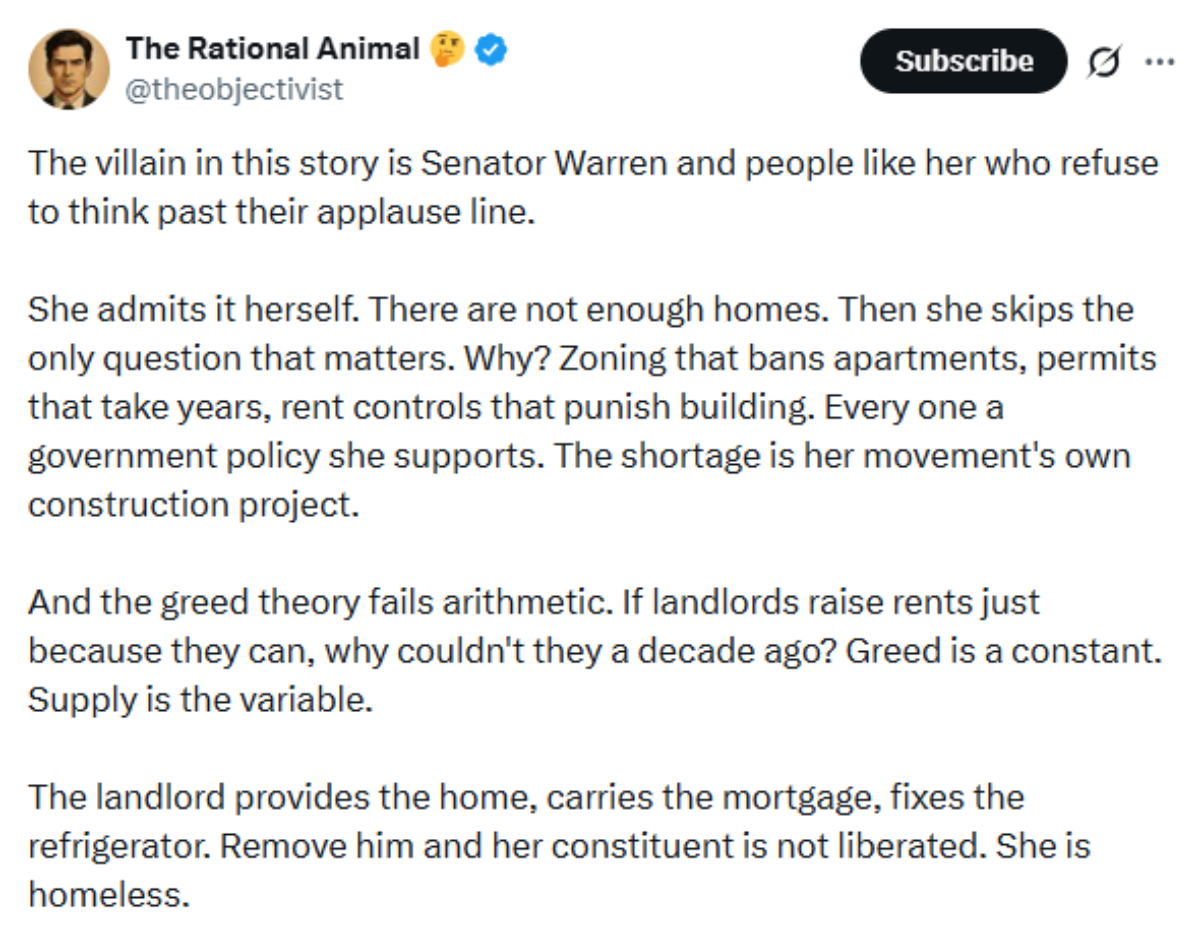
One critic delivered the economic reality Warren skipped: “She admits it herself. There are not enough homes. Then she skips the only question that matters. Why? Zoning that bans apartments, permits that take years, rent controls that punish building. Every one a government policy she supports. The shortage is her movement’s own construction project. And the greed theory fails arithmetic. If landlords raise rents just because they can, why couldn’t they a decade ago? Greed is a constant. Supply is the variable. The landlord provides the home, carries the mortgage, fixes the refrigerator. Remove him and her constituent is not liberated. She is homeless,” the user wrote.

X Screenshot – The Rational Animal

That response gets to the heart of the matter.

Greed cannot explain why rents vary across decades, cities, and neighborhoods, because human self interest is constant while housing availability, local regulation, financing costs, and population pressure all change.

If lawmakers want lower rents, they should make it easier to build more homes, approve projects faster, reduce needless barriers, and enforce immigration law.

Expanding supply while easing demand pressure would do more for renters than another round of finger pointing from Capitol Hill.

Instead, Warren and her allies keep promoting policies that punish the people providing housing, then blame those same people for the predictable fallout.

Drive enough small landlords from the market, and large corporations or government agencies will acquire what remains, hardly the liberation progressives advertise.

Renters deserve safe homes, transparent leases, and genuine competition among property owners.

They do not need economic theater from politicians who create scarcity, deny the consequences, and then demand more government control as the cure for damage government helped cause.

News

JD Vance Hails Sophie Cunningham’s Courage in Explosive Fight to Save Women’s Sports [WATCH]

Vice President JD Vance threw his support behind Indiana Fever guard Sophie Cunningham as she faces national criticism for defending fairness in women’s sports. The vice president praised her willingness to speak plainly while activists and sports leaders battle over transgender participation, as reported by Fox News.

Vance addressed Cunningham during an appearance on Fox News’ “Ingraham Angle.” The broader discussion covered the war in Iran, negotiations with the Iranian regime, and the recent birth of his fourth child.

The conversation turned to Cunningham after her public stand attracted a wave of new supporters and predictable outrage from critics. Vance argued that hostile reactions are often the price paid by people willing to challenge powerful political and cultural pressure.

“Look, sometimes when you’re courageous in this country, some of the worst people in the world will try to attack you. What I would tell Sophie and anybody is to keep speaking your mind. You actually are inspiring a dozen people for every person that criticizes you,” Vance said.

Vance connected Cunningham’s stand to the larger fight over the country’s direction and the public’s willingness to reject intimidation. “We cannot take our country back; we cannot save the United States of America unless you have people of courage who are speaking their mind.”

He also described courage as something that spreads when ordinary Americans see another person withstand attacks from an angry mob. “The thing about courage is it’s contagious,” Vance said.

His message reflected the frustration of Americans who believe common sense has been shoved aside in the debate over women’s athletics. Female athletes who defend biological distinctions frequently find themselves targeted by activists who treat basic fairness as some sort of unforgivable offense.

Cunningham has become a prominent figure in that argument, drawing both support and criticism after speaking about protecting women’s competition. Her position has helped move the issue beyond sports commentary and into a much larger national discussion about fairness, opportunity, and truth.

Rallies supporting Cunningham have taken place around the Fever’s last three games. Two additional rallies are scheduled, including one surrounding Indiana’s Saturday contest against the Chicago Sky and another when the Fever face the New York Liberty on Aug. 22.

Those gatherings have placed additional attention on the WNBA, which can no longer pretend the debate is confined to political hearings or social media. Four coaches have issued public statements about the issue since the rallies began, showing how quickly the controversy has spread across the league.

The Fever organization, meanwhile, has largely attempted to keep the national conversation away from its locker room. Team officials abruptly ended a press conference after Cunningham faced questions, a move that only generated more attention around the controversy.

Trying to bury a national debate rarely makes it disappear, especially when fans are organizing outside arenas and prominent officials are weighing in. The league now finds itself confronting questions that women across the country have been asking for years.

Indiana is also navigating a critical stretch in its 2026 season. The Fever suffered a hard-fought 108- 100 loss against the Minnesota Lynx on Aug. 2, adding competitive pressure to an already intense atmosphere surrounding the team.

The Fever next face the defending champion Las Vegas Aces on Thursday. After that contest, Indiana will meet Chicago in a weekend matchup expected to draw another rally supporting Cunningham and the broader campaign to preserve women’s sports.

The athletic stakes are significant, but the cultural stakes have become even larger. Cunningham’s critics may prefer that she remain quiet and dribble, but her supporters see an athlete willing to defend the very category that created opportunities for female competitors.

Vance’s remarks also placed the White House firmly behind Cunningham as she deals with the growing backlash. His response emphasized that speaking honestly can encourage others who agree but remain silent because they fear professional or social consequences.

The vice president said one courageous voice can inspire many others to resist public pressure. “So I would tell Sophie to keep going.”

That message is likely to resonate far beyond the WNBA. Cunningham’s stand has become another reminder that cultural institutions cannot indefinitely dodge basic questions about whether women’s sports will remain reserved for women.

News

Anti-Trump Canadian Slapper Suffers Crushing Fundraiser Flop Before Deportation [WATCH]

The legal saga of Kaitlyn Tracey ended Tuesday with a deportation order, a misdemeanor conviction, and an online fundraiser that could not even reach half of its requested total. The Canadian national drew public outrage after slapping a teenage girl wearing patriotic clothing on the Jersey Shore, as reported by The New York Post.

Tracey’s legal fund collected just $4,857 toward a $10,000 goal, leaving her supporters well short of the mark when the immigration case reached its humiliating finish. For a cause apparently pitched as worthy of rescue, the response amounted to a rather loud vote of no confidence.

The 33-year-old had been held by Immigration and Customs Enforcement in Texas before appearing by telephone in Toms River, New Jersey. She pleaded guilty Tuesday to one count of simple assault, classified as a misdemeanor, under a plea agreement that spared her from more serious punishment.

A judge sentenced Tracey to one day behind bars, but credited her for time already served in Ocean County jail last month. That meant no additional local jail time, though the larger consequence was clear: she was ordered deported to Canada, ending her unlawful stay in the United States.

The Department of Homeland Security had already supplied a memorable nickname, calling Tracey the “Maple Leaf Menace.” It was unusually colorful language from Washington, but after an adult targeted a teenager over a shirt, even the federal bureaucracy managed to find the proper level of ridicule.

The confrontation unfolded July 3 on the boardwalk in Point Pleasant Beach, where Tracey approached a group of four teenagers. One of the girls was wearing a USA 250 tank top, an unmistakably patriotic garment that apparently proved too much for the anti-Trump Canadian to tolerate peacefully.

Police said an argument followed before Tracey slapped the girl across the face, with the incident captured on camera. What should have been an ordinary holiday outing instead became another example of political hostility spilling into real life, this time with a teenager absorbing the blow.

Authorities later determined that Tracey had overstayed her visa and was in the country illegally at the time of her arrest, according to DHS. Her immigration violation transformed a local assault case into a federal removal matter and put her future in the United States squarely in the hands of immigration officials.

Tracey’s husband, Matthew Geroni, had previously launched a GoFundMe campaign to cover her legal costs. Geroni, described as fiercely opposed to President Trump, tried to rally financial support, but the platform removed the campaign because its rules prohibit fundraising for people accused of violent crimes.

That removal forced the effort elsewhere, yet changing platforms did not produce the cash avalanche the couple apparently hoped to see. The replacement fundraiser stalled below the halfway point, proving that online outrage and actual financial commitment are not always the same thing.

The plea deal resolved the criminal charge with a relatively light sentence, especially considering the public nature of the confrontation and the age of the victim. Tracey received credit for time served, while the deportation order supplied the consequence that local sentencing did not.

Supporters may have viewed Tracey as a political casualty, but the recorded encounter and her guilty plea left little room for heroic storytelling. Slapping a teenager over patriotic clothing is not principled dissent, no matter how many fashionable slogans the activist class tries to drape around it.

The case also carried a basic immigration lesson that Washington too often works overtime to avoid. A visa is permission to remain under defined conditions, not a permanent entitlement, and overstaying it can bring removal when other criminal conduct draws attention from law enforcement.

For residents of Point Pleasant Beach, the episode offered an ugly glimpse of how quickly political obsession can poison a public space. Families and teenagers should be able to walk a boardwalk in patriotic clothing without wondering whether an enraged stranger will turn partisan contempt into physical aggression.

Tracey now heads back to Canada with a conviction, a deportation order, and a legal fundraiser that fell embarrassingly flat. The “Maple Leaf Menace” may have wanted a political confrontation, but what she received was a courtroom reckoning and a one-way trip home.

News

Exposing Special Operator Identities Could Become a Federal Crime Under Sweeping Bill

Publicizing the identities of American special operations personnel could become a federal crime under language tucked into the House version of the fiscal year 2027 National Defense Authorization Act.

The proposal would extend legal protections currently reserved for covert intelligence officers and sources to certain military members and civilians.

The measure is intended to protect operators carrying out some of the nation’s most dangerous and sensitive missions.

However, its broad wording is raising questions about press freedom, public accountability, and how much authority the Pentagon should have to decide which identities are protected.

Gabe Rottman, a lawyer and vice president of policy for the Reporters Committee for Freedom of the Press, said the proposal expands the Intelligence Identities Protection Act.

That law prohibits the “intentional” disclosure of information identifying covert intelligence agents or sources.

Under the House proposal, those protections would expand to cover “protected defense individuals.” That category would include troops assigned to sensitive units, civilians who train special operations forces, certain communications personnel, and other individuals “designated” by the War Secretary.

That final category is where the legislative net starts looking mighty wide. The proposal would appear to let the War Secretary determine which military and civilian personnel receive secrecy protections backed by serious criminal penalties.

“This feels really quite broad, and it would clearly on its face cover disclosures that are manifestly in the public interest,” Rottman said.

“We’re in a period where there’s heightened public attention to military activities and the use of special forces…. This bill, were it passed, could be used to suppress reporting that is directly relevant to those issues that are part of the public debate.”

The provision appears in the House version of the annual military policy bill, according to a policy aide for Republican Rep. Richard Hudson of North Carolina.

Hudson previously introduced legislation criminalizing the online exposure of special operators and their families, while a similar proposal was introduced in the Senate.

“Our special operators take on some of the most dangerous missions in the world to keep us safe. They and their families should never have to worry someone will expose their identities and put a target on their backs,” Hudson said in the release.

That concern is hardly theoretical, especially in an era when hostile governments, terrorist networks, and internet activists can quickly spread personal information.

Air Force Expands Special Operations Wing Relocation to Arizona, Reflecting Strategic Shifts
The U.S. Air Force has modified its plans to relocate the 492nd Special Operations Wing to Davis-Monthan Air Force Base. Here, Air Force operators with the 492nd Special Operations Wing conduct a free-fall jump over Eglin Range, Florida, May 4, 2022. (Senior Airman Harrison Winchell/U.S. Air Force)

Special operators and their families should not become targets simply because somebody wants social media attention or a political scalp.

Still, the proposed language would amend a powerful national security statute rather than merely establish penalties for malicious doxxing.

The Intelligence Identities Protection Act has previously been used to prosecute intelligence personnel who revealed the identities of other agents to journalists, and violations can carry prison sentences of 10 to 15 years.

The law would allow the Pentagon to determine what qualifies as a “sensitive” unit or mission. Rottman argued that this means the “Secretary of War can unilaterally determine what is the criminal activity.”

According to Rottman, the proposal could apply both to traditional news reports and social media posts that identify covered personnel.

Marines Engage in Multiple Firefights Defending U.S. Embassy in Haiti
Marines with the 22nd Marine Expeditionary Unit (Special Operations Capable), walk back-to-back down a hallway during a live-fire shoot house at Camp Santiago, Puerto Rico on April 18, 2026. Marine Corps photo by Sgt. Tanner Bernat.

It could also potentially apply when members of special operations units speak with reporters about misconduct inside their own ranks.

“If an actual special operator sees one of his unit mates commit a war crime and wants to talk to a reporter about it, and this is a sensitive unit, then this law could kick in and make that a potential crime,” he said.

The proposal was reportedly inspired by a January social media post identifying the Delta Force commander after the unit led the military raid that captured Venezuelan President Nicolás Maduro. A policy aide from Hudson’s office pointed to that episode as the catalyst for the legislation.

Special Operations Helicopters Undergo Major Upgrades as Forces Look to the Future

The viral post on X came from journalist Seth Harp, who frequently reports on the special operations community, and it was later removed.

The House Oversight Committee subsequently voted to subpoena Harp, with the Republican leading the effort alleging that the disclosure endangered national security.

Press freedom groups pushed back, arguing that the congressional response threatened legitimate reporting because the information was not classified.

Harp also said during an interview that his post relied on a publicly available biography of the commander.

Special Operations Helicopters Undergo Major Upgrades as Forces Look to the Future
Six UH-60L Black Hawks and two CH-47F Chinooks, assigned to Task Force Brawler, 4th Battalion, 3rd Aviation Regiment, Task Force Falcon, simultaneously launch a daytime mission Jan. 18 from Multinational Base Tarin Kowt.

The House and Senate must now negotiate a final version of the authorization bill before either chamber votes on passage.

Whether the provision survives those negotiations will determine if Congress delivers a focused shield for operators or hands the Pentagon a sweeping new secrecy weapon.


Scroll to Top