News

News

Trump Ends Strait of Hormuz Blockade After Securing U.S.-Iran Ceasefire Deal

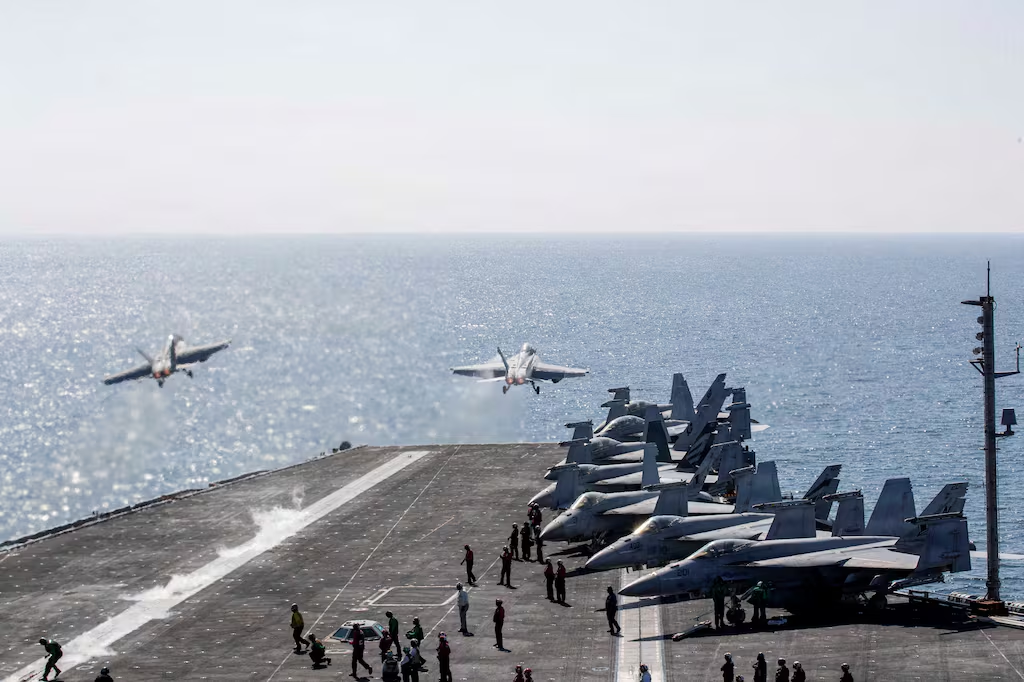
After two tense months guarding one of the most critical chokepoints in global energy corridors, the U.S. Navy has lifted its blockade of the Strait of Hormuz.

The move comes at the direction of President Donald Trump, following a memorandum of understanding signed between Washington and Tehran that imposes a 60-day ceasefire and reopens the strategic waterway to commercial traffic.

The operation, launched April 12, had redirected over 140 commercial vessels and disabled nine that refused compliance.

Trump’s order to conclude the blockade comes as part of a broader plan to deescalate tensions while projecting unmistakable American strength in the Persian Gulf.

U.S. Central Command confirmed Thursday that naval assets will not fully depart the region but remain nearby to enforce adherence to the agreement.

“Our great naval ships will remain in the general area to make sure that all aspects of the agreement are adhered to, obeyed and in full force and effect,” read the CENTCOM statement.

That assurance means the Iranian regime knows the U.S. continues to hold both the power and the will to act if red lines are crossed.

At the center of this breakthrough is President Trump’s aggressive but effective diplomacy — power first, patience second.

Trump Says Downed Apache Crew ‘Got Very Lucky’ After Iranian Attack

Unlike the weak appeasement deals of past administrations, this memorandum of understanding outlines both economic and security components designed to hold Iran accountable while avoiding further humanitarian disaster in global oil markets.

Under the terms, sanctions on Iran will be temporarily lifted to open the door for a $300 billion reconstruction fund aimed at stabilizing the Iranian economy.

Critics on the left may call this a concession, but the reality is simple: Trump forced Tehran to the table after making it clear the alternative was destruction. Once again, peace through strength delivers results.

Trump has long stood firm that no peace arrangement is meaningful until Iran’s nuclear ambitions are dismantled.

Navy Super Hornet Blows Iranian-Bound Tanker Out of Action in Gulf of Oman
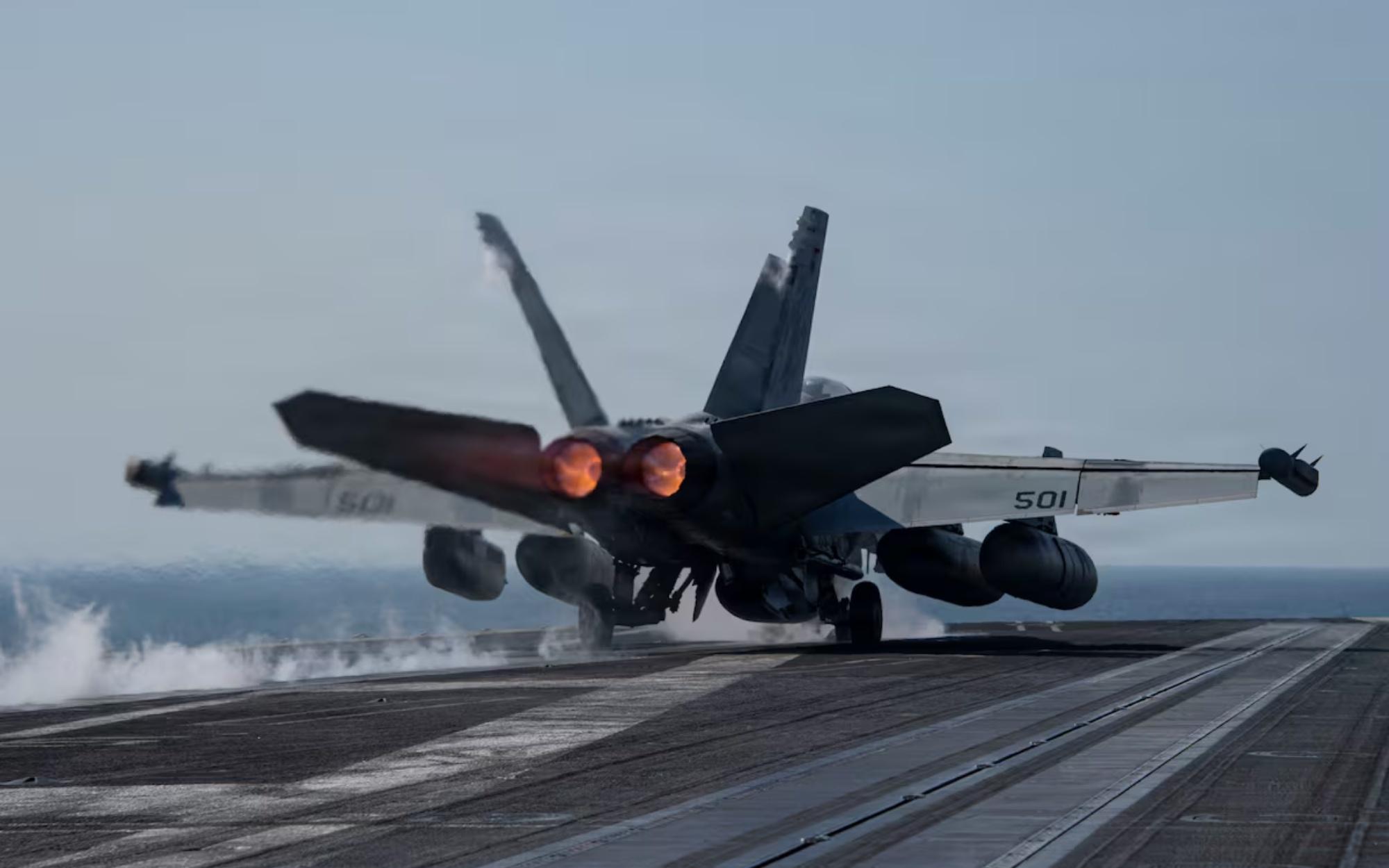
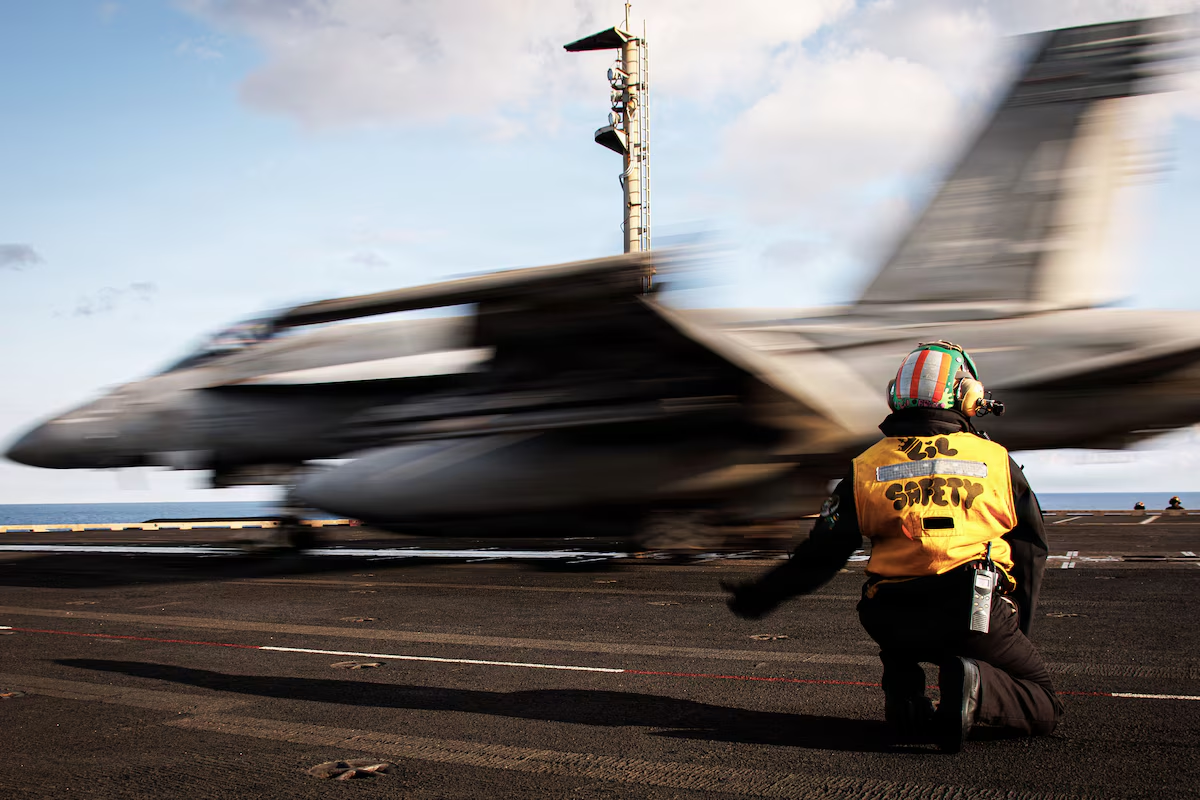
A U.S. sailor signals an F/A-18E Super Hornet on the flight deck of the USS Abraham Lincoln, March 4, 2026. (U.S. Navy)

However, both sides agreed that those specific terms will be handled in follow-up discussions. That condition ensures the U.S. maintains leverage while allowing a temporary de-escalation period to verify Iran’s sincerity.

Speaking at the G7 Summit in France, President Trump minced no words when describing the expectations going forward. “If Iran didn’t comply with the agreement,” he said, “the U.S. would go right back to dropping bombs right smack in the middle of their head.”

The blunt warning drew predictable outrage from liberal commentators but made America’s deterrent position unmistakable.

Pentagon Confirms Safe Passage Through Strait of Hormuz as U.S. Counters Iranian Mine Threat
Independence-class littoral combat ship USS Santa Barbara, equipped with a mine countermeasures mission package, participates in a training exercise in the Arabian Gulf on Feb. 2, 2026. (MCS2 Iain Page/U.S. Navy)

Since the lifting of the blockade, the first reports of oil tanker traffic resuming through the Strait of Hormuz have circulated, marking a cautious return to normal maritime commerce.

Two tankers were confirmed transiting the passage from Iranian ports on Thursday, signaling a measurable relief in global shipping flows.

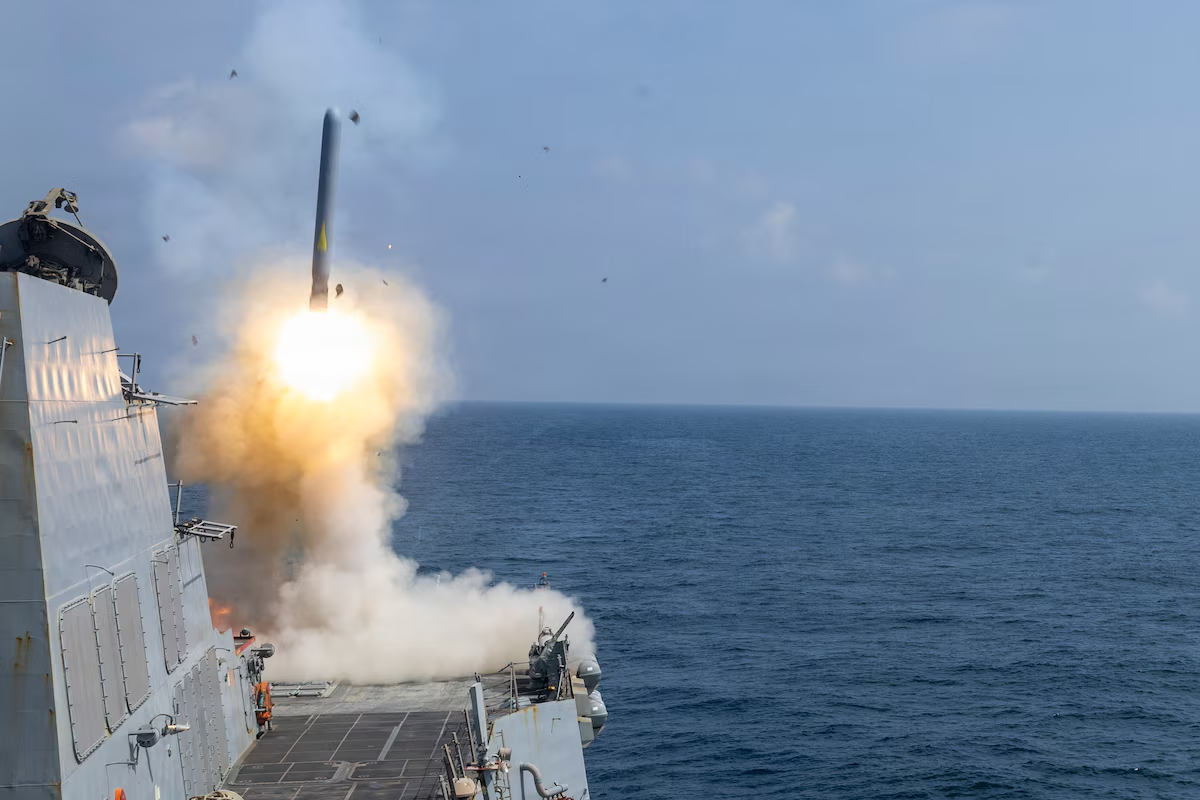
Trump noted earlier in the week on Truth Social that the strait had reopened but clarified at the summit that U.S. naval forces remain engaged in clearing mines that Iran had scattered along the sea lanes.

The careful mine-hunting and sweeping operations demonstrate both prudence and precision — the kind of military competence expected under War Secretary Pete Hegseth’s strong hand and Trump’s clear direction.

Reports of Vessels Hit as Iran Declares Hormuz Closed Again, Escalating Gulf Tensions

The operation’s completion underscores an important shift: America is reasserting its will in the global order without being shackled by endless conflict.

When force is used, it’s decisive, and when diplomacy is leveraged, it’s backed by that same credible threat. The contrast to the weak, bureaucratic dithering of the Obama-era foreign policy couldn’t be clearer.

For Tehran, the move offers a slim chance to behave like a rational actor in the international community. For Washington, it keeps all options on the table.

And for the men and women of the U.S. Navy who’ve kept watch over one of the world’s most dangerous maritime intersections, it’s another job done with excellence, professionalism, and power.

The world knows once more that under Trump’s leadership, America doesn’t back down — it directs the terms of peace.

With U.S. ships still in the vicinity and the Strait of Hormuz opening under American supervision, this latest chapter reminds friend and foe alike who truly controls the tide in the Gulf.

US Forces Blast Defiant Cargo Ship With Hellfire Missile After Ignoring Blockade Orders
A sailor stands watch on the USS Truxtun, a destroyer participating in the blockade of the Strait of Hormuz. Navy photo.
News

Trump Blasts Critics as ‘Fools’ While Calling for Global Ceasefire and Celebrating Market Boom

President Donald Trump on Thursday urged countries across the Middle East to support ongoing negotiations with Iran and called for a complete ceasefire on multiple fronts as debate continued over the recently signed memorandum of understanding between Washington and Tehran, as reported by The Gateway Pundit.

Trump signed the 14-point memorandum on Wednesday during a dinner at the Palace of Versailles alongside European leaders. Vice President JD Vance and Iranian officials signed the agreement electronically.

According to the memorandum, Iran agreed that it will not procure or develop nuclear weapons. The agreement also provides for the reopening of the Strait of Hormuz and establishes a framework for additional negotiations between the two countries.

During a White House briefing earlier Thursday, Vance outlined the administration’s position regarding sanctions relief. He said Iran would be required to demonstrate compliance before any relief measures would be considered.

Under the agreement, Vance said Iran must “show verifiable pathways to not rebuild” its nuclear program before sanctions relief could be provided.

He also emphasized that Iranian funds would remain frozen until Tehran fulfills its obligations under the agreement.

“We’re not releasing a single dollar of that money until the Iranians perform,” Vance said.

One of the memorandum’s provisions calls for an “immediate and permanent termination of military operations on all fronts, including in Lebanon.”

That section of the agreement drew scrutiny after reports indicated that an adviser to Israeli Prime Minister Benjamin Netanyahu stated that Israel does not consider itself bound by that portion of the memorandum and would not withdraw troops from Lebanon.

Vance addressed criticism from some Israeli officials and members of Netanyahu’s cabinet during his briefing. He criticized those attacking the agreement and argued that they should recognize the realities facing the region.

Following Vance’s remarks, Trump posted a message on Truth Social reiterating his support for a broad ceasefire and continued negotiations.

“The United States is committed to PEACE, and we encourage everyone in the Middle East Region to maintain their commitment to allowing our negotiations to beautifully unfold. The Markets are loving what is happening with Oil Prices, way down, and Stocks way up. We expect a complete Ceasefire on all fronts, including Lebanon, Hezbollah, and Israel. Thank you for your attention to this matter! President DONALD J. TRUMP”

Responses to Trump’s statement quickly followed from leaders in the region.

According to Axios reporter Barak Ravid, Lebanese Parliament Speaker Nabih Berri expressed support for efforts to advance negotiations between the United States and Iran.

“In order to assist the success of the Iranian-American negotiations in Switzerland, and particularly with regard to the first clause in the memorandum of understanding between Iran and the United States, and in reference to the statement by United States President Donald Trump regarding the ceasefire between Israel, Lebanon, and Hezbollah, I wish to emphasize Lebanon’s position and Hezbollah’s commitment to the ceasefire, as long as Israel upholds it in full and comprehensive manner,” Berri said.

Israeli Ambassador to the United States Yechiel Leiter also responded.

“Israel remains committed to the ceasefire agreement reached between Israel, Lebanon, and the United States. If Hezbollah does not violate the agreement, it will be upheld. In any case, Israel reserves the right to respond to any attack against it and to thwart threats to its territory, its citizens, and its soldiers,” Leiter said.

Earlier Thursday, Trump also pushed back against critics who argued that his administration had not taken a sufficiently hard line toward Iran.

“These fools, who think I haven’t been tough enough on Iran, when the Stock Market Just Hit A RECORD HIGH, and Oil prices are “tumbling” down, are either jealous, bad people, or stupid. MAKE AMERICA GREAT AGAIN!!! President DJT”

The memorandum establishes a framework for continued negotiations as the administration seeks a broader agreement covering nuclear issues, regional security concerns, sanctions relief, and long-term stability in the Middle East.

News

Pentagon Signals Openness to Permanent U.S. Base in Poland

The War Department appears receptive to Poland’s push for a permanent American military base on its soil, according to Polish Defence Minister Wladyslaw Kosiniak-Kamysz.

Following fresh discussions in Brussels with U.S. War Secretary Pete Hegseth, Poland’s top military official said Washington responded positively to the idea, signaling a growing bond between the two nations amid the ongoing instability created by Moscow’s aggression.

Kosiniak-Kamysz told reporters that his meeting with Hegseth covered collective defense priorities and bilateral cooperation, with a particular focus on strengthening NATO’s eastern flank.

“The U.S. responded positively to Poland’s proposal to establish a permanent U.S. military base in Poland,” he said.

While no official decision has been finalized, the announcement marks a strong step forward in consolidating long-term American military presence in the region.

Poland has repeatedly urged both NATO and the United States to move beyond rotational troop deployments and commit to a fixed, enduring American footprint.

That stance comes as Russian provocations along the alliance’s eastern borders continue to raise alarms. For Warsaw, a permanent U.S. garrison represents not only a security guarantee but also a symbolic reinforcement that Poland is on the front line of liberty in Eastern Europe.

For the United States, a base in Poland would also enhance logistical reach and deterrence capabilities across the region.

With Hegseth leading the review of America’s global troop posture, it’s clear the War Department is taking a pragmatic approach that prioritizes readiness over political indulgence.

Under Hegseth’s leadership, the emphasis is shifting from legacy deployments to strategic positioning where America’s interests are most at risk.

During the meetings in Brussels, Hegseth announced a comprehensive review of U.S. troop deployments across Europe, specifically targeting cost efficiency and alliance accountability.

U.S. Postpones Weapons Deliveries to European Partners Amid Iran Conflict
U.S. Patriot missile batteries stand ready in Poland, April 2022. (Sgt. 1st Class Christopher Smith/U.S. Army)

He reaffirmed America’s commitment to NATO’s collective defense principles while calling out nations that continue to shirk their 2 percent GDP defense spending commitments. The message was unmistakable: America will no longer bankroll Europe’s security theater while some allies sit on the sidelines.

“We’re done with free riding,” Hegseth stated bluntly. According to those close to the talks, the War Secretary made it clear that U.S. taxpayers deserve responsible partners, not complacent ones hiding behind American might.

“If you want the shield of freedom, you’ve got to share the cost of holding it,” an aide summarized afterward.

Poland, by contrast, is not hiding behind anyone. The country has invested heavily in modernizing its armed forces, purchasing American-made equipment such as Abrams tanks, HIMARS rocket systems, and F-35 fighter aircraft.

U.S. Greenlights Nearly $2 Billion Counter-Drone Sale to Kuwait Amid Rising Iranian Aggression
A Polish soldier prepares to launch a counter-UAS system during a showcase in Nowa Deba Training Area, Poland, on Nov. 18, 2025. (Luis Garcia/U.S. Army)

Warsaw’s defense spending now exceeds NATO’s 2 percent benchmark, positioning Poland as one of Washington’s most reliable allies on the continent. That kind of commitment resonates deeply with the current War Department’s “burden-sharing” philosophy.

From a strategic standpoint, a permanent U.S. base in Poland would allow NATO forces to project power faster and respond more effectively to threats along the eastern border.

It would also send a clear message to Russia’s Vladimir Putin that America and its allies aren’t retreating or dithering—they’re doubling down. A fixed American presence would reinforce deterrence and solidify NATO’s operational posture in Central Europe.

At the same time, a long-term base would benefit American troops with purpose-built infrastructure rather than the logistical headaches of the rotational model.

Poland Signs Onto Pentagon’s Counter-Drone Network After Abrupt U.S. Troop Pullback

Permanent installations allow for integrated command structures, continuity in training, and deeper coordination with host nation forces. Such integration boosts response times and enhances deterrence, making strategic sense both economically and militarily.

The plan isn’t without critics—mostly from within the “global management class” that fears a more assertive, Europe-focused U.S. presence could disrupt their delicate international order.

Those critics argue that making Poland a more central node of American power would provoke Russia needlessly. But that argument ignores reality: Russia has already invaded Ukraine, conducted cyber operations, and deployed nuclear-capable systems in Kaliningrad. Waiting politely has only emboldened Putin.

It’s no coincidence that this push comes as President Trump and War Secretary Hegseth are realigning America’s defense posture toward strength and reciprocity.

The Trump-Hegseth approach discards diplomatic niceties and focuses on practical, results-driven alliances. Ensuring that the allies who claim to value freedom actually invest in defending it is not controversial—it’s common sense.

Army Announces Unit Rotations in Europe and the Middle East, Including Return of Soldiers from Lithuania
U.S. Soldiers assigned to Killer Troop, 2nd Platoon, 3rd Squadron, 2nd Cavalry Regiment, move and clear a trench during a situational exercise part of Operation Atlantic Resolve in Drawsko Pomorskie training area, Poland, Feb. 24, 2015. Operation Atlantic Resolve is a U.S. Army Europe-led land force assurance training mission taking place across Estonia, Latvia, Lithuania and Poland to enhance multinational interoperability, strengthen relationships among allied militaries, contribute to regional stability and demonstrate U.S. commitment to NATO. (U.S. Army photo by Staff Sgt. Pablo N. Piedra / released)

For Poland, the opportunity to host a permanent U.S. base represents more than deterrence.

It is a declaration that their nation stands shoulder-to-shoulder with the American vision of security grounded in sovereignty and resolve. If the War Department moves this initiative forward, it could dramatically reshape NATO’s eastern defense arc for a generation to come.

As Hegseth’s review unfolds, allies from the Baltics to the Balkans will be watching closely.

But for now, Warsaw’s diplomatic persistence and America’s newfound strategic clarity are converging on a single premise: a strong Poland means a stronger NATO front line. And that is precisely what keeps both Europe and the United States safer from threats that refuse to fade.

News

Missouri Foster Mother Confesses to Swapping Child for Monkey in Shocking Case [WATCH]

A Missouri foster mother who cared for hundreds of children over two decades has pleaded guilty to child endangerment after authorities accused her of sending a young girl in her care to Texas as part of an arrangement involving a monkey, as reported by the New York Post.

Brenda Deutsch, 70, entered a guilty plea Monday to one count of first-degree child endangerment, according to court records cited by Fox 2 News.

The case began to unfold in February 2025 when a school resource officer in Winfield started investigating a series of unexplained absences involving the child.

During the inquiry, the officer learned of allegations that the girl had been sent to Texas and exchanged for an exotic animal.

Court records indicate the officer contacted authorities in Texas and spoke with the individual who was caring for the child. According to investigators, that person stated she was keeping the girl because the child and Deutsch “weren’t getting along.”

Authorities said Deutsch had fostered more than 200 children during the previous 20 years.

As questions mounted about the child’s whereabouts, Deutsch reportedly told officials that the girl was safe and attending school in Texas.

The investigation eventually expanded across state lines as Missouri and Texas authorities worked to determine the circumstances surrounding the arrangement.

Mike Wood, the prosecuting attorney for Lincoln County, described what investigators believe led to the unusual agreement.

“It was described to me early on that the defendant … became frustrated with this individual child and asked her friend in Texas if she would just take the child and keep her,” Wood told NBC News.

“And at that point I think is when she says, ‘You know, why don’t you send a monkey and you can just keep the child?’”

According to court documents, the woman in Texas later informed authorities that she no longer wished to care for the child. She also claimed that the girl was frequently left alone for several days at a time while in Texas.

The records further allege that when the caretaker sought to send the child back to Missouri, Deutsch refused to pay for a plane ticket home.

The child ultimately returned to Missouri, where investigators interviewed her about her experiences.

According to court records, the girl told authorities she had been subjected to mental and physical abuse while living in Deutsch’s home. The allegations included claims that she had been struck with wood, shoes, and a paddle.

Authorities also learned that child welfare officials had received an earlier report alleging abuse months before the criminal case became public.

Deutsch originally faced multiple criminal charges connected to the case. In addition to the child endangerment count, prosecutors had filed two counts of child abuse or neglect.

As part of the plea agreement reached this week, those additional charges will be dismissed in exchange for Deutsch’s guilty plea to first-degree child endangerment.

The case has drawn significant attention because of the unusual allegations and Deutsch’s long history as a foster parent.

She now faces sentencing and could receive a prison term of up to seven years. Court records also indicate she could face a jail sentence of as much as one year.

The guilty plea brings an end to the criminal proceedings, though sentencing remains pending.

News

Ex-Officer Accused of Giving Homeless Man Poop Sandwich Lands Top Job [WATCH]

A former San Antonio police officer whose career became the subject of national attention nearly a decade ago has been appointed police chief in a small South Texas community, as reported by The New Post.

Matthew Luckhurst officially assumed his new role as police chief of Benavides on June 1 after city leaders voted to promote him during an April 30 city council meeting.

The appointment comes years after Luckhurst was fired from the San Antonio Police Department following allegations that he left a sandwich containing dog feces for a homeless man.

The incident generated widespread media attention and ultimately led to multiple disciplinary actions during his law enforcement career.

According to city records cited by the San Antonio Current, Luckhurst will earn $28 per hour as police chief in the town of roughly 1,100 residents located about 150 miles south of San Antonio.

Benavides officials did not immediately respond to requests for comment regarding the appointment.

The controversy surrounding Luckhurst dates back to 2016, when another officer accused him of placing dog feces between slices of bread inside a Styrofoam container and leaving it near a sleeping homeless man.

Reports indicated that the homeless man never consumed the sandwich.

Luckhurst denied wrongdoing from the beginning. He maintained that the sandwich was intended to be discarded and not eaten by anyone.

The same year, Luckhurst faced another controversy when he was accused of defecating in a women’s restroom at the San Antonio Police Department and smearing a “brown substance” on a toilet seat.

According to reports, he did not deny involvement in that incident.

At the time, Luckhurst had been with the San Antonio Police Department for approximately five years.

His dismissal from the department led to a lengthy legal battle. In 2019, Luckhurst successfully appealed his firing and briefly returned to duty. However, the matter was not settled permanently.

A judge later reviewed the case and upheld his dismissal in 2020, ending his return to the San Antonio force.

Despite that setback, Luckhurst continued working in law enforcement.

In February 2022, he joined the police department in Floresville, another South Texas community. His tenure there lasted approximately 10 months before he was dismissed after renewed attention focused on his prior disciplinary history.

The next chapter of his law enforcement career began in 2023 when then-Benavides Police Chief Andrew Hines hired him as a police officer.

At the time, Hines defended the decision and said the hiring “reflects the department’s commitment to honesty and accountability.”

Three years later, city officials elevated Luckhurst to the department’s top position.

The promotion places him in charge of policing operations for the small South Texas town despite the controversies that marked much of his previous law enforcement career.

Luckhurst’s appointment has drawn renewed attention to the events that led to his firing from San Antonio and subsequent dismissal from Floresville.

Supporters have pointed to his continued service in law enforcement since those incidents, while critics have questioned whether his disciplinary history should have prevented further advancement.

As of June 1, however, Luckhurst officially became the police chief of Benavides following the city council’s vote and began overseeing the department’s operations.

News

Simplify Chaos: New Bill Seeks to Fix Guard and Reserve Pay Confusion

For decades, America’s National Guard and Reserve troops have been buried under a mountain of bureaucratic nonsense when it comes to their orders, pay, and benefits.

Now, Congress is trying to untangle that mess with a new piece of legislation called the Duty Status Reform Act.

The mission is simple: cut through the endless red tape that’s been shortchanging those who serve both state and country.

The current system is a hodgepodge of over 30 duty statuses, ranging from Title 10 to Title 32 and State Active Duty designations.

The result is confusion, uneven benefits, and in some cases, outright unfairness.

The type of duty order you’re on determines what pay, housing allowance, health care, and retirement points you get — and the inconsistencies have frustrated troops for years.

Senator Jerry Moran of Kansas, one of the bill’s Republican champions, said the reform would “simplify the structure and strengthen the Guard’s ability to carry out its missions by standardizing pay and benefits.”

Senator Moran’s statement cuts right to the heart of the issue: the Guard’s role has evolved, but Washington’s outdated paperwork hasn’t kept up.

Guardsmen Honored for Their Heroic Stand Against DC Gunman
Two guardsman deployed to Washington, D.C., were awarded the Soldier’s Medal and Airman’s Medal for their response to a shooting that killed a fellow West Virginia guardsman. National Guard photo by Master Sgt. William Blankenship.

President Donald Trump brought much-needed attention to this issue when he spoke out in Memphis last March, noting that Guardsmen deployed to American cities should receive deployment pay and benefits like any active-duty soldier.

His remarks spotlighted the very real inequities built into the current system — inequities that this reform seeks to erase.

Julian Plamann, deputy director of government affairs at the National Guard Association of the United States, put it bluntly: “If you’re a Guardsman and you’re on orders for less than 30 days, you do not receive health care or housing benefits.” That’s the catch.

The difference between a 29-day order and a 31-day order can mean the difference between having coverage or not — a ridiculous game of bureaucratic limbo that punishes those who serve.

Plamann called the reform long overdue but admitted the challenge is huge. Reforming the duty status system means rewriting hundreds of policies across war department regulations, joint travel rules, and federal pay codes.

National Guard’s DC Presence Slammed by Critics as ‘Ineffective’ Despite Visible Results

“The can of worms that this is, is so massive it really has stagnated progress,” she said. But it’s exactly the type of problem determined lawmakers and leaders should tackle head-on.

The RAND Corporation released a report in August 2025 that confirmed what every Guardsman already knew — the current system causes confusion for both commanders and troops.

RAND found that some units hesitate to activate their personnel because of pay, benefits, and administrative headaches. That doesn’t just waste time; it undercuts readiness.

One blatant example of the system’s absurdity played out during the 2020 COVID-19 response in New York. Navy reservists deployed on the hospital ship USNS Comfort were under Title 10 orders, which came with full benefits.

But Army National Guard troops working at the nearby Javits Center were under Title 32 orders, meaning their pay and benefits were completely different — even though they were doing the same mission.

Matt Schwartzman, policy director for the Reserve Organization of America, explained another major problem: “The system rewards how orders are written over the duty actually performed.”

Troops can work nearly full-time under a mix of short-term orders and still lack consistent health coverage or housing support. That reality is unacceptable in a nation that claims to support its service members.

The impact doesn’t stop with the troops themselves. Military families have also been caught in the crossfire of bureaucratic rules.

Trump Sends National Guard to New Orleans as He Backs Swamp Sweep Immigration Crackdown
Army National Guardsmen patrol a walkway in Washington, Nov. 21, 2025. About 2,400 guardsmen are supporting the D.C. Safe and Beautiful Task Force mission, helping law enforcement and community partners strengthen public safety, resilience and quality of life in the nation’s capital.

After a tragic 2015 helicopter crash in the Gulf of Mexico that killed four Guard members and seven Marines, it was revealed that the Guard families received less in survivor payments simply because their loved ones were on “inactive duty training.”

Congress tried to fix that inequity in the 2017 annual war bill, but other loopholes remain.

The new bill proposes cutting more than two dozen statuses down to four broad categories that clearly define who qualifies for what. These categories would cover everything from war and national emergency response to state-level disaster deployments, training, and even remote cyber operations.

It’s modernization the Guard desperately needs as cyber and remote missions become more frequent.

Major Plamann, who also serves as a Maryland National Guard company commander, said the change would bring much-needed clarity for modern Guard units that do remote or tech-driven work.

“There’s so much that we do in between drills,” she said. “This will be nice to actually have something to point to in a structure that allows us to get some sort of compensation for that.”

Supporters believe that passing this bill isn’t just about simplifying paperwork — it’s about fairness, respect, and finally giving Guardsmen and reservists what they’ve earned.

The Department of War exists to support our troops in every aspect, and this legislative cleanup could finally bring that principle to life.

If Congress follows through, the Duty Status Reform Act could be the long-overdue victory America’s part-time warriors have been waiting for.

Our troops deserve consistency, not confusion. The message is clear: if you serve this country, your benefits shouldn’t depend on what line of text appears at the top of your orders.

News

Boy, 3, Critically Injured After Being Thrown Into Crocodile Pit as Police Arrest Suspect [WATCH]

A 3-year-old boy was hospitalized in critical but stable condition on Thursday after being thrown into a crocodile enclosure at a zoo in Cambridgeshire, England, according to local authorities, as reported by The New York Post.

Police arrested a 30-year-old man on suspicion of attempted murder following the incident at Johnsons of Old Hurst, a popular zoo that features a reptile attraction known as the Tropical House.

Authorities said the suspect, who is from Norfolk, was taken into custody shortly after the incident. Investigators do not believe the man knew the child prior to the encounter.

The incident occurred on Thursday at the zoo in Old Hurst, a village located in Cambridgeshire. Emergency responders transported the boy to a hospital, where he was reported to be in critical but stable condition.

Police have not publicly identified either the child or the suspect, and officials said the circumstances leading up to the incident remain under investigation.

Detective Inspector Verity McCann said investigators are working to gather information from witnesses who were present at the zoo.

“At this stage we are speaking to people who were at the zoo at the time of this distressing incident to understand more about the circumstances,” McCann told The Sun.

“We do not believe the man arrested and the child are known to each other,” McCann said.

Authorities have not released additional details regarding how the boy ended up inside the enclosure or what may have motivated the suspect.

The investigation quickly drew attention from local officials, including Ben Obese-Jecty, whose parliamentary district includes Old Hurst.

In a statement, Obese-Jecty urged the public to avoid speculation while investigators continue their work.

“This is now a live criminal investigation, and I would ask people to refrain from speculation online,” he said.

“The police will provide an update with further information in due course. My thoughts are with the young victim and his family during a hugely traumatic and difficult time,” said Obese-Jecty.

Police have not indicated when additional information may be released or whether further charges could be filed as the investigation progresses.

The zoo, which opened its reptile section in 2019, has become known for interactive exhibits and specialty experiences involving reptiles. One of its featured attractions is a crocodile feeding experience that costs approximately $100.

Following Thursday’s incident, zoo officials announced the temporary closure of the Tropical House facility.

In a statement posted to Instagram, the zoo expressed support for the child and his family.

“Our thoughts and prayers are with the boy and his family following the incident that occurred today,” the Johnsons of Old Hurst zoo said.

The zoo also announced that the Tropical House area would remain closed until further notice.

The incident has prompted a major police response as investigators continue interviewing witnesses and reviewing evidence from the scene.

As of Thursday evening, authorities had not released the suspect’s identity, and the criminal investigation remained active.

Officials have urged members of the public to allow investigators to complete their work before drawing conclusions about what occurred.

News

Air Force Identifies Eight Heroes Lost in Deadly B-52 Crash at Edwards Base

The U.S. Air Force has officially released the names of the eight crew members who were killed when a B-52 Stratofortress went down shortly after takeoff from Edwards Air Force Base in California.

The tragedy has sent shockwaves through the Air Force community and across the wider military family.

According to base officials, the crew consisted of five active-duty Air Force service members and three civilians working in concert during a routine training mission.

The bomber, a workhorse of the U.S. strategic fleet for decades, crashed around 11:20 a.m. Pacific time on June 15. Emergency crews responded quickly, but the devastation was total.

Col. Thomas Tauer, commander of the 412th Test Wing, issued a somber statement honoring the fallen, saying, “These airmen were more than coworkers. They were friends, mentors, teammates and valued members of our Edwards and Air Force family.”

He emphasized the base’s immediate focus was to support the families of those lost and ensure every resource was made available to help them through this unimaginable loss.

Among those killed were Lt. Col. Gabriel Estrella, 40, of the Air Force Operational Test and Evaluation Center; Maj. Alexander Davis, 34, of the 419th Flight Test Squadron; Maj. Robert Dee, 40, and Maj. Brad Hovey, 35, both pilots from the 419th Flight Test Squadron; Col. Greg Watson, 53, a Boeing employee and Air Force reservist; retired Lt. Col. Miles Middleton, 50, also a Boeing employee; Jeromy Smith, 32, a flight test engineer; and Christopher Rischar, 41, a contractor with JT4.

Each man represented the very best of the Air Force’s tradition of courage, precision, and dedication. They served in an unforgiving profession where technical excellence meets split-second decision-making, all in the defense of America’s skies.

Two Boeing Employees Were Among the Eight Killed in Fiery B-52 Crash at Edwards Air Force Base

The nation is reminded that these warriors risk their lives not only in combat, but also in the essential testing, evaluation, and advancement of the aircraft that keep our warfighters dominant.

The Air Force stated that the cause of the crash remains under investigation, with the airfield at Edwards still closed while recovery and analysis operations are underway.

The crash occurred during a “routine training flight,” the sort that has been conducted countless times at the storied desert base—a test and training ground for the most advanced aircraft on Earth.

This tragedy marks the deadliest B-52 incident since 1982, when nine airmen lost their lives during a simulated combat flight near Mather Air Force Base.

The loss serves as a grim reminder that even during training, service to this nation demands ultimate sacrifice. Every takeoff in service of readiness carries inherent risk, but that risk is accepted with courage few outside the uniformed world can truly grasp.

Recent months have been marked by an unsettling uptick in aviation mishaps across the armed forces.

Eight Tragically Killed in Fiery B-52 Crash at Edwards Air Force Base
A B-52H Stratofortress from Edwards Air Force Base, California, departs for an evening test mission on Aug. 7, 2025. Air Force photo by Todd Schannuth.

Just within the past five weeks, a midair collision between two Navy EA-18G Growlers and a separate fatal crash of a Marine Corps F/A-18 Hornet near Mount Rainier have reminded the nation of the razor’s edge our aviators walk.

Each tragedy underscores the urgent need for vigilance, maintenance focus, and renewed commitment to supporting our military test programs without political interference or budget chokeholds from Washington bureaucrats.

Test flight operations remain a vital part of America’s readiness posture. The mission at Edwards Air Force Base, located in California’s Mojave Desert, is the backbone of innovation and experimentation for U.S. air power.

Every new weapons system, aircraft upgrade, and flight maneuver must be proven and perfected before reaching the front lines. That process is risky by nature, but it ensures American dominance in every theater of war.

While some in the media focus on headlines or bureaucratic blame games, those who understand military aviation know that every airman on that B-52 took off that morning in the proud tradition of American service.

They were fearless professionals—doing their part to keep this country strong and battle-ready.

Eight Tragically Killed in Fiery B-52 Crash at Edwards Air Force Base
Smoke rises from a blackened part of Edwards Air Force Base after the crash of a U.S. Air Force B-52 bomber aircraft on June 15, 2026, in a still image from news helicopter video. (KABC via Reuters)

Their families, colleagues, and communities will now face unimaginable grief.

Yet their sacrifice will not be forgotten. Secretary of War Pete Hegseth and the Trump administration have consistently emphasized rebuilding America’s warfighting capability and honoring those who put their lives on the line, both in combat zones and in test flights like this.

Their vision to restore the strength and pride of the U.S. military stands as the truest tribute to those who serve and fall in the line of duty.

As the investigation continues, what remains clear is the enduring spirit of America’s airmen.

From the flight line at Edwards to bases around the globe, the Air Force family grieves—but also steels itself to continue the mission. The skies may be dangerous, but it is those skies that keep this nation free.

When the flag is raised tomorrow at Edwards Air Force Base, it will wave for eight heroes who gave everything they had in service to their country.

Their memory deserves not only our tears, but our unwavering commitment to continue the mission they so honorably served.

News

Billy Bush Unleashes Brutal Takedown Of Al Roker As Vindictive And Mean [WATCH]

Television personality Billy Bush delivered a sharp critique of former “Today” show colleague Al Roker during a recent podcast appearance, accusing the longtime NBC personality of being difficult to work with during Bush’s brief tenure on the morning program in 2016, as reported by Page Six.

Bush made the comments during the June 12 episode of “The Nerve With Maureen Callahan,” where he reflected on his time at NBC and his experience working alongside Roker.

“The way I describe Al is three words: territorial, vindictive, and chronically unprepared.”

The former “Today” co-host also criticized Roker’s interviewing skills, arguing that the program’s third hour struggled because of his performance.

According to Bush, the third hour of the NBC morning show “will never be a successful hour” because Roker is “maybe the worst interviewer on television.”

Bush joined “Today” in 2016 but remained with the program for only two months before being dismissed following the release of the “Access Hollywood” recording featuring President Donald Trump.

In the leaked tape, Trump made remarks to Bush that became a major issue during the 2016 presidential campaign.

During the podcast interview, Bush said he approached his role on “Today” with preparation and research but claimed Roker viewed him as competition.

The television host alleged that Roker was “jealous” of him and further claimed that both Roker and former “Today” anchor Matt Lauer did not support his presence on the show’s third hour.

Lauer was dismissed from NBC in 2017 following allegations of inappropriate sexual behavior.

Bush also recounted an incident involving social media, alleging that Roker once liked a post on X that referred to him as a “white-splaining racist.”

Bush claimed the incident resulted in no consequences for Roker because of his longstanding position at NBC.

“Al had been there forever, so he kind of, you know, he gets free run of the place for his many credentials and one of them being longevity,” Bush said.

The criticism intensified as Bush discussed what he described as Roker’s behavior behind the scenes.

“People don’t know how mean he was. He’s mean. He’s a mean person. When you say rageful and all that, it’s mean. There is rage in there. There’s jealousy. And I talk about vindictiveness, but he’s mean,” Bush said.

Bush also claimed that Roker was reluctant to share airtime with him during their time together on the program.

According to Bush, tensions stemmed in part from the reception he received from staff members.

“When I got there, they said, you know, a younger guy with a full head of hair who the women on the staff genuinely liked a lot. And that was infuriating to him,” Bush stated.

Toward the end of the interview, Bush criticized Roker’s work as a weather forecaster.

“You’re never going to hear anything that’s truly insightful,” he said. “That’s not what he’s there for.”

Representatives for Roker and NBC’s “Today” program were contacted by Page Six for comment, according to the report.

Bush has previously discussed the personal struggles that followed his departure from “Today.” He has said that after losing the position, he spent time coping through heavy drinking, spending long periods at home, and crying.

His television career resumed in 2019 when entertainment news program “Extra” hired him to replace Mario Lopez. Bush later departed “Extra” and launched his podcast, “Hot Mics with Billy Bush,” in 2025.

The comments mark one of Bush’s most direct public criticisms of his former NBC colleague and provide a new look at the tensions he says existed behind the scenes during his short time on the network’s flagship morning show.

WATCH:

News

Coast Guard Crushes Cartel Lifeline with Massive Cocaine Seizure in Eastern Pacific

The U.S. Coast Guard struck a massive blow against the cartels this week, seizing more than 225,000 pounds of cocaine in the eastern Pacific through Operation Pacific Viper.

The effort marks a decisive win in President Trump’s aggressive counternarcotics campaign, proving that America’s warfighters on the water are keeping the poison off U.S. streets and out of American veins.

According to the Coast Guard, the cutter Bear alone snatched up 7,707 pounds of cocaine over the weekend, pushing the total tally under Operation Pacific Viper to nearly a quarter-million pounds.

The operation began in August 2025 and has kept relentless pressure on the narco-smugglers operating through the maritime corridors of Central America.

Adm. Kevin Lunday, the commandant of the Coast Guard, praised the mission’s success.

“Our forces conducting Operation Pacific Viper continue to defeat the cartels and stop the flow of deadly drugs to the United States,” he said. It’s not an overstatement.

Each pound taken represents thousands of lives potentially saved from overdose and addiction, and each bust tells hostile traffickers that America’s resolve isn’t going anywhere.

Coast Guard Breaks Recruitment Record, Reaching a 34-Year High in Active-Duty Enlistments
The U.S. Coast Guard, whose Law Enforcement Detachment 105 is seen here seizing cocaine from a smuggling vessel on Aug 11 in the eastern Pacific Ocean, brought in 5,204 new enlisted personnel. (MCS2 Sheryssa DoWard/U.S. Navy)

During the operation, the Bear and its embarked helicopter crew disabled two drug-smuggling vessels, seized several thousand pounds of cocaine, and apprehended six suspected narco-terrorists.

The precision and coordination required to pull off such actions show a level of discipline and skill that rivals any military operation conducted on foreign soil.

Officials also emphasized just how lethal this cargo could have been. The Coast Guard estimates that just 1.2 grams of cocaine can prove fatal.

That means the 225,000 pounds captured equates to about 93 million potentially deadly doses. That’s 93 million reasons why aggressive maritime enforcement must continue to ramp up under a no-nonsense American administration.

Poll Shows Broad Backing for Stronger Military Action Against Drug Traffickers as Strikes Escalate
CARIBBEAN SEA (May 25, 2025) An MH-60R Sea Hawk helicopter assigned to Helicopter Maritime Strike Squadron (HSM) 74, the “Swamp Foxes,” lifts off from the flight deck of the Arleigh Burke-class guided-missile destroyer USS Gravely (DDG 107) to conduct a routine maritime interdiction operation patrol while underway in the Caribbean Sea. U.S. Navy assets are deployed under U.S. Northern Command’s maritime homeland defense authorities with a U.S. Coast Guard Law Enforcement Detachment embarked to enable maritime interdiction missions to prevent the flow of illegal drugs and other illegal activity. U.S. Northern Command is working together with the Department of Homeland Security to provide additional military forces and capabilities at the southern border. (U.S. Navy photo by Mass Communication Specialist 1st Class Ryan Williams)

The Trump administration has been unapologetic about taking the gloves off when it comes to fighting drug cartels. Critics have sniffed at what they call “controversial tactics,” but the results speak for themselves.

Cocaine isn’t reaching American cities, overdose rates are slowing, and the traffickers have been pushed back into hiding. That’s not controversy—that’s success.

In coordination with the War Department, the administration launched targeted strikes last fall against vessels suspected of carrying narcotics in both the Caribbean and eastern Pacific.

These operations, often conducted far from public view, form part of a new counter-narcoterrorism front designed to choke off the cartels’ infrastructure at sea before it reaches U.S. borders.

The Pentagon, standing firmly behind President Trump’s directive, has labeled these missions as “counternarcotics efforts” within a “non-international armed conflict.”

Taiwan and United States Launch Firepower Center to Master Asymmetric Warfare
A sailor directs a helicopter to a vessel’s flight deck at night.
A service member directs an MH-65E Dolphin helicopter during routine nighttime flight operations aboard the Coast Guard cutter Munro in the South China Sea, Aug. 23, 2023. The Munro is deployed to the Indo-Pacific to advance relationships with ally and partner nations.

While predictably, left-wing legal scholars and certain media voices have tried to accuse the military of overreach or even “war crimes,” the facts remain clear: U.S. forces are dismantling the operational capacity of drug-running enemies who profit off American death.

Since September 2025, the War Department has reported 64 precision strikes in the Caribbean and eastern Pacific.

Those engagements have eliminated at least 191 cartel-affiliated criminals and destroyed dozens of smuggling craft before they could spread their poison. The cartels may not wear official uniforms, but they pose just as great a threat to American security as any foreign terrorist cell.

Coast Guard operations like Pacific Viper highlight the increasingly military nature of America’s counternarcotics fight. These aren’t routine arrests of fishing boats gone rogue. These are heavily armed, cartel-backed vessels running interdiction-countermeasures, communications encryption, and sometimes even foreign-sourced weaponry.

The Coast Guard’s men and women are literally waging low-intensity warfare against criminal networks that cross borders and bribe nations.

Coast Guard Expands Elite Interdiction Teams To Crush Narco-Terror Threats
Members of the U.S. Coast Guard Maritime Security Response Team (MSRT) West patrol waterways in the San Francisco Bay, Oct. 9, 2025. MSRT’s primary mission is to provide specialized maritime law enforcement and counterterrorism capabilities in support of Homeland Security and Defense Readiness operations. Coast Guard photo by Petty Officer 3rd Class Joel LaVallee.

With leadership like Adm. Lunday at the helm and War Secretary Pete Hegseth reinforcing the naval and air missions, the United States is projecting power where it counts most—on the sea lanes that cartels once believed they controlled. Every ton of cocaine seized is strategic leverage gained, and every trafficker caught scrambles the narco-economy.

While political opportunists in Washington will always nitpick tactics or question legality, anyone paying attention to the numbers knows the truth. Operation Pacific Viper is working.

The cartels are reeling, America’s maritime border is stronger, and the bad guys are either locked up or at the bottom of the ocean. To every sailor and airman involved, the message from America’s heartland is clear: job well done, now keep going until the cartels run out of boats.


Scroll to Top