News

News

Army Communications Overhaul Leaves Families Scrambling for Answers 30 Days Later

One month after the Army began consolidating its official social media presence, military families are questioning whether the communications overhaul has delivered on its promise of easier access to information.

Instead, some families say critical updates about child care, medical services and community programs have become harder to locate.

The Army announced the sweeping change on July 9, presenting it as an effort to improve information access while limiting operational risk.

Army Directive 2026 17, Optimizing Digital Media, ordered numerous subordinate commands and installation organizations to shut down their independent social media accounts.

Organizations affected by the directive include Army Community Service, Morale, Welfare and Recreation, Child and Youth Services and military treatment facilities.

Those offices are now expected to distribute information through installation accounts or other higher command channels.

Army leaders said the centralized structure would “ensure a clear, unified voice, reduce operational risk, and improve information access for Soldiers, Families and the public.”

That objective sounds reasonable on paper, but families living with the results say the new system may be producing the opposite outcome.

During the first month of implementation, organizations across the service began notifying followers that their familiar pages would close.

Fort Bragg Army Community Service and United States Army Garrison Bavaria Family and MWR were among those directing their audiences toward broader installation accounts.

The change has also reached prominent operational and ceremonial units. The 3rd United States Infantry Regiment, widely known as The Old Guard, announced this week that its Instagram presence would be managed by the United States Army Military District of Washington.

That transfer reflects the Army’s larger campaign to centralize public communications and reduce the number of independently managed accounts.

However, combining dozens of information streams into larger pages can force families to sift through ceremonial news, command announcements and general updates just to find a child care notice.

Army spouse LeAnn Nichols said the elimination of organization specific pages disrupted a communications network she used while searching for child care and remaining connected to installation resources.
“Military families should never struggle to take advantage of the programs that are meant to support and empower our families,” Nichols said.

Nichols said hospital and MWR pages had provided one of the simplest ways to learn about programs and available services. Their removal has raised concerns that families already struggling to navigate military bureaucracy will now have another communications maze placed in front of them.

“Statistics show many military families don’t take advantage of programs that they are eligible for, and could really use,” Nichols said.

“Now it will be even more difficult to find the information we need on a regular basis.”

The concern is especially serious because child care remains one of the most persistent quality of life problems facing service members and their families.

A communications overhaul that makes those resources less visible risks worsening a problem Army leaders already know exists.

According to the Blue Star Families Military Family Lifestyle Survey, one third of active duty family respondents listed child care among their leading concerns.

Among families reporting child care problems, 67 percent pointed to long waiting lists or an insufficient number of available spaces.

Michael Hanson, an Air Force spouse living in an Army community, said the consolidation has noticeably altered how his family experiences installation life.

“The installation feels like it’s gone dark,” Hanson said.

“It’s back to COVID times where we’re all living in isolation. But even in isolation, we had social media to stay connected. With the military taking us all over the world, how can we not rely on the social highway?”

The directive does provide a process for commanders to request exceptions when they can show a mission critical need that existing communications channels cannot satisfy.

It remains unclear, however, how frequently exceptions have been requested or approved during the first month.

Military Times asked the Army how officials are measuring whether information access has actually improved and whether family feedback has been collected.

The publication also requested details about approved exceptions, replacement communications channels and any early data showing whether the centralized model is working.

Those are basic accountability questions for a policy affecting families across the Army, particularly when leaders promised better access from the start.

A unified voice may reduce institutional clutter, but it does little good if the people who need child care notices, clinic updates and community services cannot hear it.

Army leaders now have an opportunity to review the early results and correct any gaps before families simply stop looking for programs altogether.

Operational security matters, but so does ensuring soldiers and their families can find the support the Army already expects them to use.


News

Air Force Stands Firm with M18 Pistols as Proven Sidearm

The Air Force plans to keep the Sig Sauer M18 as its standard sidearm, rejecting any near term search for a replacement.

After several years of field use, the service says the compact pistol continues to meet operational requirements.

The M18 is the compact version of the Army’s Modular Handgun System and entered Air Force service in 2019. Since 2017, every military branch has adopted either the M18 or the full sized M17 to replace the aging M9, which entered service in 1985.

“The Air Force is satisfied with the M18 Modular Handgun System currently employed across the department,” an Air Force spokesperson said.

“We do not plan to consider other handgun options until the current system approaches end of service life. Until then, our limited small-arms procurement budget must remain focused on older and higher priority weapons.”

That is a practical answer from a service balancing weapons requirements against a limited procurement budget.

If a pistol remains safe, reliable, and effective, there is little reason to launch another expensive acquisition circus simply to give Pentagon planners more paperwork.

The Air Force Life Cycle Management Center’s Small Arms Program Office has purchased approximately 125,000 M18 pistols.

Those weapons have been distributed to airmen serving in combat arms units throughout the service.

The Air Force recently confirmed that it had revalidated the pistol’s safety and reliability during the past two years.

21-Year-Old Airman from Kentucky's Death Prompts Firearm Ban as Questions Swirl Around M18 Pistol

That review matters because the M18 came under scrutiny following the 2025 shooting death of an airman assigned to F.E. Warren Air Force Base in Wyoming.

After the fatal shooting, the Air Force ordered an inspection of M18 pistols across the service.

Air Force Global Strike Command, which operates and protects America’s nuclear weapons, also temporarily suspended use of the handgun “out of an abundance of caution” while investigators examined what happened.

The Air Force initially reported that the death involved an M18 discharge. Another airman was later arrested in connection with the incident and charged with manslaughter and making a false statement, changing the context surrounding the original concerns about the weapon.

Global Strike Command returned the M18 to service the following month after inspecting nearly 8,000 pistols. According to the command, investigators did not find a single weapon that had misfired, providing strong evidence that the pistol itself was not responsible.

Air Force Resumes Use of M18 Pistols with Stronger Oversight
The Air Force has resumed using the Sig Sauer M18 pistol for its Global Strike security forces airmen following an inspection of thousands of the weapons. (Staff Sgt. Joshua Hoskins/Air Force)

“As affirmed by the [Air Force Global Strike Command], the M18 was specifically designed and rigorously tested to meet stringent requirements unique to the military,” an August 2025 Sig Sauer news release stated.

“The [Air Force Global Strike Command] command-wide inspection showed that no weapon discharges were attributed to a malfunction, and the M18 can safely and reliably accomplish their missions across the globe.”

The M18 is based on Sig Sauer’s P320 family of striker fired pistols. It measures 7.25 inches long and uses a 3.9 inch barrel, making it smaller than the M17, which measures 8.05 inches and carries a 4.7 inch barrel.

Both pistols fire 9mm ammunition and can accept magazines holding either 17 or 21 rounds. The weapons have an effective range of up to 50 meters and include night sights, removable rear sight plates, and manual safeties.

The Air Force spokesperson confirmed that the service does not use the larger M17. That leaves the more compact M18 as the service’s primary handgun, a sensible fit for airmen who may need to carry a sidearm while working around aircraft, vehicles, missile facilities, and other confined environments.

Marines Allow Red Dot Optics for Pistol Qualification, Under One Condition
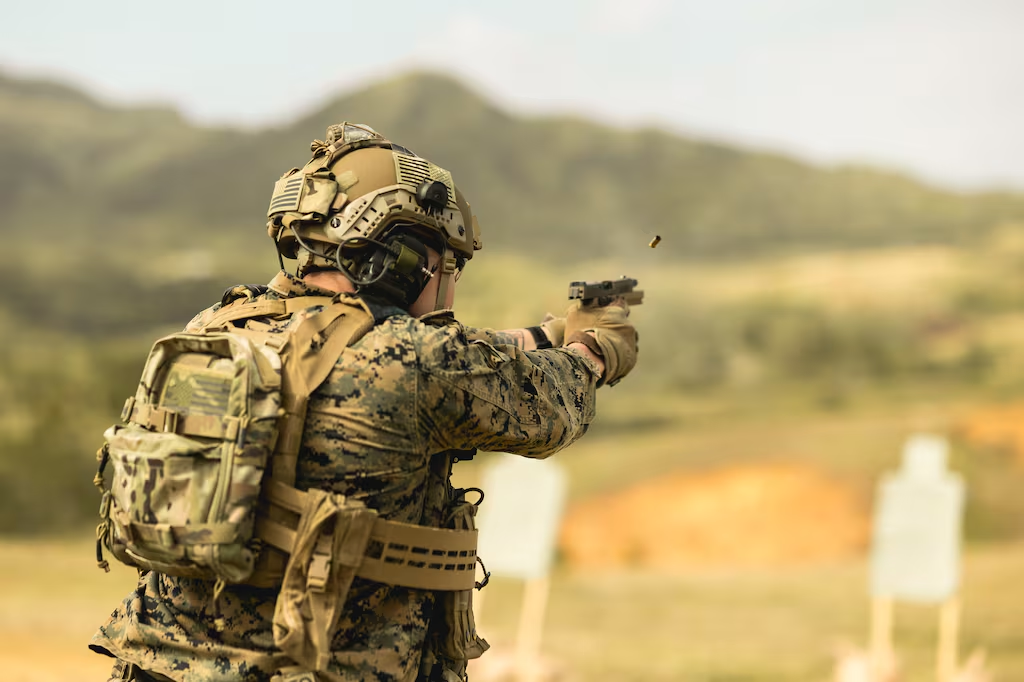
A Marine assigned to 5th ANGLICO fires an M18 service pistol during an exercise in Okinawa. (Staff Sgt. Manuel A. Serrano/Marine Corps)

Sig Sauer received the Modular Handgun System contract in January 2017. The agreement called for the company to deliver a combined 480,000 M17 and M18 pistols over a ten year period, creating a common handgun platform across the armed forces.

Other services are also reassessing small arms priorities rather than automatically chasing every new platform.

The Army recently said it had not purchased M7 rifles during the current fiscal year, while production attention shifted toward the lighter XM8 carbine, and the Marine Corps decided against replacing its M27 Infantry Automatic Rifle with the M7.

For the Air Force, the verdict is straightforward: the M18 works, inspections have supported its safety, and higher priority weapons need available funding.

Unless the pistol approaches the end of its service life or develops a genuine operational problem, airmen can expect it to remain on their holsters for years to come.

News

MAGA Fury Explodes as Thune and Cotton Accused of Blocking Brennan Investigation [WATCH]

Conservative patience is running thin after Just the News editor-in-chief John Solomon said on “Steve Bannon’s War Room” that key Senate Republicans are sitting on materials sought by the Department of Justice in a major weaponization investigation, as reported by Trending Politics News.

The allegation is not aimed at Democrats this time, which makes it even more galling for the MAGA base. Solomon named Senate Majority Leader John Thune and Senator Tom Cotton as the Republicans who have allegedly refused to turn over transcripts involving former CIA Director John Brennan.

“I’m going to go back to being a reporter for a second. I do not know this information from anything I’ve gained in government. I can tell you with 100% certainty that Republicans are obstructing the investigation into weaponization,” Solomon said.

That is the kind of sentence that lands like a brick in a movement that has spent years demanding answers about the Russia collusion hoax, the Steele dossier, and the permanent bureaucracy that treated Donald Trump like a target instead of a president.

Solomon said the records involve Brennan’s interviews before Senate committees, including materials investigators in Florida have been seeking for months. According to his account, the first request arrived in late January or early February, yet the documents still have not been provided.

“They have refused to do so,” Solomon said, referring to the Senate resistance. He added that the records could help prosecutors in Miami determine whether charges are warranted against Brennan.

That is no small matter. Brennan was a central figure in the intelligence world during the 2016 election aftermath, when the American people were fed years of Russia hysteria while the media acted like stenographers for the national security state.

The requested materials reportedly relate to the January 2017 Intelligence Community Assessment titled “Assessing Russian Activities and Intentions in Recent U.S. Elections.” They also involve records connected to the Steele dossier, its place in the assessment, and the long-running claims about collusion between Trump’s campaign and Russian officials.

Just the News reported in April that Assistant Attorney General Patrick Davis sent letters seeking “fully unredacted copies of classified and unclassified transcripts of the Committee’s interviews, depositions, briefings, and hearings with any witnesses, as well as any written responses provided by witnesses.”

The letters said the materials were needed for official use in an ongoing law enforcement matter.

The deadline, according to that reporting, was February 23, 2026. By mid April, the Senate under Thune had still not transmitted the records, while the House had already voted to provide similar evidence.

Solomon blasted the situation as politically and practically absurd, and it is hard to argue with that if Republicans are serious about exposing weaponized government.

“There ought to be a grand jury subpoena sitting in the Senate clerk’s office, and there ought to be a court case yesterday compelling this because the Justice Department has been delayed by 8 months by 2 Republicans,” he said.

The investigation in Fort Pierce, Florida, reportedly centers on whether officials from the Obama and Biden administrations took part in a conspiracy involving law enforcement and intelligence tools. Former U.S. Attorney and Independent Counsel Joe diGenova has been described as playing a major role in the Florida effort.

For years, Republican voters were told to wait for the truth to come out. They were told committees were investigating, documents were being reviewed, and accountability was just around the corner.

Now, if Solomon’s reporting is accurate, two senior Republican senators are the ones standing between investigators and documents that could matter. That is exactly the kind of Beltway behavior that makes grassroots conservatives want to flip the whole mahogany table.

Cotton and Thune owe voters clear answers, not procedural fog and Senate club excuses. If Democrats had blocked records tied to a Trump-related investigation, the press corps would be hyperventilating into every available microphone.

The Justice Department also has questions to answer. Solomon noted that a subpoena could be used if the Senate refuses to comply, yet he said the acting Attorney General has not authorized one.

MAGA voters did not send Republicans to Washington so they could guard the same institutions that spent years smearing Trump and his supporters. If Brennan’s testimony matters, release it, subpoena it, or explain to the country why Republicans are helping keep it buried.

News

Mamdani Gets Brutally Booed at NYPD Staten Island Event and Bolts in Under a Minute [WATCH]

Mayor Zohran Mamdani learned the hard way Tuesday night that Staten Island is not exactly fertile ground for Democratic socialist theatrics.

The mayor appeared at the Midland Beach boardwalk for the NYPD’s 43rd Patrol Borough National Night Out Against Crime, where roughly 3,500 residents and families had gathered for a pro police community celebration.

What he received was not applause, civic warmth, or the usual carefully managed political reception.

He was met with loud boos, jeers, and a few profanities from a crowd that clearly had no interest in pretending.

According to the Staten Island Advance, Mamdani tried to offer remarks at the event, but his turn at the microphone was over almost as soon as it began.

The mayor managed to wish attendees a “Happy Night Out Against Crime” before he was quickly moved away from the podium.

For a politician known for soaking up attention and delivering long winded speeches, the moment was brutal.

The crowd gave him less than one minute before making it plain that his presence was not welcome.

Videos posted on social media showed residents shouting as Mamdani approached the stage.

Some could be heard yelling for him to leave, while others simply booed loudly enough to drown out the polished mayoral routine.

Plenty of Staten Islanders also used body language to send the message.

Attendees were seen turning away, refusing to engage, and flashing a “thumbs down ” as Mamdani was escorted away with a grin plastered across his face.

That grin may have been the only thing more awkward than the speech itself.

Nothing says political confidence quite like smiling through a public rejection while staff hustles you off stage.

WATCH:

The moment stood out because National Night Out Against Crime is usually a upbeat event centered on police, families, and neighborhood safety.

It is meant to celebrate cooperation between law enforcement and the communities they serve.

Across New York City, officials and the NYPD hosted more than 70 events tied to the annual effort.

The gatherings are designed to promote police community partnerships and encourage safer, more connected neighborhoods.

On Staten Island, however, the event became a public reminder that law and order voters have not forgotten who stands with police and who merely shows up when cameras are rolling.

The borough has long been one of New York City’s more conservative strongholds, and Tuesday night proved it has not lost its voice.

Mamdani, a Democratic socialist, has built a political image around ideological activism and progressive branding.

That may play well in certain deep blue circles, but it did not impress a crowd gathered to back the NYPD.

The reception also contrasted sharply with the kind of stage managed applause many left wing politicians are used to receiving.

Put a radical progressive in front of ordinary residents who care about public safety, and the script can fall apart very quickly.

Despite the embarrassing rebuke, Mamdani reportedly still stopped to pose for photos with some attendees.

Politicians do love a photo op, even after being chased from the microphone by the sound of public disapproval.

The episode was a vivid snapshot of the divide between New York’s progressive political class and residents who want safe streets, respected police, and leaders who take crime seriously.

Staten Island did not whisper its verdict.

For Mamdani, the visit was supposed to be a routine public appearance at a civic event.

Instead, it became a less than one minute lesson in what happens when voters are not interested in the socialist sales pitch.

News

Florida AG Drops Fauci Subpoena Bombshell Over mRNA Vaccine Questions and Covid Profits [WATCH]

Florida Attorney General James Uthmeier is turning up the heat on Anthony Fauci, issuing a subpoena aimed at forcing answers about mRNA vaccines, Covid era decision making, and whether the former federal health bureaucrat personally benefited while Americans were being told to roll up their sleeves and stop asking questions.

The investigation, according to Uthmeier, is focused on obtaining records related to “what he knew, when he knew it, and his doubts about the efficacy of the vaccines.”

That is exactly the kind of question Washington spent years treating as forbidden speech.

Now Florida is asking it through legal channels, which means the familiar routine of media eye rolling and bureaucratic evasions may not be enough.

Fauci, who became the face of the federal Covid response, spent the pandemic appearing on television, shaping policy, and lecturing Americans about compliance.

Governors, school boards, corporations, and federal agencies treated his words as marching orders.

The costs were enormous.

Businesses were crushed, churches were restricted, children were masked, workers were threatened, and countless families were divided by mandates sold as settled science by the same expert class that kept changing its story.

Florida, under Republican leadership, became one of the few major states willing to challenge the national Covid consensus.

While blue state officials competed to see who could impose the most aggressive restrictions, Florida moved toward reopening and defended personal liberty.

Uthmeier’s subpoena signals that the state is not finished revisiting what happened.

WATCH:

It is not enough to shrug and pretend the country can simply move on while the people who made sweeping decisions escape serious scrutiny.

The mRNA vaccine debate remains one of the most politically charged chapters of the pandemic.

Americans were told the shots were the ticket back to normal life, only to watch mandates continue, breakthrough infections pile up, and official messaging shift in real time.

Questions about efficacy, side effects, disclosure, and financial incentives were often dismissed as conspiracy thinking by corporate media gatekeepers.

Those same gatekeepers have shown very little appetite for asking whether public officials were fully candid with the public.

The subpoena also places renewed attention on the issue of personal profit during Covid.

The pandemic created massive financial winners, including powerful pharmaceutical interests, while ordinary Americans were ordered to endure restrictions that would never touch the insulated ruling class.

If Fauci or any connected official had doubts, conflicts, or financial interests that were not properly disclosed, the public deserves to know.

That is not a fringe demand, it is basic accountability in a constitutional republic.

Predictably, defenders of the Covid establishment are likely to frame the Florida probe as political theater.

That argument would be more convincing if the same crowd had not spent years politicizing every question about lockdowns, mandates, masks, school closures, and vaccines.

The American people were told to trust the experts.

Trust, however, is not a magic shield against subpoenas, records requests, or hard questions from elected officials who still remember that government works for citizens, not the other way around.

Florida’s move is a reminder that the pandemic era is not merely a matter of old headlines.

The decisions made during that period reshaped American life, expanded government power, enriched major players, and exposed how quickly civil liberties can be treated as optional.

For millions of Americans, Fauci came to symbolize the arrogance of a bureaucracy that demanded obedience while resisting transparency.

Uthmeier’s subpoena now puts that posture to the test, and the answers could be deeply uncomfortable for the Covid ruling class.

News

North Carolina National Guard Retreats in Facebook Censorship Fight

The North Carolina National Guard has settled a federal lawsuit brought by former Guardsman Timothy Stanhope, who alleged the organization violated his First Amendment rights by blocking him from its official Facebook page after he criticized Guard leadership.

Under the settlement, the Guard agreed to restore Stanhope’s access to the page and make reasonable efforts to unhide his previous comments. The result delivers a clear reminder that government social media accounts are not private praise clubs for public officials.

The Guard must also revise its Facebook moderation policy. Administrators may no longer block users or remove, hide or filter comments merely because officials consider those remarks “inappropriate.”

Comments will remain subject to Facebook’s community standards, which still allow the platform to police content under its own rules. Each party also agreed to cover its own legal fees and court costs.

Michelle Scott, an attorney with the Center for Individual Rights, which represented Stanhope, described the settlement as a victory for free speech. Her organization argued that government agencies cannot open public comment sections and then silence citizens whose views make officials uncomfortable.

“When a government agency opens an official page for public comment, it cannot treat that page as a one-way bulletin board where praise is welcome but criticism is censored,” Scott said. “Government officials don’t get to invite public comment and then censor the citizens who take them up on their invitation.”

In its statement about the case, the Center for Individual Rights said the dispute involved more than “one person or one post.” The larger issue, the group argued, was whether Americans retain the right to criticize government agencies in online public forums.

Stanhope filed his complaint in March 2025 after years of commenting on North Carolina National Guard Facebook posts. According to the complaint, superior officers confronted him about those comments while he remained in uniform, but the Guard did not block him until after his 2023 retirement.

The former Guardsman repeatedly criticized what he considered poor management and questionable decisions by Guard leaders. His comments were often pointed, but the First Amendment does not exist only for speech that earns a thumbs up from the public affairs office.

In 2019, Stanhope responded to a post about a combat fitness test by asking, “so when do we get the results from the leader[’]s test?” The remark suggested that senior personnel should face scrutiny alongside the troops they command.

In 2021, he criticized what he called the Guard’s “ill-conceived and hastily planned” deployment to Washington, D.C., following the Jan. 6 attack on the United States Capitol. That deployment was among the leadership decisions he publicly questioned.

Stanhope raised the temperature again in 2023 when he commented on a post announcing an officer’s promotion. He shared the officer’s mugshot from an earlier drunken driving arrest and included a news report about the incident.

The complaint also identified posts Stanhope published on his personal Facebook page that tagged the North Carolina National Guard. Because of those tags, the posts became visible through the Guard’s Facebook presence and added to the long running dispute.

The settlement does not eliminate moderation altogether, nor does it give users permission to violate Facebook’s standards. It does, however, prevent Guard officials from treating criticism itself as sufficient grounds for digital exile.

Stanhope said the agreement confirms that “constitutional rights are not optional.” His statement framed the outcome as a defense of principles that apply whether citizens speak at a public meeting, write a letter or post criticism online.

“The right to speak freely includes the right to criticize the government, and that right doesn’t disappear when the conversation moves online,” he said. “Officials don’t get to pick and choose which opinions are allowed. I’m glad the Guard finally agrees.”

The case carries a straightforward lesson for every government office operating a social media page. If officials invite the public into the conversation, they cannot demand applause and reach for the block button when accountability arrives instead.

News

FBI Went Rogue: How Deep State Bureaucrats Secretly Targeted Their Own Commander in Chief [WATCH]

Newly declassified White House records have pulled back the curtain on another jaw dropping chapter from the Russia saga, and once again the facts do not flatter the permanent bureaucracy that spent years treating President Donald Trump like the enemy.

The FBI opened a secret criminal investigation into Trump just days after he fired former Director James Comey in 2017, according to records released by the White House Government Transparency Task Force.

The bureau was not merely asking routine questions, it was exploring whether the sitting president of the United States might have been acting as an agent of Russia.

The case was given the codename “Oxferd Comma” and was formally opened on May 16, 2017, just one week after Comey was removed.

For Americans who remember the media frenzy that followed, the newly released paperwork reads less like sober law enforcement and more like the machinery of Washington panic kicking into gear.

“The FBI is opening a full investigation based on an articulable factual basis that reasonably indicates that President Donald J. Trump may be or has been, wittingly or unwittingly, involved in activities for or on behalf of the Government of the Russian Federation which may constitute violations of federal criminal law or threats to the national security of the United States,” the document states.

That language is extraordinary on its face.

The FBI was not investigating some obscure campaign aide in a back office, it was investigating the president himself under a theory that sounded ripped from the fever dreams of cable news panels.

“The goal of the investigation is to determine if President Trump is or was directed by, controlled by, and/or coordinated activities with, the Russian Federation in a manner constituting a threat to the national security of the United States and/or a violation of federal criminal statutes,” it added.

“In addition, this investigation will also seek to determine whether President Trump and others yet to be named obstructed and/or conspiracy to obstruct any associated FBI investigation.”

The memo was prepared inside the FBI counterintelligence division and approved by former General Counsel James Baker and former Assistant Director for Counterintelligence William Priestap.

In plain English, this was not some stray idea scribbled on a napkin by a junior agent.

Investigators cited Trump’s public comments about Comey’s firing as part of the justification for opening the case.

“This alternative explanation can be reasonably read to imply that the FBI’s counterintelligence investigation was a factor in President Trump’s decision to terminate Comey,” the memo states.

That is the kind of reasoning that should make every American pause, especially those who still believe federal power should answer to elected authority and not the other way around.

A president fired an FBI director, which presidents have constitutional authority to do, and the bureau responded by probing whether he was secretly serving Moscow.

The records also show former Acting FBI Director Andrew McCabe and Deputy Attorney General Rod Rosenstein were told the investigation had been opened.

The FBI labeled the matter a “sensitive investigative matter” and described it as “the least intrusive method” available, which is a rather polished phrase for an investigation that helped engulf a presidency.

Rosenstein appointed Special Counsel Robert Mueller shortly afterward, unleashing a probe that hovered over the early Trump White House for nearly two years.

After all the leaks, breathless headlines, and liberal wish casting, Mueller did not establish a criminal conspiracy between the Trump campaign and Russia.

Years later, Special Counsel John Durham concluded that the FBI lacked sufficient grounds to open the original Crossfire Hurricane investigation into alleged Trump Russia collusion.

That finding landed with far less media hysteria than the original accusations, naturally, because corrections never get the same prime placement when Trump is the target.

The newly released records show that Oxferd Comma was closed on April 9, 2019, shortly after Mueller completed his work.

“The Special Counsel provided the Attorney General with a confidential report explaining his prosecution and declination decisions,” the closing memo states.

The declassification arrives as federal prosecutors in Fort Pierce, Florida, are reportedly examining whether officials at the FBI, Department of Justice, and intelligence agencies participated in a broader effort to violate the civil rights of Trump and his supporters through investigations allegedly lacking evidence.

If that probe moves forward, Washington may have to answer questions it has dodged for years.

WATCH:

The documents also reveal that investigators explored whether Trump could have been acting as an asset of Russian President Vladimir Putin.

That premise had already drawn doubt from within the FBI itself, including from former Deputy Assistant Director Pete Strzok.

“I hesitate in part because of my gut sense and concern there’s no big there there,” Strzok wrote to FBI special counsel Lisa Page on May 19, 2017.

That one line may end up being the most revealing sentence in the entire saga.

Even inside the bureau, there was concern that the whole thing lacked substance, yet the machine rolled on anyway, leaving Trump and millions of his voters to wonder just how far powerful agencies were willing to go.

News

Fetterman Blasts Democrats for Boosting Hamas Loving Mao Praising Communists [WATCH]

Sen. John Fetterman is once again saying the quiet part out loud, and this time his target is the growing socialist and communist wing inside his own Democrat Party.

The Pennsylvania Democrat sounded the alarm after a slate of far left candidates scored major wins in Michigan primaries, giving the party another reminder that its activist base is not drifting left so much as sprinting there with a red flag in hand.

In Michigan’s 13th Congressional District, Democratic Socialists of America backed Donavan McKinney narrowly defeated incumbent Rep. Shri Thanedar.

Progressive Abdul El Sayed won the Democrat nomination for U.S. Senate, while progressive William Lawrence also claimed victory in the seventh District.

That kind of primary result is exactly what has conservatives warning that Democrats are no longer merely flirting with socialism.

They are handing it the microphone, the donor list, and apparently the campaign stage.

Speaking with Fox News Digital, Fetterman did not hide his concern about where the party is heading.

He singled out socialist streamer Hasan Piker, a loud online figure who has become popular among the Democrat left and influential among younger activists.

“I would never try to elevate … a communist just because [Piker] has followers on some, on Twitch, whatever that is. But overall, if you identify with a communist who praises Mao and Cuba and for these places, that should be foreign to any Democrat. Without a doubt, that’s having an impact,” Fetterman told Fox News Digital on the sidelines of the Israel on Campus Coalition conference Tuesday.

WATCH:

That is not exactly complicated.

If a political party is taking cues from people who praise Mao Zedong and excuse communist regimes, it has a problem bigger than messaging.

Piker has become a favorite voice among socialists in Democrat politics.

He has backed socialist New York City Mayor Zohran Mamdani and campaigned alongside Michigan Senate candidate Abdul El Sayed as progressive candidates chase his massive online following.

The irony is rich, of course. The party that claims to defend democracy keeps finding room for figures who swoon over regimes that crush dissent, silence opposition, and leave ordinary citizens poorer and less free.

Fetterman made his remarks after addressing the Israel on Campus Coalition National Leadership Summit in Washington, D.C.

He described the direction of the Democrat Party as “troubling” and pointed to Tuesday’s primary results as another sign that the progressive flank is gaining serious influence.

That influence is showing up most clearly in the party’s increasingly hostile posture toward Israel.

Fetterman noted that activists “have turned Israel as to the ultimate litmus” and warned that major Democrats are now saying things they know are not true.

He specifically called out California Gov. Gavin Newsom, saying, “When you have Gov. Newsom describing Israel as an apartheid state. He knows better, that that’s not true.”

That is a sharp rebuke from a Democrat senator against a governor widely viewed as a future presidential hopeful.

Fetterman also said Democrats should not “pander to the fringe.”

In a sane political world, that would be obvious, but the modern Democrat Party appears to need a reminder every primary season.

This is not the first time Fetterman has ripped into the party’s radical figures.

During a CNN interview, he warned, “And a lot of the things that he has done and said during the primary were going to come back to haunt, like campaigning with a guy that loves Hamas and is very proud to stand with communist regimes.”

WATCH:

That line gets to the heart of the issue.

Democrats can pretend these are just energetic young progressives, but voters can see the banners, hear the rhetoric, and recognize the hostility toward America’s allies.

The general election will be the real test.

Socialist candidates can survive in deep blue primaries where activists dominate, but facing Republican voters and independents is a very different ballgame.

For conservatives, the spectacle is both alarming and politically revealing.

The Democrat establishment spent years insisting that socialism was just a Republican scare word, only to watch its own candidates campaign with communist sympathizers and anti Israel agitators.

Fetterman deserves credit for refusing to play along with the usual party script.

When even a Democrat senator is warning that communists and Hamas apologists are gaining influence, the country should pay attention.

The question now is whether Democrat leaders will take his warning seriously or keep pretending the fringe is just another harmless coalition partner.

Based on recent primary results, the radicals are not waiting for permission.

News

Mike Rogers Blasts Abdul El Sayed as a Prison Emptying Muslim Brotherhood Extremist [WATCH]

Michigan’s Senate race has gone from routine partisan brawl to a glaring test of how far Democrats are willing to march toward the radical edge.

Republican Senate candidate Mike Rogers is making clear that voters now face a choice between sanity and the sort of left-wing agenda that usually hides behind campus slogans.

Rogers unloaded on Democrat Abdul El Sayed after El Sayed won his Michigan primary, warning that the state is being handed another dose of ideological madness.

In his view, this is not just another election about party labels or campaign ads.

Rogers described the contrast as “common sense or complete insanity,” a line that neatly captures what many Michigan voters have watched unfold under Democrat leadership.

After more than twenty years of Democrat control and influence, he argued, the state has been dragged backward while working families foot the bill.

“They’ve dropped our schools to 45th in the nation. They’ve saddled families with the highest utility rates in the Midwest. Working people are paying more, earning less, and getting left behind,” Rogers wrote.

That is the backdrop Democrats are apparently proud to run on, because their voters just elevated El Sayed over establishment Democrat Haley Stevens.

If the party wanted to reassure normal Michiganders, nominating a socialist backed by the loudest radicals in national politics was certainly an odd strategy.

Rogers did not bother pretending El Sayed is some mild mannered progressive with a few quirky ideas.

“Abdul isn’t just another liberal. He’s an extremist,” he warned, putting a bright spotlight on the record Democrats would rather decorate with soft focus campaign language.

The Republican accused El Sayed of backing policies that would make communities less safe and life more expensive.

“He wants to empty prisons and put murderers and sex offenders back on our streets,” Rogers said, while also accusing him of aligning with the Muslim Brotherhood and supporting a historic tax hike on families already stretched thin.

Rogers also said El Sayed is not offering a serious plan for Michigan’s future. “Abdul doesn’t represent a vision for the future. He’s leading a movement grounded in ideological fanaticism,” he said.

The national security angle is especially personal for Rogers, who spent years in intelligence work.

“I spent years hunting terrorists and bringing Osama bin Laden to justice. Never in a million years did I think that I would be running against someone who believes America deserved 9/11.”

That charge centers on El Sayed’s embrace of support from Hasan Piker, a left wing online personality who said, “America deserved 9/11.”

Rather than simply condemn the remark like any normal candidate seeking statewide office might do, El Sayed claimed Piker’s comments needed to be viewed in “context.”

Context is apparently the magic word Democrats use when the radical fringe says something vile and the candidate still wants the endorsement.

Michigan voters may not be as eager as the online socialist crowd to play that game.

Rogers framed the race as bigger than one Senate seat.

He warned that Michigan must decide whether it wants a future rooted in common sense or whether it will hand power to some of the most extreme voices in American politics.

El Sayed’s win also exposes a major crack inside the Democrat Party.

Socialists such as Sen. Bernie Sanders of Vermont and Rep. Alexandria Ocasio Cortez of New York lined up behind him, while many backers of Stevens appear less than thrilled about the party’s sharp left turn.

Recent polling cited in the original report found that only 57 percent of Stevens supporters said they would back El Sayed in November.

That is a serious warning sign for Democrats, even if their activist base prefers chanting about revolution to doing basic political math.

WATCH:

Rogers previously told Breitbart News that El Sayed’s rise reflects a wider fight inside the Democrat Party.

“They believe that they can move the state and the country, by the way, to be more accepting of this socialism,” Rogers said.

Michigan voters are now staring at a clear choice.

They can choose Rogers and a message centered on public safety, affordability, and national security, or they can gamble on a socialist movement that seems determined to prove every conservative warning correct.

News

Army’s New Battlefield Command System is Ready to Scale Across the Force

The Army says its Next Generation Command and Control system, known as NGC2, is “ready to scale” after a heavy prototyping push that wrapped during a major joint force exercise at Fort Irwin, California, in July.

This is not just another Beltway slide deck dressed up as innovation. Army leaders are talking about a battlefield command system meant to replace aging tools and move real data to real commanders before the enemy gets a vote.

Maj. Gen. Patrick Ellis, commanding general of the 4th Infantry Division, called the system “functional but not optimized” and said they will “spend the next year refining how we fight using the technology to share our lessons learned across the Army.”

That is the right attitude for a force that cannot afford to treat modernization like a committee hobby. The system works, the Army says, but the next fight will demand speed, discipline, and the humility to sharpen the tool before lives depend on it.

The Army has been scaling the NGC2 prototype since 2025, with the effort culminating at Project Convergence Capstone 6. The ten day event brought together roughly 10,000 participants from U.S. and allied forces, along with industry partners testing 90 different technologies.

Fort Irwin did what Fort Irwin does best. It made the force sweat, punished weak assumptions, and gave commanders a realistic proving ground instead of another polished laboratory fantasy.

“The dedicated opposing force and the unrelenting Fort Irwin conditions afforded us a great opportunity to stress the full NGC2 stack at PCC6,” Ellis said, adding that he’s “proud to have delivered a prototype at the division scale.”

NGC2 is intended to replace the Army’s legacy command and control systems, which currently manage functions such as fires, logistics, and airspace across the battlefield. Those older systems have carried the force for years, but modern war is not waiting around for outdated networks to catch up.

Army officials say NGC2 will unify data across battlefield functions so commanders can make decisions faster and maneuver with more confidence. In plain English, that means fewer stovepipes, less lag, and a better shot at hitting first when seconds matter.

The Army said NGC2 will enable “every echelon from soldier to Corps to run modern warfighting apps and artificial intelligence to support their mission, while providing resilient communications across vast distances for greater dispersion and survivability.”

That matters because the next major battlefield will be watched by drones, satellites, sensors, and electronic warfare systems that do not care about excuses. Units will need to spread out, communicate under pressure, and still bring firepower to bear without waiting for some creaky legacy system to wake up.

Army Secretary Dan Driscoll put the stakes in blunt terms. “We know the biggest risk to our national security and our national defense is not moving too fast. It’s not moving fast enough,” he said.

“The side that can sense a target, process the data, and deliver a kinetic effect the fastest, wins. That is the decisive advantage this capability provides.”

That kind of urgency fits the moment President Trump and War Secretary Pete Hegseth have demanded across the force. The military does not need fashionable buzzwords or woke distractions, it needs battlefield systems that help American troops close with, target, and destroy the enemy.

In the Army’s proposed 2027 budget, officials requested $904 million in research and development funding to scale NGC2. The service says that money will help improve communications and networking technologies tied directly to the system’s growth.

A year earlier, Anduril Industries developed the prototype under a $99.6 million effort and has continued spearheading portions of the project. That role reflects a broader push to bring faster moving industry partners into military modernization, where the old acquisition grind has too often moved at the speed of cold molasses.

The Army said I Corps headquarters will be next in line for NGC2 capabilities. That headquarters, based at Joint Base Lewis McChord, Washington, commands tens of thousands of soldiers in the Pacific region, where China is watching every American delay with great interest.

If NGC2 can scale the way Army leaders say it can, this system could become a major step toward a faster, harder to kill, more connected force. The prototype phase is over, and now comes the part that matters most: getting it into the hands of soldiers and making it work when the battlefield gets ugly.


Scroll to Top