Author name: LifeZette

News

Republicans Better Stop Treating Socialists Like a Punchline, The Threat is Real: Finnerty [WATCH]

In a forceful monologue, Newsmax host Rob Finnerty sounded the alarm over what he describes as a radical takeover of the Democratic Party by the Democratic Socialists of America (DSA).

With just 56 days until the midterms, Finnerty argued that establishment Democrats are enabling an extreme shift away from the party’s traditional working-class roots in a desperate bid to defeat Republicans.

“You probably know them as the DSA, but what so many people just don’t realize is that their agenda is being completely covered up by the liberal media and by establishment Democrats, people like Chuck Schumer, Hakeem Jeffries, who are so desperate to win in November and are so blinded by Trump hatred that they are willing to sell their political souls, and they’re doing it as we speak, and acquiescing to the most radical group of candidates that we have ever in our history before seen in this country, 250 years,” Finnerty said.

“The old saying, not your father’s Republican Party. Well, forget about that. This is not your mother’s Democrat Party. Extreme is not an extreme enough word to describe what we are now seeing all across this country at every level.”

Finnerty contrasted today’s Democrats with the party of previous generations.

“A generation ago, Democrats were about jobs, they were about the working class, they were about America, they were pro-America. You don’t have to go back that far. Think Bill Clinton, think John F. Kennedy. That party is gone permanently, forever. They have been hijacked by a radical group with a catchy new nickname, the DSA, and I am just done pretending that this is not happening. I’m done laughing this off like it’s not serious. It is, and Republicans better start acting that way.”

He warned that high-profile DSA-aligned candidates could win major races.

“They better stop pretending that in 56 days people like Abdul El-Sayed couldn’t possibly win a Senate seat in Michigan, or Peggy Flanagan couldn’t win a Senate seat in Minnesota, or James Talarico couldn’t win in Texas. He could, and he might, and I’m just not going to pretend that the 2028 Democrat ticket might not be like AOC and El-Sayed, or Gavin Newsom and AOC. This could happen, and they could win the White House, which would mean radical socialists, communists even, in the White House. Someone who hangs out with people like Hasan Piker, who has stated in the past that America deserved 9/11. People who hate Donald Trump more than they love America.”

Finnerty pointed to a historical parallel.

“And you don’t have to go back that far for a great example of this. You don’t have to go back that far at all for an example of what I just described finding its way to the White House. In July of 2004, Democrat nominee John Kerry invited a little-known, first-term US Senator to speak at the Democrat National Convention, an obscure former community organizer and state senator who just arrived in Washington.”

In archival footage from that 2004 speech, Barack Obamatold the convention:

“Let me express my deepest gratitude for the privilege of addressing this convention. Tonight is a particular honor for me because, let’s face it, my presence on this stage is pretty unlikely. My father was a foreign student, born and raised in a small village in Kenya. He grew up herding goats.”

Finnerty continued:

“Four years later, that man, Barack Obama, would be elected president. And over the course of the next eight years, he would fundamentally change this country forever and set the stage for everything that we are seeing today: this takeover of our political system and the hijacking of the Democrat Party by the DSA. And according to the Brookings Institute, at least 280 DSA candidates will be on the ballot in November at every level of government, local all the way to the United States Senate and in your state too, all 50 states. And tonight, we’re going to look at why this is happening 56 days away from the midterms and what role Republicans have played in letting this happen. Again, we are less than 2 months from the midterms and an issue that can be summed up in just four words:”

Veteran Democratic strategist James Carville provided the familiar reminder in a clip:

“Stay focused. Talk about things that matter to people. You know, it’s the economy, stupid. Okay?”

Finnerty seized on the point.

“Once again, it’s the economy, stupid, and that guy got Bill Clinton elected. And this election, like most elections, is going to be all about the economy and the choice between common sense and what the DSA is offering, which, even though very little of it is actually true, I’ve got to admit, what they’re saying sounds pretty darn good. We saw it play out in New York a little less than 2 years ago with Zohran Mamdani, this guy, the always-smiling snake oil salesman now mayor, who promised New Yorkers free everything, free buses, if they would just vote for him, it’ll all be free, and guess what? It worked.”

In campaign footage, Zohran Mamdani declared:

“When people say buses can never be free, don’t ask them to take a hike. Ask them to take the ferry. On June 24th, let’s get some more free transit. We’ll freeze the rent, make buses fast and free, and deliver universal childcare. I’ve been very clear with New Yorkers that my commitment is to make buses fast and free. This is a site that will be 100% free with the childcare that it provides. It’ll provide full daycare.”

Finnerty closed with a reality check.

“Of course, nothing is free. The buses are still not free. The subway is still not free in New York. But very few voters can tell the difference between what these candidates tell them and what actually happens months and years later, and too many are falling for the lies once again.”

WATCH:

Finnerty’s message was clear: Republicans must focus relentlessly on kitchen-table economic issues or risk watching the DSA’s radical agenda continue its march through the Democratic Party and into positions of real power.
News

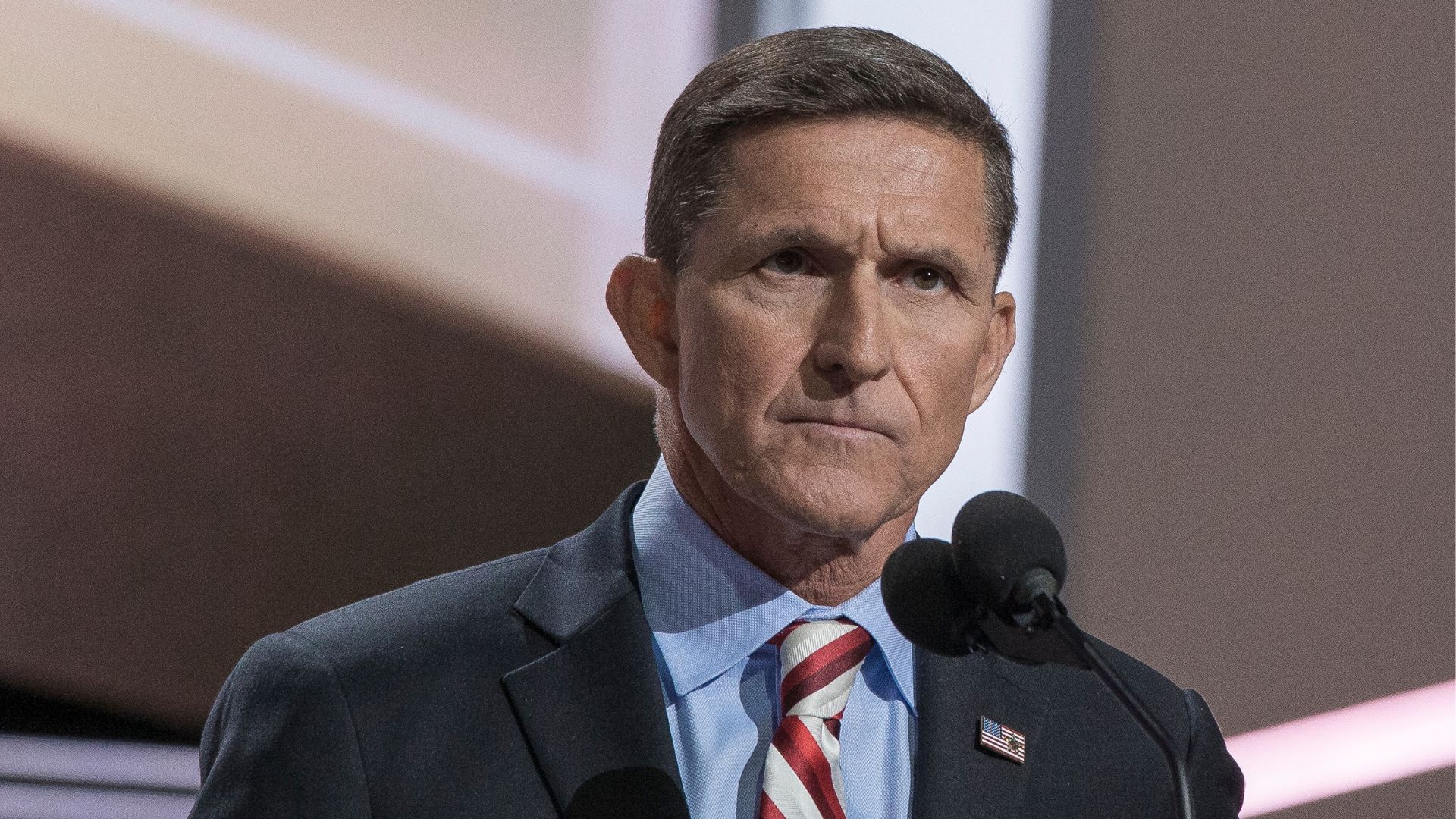
Newly Declassified FBI Notes Expose Stunning Discrepancies in General Flynn Case Records

Newly declassified FBI notes are raising serious questions about the prosecution of former national security advisor Mike Flynn.

Handwritten records from the agents who interviewed Flynn differ in key respects from the official report later used to pursue a federal criminal charge.

The notes were written by former FBI Special Agents Peter Strzok and Joe Pientka during their January 24, 2017, interview with Flynn.

The White House Government Transparency Task Force released the records Wednesday as federal prosecutors intensify their examination of the Russia collusion investigation.

At issue is the difference between the agents’ immediate notes and the typed FD 302 report entered into the FBI system more than 20 days after the interview.

That report became central to the claim that Flynn lied about conversations with Russian Ambassador Sergey Kislyak.

Prosecutors alleged that Flynn “falsely stated and represented” that he “did not ask the [Russian Ambassador Sergey Kislyak] to refrain from escalating the situation in response to sanctions the United States had imposed against Russia” following accusations of Russian election interference.

Yet Pientka’s handwritten notes contain a striking statement apparently attributed to Flynn about his discussion with Kislyak: “Hey, don’t do anything.”

That wording hardly supports the tidy narrative later presented by prosecutors that Flynn flatly denied discussing restraint with the Russian ambassador.

The official report also said Flynn remembered making four or five calls on the day in question while vacationing in the Dominican Republic.

Strzok’s handwritten notes instead quoted Flynn as saying, “If so, don’t remember. If so, busy place to make phone calls.”

Both agents’ notes indicate Flynn did not actually remember making four or five calls. One wrote, “I [do not] remember making 4-5 calls,” while another recorded that Flynn answered “if so, don’t remember,” when questioned about the number of calls.

The FD 302 presented Flynn’s response differently, stating that he remembered making four to five calls but struggled with connectivity.

That is not a minor stylistic cleanup, it is a meaningful alteration in how Flynn’s memory and certainty were portrayed.

The same problem appears in the treatment of sanctions and diplomatic expulsions.

The official report attributed this response to Flynn: “Not really. I don’t remember. It wasn’t, ‘Don’t do anything.’”

Pientka’s contemporaneous notes recorded a materially different answer: “Not really. I don’t remember. Hey don’t do anything.”

The notes also said there was no “long drawn out” discussion, but they did not show Flynn categorically denying that the issue arose.

Flynn initially pleaded guilty to making false statements, then sought to withdraw that plea after hiring attorney Sidney Powell.

She argued that the report supporting the prosecution had been altered by Strzok and FBI lawyer Lisa Page, even though Page was not present for the interview.

Text messages later revealed that Strzok and Page discussed significant revisions to the report.

The editing process becomes even harder to dismiss when compared directly with the newly released handwritten notes, which preserve uncertainty that the official version appears to smooth away.

The FBI’s own earlier findings add another troubling layer.

Agents in the Washington Field Office had prepared to close the Flynn investigation after finding “no derogatory” information suggesting he committed a crime or posed a national security threat.

Strzok intervened before the case could be closed, and the bureau shifted toward interviewing Flynn without the usual notification to the incoming White House.

Senior counterintelligence official William Priestap privately worried that the FBI was “playing games” and trying to “get him to lie, so we can prosecute him or get him fired?”

The agents who conducted the interview also did not believe Flynn was intentionally deceptive.

A later memorandum from Special Counsel Robert Mueller’s team stated, “Strzok provided his view that Flynn appeared truthful during the interview,” a conclusion that sits awkwardly beside the prosecution that followed.

Justice Department officials reportedly considered a prosecution under the Logan Act unrealistic, with one describing it as a “long shot.”

Despite court orders requiring disclosure of evidence favorable to Flynn, much of the material was allegedly withheld from his lawyers and the courts for years.

President Trump pardoned Flynn in November 2020, ending the criminal case.

Flynn later pursued a malicious prosecution lawsuit, and the Justice Department under Attorney General Pam Bondi settled the renewed case in March 2025 for approximately $1.2 million.

The newly exposed discrepancies do not resemble harmless clerical differences.

They raise the possibility that uncertainty in Flynn’s actual answers was transformed into certainty on paper, giving prosecutors a cleaner case than the agents’ own notes supported.

For years, Americans were told the Russia investigation represented sober law enforcement at work.

These records instead reveal another chapter of manipulated procedure, selective documentation, and bureaucratic gamesmanship aimed squarely at Trump and those around him.

News

‘Intentional Chaos’: Harmeet Dhillon Says Courts Aiming to Derail Midterm Election Rules [WATCH]

Harmeet Dhillon said ongoing court challenges to election-related regulations are creating uncertainty as states approach deadlines for sending ballots ahead of the midterm elections.

During an exchange with Newsmax host Carl Higbie, Dhillon argued that the regulations being defended by the Justice Department are lawful and necessary, while accusing judges blocking Trump administration priorities of engaging in what she described as “lawfare.”

“I think it’s clear and we’re taking this position that it’s very clear that these regulations are legal, constitutional, necessary, and this judge keeps trying to block it, and she’s not the only one,” Dhillon said.

She said the election disputes are part of a wider series of legal challenges facing the administration.

“So we’re facing this kind of lawfare from the courts around the country on many of our important Trump administration priorities, and something that we deal with every day at the DOJ,” Dhillon said.

Higbie focused on the approaching election calendar, noting that some mail ballots will soon have to be sent to voters.

“100%, but I mean we’re talking about some of these mail-in ballots go in the mail like next week,” Higbie said.

Dhillon agreed that the timing has made resolving the court disputes more urgent.

She said officials have attempted to move quickly to put the regulations in place but have faced delays as litigation continues.

“I couldn’t agree with you more,” Dhillon said.

“That’s why we’ve tried to move expeditiously to get these regulations in place, and if we didn’t have these types of delays, we could have a lot more certainty around our elections all over the country.”

Dhillon pointed specifically to Missouri, where she said the state Supreme Court issued an injunction the previous week as election officials approached the point when voting would begin and ballots would be mailed.

“We just had in Missouri a Missouri Supreme Court do an injunction last week, and again there they’re about to start voting and get the ballots in the mail,” Dhillon said.

The timing is particularly important for military ballots, according to Dhillon, because those ballots are sent before regular ballots.

She argued that last-minute court action creates uncertainty as election deadlines approach.

“Our military ballots go out before the regular ballots go out, and so I think this type of a chaos is really intentional to try to prevent things from happening by the midterms,” Dhillon said.

Dhillon’s characterization of the delays as intentional reflected her view of the litigation.

The exchange did not include a response from the judges or parties responsible for bringing the court challenges.

Dhillon said the Justice Department continues working through the litigation as the election approaches, describing the effort as an ongoing struggle involving multiple parts of the department.

“And so it’s it’s just a constant struggle,” Dhillon said.

She specifically praised attorneys in the Solicitor General’s office and Civil Division for their work defending the administration’s position in court, saying they have been filing briefs as the government attempts to resolve the disputes before election deadlines arrive.

“I’m really proud of our colleagues at the Solicitor General’s office, Civil Division, who are constantly filing briefs around the clock with all of the courts to make sure that we get this done in time,” Dhillon said.

WATCH:

News

DHS Chief Unveils Wartime Seal as Islamic Terrorists Join with Mexican Cartels [WATCH]

Homeland Security Secretary Markwayne Mullin announced that his department is changing its official seal to reflect what he described as a constant battle against forces targeting the United States.

The symbolic adjustment will turn the eagle toward the arrows held in one talon rather than the palm leaf held in the other.

Mullin revealed the change during an appearance on “The Sunday Briefing,” where he discussed the growing range of dangers confronting the homeland.

Those threats include Islamic terrorism, Mexican drug cartels, hostile cyber operations, weaponized drones, and violence directed at public officials.

The announcement comes as the nation approaches the twenty fifth anniversary of the September 11 terrorist attacks.

Mullin said DHS is “at war every single day,” a blunt assessment that cuts through the usual Washington habit of dressing serious threats in soothing bureaucratic language.

The existing DHS seal features an eagle with a shield positioned across its breast.

The shield contains symbols representing American air, land, and sea, while 22 stars represent the original government entities brought together to form the department.

Mullin explained that the eagle traditionally looks toward the palm during a period of peace and toward the arrows during war.

The new design is intended to send a clear message about the dangerous and rapidly shifting environment facing federal security officials.

“If you look at most of our seals throughout all the agencies, the eagle looks to the palm because that’s in a time of peace. We’re actually changing our seal to make it look towards the arrows, because when it looks towards the arrows is when it means we’re at war.”

Asked to identify the leading danger to the homeland, Mullin said terrorism remains at the top of the list, although its shape has changed.

Rather than operating only through familiar extremist networks, terrorists are increasingly finding common cause with criminal organizations that already control smuggling routes and other resources.

“It’s still terrorists, but the terrorists have joined with the cartels,” said Mullin.

He also noted that fentanyl overdoses have killed more Americans than the Vietnam War, an appalling toll that Washington ignored for far too long while border communities carried the burden.

Mullin praised President Donald Trump for placing cartels on the lists of Foreign Terrorist Organizations and Specially Designated Global Terrorists.

That designation recognizes the obvious reality that these groups are not merely street criminals seeking profit, but powerful organizations capable of destabilizing communities and assisting enemies of the United States.

“We’re seeing the Islamic terrorists joining with the Mexican cartels that are trying to use all the resources to come after us. And then, we’re seeing the drone attacks that are starting to take place,” Mullin said.

The drone threat has forced DHS and other agencies to reconsider how sensitive locations are protected.

Traditional fences, guards, cameras, and checkpoints remain necessary, but inexpensive technology now allows hostile actors to approach critical sites from above with equipment that can be purchased by ordinary consumers.

“We have tried to protect our sensitive areas with fences and armed security guards. Now we’re having to realize that the threat comes from the air, too, with simple drones that people can buy online on Amazon.”

Mullin also addressed the dangers facing political candidates and officials as the campaign season begins.

“I would say you’re never safe when you’re [in the] public eye,” he said, while urging Americans to accept political disagreement without allowing heated rhetoric to become an excuse for intimidation or bloodshed.

WATCH:

He stressed that a constitutional republic depends on citizens tolerating opinions they strongly oppose.

Once activists decide an opposing viewpoint must be silenced through violence, DHS has a duty to step in and prevent the threatened act rather than wait for another tragedy.

Cyberattacks represent another front in the department’s daily fight.

Mullin identified actors linked to Iran, North Korea, China, and Russia as major sources of attacks, which he said occur by the hundreds of thousands each week and require officials to adapt constantly across cyber, sea, air, and land.

“Every single day, I get a briefing. Every single day we have new threats, and every single day the threats are changing,” Mullin said.

The redesigned seal puts that reality in plain view, reminding Americans that DHS is confronting enemies who change tactics whenever authorities shut down an attack, criminal operation, or security vulnerability.

News

Trump Unleashes Lawsuit Against Soros-Funded Center Over National Guard Crime Smear [WATCH]

President Donald Trump announced that legal action is being prepared against the Center for American Progress after the left wing organization claimed National Guard deployments had no impact on crime. The president revealed the move in a post on Truth Social.

Trump cited a report by Chandler Hall, the Associate Director of Public Safety for the Center for American Progress.

He said a lawsuit was “being drawn now” and added that he was “strongly considering adding some of the contributors to this Fake Organization.”

The president had previously shared the same criticism on Truth Social on August 10. His latest announcement makes clear that the dispute is moving beyond another Washington war of words.

Trump mocked the organization as the “foolish Center for American Lack of Progress” and blasted Hall for claiming the Guard had “NO impact on Crime.”

He added, “How crazy is that. Hall was met with furious dissent.”

The president also took aim at the wealthy institutions and corporations that have contributed to CAP. He described the organization and its financial supporters as a “gaggle of Lunatics,” while naming George Soros, Bill and Melinda Gates, Google, Apple, Visa, Goldman Sachs, Citigroup, Wells Fargo, Bank of America, Walmart, Toyota, T Mobile, and NBC Universal.

Trump further pointed to foreign support connected to the organization. Contributors have reportedly included the Embassy of Japan, the Korea Foundation, and the Embassy of the United Arab Emirates, among others.

“The Dumocrats love it, and are against anything ‘TRUMP,’” Trump wrote.

“These people, and others like them, are so bad for our Country. Their stated course is anything to hate or demean ‘TRUMP.’”

Hall’s report argues that the Trump administration is taking credit for a national decline in violent crime that began before the president returned to office.

It claims falling homicide and violent crime figures were already visible in American cities during 2023 and 2024.

CAP further accuses the administration of using those declines to defend policies the group considers unpopular, ineffective, and expensive.

Naturally, the liberal think tank portrays National Guard support for local law enforcement as an extreme intervention rather than a serious response to disorder.

The report states, “However, new Center for American Progress analysis finds no evidence that National Guard deployments have reduced violent crime.”

It also estimates that deployments continuing through the end of 2026 could cost taxpayers more than $1.7 billion.

CAP examined 11 cities where the National Guard was deployed or where deployment had been threatened.

According to its analysis, those cities experienced a 14 percent decline in their rolling violent crime rate and a 22 percent decline in their rolling murder rate from June 2024 through June 2025.

The organization argues those declines occurred before the Guard was first sent to Los Angeles.

From that premise, CAP claims Trump is exploiting an existing trend to promote his public safety agenda and claim credit for results already underway.

The National Guard has been sent to cities including Los Angeles, Washington, D.C., and New Orleans in response to crime, unrest, and riots.

Those deployments have become another dividing line between an administration emphasizing law and order and left wing officials who routinely object to federal action.

The administration can also point to notable results in the nation’s capital. Breitbart News reported in August 2025 that violent crime in Washington fell 22 percent during the week after Trump announced his crackdown.

That same period reportedly saw no murders in the city for seven consecutive days.

CAP may dismiss the timing as irrelevant, but residents who want safer streets are unlikely to sneer at fewer violent crimes and an entire week without a homicide.

WATCH:

The threatened lawsuit now raises the stakes for CAP and possibly its contributors.

Trump is signaling that organizations making sweeping claims about his crime policies may soon have to defend their research somewhere less friendly than a television studio or a liberal policy conference.

News

James Talarico Mourns Collapse of Scheme Threatening Half a Million Texas Energy Jobs [WATCH]

Texas Democrat James Talarico appears determined to provide voters with a fresh reason to reject his United States Senate campaign every time he approaches a camera.

His latest trouble involves an energy proposal that critics say could threaten roughly half a million oil and gas jobs across the Lone Star State.

That is a staggering political liability in Texas, where the energy industry supports families, communities, local businesses, and state revenue.

Yet Talarico expressed regret that his proposal never received a hearing in the Texas Legislature, as though lawmakers had somehow missed a grand opportunity.

The Republican National Committee research operation highlighted Talarico’s exchange with CBS Texas political reporter Jack Fink.

Fink questioned him about House Bill 2206 and its promised transition toward a green economy, including the replacement of jobs lost during that process.

Fink asked, “I mean, in your bill, back in House Bill 2206, on the energy, you said there would be a transition to the green economy, and you would want to replace lost jobs. That doesn’t suggest that there wouldn’t be an impact on oil and gas.”

Talarico answered, “Well, this is why I was trying to work with Republicans, and Democrats alike, in the legislature, to make this bill a reality. But the bill wasn’t even given a hearing.”

He continued, “And as you know, when covering the legislature, bills, when they are first introduced, are a rough draft. And it’s meant to go through a process with stakeholders and with members of both political parties.”

Talarico added, “But folks in the state capital didn’t want to have this conversation. And so, the bill died before it even got to committee.”

He concluded, “And that’s a real shame, because I think there are ways to both grow our oil and gas industry and limit these emissions at the same time.”

WATCH:

That explanation is unlikely to reassure Texans whose livelihoods depend upon drilling, refining, transportation, equipment, and the countless businesses surrounding energy production.

Calling legislation a rough draft does not erase the unmistakable premise that jobs could disappear during the green transition Talarico envisioned.

Texas lawmakers apparently saw little reason to advance a measure carrying such enormous economic risks.

Rather than treating its failure as a tragedy, working Texans may view the outcome as the Legislature doing exactly what it was elected to do, protecting prosperity from another costly liberal experiment.

The controversy becomes even more damaging when paired with Talarico’s record on taxes.

He has also faced criticism for voting against a proposal to ban a state income tax, an idea that should be politically radioactive for anyone seeking statewide office in Texas.

Taken together, the energy bill and tax vote offer voters a revealing picture.

Talarico seems prepared to place jobs at risk while leaving the door open to a new tax burden, all in service of the same expansive government agenda Democrats routinely attempt to market as progress.

His campaign has already suffered from awkward efforts to connect with ordinary Texans, including a vegan controversy followed by an uncomfortable barbecue appearance.

Add his hostility toward Second Amendment priorities, and the pattern looks less like a Texas campaign than a seminar in misreading the electorate.

Public polling may suggest a competitive contest, but Talarico keeps handing Republicans material that could move voters toward Ken Paxton.

Every explanation creates another question about whether the Democrat understands the culture, economy, and priorities of the state he wants to represent.

Republicans do face serious Senate battles during the 2026 elections, and complacency would be foolish with control of Congress at stake.

This race, however, should not become one of the party’s major worries if voters receive a clear account of Talarico’s record.

Texas energy workers do not need lectures about managed decline from politicians chasing fashionable climate policies.

They need leaders who recognize that oil and gas jobs are not disposable statistics, and Talarico’s lament over his failed bill gives Republicans an unmistakable opening.

News

‘F**k Him Up’: BLM Founder and Cal State LA Professor Exposed Urging Mob Violence Against ICE Agent [WATCH]

A California State University professor and Black Lives Matter founder is facing outrage after video appeared to show her identifying an ICE officer and urging activists to confront him.

The remarks, delivered before a political gathering in Oxnard, quickly ignited concern that an individual federal agent had been placed in danger.

The Sunday event was hosted by La Defensa del Pueblo, a far left coalition that brought together immigration activists, religious figures, labor groups, and allied organizers.

Its summit portrayed federal immigration enforcement and the Trump administration’s public safety agenda as “terror against the people.”

Speakers directed much of their anger at President Donald Trump’s September 2025 executive order, “Countering Domestic Terrorism and Organized Political Violence.”

The order was designed to give federal officials more tools to investigate and disrupt organized political violence, an obvious sore spot for activists accustomed to friendly treatment from Democrats and the press.

The coalition also condemned Trump’s immigration policies and accused his administration of waging a “war on Black America.”

That overheated rhetoric was merely the warmup, however, as the event moved from familiar left wing grievance politics toward language critics viewed as a direct threat.

Stu Smith of the Manhattan Institute shared footage Monday that appeared to show Cal State Los Angeles professor Melina Abdullah naming the officer and telling attendees where she believed he was staying.

We are withholding those identifying and location details because repeating them would further expose the agent targeted in the remarks.

In the clip, Abdullah described the unnamed officer as “The killer ICE agent” and displayed what she said was his photograph.

She then told the crowd, “You see the devil right there, f**k him up!” before repeating the same profane command as she discussed his supposed location.

Her language did not stop at one angry outburst.

Abdullah later said, “When I say f**k him up, I mean in many ways! They don’t get to do their dirt in the dark!”

She added, “There should be nowhere where they go where they are comfortable!”

The message was hard to mistake, even with the attempt to broaden what “many ways” might mean after repeatedly telling a politically charged audience to target a named officer.

Abdullah also directed attendees toward revolutionary reading. “If you already read “Blood in My Eye”…If not, pick up that book and study guerrilla warfare.”

WATCH:

That combination of personal identification, claimed lodging information, a displayed image, repeated profanity, and a recommendation to study guerrilla warfare raises serious questions.

Political speech is protected, but publicly steering an agitated crowd toward a specific law enforcement officer is not normal protest rhetoric, no matter how campus activists try to sanitize it.

The Heritage Foundation’s Mike Gonzalez noted that Abdullah is not merely another rally speaker.

She is a university professor, was among the original founders of Black Lives Matter, and previously served as a leader of BLM Grassroots, giving her words far more reach than those of a random protester.

Abdullah has also reportedly been friendly with Los Angeles Mayor Karen Bass.


That connection adds another political layer to a controversy involving a prominent activist, a public university employee, and an immigration officer carrying out federal duties amid a furious national debate.

The episode offers another ugly snapshot of the double standard surrounding political extremism.

If a conservative professor identified a federal employee, announced where that person could be found, flashed a photograph, and repeatedly urged a crowd to attack, cable news panels and university administrators would demand consequences before the video finished playing.

Cal State Los Angeles now faces an obvious question about whether this conduct meets its standards for faculty members.

Taxpayers should not be expected to shrug while a professor uses her platform to inflame a crowd against an officer whose job has already become more dangerous because of reckless political demonization.

Federal authorities may also have to determine whether the comments crossed any legal line, a judgment that depends on context, intent, and the likelihood of imminent action.

At minimum, the footage deserves a serious review rather than the usual institutional silence reserved for radicals with fashionable causes.

ICE officers enforce laws passed by Congress, regardless of how loudly activist groups object.

Naming an agent, pointing supporters toward his supposed lodging, and chanting violent instructions is not courageous resistance, it is a dangerous escalation that responsible leaders should condemn without hesitation.

News

Democrats’ Hidden Midterm Agenda is So Toxic They Dare Not Show Voters: Jesse Watters [WATCH]

With roughly two months remaining before the midterm elections, Democrats are still struggling to secure the commanding advantage that political conventional wisdom says should be theirs.

History, President Donald Trump’s approval numbers, and voter frustration over gas prices were supposed to produce a comfortable path back to a congressional majority.

Instead, the latest Harvard Harris survey cited in the report placed Republicans two points ahead among likely voters on the generic congressional ballot.

That is hardly the picture of an unstoppable Democrat wave, no matter how eagerly the usual media chorus tries to hum that tune.

The explanation is hiding in plain sight.

Democrats are asking voters to hand them power while refusing to provide a specific, public agenda, relying instead on another round of outrage about Trump and hazy promises about affordability after their last turn in power helped make daily life more expensive.

This is not an accidental communications failure.

It resembles the strategy Democrats used in 2020, when candidates projected moderation during the campaign, then empowered a far more radical governing program once the ballots were counted and the press returned to its regularly scheduled applause.

Jesse Watters drove directly at that weakness during a sharp exchange with Harold Ford Jr. on The Five.

“Your party is nuts, all right,” Watters told Ford, before explaining why Democrats would rather keep their platform locked in a political basement.

“They don’t even put anything out because it’s so unpopular. What are they going to say? ‘We’re going to abolish ICE’? No one wants to do that, Harold.”

The point was blunt, but bluntness is useful when a party wants a blank check without showing the invoice.

Ford attempted to separate the Democratic Socialists of America from the Democratic National Committee on abolishing Immigration and Customs Enforcement.

Watters answered, “No. The DNC voted to get rid of ICE last week. I think you were on vacation,” exposing just how awkward the party’s immigration position has become.

Watters then raised the comparison Democrats would prefer voters forget, Newt Gingrich’s 1994 Contract with America.

Republicans offered a written and specific governing program, campaigned on it openly, and then captured a historic House majority because citizens knew what they were being asked to support.

“Remember Newt’s Contract [with] America?” Watters asked.

“Put it out. I mean, I dare you guys to put it out.”

That dare cuts because Democrats know a clear list of their priorities would likely repel many of the persuadable voters they need.

The most ambitious items on the left’s wish list are not exactly crowd pleasers outside activist circles.

Government domination of the massive health insurance industry and a revival of Green New Deal politics remain expensive ideological projects, not kitchen table solutions for families trying to cover groceries and fuel.

“You guys want to nationalize the $2 trillion health insurance industry. You can’t do it because it’s stupid, Harold. You guys want to do the Green New Deal again? It didn’t work, you can’t do it,” Watters said.

WATCH:

Democrats could not enact those plans even while controlling Congress and the White House.

That leaves House Minority Leader Hakeem Jeffries trapped between competing factions.

The activist left wants impeachment votes, shutdown fights, and endless investigations tied to Trump, while Democrats dreaming about the presidency understand that a broader general election electorate has little appetite for another helping of institutional chaos.

Jeffries appears unable to force either camp into line, so the party’s practical message has been reduced to “orange man bad.”

Resistance may excite the faithful, but it is not a governing platform, and it does not tell working Americans how Democrat control would improve their lives.

If Democrats believed their ideas were popular, they would publish them, defend them, and invite voters to judge the results, just as Republicans did in 1994.

Their refusal to do so is itself revealing, because politicians rarely hide proposals they expect the public to celebrate.

The stakes in 2026 extend beyond another routine congressional contest.

Control of the House and Senate will determine whether Trump’s America First program moves forward or is buried beneath investigations, obstruction, and the familiar Washington spectacle of Democrats treating resistance as a substitute for governing.

Republicans cannot afford complacency, but Democrats cannot escape the basic question either.

What, precisely, would they do with power, and why are they so unwilling to say it before Election Day?

News

Trump Team Walks Into Moscow and Kyiv, Globalists Panic: Empire’s Ukraine Gravy Train in Trouble [WATCH]

Susan Kokinda of Promethean Action argued that President Donald Trump’s foreign policy is moving against the financial and geopolitical structures she says have sustained conflicts in Ukraine and the Middle East, pointing to renewed diplomacy with Russia and changing U.S. signals concerning the Falkland Islands dispute.

Kokinda began with the Kremlin’s decision to release footage from a meeting between Russian President Vladimir Putin and American representatives.

“You don’t see this very often: the Kremlin posting full video footage of a high-level meeting between Russian President Putin and American representatives,” Kokinda said.

During the meeting, Putin asked the delegation to deliver a message to Trump.

“But before we begin, I’d like you to please convey my best wishes and the words of sincere gratitude to the President of the United States,” Putin said.

“I know that he might be entering a difficult streak, but anyway, he will not stop trying to resolve the Russian-Ukrainian conflict.”

The meeting took place Saturday during a visit to Moscow by presidential envoys Steve Witkoff and Jared Kushner.

The pair traveled to Kyiv the following day and met Ukrainian President Volodymyr Zelenskyy in their first visit to the Ukrainian capital as U.S. negotiators during Trump’s second term.

Reuters reported that Witkoff and Kushner spent three hours meeting Putin before traveling to Kyiv as part of an effort to revive stalled peace negotiations.

“All of a sudden, U.S. diplomacy on Ukraine is live again,” Kokinda said.

“What changed?”

Kokinda highlighted Putin’s description of his relationship with the American negotiators.

“So, and definitely, when it comes to such brokerage, well, what matters is trust and comfort with those who serve as brokers,” Putin said.

“And actually, well, you have been enjoying our full trust and it’s been quite convenient for us to work with you.”

“A very high level of trust,” Kokinda said.

“Putin does trust the American delegation to be an honest broker, unlike the Europeans who’ve made pretty clear they won’t stop until Russia is humiliated or crushed.”

Kokinda placed the meetings alongside CIA Director John Ratcliffe’s earlier trip to Moscow and Treasury Secretary Scott Bessent’s invitation to Russian Finance Minister Anton Siluanov to attend the G20 summit.

She also noted that Kirill Dmitriev, head of Russia’s sovereign wealth fund, participated in the Moscow meeting.

According to Kokinda, Dmitriev’s presence was significant because the discussions extended beyond the war to possible economic cooperation between Russia and the United States.

She cited an analysis arguing that ending the conflict and sanctions on Russia could bring Russian oil, gas and natural resources more fully into the global economy, altering the economic leverage held by Iran, European governments, Britain and Canada.

Kokinda then focused on Bessent’s actions against financial networks associated with Iran and what she described as financial mechanisms supporting Ukraine.

“Treasury Secretary Scott Bessent has been clear about his intentions, cutting off from the dollar system those that continue to support not just Iran, but also Ukraine by proxy, because one was the source of the flow for the other,” Kokinda said while recounting the analysis.

“First, you cut off the oil flow, which cuts collateral chains, and then any continued flow is choked off at the banks.”

She pointed to Turkey, the United Arab Emirates, Hong Kong, the British Virgin Islands, Saint Barth and the Cayman Islands while arguing that the administration’s financial actions reach beyond Iran and Russia.

“That’s not just a war financing map,” Kokinda said.

“That’s the offshore architecture of the empire itself.”

Kokinda contrasted that interpretation with criticism of Trump’s handling of Iran and the Russia-Ukraine conflict.

“Or you can see what we see: an administration that has been moving against the imperial system step by step, ensuring American energy independence, eliminating Hormuz as a choke point, and drying up speculative and illicit money flows,” Kokinda said.

“And suddenly, out of nowhere, the peace talks are back.”

She then connected her argument to developments surrounding Argentina’s claim to the Falkland Islands, known in Argentina as the Malvinas.

Argentine President Javier Milei announced measures targeting companies involved in offshore oil development and proposed legislation concerning the islands while pledging additional support for a naval base in Tierra del Fuego.

Reuters reported that Milei’s actions followed signals from Trump that Washington could reconsider its position on the dispute.

Kokinda played a clip in which Trump was asked whether the United States was reviewing its position.

“Are you reviewing the US position on the Falkland Islands? I always review every position. That’s just one of many,” Trump said.

Kokinda said Trump was subsequently asked whether the United States continued to support British sovereignty over the islands.

“That’s a big trip. It’s a long way, so your country’s not doing well,” Trump said.

“Don’t forget, you get a big percentage of your of your oil from the Strait of Hormuz, and you weren’t there to help me. Your country was not there to help me.”

“For decades, the automatic American tilt has been toward London, and the president just reduced it to one of many possibilities,” Kokinda said.

Kokinda placed the current dispute in the context of the 1982 Falklands War, when competing factions within the Reagan administration disagreed about whether the United States should support Britain or approach the dispute through the Monroe Doctrine.

She cited Secretary of State Alexander Haig and Defense Secretary Caspar Weinberger on the British side of that debate, while pointing to U.N. Ambassador Jeane Kirkpatrick, National Security Advisor William Clark and Republican Sen. Jesse Helms as figures who took a different approach.

The United States ultimately supported Britain during the 1982 conflict.

Kokinda argued that Trump’s recent remarks represent a reopening of a question that had long appeared settled in Washington.

“But now, for the first time in decades, an American president is reopening the question Reagan closed in Britain’s favor,” Kokinda said.

“And this time, London may not like the answer.”

WATCH:

News

James Talarico Rejected Jesus as the Only Way, Claimed Allah Leads to Same Truth in Resurfaced Video [WATCH]

Texas Democrat Senate candidate James Talarico is drawing renewed scrutiny after a resurfaced video showed him rejecting the Christian teaching that Jesus Christ is the only path to salvation.

Instead, Talarico presented Christianity, Islam, and other religions as equally valid routes toward one shared divine truth.

The remarks offer voters another revealing look at the theology promoted by the Democrat, who regularly discusses faith while advancing views that sharply conflict with traditional Christian doctrine.

His message sounds less like biblical Christianity and more like religious relativism wrapped in campaign language.

In the video, Talarico described the major religions of the world as comparable paths toward the same mysterious destination.

That position directly clashes with the Christian belief that salvation comes through Jesus Christ, not through a collection of interchangeable spiritual traditions.

“I find that they’re all kind of equal pathways to truth. You know, that’s how I think, you know, I always think of all of the world’s faith traditions as like a circle with,” Talarico said.

“That divine mystery of the universe in the middle. And we all have different names for that mystery.”

Talarico then listed several religious concepts as different labels for what he considers the same underlying reality.

In his telling, the distinctions between Christianity, Islam, Buddhism, indigenous spirituality, and other belief systems appear secondary to a supposedly universal spiritual truth.

“Whether it’s God or Yahweh or Allah or Nirvana, the Great Spirit, whatever you call it, this is all, you know, different pathways to the same kind of fundamental truth of reality,” Talarico continued.

WATCH:

Those comments are notable because Talarico has cultivated a public image that leans heavily on religious language.

Yet when pressed through his own statements, his theology repeatedly places historic Christian claims alongside competing religions as though they are merely different names on the same spiritual menu.

For Christians, the issue is not simply that Talarico acknowledged the existence of other faith traditions.

His remarks went considerably further by calling those traditions equal pathways to truth, effectively denying the unique role of Christ proclaimed in Christian scripture.

This was not an isolated venture into theological improvisation. Talarico has previously used government proceedings to promote a similarly broad religious framework, suggesting that his latest resurfaced remarks fit an established pattern rather than an accidental turn of phrase.

During a Texas House invocation in 2021, Talarico referenced the Torah, Quran, Gita, Dharma, and the First Epistle of John.

He closed that invocation by declaring, “In all your many names, we pray.”

That prayer treated distinct religions and their vastly different teachings as expressions of one shared divine identity.

It was a politically fashionable approach, especially among progressives who prefer a faith stripped of exclusive truth claims, moral boundaries, and inconvenient biblical teachings.

Talarico has also generated controversy with previous remarks about Christianity itself.

He reportedly called Christianity the “most violent” religion and claimed it had inflicted “more damage” on Islam than any other faith, comments that hardly sound like a respectful defense of the tradition he often invokes.

The Democrat has likewise argued that God is “beyond gender” and claimed that the Bible is “silent on abortion.”

Those assertions place him comfortably within the modern progressive habit of reshaping theology until it conveniently approves the political priorities of the left.

Talarico is free to embrace religious pluralism, but Texas voters are equally free to examine what he actually believes when he speaks about Christianity.

A candidate cannot repeatedly invoke Christian language for public credibility, then brush aside one of the faith’s central claims without expecting serious questions.

His resurfaced comments make the contrast plain.

Traditional Christianity proclaims Christ as the way to salvation, while Talarico says Allah, Nirvana, the Great Spirit, and other concepts can lead people toward the same truth.

That distinction matters in a Senate race where character, convictions, and honesty with voters are fair game.

Texans now have another opportunity to decide whether Talarico is representing Christian belief or simply borrowing its vocabulary while promoting a thoroughly progressive substitute.


Scroll to Top