Author name: Common Defense

News

Trump Signs 14-Point Peace Accord Setting 60-Day Ceasefire and $300 Billion Iran Reconstruction Plan

In a move reshaping the Middle East chessboard, President Donald Trump has signed a 14-point memorandum of understanding with Iran establishing a 60-day ceasefire, reopening the Strait of Hormuz, and outlining up to $300 billion in potential reconstruction incentives for the Islamic Republic.

The accord, inked electronically by President Trump and Vice President JD Vance, marks the most daring high-stakes diplomatic engagement between Washington and Tehran in decades.

The signing, conducted ahead of a formal ceremony expected in Switzerland, also reflects the new administration’s willingness to negotiate from a position of strength while keeping the threat of overwhelming military response on the table.

“If they don’t behave, we’ll go right back to dropping bombs right smack in the middle of their head,” President Trump told reporters at the Group of Seven summit in France, a clear warning to Tehran that peace comes only with good behavior.

The agreement—referred to as the “Islamabad Memorandum of Understanding”—commits both nations to immediately halt military operations and hold to strict non-aggression terms.

It also calls for a full reopening of maritime traffic through the Strait of Hormuz, the critical global oil chokepoint that Iran has periodically threatened to close.

Under the terms of the document, the U.S. will begin removing its naval blockade and other “impediments” against Iran within 30 days.

Hormuz Strait Exposes the Limits of Air Denial in Open Shipping

In return, Iran will ensure safe passage for commercial vessels, promising 60 days of toll-free maritime traffic while working with Oman and other Gulf states to establish a longer-term governance framework for the strait.

The MOU also lays the groundwork for a massive economic reconstruction initiative funded by $300 billion in combined regional and international investment.

The proposal is clearly designed to incentivize Tehran to comply with negotiations, rebuild its shattered economy, and reduce its reliance on hostile state sponsorship and terror financing networks.

As part of the agreement, the U.S. has committed to lifting all sanctions—both unilateral and multilateral—if a final deal is reached within 60 days.

Reports of Vessels Hit as Iran Declares Hormuz Closed Again, Escalating Gulf Tensions

The memorandum also specifies that all frozen or restricted Iranian funds and assets will be released for use by Tehran, pending oversight procedures established during negotiations.

Iran, for its part, reaffirmed that it “shall not procure or develop nuclear weapons” and agreed to work with international inspectors on neutralizing its enriched uranium stockpiles through supervised down-blending on Iranian soil.

The two nations also agreed to immediately begin discussions on peaceful nuclear energy needs within an established oversight mechanism.

Still, the most difficult issues remain unresolved. The question of Iran’s ballistic missile program, its regional proxy militias, and the long-term verification of its nuclear activities will be tabled for the final round of talks.

Trump Ends Hormuz Blockade After Securing Peace Deal With Iran
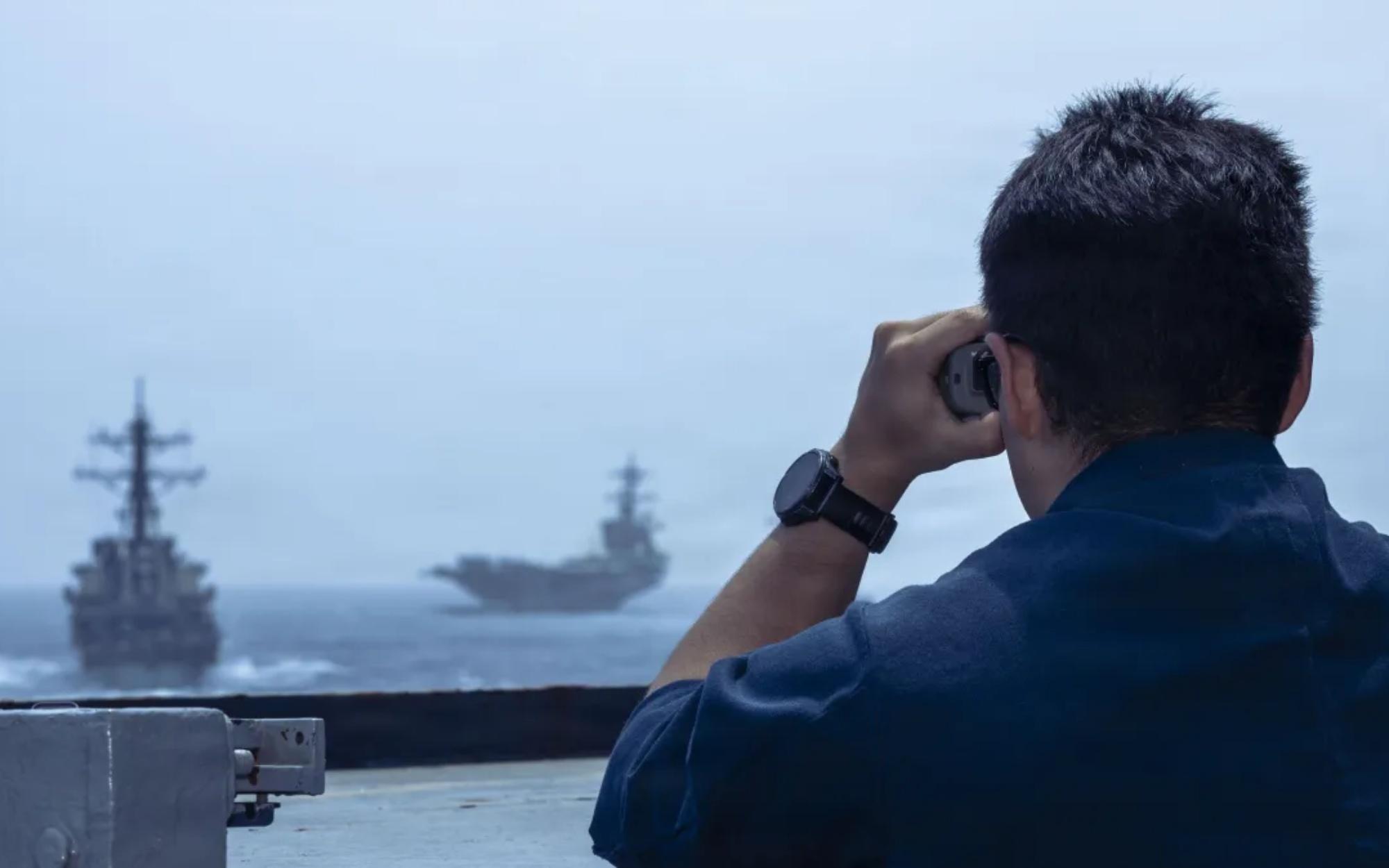
A sailor stands watch on the USS Truxtun, a destroyer participating in the blockade of the Strait of Hormuz. Navy photo.

Those talks are to conclude within the 60-day window—though extensions are possible if both sides agree.

American officials close to the discussions told reporters that Vice President JD Vance, a strong advocate of peace through strength, will lead the American delegation in the coming negotiations.

He will be joined by special envoy Steve Witkoff and Jared Kushner, bringing a balance of diplomatic, business, and political expertise to the table.

The accord also contains a strict compliance enforcement framework. Both nations agreed to establish a joint “executive mechanism” responsible for verifying the implementation of the deal and ensuring adherence to every major provision.

The United Nations Security Council will ultimately endorse the final agreement through a binding resolution.

Behind the scenes, Pentagon insiders view the MOU as part of a broader strategic maneuver.

With the Taliban eliminated, the Houthis neutralized, and Israel stabilizing northern fronts, the administration is seeking to lock in a sustainable peace, freeze Iranian escalation, restore Gulf navigation, and leverage economic incentives to drain Iran’s rogue funding networks.

Blockade at Hormuz Grips Global Trade as United States Tightens Grip on Iranian Ports
The aircraft carrier USS Dwight D. Eisenhower (CVN 69) (IKE), Ticonderoga-class guided-missile cruiser USS Philippine Sea (CG 58), guided-missile destroyer USS Gravely (DDG 107), guided-missile destroyer USS Stethem (DDG 63), and French Navy destroyer FS Languedoc (D 653) transit the Strait of Hormuz along with air support from a French Navy E-2C Hawkeye and Air Force Rafale strike aircraft, Nov. 26. IKECSG is deployed to the U.S. 5th Fleet area of operations to help ensure maritime security and stability In the Middle East region. (U.S. Navy photo by Information Technician Second Class Ruskin Naval)

Critics on the left immediately accused President Trump of “appeasing Tehran,” but the hard language built into the MOU tells a different story.

The deal gives Washington total leverage—should Iran violate its commitments, American forces will be fully authorized to resume military operations without delay.

Supporters argue that this exact blend of reward and deterrence typifies Trump’s foreign policy. Similar to his approach with North Korea, the message is clear: engage if you behave, face destruction if you cheat.

For decades, U.S. leaders have offered Iran concessions for nothing in return; this time, Trump has bet that a combination of pressure and opportunity will force change from within.

War Secretary Pete Hegseth has praised the accord’s balance of power and restraint, telling reporters, “Peace is good—but peace only lasts when it’s enforced by overwhelming strength. This memorandum sets that standard.”

For Iran, the opening is both an opportunity and a test. For the United States, it’s a strategic challenge to consolidate victory after years of regional conflict.

Either way, American warfighters and taxpayers can expect a future where stability is enforced not by weakness, but by an unflinching readiness to act.

If Tehran honors its word, the Middle East could see its first genuine ceasefire in decades.

If it doesn’t, President Trump has already made clear where America stands—ready, armed, and unwilling to be played twice.

News

Hegseth Orders Sweeping Review of Troops in Europe, Warns NATO Freeloaders the Ride is Over

War Secretary Pete Hegseth dropped a thunderbolt on NATO’s doorstep this week, announcing a comprehensive review of U.S. troop deployments in Europe and taking sharp aim at so-called “allies” who still refuse to pay their fair share for their own defense.

His message in Brussels was clear — America will no longer bankroll Europe’s security while others sit comfortably on the sidelines.

Speaking before a gathering of European defense ministers, Hegseth outlined a six-month review process that will evaluate not just troop counts, but also the deeper strategic posture of U.S. forces across the continent.

The review will consult with Congress, which has mandates for minimum troop levels in Europe, but Hegseth made it plain this is about accountability, not bureaucracy.

“Make no mistake about it, this will be a real review,” Hegseth told NATO ministers.

“It will ensure that NATO is moving fast and irreversibly toward Europe leading, stepping up to take primary responsibility for the defense of Europe.” To many, that sounded like the end of the decades-old European dependence on U.S. muscle.

The bold move comes as NATO grapples with shrinking U.S. contributions to its so-called crisis forces.

Washington recently notified allies that it would scale back certain assets previously available for NATO emergency deployments, including fighter jets, drones, and refueling aircraft.

Europe Reduces U.S. Arms Dependence as SIPRI Data Spotlight Regional Diversification
Secretary of War Pete Hegseth stands with his spouse Jennifer prior to conducting a press conference after taking part in a NATO Defense Ministerial Session at NATO Headquarters in Brussels, Belgium, Feb. 13, 2025. (DoD photo by U.S. Navy Petty Officer 1st Class Alexander C. Kubitza)

The reason, according to U.S. commanders, is simple: America must prepare for multiple potential war fronts at once, not just defend countries that won’t defend themselves.

NATO’s top U.S. commander, Air Force Gen. Alexus Grynkewich, called the move part of reducing Europe’s “unhealthy co-dependence” on U.S. capabilities. Translation: time to grow up and shoulder the load.

Hegseth, who embodies the unapologetic America First spirit of President Trump, did not mince words about freeloading allies. “Some still need to do more, and we will be candid about that — both in private and in public,” he said.

“Friends need to be honest with friends.”

The War Secretary blasted certain members for stonewalling U.S. operations during the war with Iran, noting that several nations refused basing and overflight rights when American forces needed them most.

“This review,” Hegseth declared, “will ensure those rights are guaranteed moving forward.” He added that NATO’s next evolution — “NATO 3.0” — must be a “real hardline military alliance” capable of defending Europe without hiding behind U.S. forces as the first and only responders.

NATO’s civilian leadership, including recently promoted Secretary General Mark Rutte, confirmed that U.S. force reductions had already taken effect.

Trump Reviews Troop Levels in Europe as Germany Footprint Remains a Cornerstone
U.S. Soldiers assigned to 1st Squadron, 2nd Cavalry Regiment (1/2CR) exchange patches with German soldiers during a Schuetzenschnur (German weapons proficiency test) event with the German partner unit of 1/2CR, the Panzergrenadierbataillon 112, at Regen, Germany, Sept. 29, 2022. 1/2CR provided an opportunity for exemplary Soldiers to earn a foreign award and to build camaraderie with German Army counterparts in order to strengthen NATO and multinational partnerships. (U.S. Army photo by Markus Rauchenberger)

“The question yesterday came up: Is this immediate or not? It is immediate,” Rutte admitted.

Still, he tried to soothe tensions, claiming that in the event of war, every ally — including America — would “max out” support.

European ministers scrambled to save face, rushing out promises to plug the gaps created by reduced U.S. assets.

Belgium’s Defense Minister Theo Francken pledged additional F-16s and MQ-9B drones to NATO’s crisis forces, saying, “There will be heavy discussions on who is doing what, but Belgium is contributing.”

The question is whether that commitment will hold, or if it’s just European politeness masking panic.

Germany’s Defense Minister Boris Pistorius voiced the typical European hesitancy, warning that a quick U.S. drawdown could create “dangerous capability gaps.”

He pleaded for “stop-gap solutions” or “more time” before any withdrawal, acknowledging that many European militaries simply don’t possess the hardware to fill the void left by the U.S. deep strike, refueling, and surveillance assets.

Meanwhile, insider sources revealed the hard numbers: U.S. contributions to NATO’s airborne power are taking a noticeable hit.

The number of F-15 and F-15E fighters available to NATO will reportedly shrink by a third, while U.S. MQ-4 and MQ-9 drones available to the alliance will be cut in half. For those still clinging to the illusion that America’s commitment is infinite, the signal couldn’t be clearer.

Trump Warns NATO Expansion Risks Fracturing the West
First Council meeting in new Room 1 conference chamber with Allied Ambassadors

The review also comes as NATO prepares for a major summit in Ankara this July, where Hegseth is expected to lead U.S. demands for hard commitments — not lofty declarations — from European partners.

The War Secretary’s core premise is brutally simple: Europe must defend Europe. Washington will remain a leader, but not a crutch.

Critics in Europe see the move as heavy-handed, but for millions of patriotic Americans, it’s long overdue.

After decades of watching America pick up the tab while European capitals moralized about spending caps, Hegseth’s approach marks a shift back to realism and strength.

The message is very much in the Trump mold: if you want protection, invest in defense; if not, don’t expect endless U.S. subsidies.

While some European elites grumble that Hegseth’s rhetoric is “too blunt,” the War Secretary’s stance resonates deeply with the grassroots base at home — veterans, families, and taxpayers who’ve shouldered the cost of Europe’s comfort for generations.

They see in Hegseth a leader unafraid to call freeloading what it is, and unapologetic about putting America’s security first.

News

Pentagon Orders Unified Overhaul to Supercharge Warfighter Fitness and Brainpower

The Pentagon is kicking into high gear with a sweeping overhaul that will unify and strengthen how the armed services train, sustain, and measure warfighter fitness across the force.

The move comes from War Secretary Pete Hegseth, who has made clear that the new focus is not just on muscle and endurance, but also on technology, cognitive power, and total battlefield readiness.

Two internal memos, quietly circulated in May and obtained by Military Times, detail the “Warfighter Performance Optimization” (WPO) initiative.

It’s a department-wide push to harness data-driven strategies that will measure, track, and boost every aspect of a service member’s performance — from physical resilience to mental sharpness.

Hegseth’s May 6 directive assigns Under Secretary for Personnel and Readiness Anthony Tata to deliver a full report within 60 days.

That report will assess all existing human performance efforts across the services, identify the gaps, and produce an action plan designed to rally every component of the armed forces under one coordinated system of performance standards.

At the heart of Hegseth’s vision is a unified Department of War strategy that treats fitness as a national readiness imperative.

“We will equip our service members and leaders with the tools, data, and resources necessary to meet and exceed readiness standards and to maximize their lethality and effectiveness,” Hegseth’s memo states.

Thousands of Sailors Help Meet Fitness Standards with Trendy Weight-Loss App in New Deal

Unlike the bureaucratic initiatives of the past, this one comes with teeth. Hegseth is emphasizing speed, integration, and measurable results.

The Pentagon wants every branch — Army, Navy, Air Force, Marine Corps, and Space Force — to feed real-time performance and health metrics into a single data ecosystem. From cognitive training to wearable tech, the goal is to have a full picture of the warrior’s readiness at all times.

The new initiative also places “cognitive performance” on the same level as physical standards. As the memo outlines, the Department will “measure and manage cognition with the same attention and discipline we apply to our physical standards.”

The History, Evolution and Healing of Military Tattoos from Sailor Jerry to Punisher Skulls
Capt. David B. Winne, an Army Explosive Ordnance Disposal officer and instructor at the Naval School Explosive Ordnance Disposal on Eglin Air Force Base, Florida, routinely demonstrates his commitment to physical fitness by participating in bodybuilding and Crossfit competitions. After spending half of the last year competing in local Crossfit competitions before qualifying for the Crossfit quarterfinals, Winne spent the rest of the year focused on bodybuilding and qualified for national competitions while almost earning a bodybuilding Pro card. Courtesy photo / DoW.

That means brain health, mental clarity, and split-second decision-making are now metrics of combat effectiveness, not afterthoughts.

Commanders across the U.S. combatant commands have been ordered to compile comprehensive data by this month. They’ll catalog everything from wearable device usage to nutrition programs, sleep studies, and partnerships with research institutes.

The idea is to consolidate the best practices and scrap anything wasting taxpayer dollars or failing to produce results.

This fall, the Department of War will release a full WPO strategic roadmap setting baseline performance standards and metrics. By early next year, pilot programs will begin testing these unified standards in live environments.

The multi-service rollout will include new digital tools, professional military education programs, and real-world fitness pilot trials designed to measure endurance, cognitive speed, and recovery times across operational units.

Air Force Launches “Culture of Fitness” Initiative to Promote Wellness and Readiness
The Department of the Air Force has launched a new initiative aimed at motivating airmen and guardians to maintain high standards of physical fitness. Here, guardians perform air squats at Peterson Space Force Base, Colorado, in September 2025. (Keefer Patterson/U.S. Space Force)

Hegseth’s plan also includes a massive data hub — a WPO “dashboard” that compiles the vast flow of military performance data into one centralized system.

For years, each branch has run its own fitness and human performance programs, often with overlapping objectives but inconsistent results. The dashboard will finally bring those efforts into alignment.

The Army, for instance, has its Holistic Health and Fitness program, which ties together mental, physical, and spiritual performance.

The Navy’s Human Performance Optimization initiative takes a similar approach, focusing on overall well-being and productivity. The Air Force is investing in new facilities — like its state-of-the-art HPO center at Davis-Monthan Air Force Base — while the Marine Corps continues to expand its base-level resiliency and recovery centers.

Army Shifts Fitness Strategy – Athletic Trainers Cut, Medics and Strength Coaches Step Up
Army Staff Sgt. Mark Masten, geospatial engineer sergeant for the 36th Combat Aviation Brigade, “Task Force Mustang,” leads an Army Combat Fitness Test diagnostic at Camp Buehring, Kuwait, Oct. 24, 2022.

Special operations units have long been the testing grounds for cutting-edge performance tools, from neural stimulation devices to data-tracking wearables. However, until now, these programs have existed in their own silos.

The new WPO structure aims to fuse them into a system that collects data, identifies gaps, and funnels investment into the most effective approaches.

A former military human performance official told Military Times that the WPO reforms are overdue. “Hopefully this effort will find out what the best practices are, so those which stand out can be scaled within cyber limits,” the official said.

“Wearables aren’t the answer to everything, but they’re complementary to other methods. We’ll see what the data shows.”

Army Shifts Fitness Strategy – Athletic Trainers Cut, Medics and Strength Coaches Step Up
Soldiers flip a tire during a competition at Schofield Barracks East Range, Hawaii, Feb. 25, 2022.

For the War Department, the stakes are high. U.S. military readiness has to evolve faster than the threats it faces, and today’s battles are as much about cognition and endurance as they are about firepower.

Hegseth’s initiative represents a pivot toward a truly modernized, data-driven force — one that values sharp minds as much as strong bodies.

If the Pentagon’s WPO plan delivers what Hegseth envisions, the American warfighter will emerge not just stronger, but smarter, faster, and more resilient than any adversary on earth.

News

Congress Moves to Block Trump’s Push for Foreign-Built Navy Ships

Congress is bracing for a high-seas policy fight with the Trump administration over where America’s naval might gets built.

Lawmakers, particularly from the Senate Armed Services Committee, are setting up roadblocks to limit President Trump’s authority to commission new Navy ships from foreign allied shipyards — a move they say protects U.S. shipbuilding interests, but one that risks slowing the rapid fleet expansion the President has long demanded.

At the center of the dispute is a little-known clause in federal law — Title 10, section 8679 — which gives the Commander-in-Chief the ability to waive domestic shipbuilding requirements under the catchall definition of “national security interest.”

The 2027 National Defense Authorization Act draft markup seeks to strip that presidential waiver, effectively tying the president’s hands when it comes to tapping allied foreign construction yards.

The new language would allow the War Secretary to construct no more than two vessels per ship class in an allied nation’s yard. These vessels would be limited strictly to bulk fuel and roll-on/roll-off ships.

Even then, the War Secretary must produce hard evidence that the construction benefits national security, and not just for convenience or cost reasons.

Under the proposal, whenever the War Department enters a construction deal with an ally like Finland or Canada, Congress must be notified within 30 days.

That report would have to detail which ships are being built, how sensitive information will be secured during construction, and what safeguards will protect classified and controlled data during the build.

Trump Aims to Double Naval Ship Requests in 2027 Budget Push
The USS John F. Kennedy undergoes ship construction on July 10, 2019, at Huntington Ingalls Industries Newport News Shipbuilding, Virginia. (Matt Hildreth/U.S. Navy)

Additional oversight rules would also ensure that all mission-critical technology — including command systems, secure comms gear, and intel modules — is installed stateside or at a secure allied facility before delivery.

Supporters of the measure claim these extra hoops will protect national security secrets, though critics argue it could bog down much-needed shipbuilding speed at a time when America’s naval presence is spread thin across the globe.

President Trump’s team calls this approach the “Finland model,” touting it as a practical, allied-partnering method for expanding the Navy’s auxiliary fleet.

U.S. and South Korea Join Forces to Strengthen Global Shipbuilding Capabilities in New Partnership

The logic mirrors the 2024 ICE Pact established between the U.S., Canada, and Finland, which created a shared framework to build Arctic icebreakers and polar vessels in cooperation with trusted allies.

Trump officials argue this same model can supercharge shipbuilding speed while funneling future investment and supply chain development back into U.S. shipyards.

A Senate Majority official briefed on the bill told the U.S. Naval Institute that such projects “can follow the ICE Pact model.”

The official added that building up to two overseas vessels concurrently with foreign direct investment into American yards will strengthen supply lines and lower costs over the long term.

That reasoning aligns perfectly with President Trump’s larger military rebuild agenda — a $1.5 trillion plan outlined in his fiscal 2027 War Department budget.

The goal: grow the Navy’s fleet from fewer than 300 battle force ships today to 395 in 2027, and eventually 450 by 2031. Those numbers represent a massive leap from the 355-ship target once considered ambitious under prior administrations.

Trump Signs Executive Order to Revitalize U.S. Shipbuilding as Navy Pursues 381-Ship Fleet
211003-N-DW158-1260 PHILIPPINE SEA (Oct. 3, 2021) The United Kingdom’s carrier strike
group led by HMS Queen Elizabeth (R 08), and Japan Maritime Self-Defense Forces led by
(JMSDF) Hyuga-class helicopter destroyer JS Ise (DDH 182) joined with U.S. Navy carrier
strike groups led by flagships USS Ronald Reagan (CVN 76) and USS Carl Vinson (CVN 70) to
conduct multiple carrier strike group operations in the Philippine Sea. The integrated at-sea
operations brought together more than 15,000 Sailors across six nations, and demonstrates the
U.S. Navy’s ability to work closely with its unmatched network of alliances and partnerships in
support of a free and open Indo-Pacific. (U.S. Navy photo by Mass Communication Specialist
3rd Class Gray Gibson)

Currently, only about 10 percent of shipbuilding is done at distributed sites.

The new plan would direct at least half of all shipbuilding and retrofitting to wider facilities domestically and abroad, greatly increasing flexibility and reducing wait times caused by the bottlenecks at traditional U.S. shipyards.

Critics in Congress claim the Trump administration’s plan risks funneling jobs — and potentially critical secrets — to foreign yards.

Yet proponents point out that those “foreign” sites are trusted allied bases and that all sensitive material would stay within the U.S. and be installed stateside.

This isn’t about offshoring American defense capability, they argue; it’s about accelerating readiness and responding to the challenges posed by China’s rapidly growing navy.

War Secretary Pete Hegseth has publicly backed Trump’s initiative, noting that America’s shipyards have been stretched to their limits.

Hegseth emphasized that foreign cooperation with close allies can help forge a stronger industrial base and ensure ships actually hit the water faster — not years behind schedule. In today’s geopolitical environment, delay is weakness, and weakness invites aggression.

Trump Budget Could Double Navy Shipbuilding, Navy Secretary Says

Behind the scenes, some military officials see the congressional move as political posturing by lawmakers eager to appear tough on protecting U.S. jobs while quietly stifling one of Trump’s most ambitious naval expansion plans.

By stripping the President’s waiver authority, Congress reclaims a layer of control, ensuring they remain gatekeepers to any future fleet modernization that looks “too unorthodox.”

In short, Congress wants to tighten the leash on the White House, while Trump wants to unleash American power — by whatever innovative shipbuilding model gets the job done faster.

The core question is whether lawmakers will keep prioritizing bureaucratic purity over shipyard productivity.

If Washington gridlock wins again, the only real beneficiary will be Beijing, not the American shipbuilder, sailor, or taxpayer.

News

Senate Backs Probe Into Use of JAG Officers in Immigration Courts

The Senate is moving forward with a plan to investigate how the Justice Department roped military lawyers into doing civilian immigration work — a move that has raised alarms about the politicization of the armed forces and the erosion of military readiness.

At the center of the push is Senator Elizabeth Warren of Massachusetts, who introduced a measure directing the U.S. Comptroller General to audit the use of Judge Advocates General, or JAGs, as immigration judges and special assistant U.S. attorneys.

The measure, tucked quietly into the Senate Armed Services Committee’s report for the fiscal 2027 National Defense Authorization Act, earned bipartisan support but not without controversy.

To most Americans, JAG officers represent the legal backbone of military justice — uniformed attorneys who prosecute, defend, and ensure fair trials under the Uniform Code of Military Justice.

Yet, beginning in September 2025, roughly 600 JAGs were reassigned to act as immigration judges to help clear the massive case backlog created by the Biden administration’s open-border policies.

By January, these military lawyers were also deployed as special assistant U.S. attorneys in cities across the country, often working on civilian cases unrelated to the military.

For many observers, this raised red flags that the administration was overreaching its authority and draining military legal resources for political gain.

“Judge Advocates, I suppose, looked like a resource that the administration could tap into, that couldn’t quit if they were being asked to do things they didn’t want to do,” retired Air Force Major General Steve Lepper said.

As a member of the Former JAG Working Group, Lepper has long warned that using military lawyers as quasi-civilian prosecutors undermines their independence and distorts their mission.

“That’s actually why my colleagues and I view this as so detrimental to the rule of law,” Lepper added. “They have to follow orders, lawful or not, and they can’t walk away.”

His words echo the frustration felt by many who see the War Department being pulled into social and political experiments rather than focusing on warfighting and deterrence.

The proposal by Warren requires the Government Accountability Office to dig into how these JAGs were chosen, what training they received for civilian legal work, how long their assignments are expected to last, and how this diversion has impacted readiness and the military justice system.

The GAO’s findings are due to Congress by April 2027, but critics argue that’s far too long to wait while constitutional lines continue to blur.

Of course, Warren framed her move as “holding the administration accountable.” In an emailed statement, she accused War Secretary Pete Hegseth of treating “independent military lawyers like pawns in [President Donald] Trump’s cruel immigration agenda.”

The irony was not lost on observers — this is the same senator who’s spent her career undermining the military at every turn, now suddenly claiming to fight for troops’ morale and legal integrity.

Her rhetoric suggests a typical political maneuver from the left: attack anything associated with Trump while conveniently ignoring the chaos resulting from Biden’s border disaster.

The fact remains, the War Department’s involvement in mass immigration adjudication is something few Americans ever imagined would happen.

Representative Jason Crow of Colorado, another Democrat, tried to take it a step further with a proposal barring JAGs from any case lacking a “direct military nexus.”

His measure was rejected during the House Armed Services Committee’s review of its version of the defense bill. The left’s sudden concern for overextension of military assets rings hollow, considering it was their bureaucracy that created this problem in the first place.

Others like Lepper say the Senate’s GAO amendment is too mild.

“I think the GAO study is a half measure,” he said.

“What we prefer is what we proposed at the beginning of the NDAA process — an outright prohibition.”

That kind of clear, strong policy would ensure military lawyers remain focused on defending warfighters, not babysitting the failures of civilian immigration courts.

Meanwhile, many in the military legal community are echoing those calls. The Former JAG Working Group argues the use of JAGs in nonmilitary prosecutions is not just inefficient but dangerous — creating a precedent that could see uniformed legal officers dragged into partisan legal fights.

The group, formed after Secretary Hegseth’s overhaul of the military legal leadership, believes this was precisely why layers of independence were built into the system: to keep political actors out.

If the Senate’s inquiry forces accountability and transparency into how far this mission creep has gone, it will be a step toward restoring sanity and focus within the War Department.

Until then, expect Warren and her allies to keep using the military as props in their “moral” crusades against border enforcement, all while lecturing the very service members they habitually undermine.

It’s business as usual for the left — one investigation at a time.

News

U.S. Army’s ‘Tropic Lightning’ Division Studies Transformation Lessons After Philippine War Games

The U.S. Army’s 25th Infantry Division, famously known as the “Tropic Lightning” Division, is turning heads yet again as it fine-tunes its transformation strategy following extensive joint exercises in the Philippines.

Under the hard-charging leadership of Maj. Gen. James Bartholomees, this Pacific powerhouse is not just keeping pace with modernization—it’s setting the standard.

During an in-depth discussion while deployed for exercises Balikatan and Salaknib, Bartholomees described how his division’s continuous transformation is reshaping the Army’s posture across the Indo-Pacific.

Four of the division’s five brigades have already undergone sweeping changes as part of its status as one of the original “Transformation in Contact” divisions.

The next in line is the 25th Combat Aviation Brigade, or CAB, which is gearing up for its own modernization.

“The Gray Eagle company that was in Alaska is going to move to Hawaii,” Bartholomees explained. “As the Army determines what larger-class unmanned aerial systems it will use, they’ll land in the CAB.” His focus, he added, is on extending reach, precision, and adaptability.

Bartholomees underscored the vital role of long-range drones in strengthening the Army’s Pacific posture.

U.S. Army Reorganizes for Multi-Domain Operations in the Pacific to Deter China
A U.S. HIMARS, seen here being fired by U.S. soldiers during the Balikatan military exercise in Rizal, Philippines, May 2, 2024. (Cpl. Kyle Chan/Marine Corps)

“Longer-range drones are essential to support the ranges that we can now shoot out to, particularly with HIMARS,” he said, referring to the High Mobility Artillery Rocket System that has already joined the ranks of the 25th ID.

The inclusion of HIMARS has given the division unprecedented reach and striking power compared to its previous towed howitzers, the M777 and M119.

Because of HIMARS, Bartholomees said his division artillery “is really what transformed the most.”

That transformation was vividly demonstrated during the Philippine exercises, with the 25th ID performing HIMARS infiltrations across the Luzon Strait islands.

These wargames were not just symbolic joint exercises—they were live labs for testing new tactics, apps, and warfighting technologies.

The general emphasized the Army’s shift away from hardware locked in decades-long procurement cycles toward flexibility and speed of innovation.

“The Army wants maximum flexibility in new technologies, drones, counter-drones, electronic warfare, software-enabled technologies,” Bartholomees said. “You don’t want to be stuck with a program of record that’s obsolete before you even field it.”

That hands-on, get-it-done mindset is something both President Trump and War Secretary Pete Hegseth have championed across the entire War Department.

Army Combines 7th Infantry and 1st MDTF Into New Indo-Pacific Warfighting Command
U.S. Soldiers assigned to the 7th Infantry Division (Multi-Domain Command – Pacific) shoot artillery during Exercise Balikatan 2026 at Cape Bojeador, Philippines, May 6, 2026. Balikatan is a longstanding annual exercise between the Armed Forces of the Philippines and U.S. military that represents the strength of our alliance, improves our capable combined force, and demonstrates our commitment to regional peace and prosperity. (U.S. Army photo by Staff Sgt. Jameson Harris)

Bartholomees’ approach reflects a broader Pentagon-wide initiative to prioritize mobility, lethality, and modernized command systems without the bureaucratic drag that has too often slowed progress in the past.

Among the tools driving this transformation is the Infantry Squad Vehicle, a nimble, lightweight transport platform hailed by troops on the ground. According to Bartholomees, it makes his soldiers “more lethal, light and mobile.”

He made it clear that his goal is to shed unnecessary bulk—“Infantry brigades had too much stuff, too many vehicles, they were too unwieldy,” he said. Streamlining gear has made the 25th more agile and combat-ready.

Bartholomees praised the Balikatan and Salaknib exercises as crucial proving grounds. “You don’t really know if your equipment or formations are going to work until you operate with them in these environments,” he said.

No Indo-Pacific Peace Without Military-Industrial Muscle and Allied Buy-In, U.S. General Warns
A U.S. Army UH-60 Black Hawk helicopter flies over the Luzon Strait, Philippines, during Exercise Balikatan 2026. (Sgt. Olivia Cowart/U.S. Army)

In the humid jungles and rugged terrain of the Philippines, the division validated a host of emerging capabilities, from advanced communications systems to 3D-printed sustainment parts.

The 25th is also pushing hard on electronic warfare innovation, distributing EW capabilities throughout frontline units rather than isolating them at the headquarters level.

This “democratization” of modern combat tech allows smaller formations to jam, detect, and counter enemy signals in real time—a clear advantage on a modern battlefield.

At the same time, 25th ID is pioneering Next-Generation Command and Control, which means moving toward smaller, software-driven systems that are both more efficient and more adaptable.

“We’re one of two divisions in the U.S. Army that’s conducting what’s called Next-Generation Command and Control,” Bartholomees said. This focus on smart, software-enabled warfare signals a major cultural shift inside the Army.

U.S. Army Quietly Stages Rotation in Philippines as Washington Expands Pacific Partnerships
U.S. Army soldiers with the 25th Infantry Division train in the Philippines as part of exercise Balikatan 25. Army photo by Staff Sgt. Brenden Delgado.

Logistics have also seen innovation through the Forge, a forward-deployed 3D printing capability allowing soldiers to manufacture parts in the field instead of waiting for shipment from the mainland.

“The Forge is helping to thicken our sustainment lines by creating capability, creating parts and manufacturing forward where we can,” he explained.

As Bartholomees put it, the 25th is “literally transforming all the time.”

He acknowledged that transformation must be done with discipline and focus, but made no apologies for the pace. On the front line of American power projection in Asia, there’s no room for complacency.

The “Tropic Lightning” soldiers are embracing a future where adaptability and speed are the ultimate weapons.

From longer-range fires to battlefield fabrication, the 25th Division isn’t just preparing for the next fight—it’s defining it.

News

Hero Marine James Capers Jr. Finally Receives Long-Overdue Medal of Honor

Nearly six decades after one of the most harrowing acts of Marine courage in the Vietnam War, retired Maj. James Capers Jr. is finally receiving the Medal of Honor.

This Thursday, President Donald Trump will present the nation’s highest award for valor to a man who lived the Marine motto every single day of his life—Semper Fidelis in its truest form.

Maj. Capers’ story is the kind of battlefield grit that defines the heart of the American warfighter. In April 1967, while leading a nine-man reconnaissance team in South Vietnam, Capers was ambushed and severely wounded.

Despite multiple bullet and shrapnel injuries and even a broken leg, he refused to quit.

Instead, he rallied his Marines and led them through chaos to reach a helicopter landing zone as enemy fire raged.

Once the extraction bird arrived, Capers did something that forever solidified his legend. He made sure the team’s military working dog, whose loyalty had been crucial in their mission, was brought aboard.

When the overloaded helicopter couldn’t lift, Capers tried—twice—to jump off so his men could escape. Selfless to the end, he insisted he’d rather die on the dirt than endanger his men.

“It was an attempt to save my troops,” Capers said. “It wasn’t heroism. It might have looked that way, but it wasn’t about Jim Capers. It was about the 10 men that I had and the dog’s body that I wanted to get home.”

Those words reflect the old-school definition of leadership—one tragically rare in many corners of Washington today.

His team had fought for four brutal days and nights before that moment. They were bloodied, sleep-deprived, and barely alive. The helicopter floor ran slick with blood, and even the co-pilot had been shot.

Hero Marine James Capers Jr. Finally Receives Long-Overdue Medal of Honor
James Capers Jr. led a small reconnaissance team through an ambush in Vietnam even though he had more than a dozen shrapnel and bullet wounds. Photo courtesy of James Capers Jr.

Still, Capers focused not on his pain, but on the mission—and his men. Another Marine had to physically drag him back into the aircraft to keep him from sacrificing himself.

“When you’re in command, you look after your troops,” he later said.

“When the helicopter was too heavy with the man load, I did what any commander would do: lighten the load.” These are the kinds of leaders that built the U.S. military’s warrior ethos—leading from the front, not the Pentagon conference room.

Originally, Capers’ courage earned him a Bronze Star with “V” device, a commendation for valor.

That award was later upgraded to a Silver Star in 2010. But veterans and fellow service members knew it wasn’t enough. For years, they pushed for proper recognition.

Bureaucratic red tape and timid officials within the War Department repeatedly claimed there was “no new information.”

Brooks Tucker, a retired Marine lieutenant colonel who spearheaded efforts to right that wrong, summed it up plainly: “We simply said to people: Look at this logically; this makes no sense. And enough people who mattered looked at this and said, ‘Yeah, it makes sense to me. I don’t know why we need any new information. We have it all here.’”

That push finally met presidential action when President Trump, on March 26, signed a bill eliminating the time limit for Capers to receive the Medal of Honor.

Federal law typically restricts awards to within five years of the act, but Trump’s signature cut through the red tape the way a warrior should—decisively and with purpose.

This ceremony isn’t just about Capers; it’s about an entire generation of warriors whose heroism was buried in bureaucratic technicalities.

It’s about a nation correcting the record for a Marine who bled for freedom long before many of today’s politicians were even born. And it’s a reminder that when America honors its veterans, it honors the best of itself.

Even with the medal around his neck, Capers refused any label of “hero.” “If you ask a bunch of guys, they will say no,” he said.

“We did our job. The country asked us to go there and represent the country, and they would say no. The country may look at it differently, but most of us, we were there for our friends, and we fought for the country. They call me a hero, but we were just surviving, basically.”

That humility is exactly what separates our warriors from the political class.

Capers and his team didn’t fight for applause, they fought for each other—and for America. Their story is a quiet, enduring reminder that the United States produces a kind of courage no other nation can replicate.

As the Medal of Honor is finally placed around Maj. Capers’ neck, America will not only be honoring his bravery in that jungle nearly 60 years ago, but also reaffirming the timeless truth that true heroism doesn’t demand recognition—it earns it through blood, loyalty, and an unyielding commitment to the men beside you.

News

Army Finally Nabs Fugitive Soldier After Three Decades on the Run

After nearly thirty years of running from justice, the Army’s most wanted fugitive, former Staff Sgt. Jesse Bussey, is finally back on U.S. soil—and behind bars where he belongs.

The long hunt came to an end when U.S. Marshals, led by Army veteran and acting U.S. Marshal Nick Ricigliano, tracked the deserter down in Spain. For Ricigliano, it was a career-defining moment that brought long-awaited justice to Bussey’s victims and closure to one of the Army’s most infamous cold cases.

Bussey’s story reads like something out of a spy thriller, except this one comes with real heroes and real scars. Back in 1996, Bussey fled from an Army base in Germany just as he was about to face a court-martial for attacking multiple women in his unit.

He was later convicted in absentia on charges of rape, indecent assault, and desertion. The court sentenced him to sixteen years, stripped him of rank, and issued a dishonorable discharge, but Bussey had already slipped into Europe, vanishing for decades.

When Ricigliano received the case in 2019, Bussey had a twenty-three-year lead. Most investigators might have considered it a hopeless chase, but Ricigliano wasn’t built that way.

A battle-tested veteran and relentless marshal, he pieced together scraps of evidence, old personnel files, and long-forgotten tips to rebuild the fugitive’s trail. He and Senior Inspector Kevin Kamrowski used every tool available—from modern databases to old-fashioned legwork—to bring Bussey down.

The Marshals began interviewing old comrades, acquaintances, and victims linked to Bussey. Through these interviews, they discovered Bussey’s bizarre post-Army journey, which included a stint in the French Foreign Legion.

Investigators believe he joined around 1999 or 2000, living under assumed identities and operating inside a military force notorious for its secrecy and toughness.

Ricigliano said Bussey’s time in the Legion left him physically battered and emotionally drained.

Bussey had told Marshals after his capture that the Legion’s training was brutally unforgiving and that he left because he didn’t want to fight “pocket wars in Africa.”

The Legion, he said, made no secret of its purpose: “You’re here to die for France so that Frenchmen don’t have to die.”

Following his discharge from the Legion, Bussey apparently drifted across Europe, eventually ending up homeless on the streets of Paris.

He later surfaced in Spain under the alias “David Osuji,” a name he used to convince others he was of African origin. By this point, nearly a generation had passed since his crimes—proof that time didn’t erase accountability.

In 2024, the big break came. Ricigliano’s partner Kamrowski received a tip about a man teaching at the Málaga English Academy.

Something about the story didn’t add up. “I really like this tip, and this is the one we’re going to drill down on,” Kamrowski said, trusting his instincts. After digging deeper, the Marshals identified the mysterious teacher as none other than Jesse Bussey.

With positive identification secured by September 2024, U.S. officials began coordinating with Spanish authorities to arrest the fugitive.

It took over a year of patient diplomacy before a Spanish judge issued a formal warrant in November 2025. Bussey fought extradition for months, but the law—patient and persistent—finally caught up.

On June 8, 2026, the Army’s most wanted fugitive landed back in the United States at Newark Airport, escorted by U.S. Marshals. From there, he was transferred to the United States Disciplinary Barracks at Fort Leavenworth, Kansas.

After thirty years of hiding, lying, and running, Bussey’s long evasion had finally ended in shackles.

At 69 years old, Bussey is a frail reflection of the soldier he once was. Ricigliano admitted feeling a mixture of surprise and grim satisfaction when he saw the fugitive face-to-face for the first time. “I was a bit taken aback by how much he had aged,” he said.

“I suppose 30 years of waiting for that knock on the door had taken a physical as well as mental toll.”

Still, Ricigliano’s focus wasn’t on sympathy. His mission was about something far more important—justice for Bussey’s victims, many of whom have carried their trauma in silence for decades. Delivering the news of Bussey’s capture to them, he said, was a moment of profound satisfaction.

“It’s an incredible feeling,” Ricigliano said. “You feel like you are actually contributing to ensuring that the victims get justice.”

The case demonstrates not only the tenacity of U.S. law enforcement but also the resilience of America’s military justice system, even decades later.

The War Department and federal agencies worked hand-in-hand with international partners to close the loop. It’s a reminder that while fugitives can hide, the long arm of American justice keeps reaching.

Justice took time in this case—three long decades—but justice came nonetheless. A soldier who once deserted the flag will now spend the rest of his days beneath its shadow. That’s exactly how it should be.

News

Air Force Rolls Out New Faith-Based Insignia for Chaplains and Maternity Uniform Guidance

The U.S. Air Force is implementing a pair of long-anticipated uniform updates — one reinforcing the faith-first identity of military chaplains and another offering more practical uniform options for expectant servicewomen.

Both moves signal cultural adjustments in the force under new direction from the War Department and Secretary of War Pete Hegseth.

According to a notice released Wednesday, chaplains in the Air Force must now wear the chaplain insignia on their Operational Camouflage Pattern uniforms instead of officer rank insignia.

It’s a change that aligns with March guidance issued across the Department of War to better reflect a chaplain’s primary duty as a spiritual leader rather than a commissioned officer.

The memo, dated June 15, clarified that all Air Force chaplains must comply within 30 days. An Air Force spokesperson confirmed its authenticity after it circulated on the unofficial Air Force Facebook page “Air Force amn/nco/snco.”

The online chatter quickly spread, as service members discussed the new look and the deeper implications behind it.

Secretary of War Pete Hegseth, who announced the change in March, said plainly that “A chaplain is first and foremost a chaplain and an officer second. This change is a visual representation of that fact.”

Hegseth’s words echoed a principle often emphasized by faith leaders in the ranks — that spiritual authority transcends rank and bureaucracy.

Previously, Air Force chaplains would wear both their officer rank insignia and a small symbol of their faith. The new rule simplifies that, giving chaplains one clear identifier: the insignia of their calling, not their pay grade.

The update applies to camouflage uniforms, patrol caps, tactical caps, and outer garments, though not the service dress uniform.

Customs and courtesies remain unchanged: chaplains will still be addressed and saluted according to their rank, even if the insignia itself will no longer be visible on their combat wear.

U.S. Military Chaplaincy Celebrates 250 Years of Faith, Service, and Support
Chaplain (Capt.) Jonathan Dawson, 436th Airlift Wing chaplain, speaks during a service recording April 25, 2020, at Chapel 1 on Dover Air Force Base, Delaware. The recordings are created during the week and aired on Sunday due to COVID-19 restrictions. The recordings allow the chapel to provide services while ensuring people’s safety. (U.S. Air Force photo by Senior Airman Christopher Quail)

The change brings the Air Force in line with the U.S. Navy, which last week confirmed that its chaplains would drop rank insignias as well.

The Department of War guidance is expected to expand to all services, including the Army and Marine Corps, though they have yet to issue formal updates mirroring the policy.

For reserve and Air National Guard chaplains, the memo gives a 60-day compliance window. The directive warns that “instances of non-compliance require justification, corrective action plans, and will be reported monthly to the Chief of Chaplains until full compliance is achieved.”

While the chaplain policy emphasizes faith, the Air Force’s second uniform update speaks to practicality.

Pregnant airmen will soon have the option to wear a new maternity wrap dress. It’s authorized as a mess dress, semi-formal, and Class A uniform, with mandatory wear beginning in July 2030.

This move updates outdated uniform options for female personnel, replacing decades-old designs that were uncomfortable and out of step with modern fit standards.

According to the official release, a metal engraved name tag will accompany the Class A configuration, though mess and semi-formal versions will not require one.

The dress will soon be stocked across U.S. Army and Air Force Exchange Service stores, both stateside and abroad, by the end of summer.

The wrap dress, though practical and arguably long overdue, also signals the Air Force’s continued investment in retaining women servicemembers through improved equipment and uniform design.

U.S. Military Chaplaincy Celebrates 250 Years of Faith, Service, and Support

It’s a pragmatic change rather than a political one, aiming to better accommodate women who serve while pregnant without sacrificing professionalism or comfort.

Notably, the Space Force guardians are excluded from this update — they’ll continue wearing the Air Force jumper until their own maternity uniform arrives in 2027.

That design is still in the prototype phase, part of the growing effort to establish a unique look for the youngest branch in the U.S. military.

Critics of the broader Pentagon modernization effort have claimed the military’s emphasis on uniforms and social issues distracts from readiness.

However, Hegseth’s leadership has so far balanced practical updates like these while sharpening focus on warfighting priorities, returning the Department of War to a mindset of strength, faith, and mission execution.

For many in the chaplain corps, the removal of rank insignia is a visible reminder that their calling isn’t bound by bureaucracy but by faith and service.

As one Air Force chaplain privately noted, “This policy finally matches what we’ve always been — servants of faith, not rank.”

From faith-first chaplain uniforms to maternity wrap dresses, the Air Force is executing orders that both honor tradition and address real needs across the force. It’s a blend of purpose and practicality — and exactly the kind of balance the American military needs in today’s unpredictable world.

News

U.S. Holds Firm on Middle East Military Power Despite Iran Deal

The United States is keeping its combat power firmly in place across the Middle East, even after signing an electronic peace agreement with Iran.

Despite the diplomatic fanfare, Washington isn’t budging an inch on troop posture, signaling that America’s military muscle remains ready for whatever comes next.

A senior U.S. official made it clear that while the administration hopes to see progress, no drawdown is in the cards right now. “The plan is to keep to the current force posture during the succeeding negotiations,” the official said.

“We hope to draw them down, but we’re not doing that yet.” That line alone tells the real story — this “peace deal” is on paper, not in practice.

Washington is talking, but its aircraft carriers and Marines are staying put.

Roughly 50,000 American troops remain spread across key positions in the region, with two carrier groups — the USS Abraham Lincoln and the USS George H.W. Bush — acting as the iron backbone of deterrence. It’s a show of strength that says: we’ll talk peace, but we’re still packing a punch.

The official doubled down on the message that trust is not a given when dealing with Tehran. “We want to see, again, that the Iranians do what they promised they’re going to tell us that they’re going to do,” the official said.

That circular phrasing perfectly reflects Washington’s cautious mindset — after decades of Iranian deception, the U.S. isn’t ready to take them at their word.

While the agreement has been touted as a step toward calm, key details remain shrouded in secrecy.

Trump Ends Hormuz Blockade After Securing Peace Deal With Iran
A sailor stands watch on the USS Truxtun, a destroyer participating in the blockade of the Strait of Hormuz. Navy photo.

The memorandum’s full text hasn’t been made public, and officials admit that the tough issues — like how far Iran’s nuclear ambitions go — have been punted down the road. Negotiations to iron those out are slated for the next 60 days, but few expect miracles.

For now, the agreement’s first phase means an extended ceasefire, the reopening of the vital Strait of Hormuz, and the lifting of a U.S. naval blockade on Iranian ports.

Those moves may relax tensions on the surface, but they also give Iran breathing room — something critics warn could be dangerous if the regime uses it to rebuild strength or stall inspections.

The Trump administration’s call to keep the U.S. posture locked and loaded makes one thing clear: this “peace” is fragile.

A single rocket launch or covert nuclear violation by Tehran could easily unravel months of talk. The message from Washington is unmistakable — peace will hold only as long as Iran behaves.

Pentagon Rolls Out ‘Cyber Mastery Incentive Pay’ to Boost Digital Warfighters
U.S. Cyber Command members work in the Integrated Cyber Center, Joint Operations Center at Fort George G. Meade, Maryland, April. 2, 2021. (Josef Cole/DoD)

Maintaining carrier presence in the Persian Gulf serves a dual function.

It not only reassures U.S. allies like Israel, Saudi Arabia, and the UAE, but also reminds Iranian hardliners that America’s response can shift from diplomatic to kinetic in seconds if the situation demands it. This is strategic steadiness, not saber-rattling.

War Secretary Pete Hegseth and top Pentagon brass have repeatedly said American deterrence depends on readiness, not rhetoric.

And with Biden’s era of weakness fading fast, the new Trump team appears determined to show that America’s friends and foes alike will once again respect U.S. red lines. Iran’s “deal” moment isn’t going to rewrite that policy.

Admiral Brad Cooper of Central Command highlighted the scale of the deployment, noting that the Persian Gulf remains one of the world’s most volatile flashpoints. “Our posture allows us to defend our partners, our people, and our interests in the region,” he said.

Those are not hollow words but a reminder that America still carries the big stick globally.

Critics in Washington who call for immediate withdrawal or large-scale troop cuts ignore the lessons of the past. Every time an American administration tried to retreat from the region, Iran and its proxies filled the vacuum.

Navy Super Hornet Blows Iranian-Bound Tanker Out of Action in Gulf of Oman
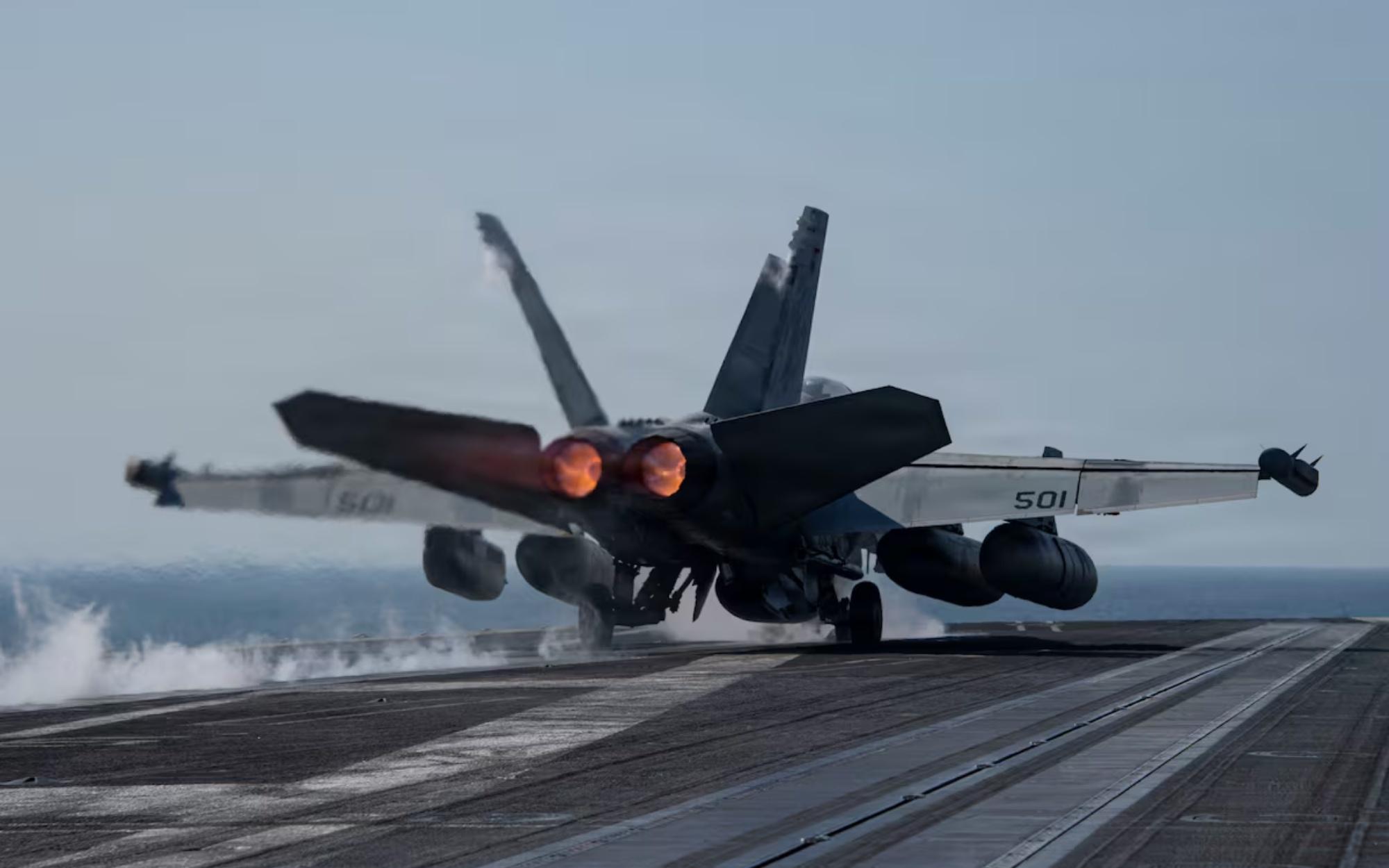
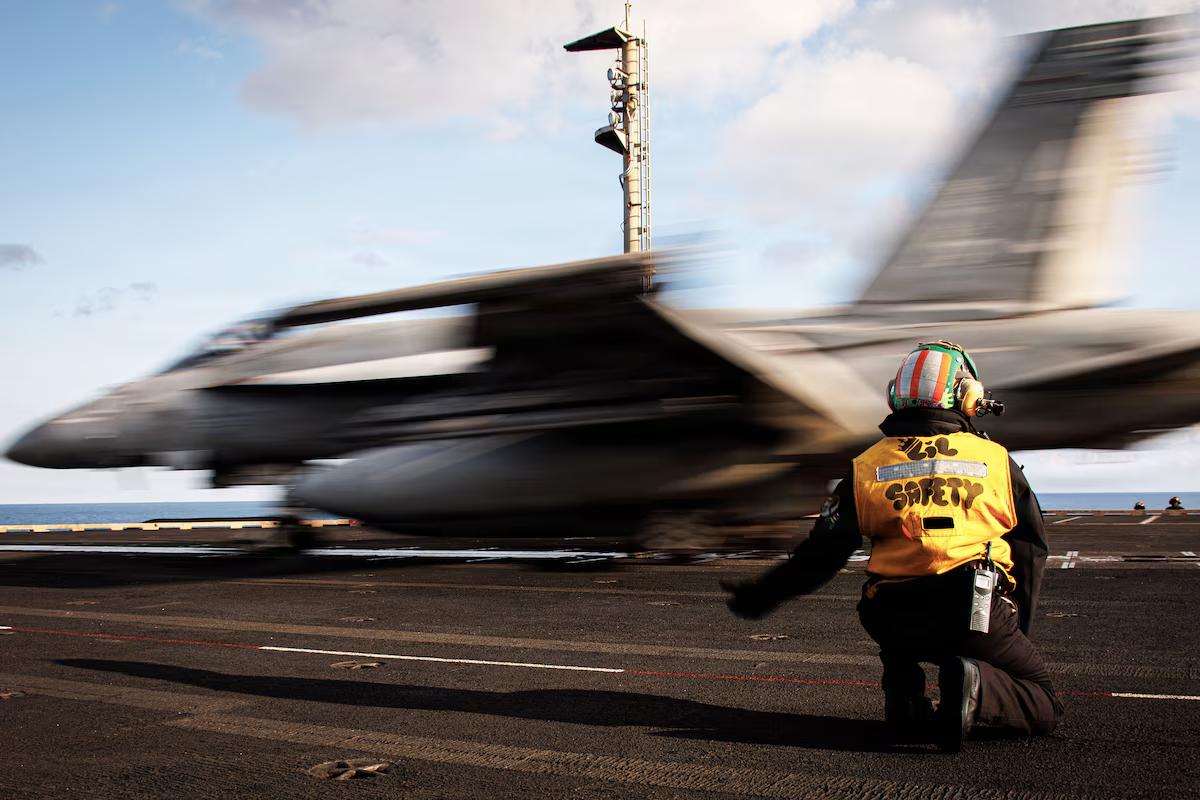
A U.S. sailor signals an F/A-18E Super Hornet on the flight deck of the USS Abraham Lincoln, March 4, 2026. (U.S. Navy)

From Hezbollah to the Houthis, Tehran has turned every power gap into a launchpad for chaos. The Trump administration seems determined not to repeat that mistake.

Ultimately, the White House is taking a pragmatic approach. A signed deal may sound good on paper, but as seasoned officers remind us, Iran’s word has rarely matched its actions.

Until Tehran proves itself through verifiable compliance — not just vague promises — U.S. combat forces will remain right where they are, ensuring stability the hard way.

Whether these next two months of talks yield anything meaningful will depend entirely on Iran’s willingness to live up to its side of the bargain. Don’t expect the War Department to take chances.

For now, America’s message remains loud and clear: peace through strength is back — and this time, the strength isn’t negotiable.


Scroll to Top