Author name: Common Defense

News

U.S. Forces Hammer Iranian Targets After Drone Shootdown, Intercept Missiles Over Kuwait

American forces didn’t mince words or fire this weekend as they struck back at Iran’s latest aggression.

According to U.S. Central Command, the War Department’s precision strikes pounded Iranian command-and-control sites and radar installations following Tehran’s reckless shootdown of a U.S. MQ-1 drone operating legally over international waters.

U.S. fighter jets destroyed multiple Iranian air defense assets, a ground control station, and two suicide drones attempting to disrupt commercial and military traffic in international sea lanes.

In typical fashion, Iran thought it could poke the United States with impunity.

It quickly learned that President Trump’s military does not tolerate direct threats to American forces or allies.

CENTCOM described the response as “measured and deliberate,” language that underscores both the restraint and the readiness of U.S. forces.

While no American lives were lost, the strikes sent a clear signal: the War Department will not stand idle as Iran escalates.

The problem for the Islamic Republic is that every time it tests the Trump administration’s resolve, it exposes its own vulnerabilities.

The United States has the best-trained military on Earth, commanded under a War Secretary, Pete Hegseth, who believes in peace through overwhelming strength. And once again, that doctrine worked precisely as intended.

US Navy Takes Out Two Iranian Tankers Defying Blockade in Strait of Hormuz
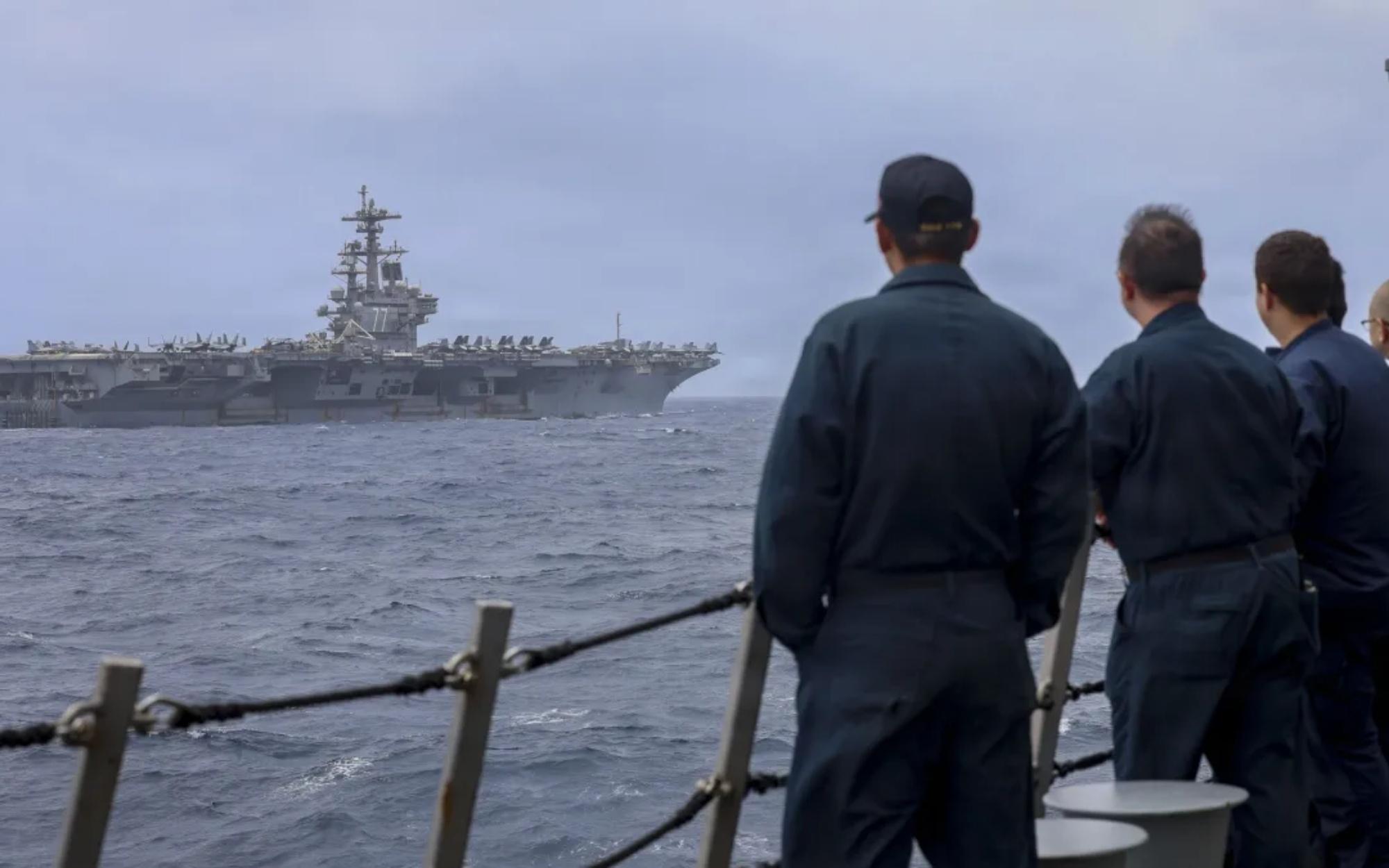
An F/A-18E Super Hornet taxis on the flight deck of Nimitz-class aircraft carrier USS Abraham Lincoln on April 16, 2026. (U.S. Navy)

CENTCOM confirmed that even amid heightened military activity, the ceasefire that began April 12 remains technically in effect.

Yet everyone knows this so-called “ceasefire” is hanging by a thread thin enough to slice paper. Iranian militias and naval units continue testing limits in the Gulf, hoping American patience will falter. It won’t.

On May 25, U.S. forces carried out additional strikes on Iranian missile launch sites and boats actively laying naval mines.

Those aggressive Iranian operations directly threatened international shipping lanes and put countless lives at risk. Washington’s answer was swift and surgical—American hardware neutralized those hostile positions before they could cause greater harm.

Then, just as tensions seemed to cool, Tehran tried again. On Sunday evening, Iran launched two ballistic missiles aimed toward U.S. forces stationed in Kuwait.

The attack accomplished little besides proving that Trump’s military deterrence strategy is still needed.

Both missiles were intercepted midflight, an achievement demonstrating American technological superiority and constant readiness.

Naval Blockade Sparks Showdown as Destroyer Halts Iranian-Bound Cargo Vessel
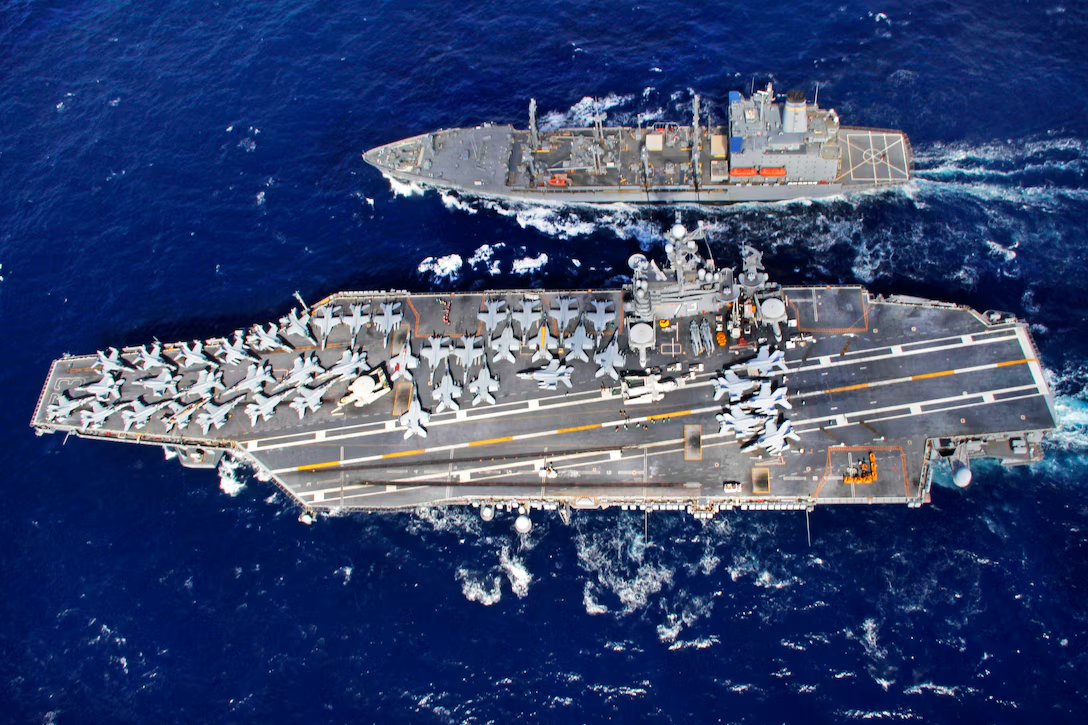
The destroyers Spruance, front, and Decatur alongside the fleet oiler Carl Brashear. (U.S. Navy photo by MC2 Will Gaskill)

While military commanders handle operations on the ground, the Trump administration continues diplomatic maneuvering at the highest level. Reports suggest Washington and Tehran have been engaged in overtures about a potential deal that could end the Iran war.

But in a classic Trump move, the president reportedly modified the deal terms to force Tehran into accountability—a step critics say could finally bring real results after decades of failed “talks.”

The proposed resolution would not only wind down hostilities but also ensure Israel’s right to defend itself is not undercut. Iran would have to lift its blockade of the Strait of Hormuz, reopening one of the world’s most strategic waterways.

For years, Iranian forces have used that strait as leverage against global trade and American influence. That leverage may soon be gone.

The pattern is as predictable as ever: Iran provokes, the U.S. retaliates, and the world watches to see if the regime can take a hint.

Each strike reminds the mullahs in Tehran that they’re not dealing with the indecisive bureaucracy of the Obama years—they’re up against the no-nonsense leadership of President Trump and War Secretary Hegseth, who put results before rhetoric.

As always, American forces remain focused on mission success, safety of personnel, and deterrence of future attacks. This is not nation-building or appeasement; it’s strategic dominance.

It’s the reassertion of what the War Department was meant to do: protect American lives and interests anywhere on the map.

Iran’s repeated provocations only prove how effective U.S. force projection truly is. Their desperation to disrupt stability in the Gulf region is a sign of weakness, not strength.

Every missile they launch and every drone they lose chips away at their shrinking power base and emboldens their internal opposition.

For now, the United States stands ready, steady, and fully capable of defending every inch of international waters, airspace, and land where our forces operate.

Iran, take note: when you fire at America, you will get hit back harder—and faster—every single time.

News

Hegseth Sounds Alarm Over China’s Aggression, Demands Allies Step Up Their Game

War Secretary Pete Hegseth made it crystal clear in Singapore: China’s military surge is not something to shrug off, and America’s allies across Asia need to stop relying on Washington’s wallet and start investing in their own defense.

Standing before an audience of international defense leaders at the Shangri-La Dialogue—the top Asian security summit—Hegseth didn’t mince words. He said the world’s “rightful alarm” over China’s expanding military footprint is entirely justified.

Beijing’s buildup, he warned, aimed to tilt the regional balance of power toward a single dominating force: the Chinese Communist Party.

Hegseth spoke with the kind of clarity and conviction that’s become his signature under President Trump’s leadership.

“A Pacific dominated by any hegemon would unravel the regional balance of power,” Hegseth asserted, leaving no doubt which hegemon he was referring to. “No state, including China, can impose its will on the region.”

For decades, too many nations expected the United States to foot the bill for their security. Hegseth was blunt that those days are over.

He backed Trump’s insistence that America’s wealthier partners shoulder more of their own defense burdens. The War Secretary called on allies to push defense spending to 3.5% of GDP while the U.S. pours $1.5 trillion into maintaining its edge.

“Less Shangri-La, more ships, more subs,” Hegseth quipped, highlighting that endless conferences don’t stop aggression—military strength does.

China Bets on AI as U.S. Military Edge Grows, Yet Beijing Moves Cautiously

It was a wake-up call to those who still think talking circles replace putting steel in the sea.

Hegseth stressed that stability requires resolve, not rhetoric.

“What allies want, and what the United States delivers, is strength that is disciplined, resolve that is steady, and leadership confident enough to carry a big stick,” he said, echoing a distinctly Rooseveltian tone that resonated deeply among the allied representatives.

Interestingly, Hegseth kept the door open for measured cooperation with Beijing, noting that U.S.-China military communication has improved under Trump’s pragmatic diplomacy.

“We are meeting more frequently with our Chinese counterparts,” he said, emphasizing that open channels don’t mean soft policies—they mean managing risks from a position of strength.

Chinese delegate Zhou Bo, a retired People’s Liberation Army colonel, admitted relations had “improved,” attributing it to President Trump’s recent visit to China.

U.S. Commander Says China’s Bullying in South China Sea Has Failed, Allies Poised to Bolster Deterrence
190116-N-ES994-0043 BEIJING (Jan. 14, 2019) Chief of Naval Operations (CNO) Adm. John Richardson visits the People’s Liberation Army (Navy) (PLA(N)) headquarters in Beijing. Richardson is on a three-day visit to Beijing and Nanjing to continue the ongoing dialog between the two heads of navy and encourage professional interactions at sea, specifically addressing risk reduction and operational safety measures to prevent unwanted and unnecessary escalation. (U.S. Navy Photo by Chief Mass Communication Specialist Elliott Fabrizio/Released)

That acknowledgment alone was a diplomatic victory in a region wary of China’s growing influence.

Still, Hegseth refused to indulge any illusions. Beijing skipped the summit for a second year running, continuing its habit of avoiding open forums where its intentions might be challenged.

Last year, Chinese officials accused Hegseth of being “vilifying.” This year, they got a sober reality check wrapped in calm authority.

On the issue of burden-sharing, Hegseth reaffirmed Trump’s long-held position: “The era of the United States subsidizing the defense of wealthy nations is over. We need partners, not protectorates.”

That line drew applause from U.S. allies who’ve recognized the need to invest more seriously in their own security.

He praised nations stepping up: South Korea boosting readiness against northern aggression, Australia committing to regional security, and Japan rebuilding its military posture.

“Tokyo and Washington must each pull our weight,” he said, highlighting Japan’s recent defense modernization as a model for others in the Indo-Pacific.

China, Iran and Russia Hold Joint Naval Drills in Mideast

Pivoting briefly to the Middle East, Hegseth dismissed claims that America’s attention was drifting away from the Indo-Pacific toward Iran. He reaffirmed U.S. capability to handle both theaters simultaneously.

“If necessary, we are more than capable of resuming strikes,” he said, making clear that American deterrence remains as sharp as ever.

When asked about Taiwan—the flashpoint China hates being reminded of—Hegseth remained tight-lipped but confident. The island awaits an arms package rumored to be worth $14 billion, but final approval, he said, rests with President Trump.

“Those decisions will depend on the president and the nature of that relationship,” Hegseth told reporters, signaling continuity in U.S. policy despite renewed engagement with Beijing.

Trump himself, back in Washington, continues his doctrine of peace through strength—demanding allies contribute to their own security and enemies think twice before challenging American power.

Hegseth’s message in Singapore carried that same spirit across the Pacific: strength is shared, but leadership must be earned.

For decades, the U.S. carried the burden of safeguarding free nations. Now, under Trump and Hegseth, America’s allies are being invited—not begged—to stand tall beside her.

The message couldn’t be clearer: China’s challenge will be met not with appeasement, but with power, partnership, and purpose.

News

U.S. Court Halts War Department from Removing Transgender Troops, But Ban Still Stands

A divided federal appeals court has handed down a split decision on President Trump’s common-sense military policy regarding transgender service, allowing the ban on new enlistments to remain in place while temporarily shielding current transgender troops from expulsion as a lawsuit continues.

In a 2-1 ruling, the D.C. Circuit Court of Appeals declared that while the War Department, led by Secretary Pete Hegseth, may enforce standards for enlistment that exclude those identifying as transgender, it cannot yet push out existing service members already in uniform.

The ruling effectively leaves the Trump administration’s enlistment ban in place, reaffirming that military readiness—not political activism—determines who qualifies to serve.

The court majority, led by Obama-appointed Circuit Judge Robert Wilkins, called the administration’s military policy “unlawfully motivated by the bare desire to harm a politically unpopular group.”

That’s quite a stretch, considering the long-standing authority of the War Department to set the physical and mental standards needed to maintain America’s fighting force.

Wilkins admitted, however, that “it appears to us to be a much greater hardship to end a military career than to delay the start of one,” signaling that current transgender troops may remain pending resolution of the case.

Judge Justin Walker, appointed by President Trump, stepped in with a pointed dissent that hit at the core of the issue.

“Courts have neither the expertise nor the authority to decide whether the military can exclude the plaintiffs from its ranks,” he wrote, taking aim at the judicial micromanagement that has interfered with national security decisions for years. Walker’s blunt assessment reflected what countless Americans already believe: that the courtroom is not the place to run the U.S. military.

Trump Seizes Moment as US and Israel Escalate Iran Campaign

Jennifer Levi of the left-wing group GLAD Law, representing the plaintiffs, praised the ruling as a win for transgender rights.

Levi claimed the decision “confirms that the Trump Administration has no legitimate basis to discharge transgender service members who have met every demanding standard.”

Of course, what Levi neglected to mention is that the military’s job is not to affirm identity politics—it’s to win wars, something Secretary Hegseth and the current War Department have made clear from day one.

The Pentagon, or as it’s properly called under the revived Department of War designation, did not immediately comment on the ruling.

But inside military circles, there’s little doubt that the leadership remains committed to restoring discipline and cohesion to America’s ranks after years of social experimentation.

The 2025 policy came in response to a January executive order from President Trump reiterating that adopting a transgender identity “conflicts with a soldier’s commitment to an honorable, truthful, and disciplined lifestyle.”

U.S. Court Halts War Department from Removing Transgender Troops, But Ban Still Stands

Secretary Hegseth moved quickly to implement the directive, making clear that military service is a privilege rooted in performance, not in identity politics pushed by the cultural left.

Critics have predictably painted the policy as discriminatory, but the administration has framed it as a necessary return to readiness standards that prioritize combat effectiveness, morale, and cost efficiency. Years of gender-based experimentation had diverted focus and resources away from training and mission capability—something the War Department has worked hard to correct since Trump’s return to office.

Advocates for transgender troops argue that there may be as many as 15,000 transgender individuals serving among the 1.3 million active-duty personnel. However, internal War Department figures say that the number is likely far lower.

Even so, the administration’s policy isn’t about headcounts—it’s about ensuring the standards of America’s armed forces remain rooted in realism, not ideology.

The Supreme Court in May 2025 already allowed the policy to move forward amid litigation, lifting a temporary block from a federal judge in Washington State.

The high court offered no written reasoning, though Judge Wilkins speculated that it might have acted on a technical procedural matter.

Regardless, that earlier decision laid the groundwork for what the Trump administration views as a necessary reaffirmation of command authority.

Trump Signals Bold Move as U.S. Deploys Thousands to the Middle East

While left-leaning activists are cheering the partial block, the White House remains confident that the broader case will uphold the president’s constitutional authority to determine military eligibility standards.

The War Department under Secretary Hegseth continues to argue that national defense—not gender ideology—must drive policy decisions.

At the same time, conservatives view this ruling as yet another example of federal judges overstepping their bounds at the expense of common sense.

Military command decisions should be left to generals and warfighters, not judicial panels looking for political validation. There’s a simple truth driving this debate: America’s enemies don’t care about pronouns, and neither should its warriors.

For now, the ban on new transgender enlistments stands firm—a reflection of President Trump’s clear vision of a disciplined, mission-ready force.

Whether the courts finally respect that authority or continue down the path of social-engineered activism remains to be seen, but one thing is certain: the Trump administration and War Secretary Pete Hegseth are not backing down when it comes to restoring America’s military might.

News

Air Force Clears T-38 Talon for Flight After Crash Probe Grounds Fleet

The U.S. Air Force’s T-38 Talon trainers are back in the air after a brief grounding, wrapping up just over a week of operational pause following a training accident that sent one of the jets down in rural Alabama.

The return to flight marks a fast turnaround by the service as investigators continue to sift through the cause of the mishap.

The incident took place on May 12 when a T-38 Talon II from Columbus Air Force Base in Mississippi went down in Lamar County, Alabama.

The crash prompted a May 19 decision to temporarily halt all T-38 flying operations across the force until safety teams could complete a thorough inspection.

The fleetwide pause was a standard safety measure but also a reminder of how high the Air Force’s bar for flight safety remains. By last Friday, the service announced that the halt had been lifted and that planes would return to duty in the days ahead.

Air Education and Training Command, Air Combat Command, Air Force Materiel Command, and Air Force Global Strike Command were all affected by the pause.

According to the Air Force’s statement, engineers and maintenance specialists have developed and validated a detailed inspection process for every aircraft before it returns to flight.

That extra scrutiny, the service said, ensures “a safe and thorough return to flight” while the ongoing investigation continues to determine the root cause of the crash.

Air Force Clears T-38 Talon for Flight After Crash Probe Grounds Fleet
A formation of T-38 Talons flies over Sacramento, Calif., July 27, 2022.

The Safety Investigation Board remains at work, examining flight data, maintenance records, and component performance.

Though officials haven’t disclosed technical details, they insist that every T-38 that takes off again has passed multiple layers of scrutiny from engineering, maintenance, and operational safety experts.

While a pause in training operations could normally slow down pilot production, the Air Force avoided major setbacks by ramping up simulator time. The affected aircrews turned to simulators to sharpen skills, meet proficiency standards, and maintain familiarity with flight procedures.

According to the Air Force, those additional simulator sessions have helped “mitigate impacts to operations, training, and readiness.”

A spokesperson for Air Education and Training Command confirmed that while the cause of the crash remains unknown, critical investigative and analytical steps have been taken.

“The operational pause allowed time for continued investigation, engineering assessment, and coordination with safety, maintenance, and program office experts,” the spokesperson told Military Times.

It’s worth noting that the T-38, though a workhorse of America’s training fleet since the early 1960s, is now an older platform approaching its seventh decade of service. Still, it continues to play a central role in producing the next generation of fighter and bomber pilots.

The fleet’s age only reinforces the importance of meticulous inspections and a robust maintenance culture—something the Air Force has doubled down on.

Air Force Clears T-38 Talon for Flight After Crash Probe Grounds Fleet
Two T-38 Talons fly in formation over Eastern Shore, Virginia, after participating in a RED AIR mission, on Dec. 7, 2017. (Carlin Leslie/U.S. Air Force)

The Talon’s history is a proud one. Generations of Air Force aviators have earned their wings in its cockpit, and even as the branch prepares to transition to the next-generation T-7A Red Hawk, the T-38 remains crucial.

Many in the Air Force see its longevity as a testament to good maintenance practices and disciplined flight safety—hallmarks of U.S. air superiority.

The Air Force’s calm, methodical approach to restoring operations stands in contrast to how Washington bureaucracies often respond to crisis—showing exactly what real leadership looks like in uniform. Rather than panic or foot-drag, the service acted swiftly, investigated thoroughly, and resumed mission-critical training with confidence.

That’s the kind of readiness and efficiency Secretary of War Pete Hegseth continues to champion across the War Department: bold accountability matched with action.

For an Air Force now operating in an increasingly contested world environment, the ability to return assets to service quickly and safely is not a luxury—it’s a matter of national strength.

Operational pauses like this one remind America’s adversaries that safety doesn’t mean softness; it means precision, discipline, and unwavering commitment to readiness.

The ongoing investigation will eventually determine what caused the Alabama crash, but the Air Force’s response already underscores a clear message: America’s air power keeps flying, no matter the challenge.

The Talon is back, the training pipeline is humming, and the mission continues.

News

U.S. Military is Looking for ‘Cultural Advisors’ in Somalia as Regional Threats Surge

The U.S. military is seeking cultural and political advisors to bolster operations in Somalia, a clear signal that Washington is trying to re-anchor its presence in a region increasingly defined by instability, extremism, and dwindling intelligence visibility.

According to a federal notice posted in late May, the Joint Special Operations Task Force-Somalia (JSOTF-SOM) is hiring three contractors who will advise troops on Somali politics, tribal dynamics, and cultural customs.

It’s a targeted effort to bridge the growing intelligence and cultural gap that has widened during years of U.S. drawdowns across Africa.

The advisors will not be ordinary contractors. They’ll need Top Secret clearances, and their mission will stretch beyond Mogadishu’s fortified compound into austere environments across Somalia, Djibouti, and Kenya.

Those posting for the job are warned of personal risk, yet the implication is obvious—America is plugging serious intelligence holes that emerged after a decade of strategic neglect.

The move comes as the War Department continues to recalibrate its approach to African operations following years of troop reductions. U.S. Africa Command (AFRICOM) has seen its footprint slashed by nearly 75% over the past decade.

Gen. Dagvin Anderson, who commands the effort, bluntly described the result before Congress as “an intelligence black hole.”

That’s not hyperbole. Fewer boots on the ground combined with reduced local coordination have created blind spots across the continent.

Anderson’s testimony warned that terrorist groups like ISIS and al Shabab still possess both intent and capability to target American interests abroad—and potentially at home.

U.S. Forces Capture ISIS-Somalia Finance Chief in Puntland Raid

President Donald Trump, not one to play defense when it comes to national security, recently confirmed ordering the strike that killed Abu-Bilal al-Minuki, ISIS’s second-in-command, in the Lake Chad Basin earlier this year.

The operation reinforced Trump’s no-nonsense approach to counterterrorism—seek, strike, and eliminate threats wherever they hide.

While the Lake Chad operation occurred far from Somalia’s limits, the mission highlighted a broader truth: Africa remains a live front in the global war on terror.

Somalia, in particular, continues to serve as a breeding ground for extremism with both ISIS and the al-Qaeda-linked al Shabab group vying for control.

The Africa Center for Strategic Studies has repeatedly flagged the region as one of the world’s most dangerous for insurgent activity.

In 2025 alone, U.S. forces carried out 124 strikes inside Somalia targeting militants, a staggering jump from just 10 the previous year. Even with fewer troops in the field, Washington’s airpower has surged, signaling that the U.S. is far from retreating.

If anything, this combination of kinetic force and cultural intelligence gathering suggests a more surgical, data-driven strategy emerging under a refocus on combat effectiveness.

U.S. Forces Capture ISIS-Somalia Finance Chief in Puntland Raid

These newly sought-after advisors aren’t meant to teach American soldiers about Somali folklore. Their real purpose is far more tactical—decode the alliances, tribal rivalries, and political undercurrents that extremists exploit to hide and recruit. Every successful special operations campaign depends not just on ordinance, but on understanding.

Knowing which tribes support who, which local governments command legitimacy, and which cultural lines can be crossed—or must never be—can mean the difference between operational success and disaster.

As U.S. forces adapt to leaner conditions in Africa, the importance of these advisors cannot be overstated. With intelligence shortfalls threatening to blind frontline operators, the Pentagon’s decision to re-engage locally, however modestly, could reenergize coordination with African partners and deter renewed terrorist momentum.

Critics may argue that American involvement in Somalia hasn’t yielded much in two decades.

That misses the point. Counterterrorism is not a one-and-done affair; it’s a sustained act of vigilance. The alternative—abandoning key ground to al Shabab and ISIS—isn’t containment, it’s surrender.

Secretary of War Pete Hegseth has long warned that disengagement from hot zones like the Horn of Africa only emboldens America’s enemies and undermines hard-won security gains.

Contractors heading into this mission have a tough job ahead. They’ll be called upon to navigate complex cultural landscapes for operators conducting precision raids, intelligence gathering, and local outreach.

Their work will underpin future operations in East Africa and could determine how effectively U.S. command reestablishes situational awareness on the continent.

U.S. Strikes in Somalia Persist, Matching Last Year’s Pace
U.S. forces host a land navigation course with the Danab Brigade in Somalia, May 18, 2021. Special Operations Command Africa remains engaged with partner forces in Somalia in order to promote safety and stability across the Horn of Africa. (U.S. Air Force photo by Staff Sgt. Zoe Russell)

The new advisory program begins this September, symbolizing more than a hiring effort. It’s a strategic correction—a recognition that America must not only strike hard but also understand deeply. In a world of asymmetric threats, both guns and brains are needed to win.

For now, Somalia remains both a proving ground and a warning. The U.S. military’s hunt for cultural advisors is not just about diplomacy—it’s about survival in one of the world’s most volatile regions.

News

U.S. Forces Blast Defiant Cargo Ship with Hellfire Missile After Ignoring Blockade Orders

An American aircraft fired a precision Hellfire missile on Friday, slamming into the engine room of a cargo ship that tried to defy the U.S. blockade in the Strait of Hormuz.

The strike disabled the vessel instantly, sending a crystal-clear message that the United States will not tolerate violations of its maritime control zone.

According to U.S. Central Command, the Gambia-flagged M/V Lian Star ignored more than twenty warnings before the aircraft engaged.

The ship was attempting to sneak through the Gulf of Oman toward an Iranian port, a direct breach of the U.S.-enforced blockade. CENTCOM later confirmed the operation, specifying that the vessel was immobilized and is no longer advancing toward Iran.

This marks the fifth time since early April that U.S. forces have fired directly on a ship to disable it.

The blockade around the Strait of Hormuz — a crucial global energy artery — has been at the heart of the tense standoff between Washington and Tehran. Both nations have been enforcing competing blockades, making the narrow strait a geopolitical powder keg.

Marine tracking satellites had monitored the Lian Star for days.

The ship, which initially departed from Karachi, Pakistan en route to Iraq, reportedly attempted a diversion toward Iran. CENTCOM officials decided to take decisive action when it became clear the ship intended to break through.

The Hellfire strike into the engine room was described as “measured” and “precise,” meant to cripple the vessel without sinking it.

US Forces Blast Defiant Cargo Ship With Hellfire Missile After Ignoring Blockade Orders
An AGM-114L Longbow Hellfire missile launches from the surface-to-surface missile module aboard the Littoral Combat Ship USS Montgomery in the Pacific Ocean, May, 12, 2022. The exercise was the first proof of concept launch of the Longbow Hellfire missile against land-based target.

The Pentagon did not release the names of the warships or aircraft involved. The cargo vessel remains adrift in the Gulf of Oman, awaiting recovery or boarding teams. As of Saturday evening, U.S. officials had no confirmation of injuries among the crew.

The strike was part of a larger campaign of enforcement that has already disabled five vessels and redirected 116 since April.

In a statement, CENTCOM emphasized that multiple warnings went ignored before the strike, underscoring U.S. patience throughout the incident.

“The ship was given every opportunity to comply,” said a senior military officer. “This was about maintaining lawful control of international waters under blockade conditions — not escalation.”

While large-scale combat between the U.S. and Iran has paused since April’s ceasefire, smaller flare-ups continue to erupt almost weekly. These range from intercepted Iranian drone flights to tit-for-tat missile incidents.

The Strait of Hormuz has become the flashpoint in a broader chess match involving energy flow, regional influence, and U.S. power projection.

Hormuz Strait Exposes the Limits of Air Denial in Open Shipping

President Donald Trump’s leadership continues to send a clear message: America will defend its interests with strength and precision. On Friday, he hinted that the blockade “will now be lifted,” signaling that Washington may be willing to ease restrictions if Iran steps back from provocations. For now, CENTCOM says operations remain ongoing until ordered otherwise by the White House.

Despite this, Iran’s regime continues to act recklessly. Bloomberg reported that an Iranian missile strike on Ali Al Salem Air Base in Kuwait wounded five people, including American service members.

Kuwaiti air defenses intercepted the missile before impact, yet debris still caused minor injuries. U.S. forces responded earlier this week with strikes on targets near Bandar Abbas, hitting facilities linked to Iranian missile operations.

Since early spring, CENTCOM has focused on balancing controlled pressure against Iran’s aggressive proxies while avoiding full-scale escalation.

Each strike, boarding, or blockade enforcement reflects that strategy — containment without chaos. The Hellfire strike on Friday fits exactly within that doctrine of firm deterrence.

US Forces Blast Defiant Cargo Ship With Hellfire Missile After Ignoring Blockade Orders
A Navy MH-60R Seahawk helicopter shoots an AGM-114N Hellfire missile during Exercise Baltic Operations in the Baltic Sea, June 14, 2019. The annual maritime-focused exercise enhances flexibility and interoperability among allied and partner nations.

America’s continued naval dominance in the Gulf is not just about oil or shipping lanes.

It’s about maintaining order against a regime that thrives on chaos. The mullahs in Tehran have long tried to exploit every perceived opening to move weapons, fuel, and hostages across international waters.

But this administration — led by Trump and backed by War Secretary Pete Hegseth — has made clear that the days of looking the other way are over.

The message heard worldwide after Friday’s missile strike is unmistakable: defy American warnings, and you’ll face consequences. No apologies, no lengthy “diplomatic consultations,” just precision force delivered at the exact moment necessary.

With both the United States and Iran negotiating around a fragile ceasefire, these incidents continue to test just how far each side is willing to go. For the Trump administration, enforcement comes before appeasement, and the U.S. Navy will maintain that posture until Tehran learns the meaning of compliance.

Reports of Vessels Hit as Iran Declares Hormuz Closed Again, Escalating Gulf Tensions

The Strait of Hormuz may be 21 miles wide at its narrowest point, but in terms of world power, it’s the most heavily policed stretch of water on Earth. American resolve — backed by firepower — ensures that freedom of navigation doesn’t bend to rogue states or blockade breakers.

At this stage, the Lian Star may be nothing more than a drifting reminder of what happens when a vessel challenges U.S. might.

The blockade still stands, U.S. control remains intact, and the next blockade violator will face the same fate.


Scroll to Top