News

News

Startups Take Command in Pentagon’s New Drone Race

A new era is unfolding inside the War Department’s rapidly expanding drone industry, and it isn’t being led by the traditional bloated defense primes—but by scrappy young startups that are moving faster, thinking sharper, and delivering results now.

The Pentagon’s latest “Drone Dominance” competition revealed as much, showcasing how innovation and battlefield utility are finally being driven by the private sector rather than Beltway bureaucracy.

Last month at Camp Grayling, Michigan, 49 companies squared off in this $1.1 billion effort aimed at boosting America’s domestic unmanned aerial systems. The War Department’s goal was simple: find who can build smarter, tougher, ready-to-fly drones that serve the real-world needs of troops.

After nearly two weeks of testing, 19 companies advanced to the next phase—a testament to how quickly America’s private innovators are outpacing government timelines.

Unlike the defense contractors of the past, these aren’t outfits sitting on Washington contracts for decades. Most of these finalists are young, privately-held companies producing small tactical drones for today’s battlefield realities.

About half are already on the War Department’s “Blue UAS” cleared lists—meaning they’ve passed the government security vetting that ensures they’re safe from foreign interference. Many of these startups didn’t even exist a decade ago, yet they’re challenging corporate giants at their own game.

US Warrior Killed Handling Iranian Drone Ordnance in Northern Iraq

J.R. Mullis, a retired Air Force contracting officer turned defense innovation advisor, described the group as “more mature than the average drone startup.”

n his words, “They’re able to be deployed right now.” These companies aren’t chasing headlines—they’re chasing capability. America’s warfighters need drones that work today, not next decade, and these entrepreneurs are delivering.

Mullis emphasized that the secret sauce isn’t just in building an airframe, but in creating the entire ecosystem—sensors, software autonomy, payloads, and more.

Army’s Supply Drone Transforms Into Rocket Launcher In Bold Alabama Test

“If you were to circle all of them and mash them together,” he said, “I think it would make a really good capability.” Translation: while large defense corporations bicker over bureaucratic turf, these small teams are building the full picture element by element.

The real revolution underway here is not only technological but cultural. The War Department, long criticized for its sluggish acquisition processes, is changing its tune.

By identifying gaps openly and giving American innovators a fair shot, the Pentagon is finally acting like a modern warfighting institution rather than a slow-motion logistics office. It’s a shift that President Trump and his allies like Secretary of War Pete Hegseth have been pushing for—prioritizing speed, innovation, and results.

Poland Signs Onto Pentagon’s Counter-Drone Network After Abrupt U.S. Troop Pullback

One example is Ascent AeroSystems from Massachusetts. Founded by a pair of brothers and a friend, it started as a hobbyist idea—build a rugged little drone for hiking.

Today, their Aero Spirit drone sits proudly on the Pentagon’s Blue UAS list, with over $2 million in contracts and a major acquisition by Robinson Helicopter behind it. That’s the American dream playing out in the defense-tech world: small inventors with grit, rewarded for solving real problems.

Pentagon Eyes Fleet of Drone-Mounted Laser Interceptors
Artist’s rendering of an MQ-9B SkyGuardian drone disabling several attack drones with an integrated laser weapon pod. (General Atomics)

But the journey isn’t easy. Mullis noted the “valley of death” that many startups face—the gap between building one successful prototype and scaling it to the thousands the government demands. Many don’t have the capital or production footprint to keep up. That’s where true American collaboration comes in.

Take Georgia’s Kinetic Frames teaming up with Alabama’s Griffon Aerospace. The former had the innovation chops; the latter had years of contract experience and production muscle.

Pentagon Readies High Energy Laser Test to Take Down Drones
A resupply drone takes off during a test flight at the Joint Multinational Readiness Center near Hohenfels, Germany, Feb. 18, 2026. (Sgt. Glenn Brennan/U.S. Army National Guard)

Together, they’ve delivered more than 2,000 drones to the U.S. military—proof that small players backed by established muscle can deliver results faster than the corporate defense complex that takes decades to move a design from blueprint to battle.

Mullis argues that the major “prime” contractors aren’t sitting this out—they just play differently. They have their own long-term programs locked in with the War Department, and they don’t need the publicity that a competition brings. But for the smaller firms, visibility means survival. These competitions give them legitimacy, feedback, and the opportunity to prove their tech under pressure.

Pentagon and FAA Launch Laser Tests Against Drones in New Mexico
A high energy laser weapon system mounted on a Polaris RZR. (Raytheon)

Even failure, Mullis said, has its benefits. “The best founders in the world wear failure like a badge of honor,” he noted. Each competition gives startups hands-on insight into what the military really wants—and how to make their next design better. That’s a feedback loop that’s worth more than another round of venture capital.

As the Pentagon rolls out the Drone Dominance Lethality Prize—linking drone makers with trusted suppliers of standardized attack payloads—the message is clear: innovation is no longer optional.

America’s future wars will be won by the teams that move fast, think smart, and collaborate effectively.

These entrepreneurs aren’t waiting for the bureaucracy to catch up. They’re building, flying, and learning right now. As Mullis put it succinctly, “An acquisition is just an absolute success.”

Arctic Front Flares Up: FPV Drones Redefine Arctic Warfare After Ukraine [WATCH]
A Navy explosive ordnance disposal technician assigned to Explosive Ordnance Disposal Mobile Unit 8 conducts long-range aerial reconnaissance during a rapid airfield damage repair drill at Arctic Specialist 2026. Arctic Specialist is an annual Norway-hosted multinational joint EOD and expeditionary mine countermeasure exercise providing training, exercise and development of land and maritime EOD tactics, techniques and procedures in a cold-weather environment.

For America’s emerging drone industrial base, success looks like smaller teams, bigger ideas, and a War Department finally ready to embrace its next generation of innovators.

As global adversaries churn out mass-produced UAVs, the Pentagon’s bet on these agile startups could prove decisive. If Washington keeps streamlining the red tape and letting true innovators lead, the United States won’t just keep up—it will stay ahead.

News

Elizabeth Warren Throws Weight Behind Radical Michigan Leftist Abdul El Sayed [WATCH]

Sen. Elizabeth Warren, D-Mass., has endorsed Michigan Democratic U.S. Senate candidate Abdul El-Sayed in the state’s Democratic primary, adding her support to a growing list of progressive lawmakers backing his campaign to succeed retiring Sen. Gary Peters, D-Mich, as reported by Breitbart.

Warren announced her endorsement on July 20, describing El-Sayed as the candidate best positioned to build a grassroots campaign centered on healthcare reform, campaign finance changes, and organized labor.

El-Sayed has also received endorsements from Sen. Bernie Sanders, I-Vt., Rep. Alexandria Ocasio-Cortez, D-N.Y., and the United Auto Workers.

In a statement announcing her endorsement, Warren praised El-Sayed’s campaign platform and fundraising approach.

“Abdul is the only candidate in this race not taking corporate money, and he’s fighting to get money out of politics altogether. Abdul studied to be a doctor, and he’s fighting for every single American to have affordable, high-quality healthcare,” Warren said.

She continued, “Abdul has been a card-carrying union member, and he’s fighting for working people. That’s why he’s endorsed by the United Auto Workers, and he’s growing a movement of working people all across Michigan. And that’s why I’m endorsing Abdul. He is the fighter Michigan needs in the Senate.”

Warren also described El-Sayed as the “only candidate in this race who can build the grassroots movement needed to win in November for money in your pocket to get money out of politics and deliver Medicare for all.”

Healthcare remains one of the central issues in El-Sayed’s campaign. The former physician supports a Medicare for All system that would replace private health insurance with a government-run program.

His proposal calls for healthcare coverage without premiums, copays, deductibles, provider networks, or other out-of-pocket expenses.

During an appearance on Intellectually Petty Radio, El-Sayed explained his vision for universal healthcare.

“I think you need to guarantee health care for everyone, cradle to grave, without premium, copay, deductible. Medicare for all. And I just want you to imagine, right, that that card that you get in your — via your private health insurer — that card sits in your back pocket. You pay a ton of money for it, and it goes away if you lose your job. Now, imagine you had one right there, but you got the day you were born that doesn’t expire until you expire, God willing, after a long, healthy life at 120 years old in your sleep. You don’t lose it if you turn 26. You don’t lose it if you turn 65. You don’t lose it if you get married, get divorced. Doesn’t matter. It’s there for you. There’s no network, and there’s no cost out of pocket. That’s the security people need and deserve.”

In addition to healthcare reform, El-Sayed’s campaign platform supports continued access to reproductive healthcare and gender-affirming care.

His campaign website states, “Everyone has the right to make personal decisions about their healthcare. Healthcare decisions should be made by a patient (and their parents if they are a minor) and their doctor — no one else.”

The platform continues, “That includes reproductive and gender-affirming care.”

Ocasio-Cortez has also publicly supported El-Sayed’s campaign, saying he “represents the politics of the future.”

The Michigan Senate race is expected to be closely watched nationally as Democrats seek to retain the seat being vacated by Peters.

Several progressive organizations have lined up behind El-Sayed as the primary campaign continues.

Republican National Committee Chairman Joe Gruters criticized the Democratic field during an appearance on Breitbart News Daily earlier this month.

“Here’s the deal, even if it’s not El-Sayed, the left is so far to the left, it doesn’t matter what the candidate is anymore,” Gruters said.

He added, “El-Sayed has more things that he said in the past, but both candidates are disasters. Both would be terrible for the president and working to push his agenda forward. And so, yes, I don’t care who the nominee is.”

The Democratic primary will determine who advances to the general election to compete for the Senate seat currently held by Peters.

News

Lockheed Martin Rolls Out Budget Patriot Interceptor to Battle Cheap Drone Swarms

Lockheed Martin made waves at the 2026 Farnborough Airshow in London by unveiling a new Patriot missile interceptor designed to cut costs while ramping up battlefield efficiency for the U.S. and its allies.

The new system, called the PAC-3 Adapted Capability Effector (ACE), promises to deliver lethal performance at less than half the price of the existing PAC-3 Missile Segment Enhancement (MSE) unit.

The announcement comes as Washington and partner nations face mounting pressure to defend against low-cost enemy drones and missiles without bankrupting their missile stockpiles.

The Pentagon has watched hundreds of millions of dollars vanish as advanced Patriot interceptors take down munitions costing pennies in comparison.

For perspective, a single PAC-3 MSE runs around $4 million, while one of Iran’s Shahed drones—a frequent menace in the Middle East—costs as little as $35,000.

That math is not lost on U.S. commanders or fiscal conservatives who have criticized the War Department’s imbalance of cost versus return in modern air defense engagements.

Lockheed says the new ACE missile will still plug seamlessly into existing Patriot systems and the Integrated Battle Command System (IBCS).

That compatibility is no small advantage—it means ACE can be fielded faster and cheaper, without overhauling launchers or infrastructure. Designed to fight “airbreathing threats” like cruise missiles and short-range ballistic weapons, ACE adds flexibility without the heavy price tag.

The move is a smart one for both the company and the U.S. military. As American forces have burned through interceptors during Operation Epic Fury—a campaign that saw Iran’s inexpensive drones fill the skies—concerns swelled about whether defense stockpiles could keep up.

The last thing the War Department needs is to run out of interceptors in the middle of a major regional conflict.

U.S. and allied troops have been leaning hard on the Patriot system in recent years. Using radar to track and destroy incoming threats with a kinetic “hit-to-kill” approach, it’s become a mainstay of America’s missile defense strategy. But that strategy is less sustainable when each successful hit costs millions.

The Patriot’s reputation has only grown in Ukraine, where its interceptors have been critical in fending off Russia’s missile barrages. Now, with Ukraine’s missile supply dwindling, Kyiv has teamed with nine partner nations to create “Freyja”—a multinational project aimed at developing a homegrown alternative to the Patriot.

Their shared challenge is simple: the global supply of anti-ballistic interceptors can’t keep up with modern conflict rates.

For the U.S., the new ACE interceptor signals a shift toward smarter, more cost-effective missile defense production. It’s consistent with a broader push by the Trump administration to rebuild military readiness while getting real value for the American taxpayer.

War Secretary Pete Hegseth has prioritized cutting bureaucratic waste and ensuring that taxpayer dollars go toward hardware that works on the battlefield—not overpriced technical experiments.

Lockheed Martin, a longtime giant in missile systems, is clearly reading the room. Earlier this year, it secured a $4.7 billion War Department contract to accelerate production of PAC-3 MSE interceptors. Meanwhile, the U.S. Navy is adapting those same interceptors for ship-based Aegis systems, which use advanced radar to engage ballistic and cruise missile threats at sea.

Lockheed’s decision to complement those pricey missiles with a lower-cost ACE option demonstrates awareness that cost efficiency is now a strategic weapon in itself.

The days of open checkbooks for the sake of “innovation” are being replaced by a pragmatic focus on sustainability and combat readiness.

Experts in military procurement point out that high-end interceptors will always have their place for truly advanced threats, but the surge in mass-produced Iranian and Russian drones has forced a rethink. A sophisticated ballistic missile justifies a $4 million shot—an airborne lawnmower with wings does not.

The United States currently fields a layered missile defense network including Patriot, Aegis, and the THAAD system. That architecture gives the military flexibility but also complexity—and costs that stack up fast when hundreds of interceptors are used in a short campaign.

The ACE missile fits into that structure as a mid-tier option, designed to balance performance with affordability.

Industry insiders also highlight that ACE’s adaptability with European systems could be a game changer.

American and NATO allies will be able to share technology and coordinate production, reducing dependency on limited factories and supply lines. That’s a quiet but crucial advantage as the West braces for long-term strategic competition with China, Russia, and Iran.

As the world confronts increasingly cheap but effective aerial threats, Lockheed Martin’s new interceptor appears to be a step toward sanity in missile economics.

It offers a reminder that winning wars requires more than technology—it demands sustainability, foresight, and leadership willing to prioritize both.

With a pro-troop administration and War Secretary Hegseth’s focus on making the U.S. military leaner, tougher, and more efficient, the ACE program could mark the beginning of a smarter era for America’s air defense systems.

News

California In-N-Out Turns Into Chaos As Late-Night Fight Erupts [WATCH]

A fight between an In-N-Out employee and a customer inside a Sacramento restaurant early Saturday morning was captured on video, drawing widespread attention online and prompting questions about what led to the confrontation, as reported by The New York Post.

The incident occurred at approximately 12:33 a.m. Saturday at the In-N-Out restaurant located at 2001 Alta Arden Expressway in Sacramento, Northern California.

Video circulating on social media appears to show an altercation that escalated into a physical fight after the customer allegedly acted disrespectfully toward the employee.

Based on the video, the employee appeared to throw the first punch before the customer responded.

As the confrontation continued, the employee appeared to gain the upper hand during the exchange before coworkers stepped in and restrained her in an effort to end the fight.

The footage also captured the employee shouting profanities during the altercation.

At one point, the camera panned across the restaurant floor, where a wig could be seen lying nearby, suggesting it had come off during the struggle.

Customers inside the restaurant witnessed the fight as it unfolded. Several bystanders recorded video while others watched the confrontation from nearby tables.

The restaurant remained open during the incident, and coworkers attempted to separate the two individuals before the situation escalated further.

The video quickly spread across social media, generating thousands of reactions and comments.

One user joked about the fight, writing, “She caught a double double with extra raw hands lol.”

Another commenter criticized the employee’s actions, writing, “How embarrassing for In-N-Out to hire such feral trash that she can’t even control her temper. We expect a follow-up and a termination. That is all.”

Authorities have not publicly released additional information regarding the events leading up to the confrontation beyond reports that the customer allegedly disrespected the employee before the fight began.

As of Monday, no information had been released regarding whether either person suffered injuries requiring medical treatment.

Likewise, there has been no public update on the employee’s job status or whether any criminal charges are being considered.

The New York Post reported that In-N-Out’s corporate office declined to provide additional details or comment on the Sacramento incident when contacted.

The Sacramento fight follows another high-profile disturbance inside an In-N-Out restaurant less than a week earlier.

On July 13, a large fight broke out inside an In-N-Out location in Arizona.

According to reports, a group of teenagers could be seen arguing before the confrontation became physical, with participants punching and tackling one another in the middle of the restaurant.

That Arizona restaurant was reportedly crowded with customers who had remained indoors because heavy rain prevented outdoor seating.

As the altercation intensified, some diners hurried toward the exits while others remained inside and laughed at the unusual scene.

Videos from both incidents have circulated widely online, drawing significant attention and prompting discussion about customer behavior and workplace confrontations inside busy restaurants.

No additional information has been released by In-N-Out regarding either incident.

News

Nuns Take Hochul to Court Over New York’s Deadly Assisted Suicide Mandate [WATCH]

A coalition of approximately 13 plaintiffs, including Catholic healthcare providers, religious organizations, and multiple congregations of nuns, has filed a federal lawsuit challenging New York’s newly enacted assisted suicide law, arguing that it violates their religious beliefs and could force them to participate in practices that conflict with their faith, as reported by Red State.

The lawsuit was filed after Democratic Gov. Kathy Hochul signed legislation permitting physician-assisted dying for certain terminally ill patients in New York.

According to the complaint, the plaintiffs contend the law places them in a position where they must either comply with requirements they believe violate their religious convictions, discontinue long-standing healthcare ministries, or face potential legal and professional consequences.

Among the organizations participating in the lawsuit are the Dominican Sisters of Hawthorne, the Carmelite Sisters, the Benedictine Sisters, the Little Sisters of the Poor, Bishop John O. Barres, and the Diocese of Rockville Centre.

According to the lawsuit, the state’s assisted dying law operates alongside New York’s existing Palliative Care Information Act, which requires physicians and nurse practitioners to discuss end-of-life care options with terminally ill patients.

Because physician-assisted dying is now recognized as one of those options, the plaintiffs argue that healthcare providers must proactively inform patients about it regardless of whether patients request that information.

The plaintiffs maintain that the law would require them to counsel patients about physician-assisted suicide and, in some cases, refer patients to providers who offer those services.

They argue those requirements directly conflict with longstanding Catholic teachings regarding the sanctity of human life.

Mother Marie Edward of the Dominican Sisters of Hawthorne discussed the group’s position in comments to The Free Press.

“Everyone is made in the image and likeness of God, and there is a dignity about the human person,” Mother Marie Edward said.

“We are only the guardians of this body. We do not take the charge of whether or not we live or we die. That’s up to God.”

The Dominican Sisters of Hawthorne have long provided care for terminally ill patients through their healthcare ministry.

The lawsuit argues that complying with the state’s requirements would force the organization to abandon religious principles that have guided its work for decades.

Legal representation for several of the plaintiffs is being provided by Becket, a nonprofit legal organization that frequently litigates religious liberty cases.

Mark Rienzi, president of Becket, issued a statement criticizing the law and its requirements for religious healthcare providers.

“New York is forcing sick and dying people to consider suicide at their lowest moment, regardless of whether they ask for it or not.”

He continued, “Worse, it’s conscripting the nuns who care for them into its suicide cult on pain of crushing fines and professional ruin. That is both unconscionable and unconstitutional. We’re confident the federal courts will put a stop to it.”

According to the complaint, the plaintiffs argue they could face significant financial penalties or the loss of professional licenses if they refuse to comply with the law’s requirements.

The lawsuit asks the federal court to block enforcement of the provisions as they apply to the religious organizations and healthcare providers involved in the case.

The plaintiffs contend the law infringes upon constitutional protections for the free exercise of religion by compelling participation in conduct they believe violates their faith.

The case adds to a growing number of legal challenges nationwide involving religious liberty claims and state healthcare policies.

Courts in several states have been asked to determine whether governments may require faith-based healthcare providers to participate in or facilitate medical procedures that conflict with their religious beliefs.

As the litigation moves forward, the federal court will be asked to determine whether New York’s assisted suicide law can be enforced against religious healthcare organizations while complying with constitutional protections for religious freedom.

News

X-Bow Rolls Out Game-Changing Drone Killer for Under $100,000

The U.S. military’s long-running struggle to take out cheap enemy drones with sky-high interceptors may have finally met its match.

X-Bow Systems, a solid rocket motor manufacturer out of New Mexico, is setting out to fix one of modern warfare’s most glaring cost imbalances — multi-million-dollar interceptors versus bargain-bin drones — with a new system called the Buckler.

The company unveiled Buckler at the 2026 Farnborough Airshow in London, presenting it as a compact, sub-$100,000 supersonic interceptor meant to destroy mid-size Group 3 drones.

These unmanned aircraft systems, often weighing up to 1,320 pounds, have been causing headaches across the battlefield as America’s adversaries, particularly Iran, churn them out by the thousands.

X-Bow’s leadership knows the stakes. “You can’t win a war of attrition trading million-dollar interceptors against thousand-dollar threats,” said Jason Hundley, X-Bow’s founder and CEO.

“Buckler has flown, it comes in under $100,000, and we build its airframe and propulsion ourselves — the part of the industrial base that is so stressed by today’s munitions demands.”

With U.S. forces in the Central Command region continually seated behind console screens and launch buttons, sending off Patriot and PAC-3 missiles to take down glorified lawnmower engines from Tehran, it’s become painfully obvious the current model isn’t sustainable.

Paying $4 million per shot to kill an Iranian Shahed-136 drone that costs less than $35,000 is the kind of math only Washington bureaucrats could pretend makes sense.

Buckler could flip that entire equation. Designed as a nimble interceptor capable of supersonic performance, it’s assembled entirely within X-Bow’s own manufacturing system – no endless supply chain red tape slowing things down.

The company is betting on self-sufficiency as the key to maintaining production during high-tempo conflict, a lesson the nation’s war industry has been forced to relearn after decades of outsourcing and dependence.

Hundley’s team made sure Buckler wasn’t just a concept drawing. The interceptor, named after a medieval-era shield, has already been flight tested and demonstrated its propulsion and guidance potential.

The company believes these early tests prove that Buckler can provide a scalable, industrially sustainable answer to the flood of enemy drones harassing U.S. bases and allied partners.

The timing couldn’t be better. With America’s ongoing clash with Iran exposing how vulnerable even advanced forces can be when economics turn against them, Buckler’s affordability could redefine battlefield deterrence.

Instead of being forced to ration multi-million-dollar missiles, commanders could actually afford to waste enemy drones by the dozen.

The system’s debut comes as major industry players like Lockheed Martin also scramble to showcase low-cost alternatives. Lockheed introduced the Morfius X-Rotor, a reusable, ground-launched microwave counter-UAS capable of wiping out over 50 drones in one flight.

The war industry, it seems, is waking up to the new cost-conscious reality of modern air defense: victory won’t belong to whoever spends more, but to whoever spends smarter.

Yet Buckler’s simplicity may be its secret weapon. By manufacturing its airframe and propulsion in-house, X-Bow avoids the long, fragile contractor chains that bog down production of larger systems like the Patriot.

In today’s climate, where the War Department is pressed to replenish munitions stockpiles faster than adversaries can build threats, that independence is operational gold.

The practicality of such a low-cost, high-velocity interceptor lines up squarely with President Trump’s philosophy of rebuilding American industrial might.

Under his administration’s return to “Peace Through Strength,” initiatives like Buckler’s represent an ingredient of that doctrine: cutting through waste, restoring domestic production, and arming warfighters with accessible, scalable tools to win decisively.

With Secretary of War Pete Hegseth championing innovation aimed at strengthening America’s defensive edge, systems like Buckler are likely to find enthusiastic allies in the War Department’s modernization drive.

The Pentagon has learned the hard way that defense spending doesn’t automatically translate to battlefield dominance if inefficiency eats every dollar before it reaches the front line.

X-Bow’s model could serve as a blueprint for a new industrial defense surge — not bloated contracts and bureaucratic stagnation, but rapid, affordable production that meets the gritty, real demands of war.

If it delivers on its promise, Buckler could prove that American ingenuity still outpaces its enemies, not just in technology, but in common sense.

While flashy projects often steal the headlines, the quiet practicality of Buckler may carry the most strategic weight. The drones swarming over our forward bases don’t need billion-dollar weapons to stop them — just American-made precision and efficiency.

If Buckler can consistently shoot down enemy drones for one-twentieth the cost of today’s interceptors, it will do more than save taxpayers a fortune. It will restore sanity to the economics of modern warfare — giving U.S. troops a smarter, cheaper shield in a world full of small, deadly machines.

News

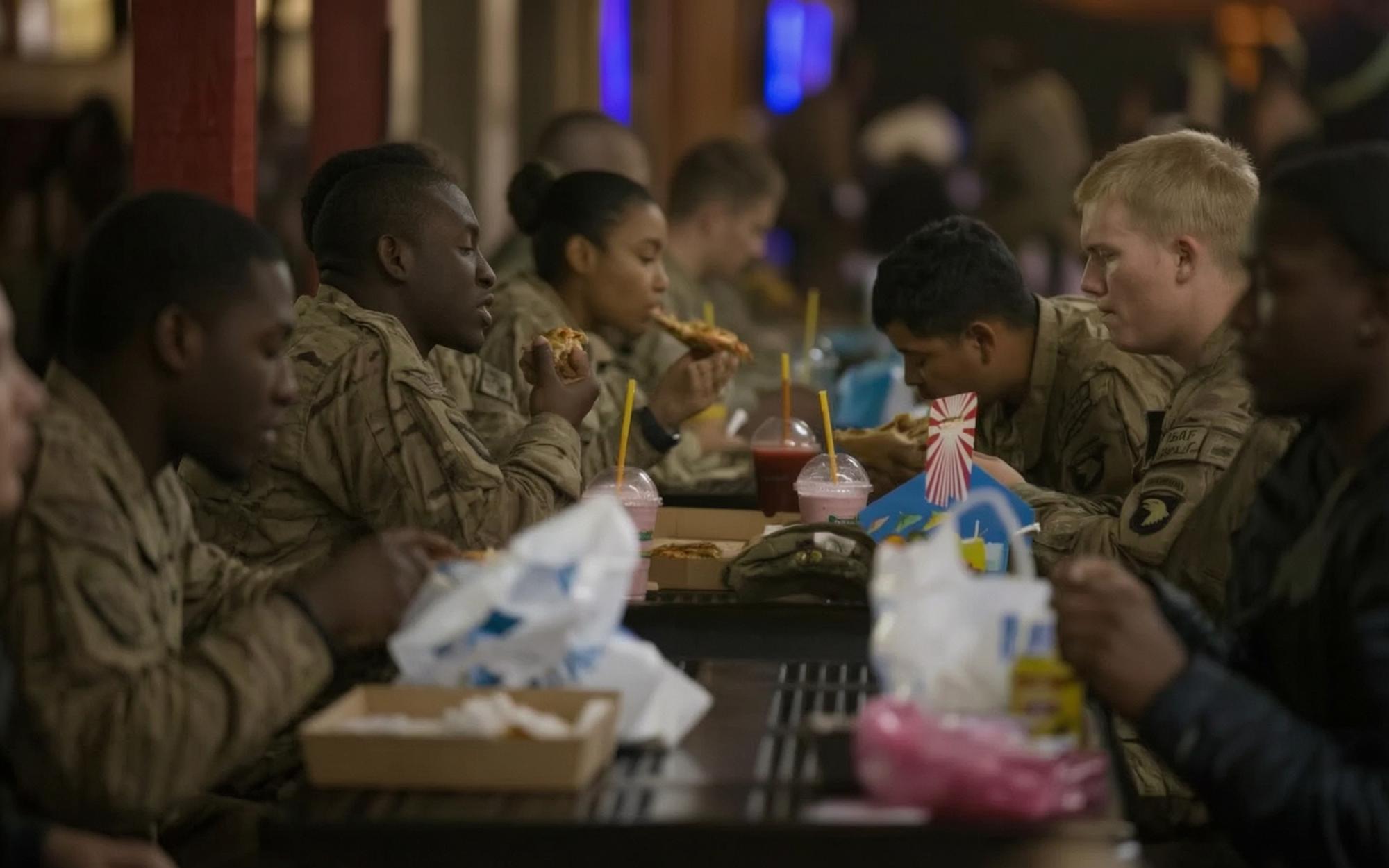
Army Launches New Meal Card Program Letting Troops Grab Burger King and Starbucks On Base

The Army is finally modernizing one of its oldest and most complained-about systems — the chow plan. Soldiers stationed at Fort Stewart, Georgia, will soon be able to grab a coffee at Starbucks or sink their teeth into a Subway sandwich using their regular meal cards, thanks to a new initiative aimed at making life on base a little less rigid.

Starting August 3, Fort Stewart will become the first Army installation to roll out the Flexible Eating and Expanded Dining Program, or FEED.

According to Capt. Destinee Johnson, a spokesperson for the 3rd Infantry Division, FEED represents a major step forward in how the Army feeds its soldiers — and hopefully, how it keeps them satisfied while doing it.

Under the new system, soldiers will be able to swipe their Common Access Cards at participating restaurants like Subway, Burger King, Starbucks and QDOBA, all of which operate under contracts with the Army & Air Force Exchange Service.

Each location will have a pre-approved FEED menu, ensuring troops can grab something hot and fast without worrying about breaking regulations or budgets.

The FEED program is part of a broader Army push to give junior enlisted troops more freedom in their daily lives.

For too long, the “three swipes a day” dining hall routine has felt more like a boot camp leftover than a perk of military service. The new system adds real flexibility to the process — and not a moment too soon.

The concept was tested last year at Fort Hood, Texas, where 200 soldiers from the 61st Quartermaster Battalion participated in the pilot run.

Army officials say the Fort Stewart rollout will serve as the model for other bases nationwide, as feedback from the pilot was extremely positive. Soldiers appreciated being able to grab food that didn’t taste like it came out of a field kitchen on a bad day.

In the old setup, troops living in the barracks received meal cards that entitled them to three standard meals at the dining facility.

Navy Expands All-Day Grab-and-Go Stations at Shore Bases by End of 2026
A sailor assigned to Naval Construction Battalion Center Gulfport, Mississippi, prepares food at the vegan station on May 29, 2026. (Brittney Kinsey/U.S. Navy)

The menu might as well have been set in stone, and if you missed a meal, tough luck — it didn’t roll over. The new program keeps structure but introduces much-needed flavor by linking meal benefits to name-brand restaurants right on base.

Instead of “freedom dollars” used at other installations, Fort Stewart’s FEED soldiers will use their meal cards directly for specified menu items.

Those include options like a bacon, egg, and gouda sandwich with milk or juice, or a vegetarian-friendly red pepper egg bite breakfast — a noticeable upgrade from powdered eggs and mystery meatloaf.

According to Army Materiel Command spokesperson Samantha Tyler, soldiers will also be allowed to redeem missed meals as long as the restaurant is still serving that option.

If a soldier misses breakfast due to early duty, for instance, they can still make it up later by redeeming breakfast and lunch separately. It’s a small but important nod to the unpredictable nature of military schedules.

Menu items and meal options under the FEED program will be clearly marked on restaurant boards and displayed in the My Army Post app, letting soldiers know exactly what counts toward the meal plan. The move also gives troops the freedom to eat closer to their work area or housing — a big deal for bases where dining facilities are few and far between.

Navy Expands All-Day Grab-and-Go Stations at Shore Bases by End of 2026
Navy Petty Officer 2nd Class David Tuil conducts a health inspection of food vendors at the Navy Exchange Mall, Joint Base Pearl Harbor-Hickam, Hawaii, March 21, 2022. The Navy is working closely with the Hawaii Department of Health, Environmental Protection Agency and the Army to restore safe drinking water to Joint Base Pearl Harbor-Hickam housing communities through sampling and flushing.

While this may sound like a small lifestyle change, in military terms, it’s a huge cultural shift. The Army has long battled complaints about low-quality dining hall food, inconvenient hours, and a general lack of choice.

Now, troops will have the chance to eat more like civilians, without paying extra out-of-pocket. That’s not just troop morale — that’s retention strategy.

The Navy is already taking notes. A similar program is now being tested at Naval Base Kitsap-Bangor in Washington, where sailors are swiping their cards for meals at on-base restaurants. The reaction from sailors has mirrored the soldiers’ response: enthusiastic approval mixed with a hint of disbelief that the brass actually listened for once.

For years, enlisted service members have dealt with bureaucratic food systems that ignored their reality. The FEED program, by contrast, reflects a War Department that seems to understand what motivates modern troops — convenience, flexibility, and being treated like adults.

It’s a smart move that aligns morale with practicality and shows that sometimes, the simplest acts of modernization make the biggest difference.

If allowing a soldier to buy Starbucks on base with their meal card makes it easier for them to focus on the mission, then it’s hard to argue with that kind of progress. Here’s hoping FEED spreads as fast as the lunch line at Burger King after a long field day.

News

Obama Accuses Vance of Pushing ‘Blood and Soil’ Politics While Ignoring His Own Hypocrisy [WATCH]

Former President Barack Obama criticized Vice President JD Vance during a public discussion Thursday, arguing that the current political debate over national identity reflects many of the same issues that emerged during the Reconstruction era following the Civil War, as reported by Fox News.

Obama made the remarks while speaking with author Malcolm Gladwell about Reconstruction, saying that questions surrounding citizenship, voting rights, and belonging in America remain central to the country’s political landscape.

“It’s impossible to spend a lot of time thinking about Reconstruction without reflecting on the present day, right?” Obama said.

“Because these issues are — well, they’re still there. If somebody is asking why it is relevant to talk about Reconstruction, I have to describe for them the degree to which we’re having the same arguments. The issues of: How are we going to help the freed people who’ve been enslaved? What are we going to give them to allow them to have a go at life? What does real freedom mean?”

Obama argued that similar debates continue today over voting rights and citizenship.

He pointed to recent Supreme Court decisions involving race-based congressional redistricting and criticized what he described as political messaging within one of the nation’s two major parties.

“We have a politics now that at least one of our major parties has been captured by politics that is not that subtle about suggesting that ‘We the people’ means a certain kind of people,” Obama said.

“When you have the vice president, current vice president, making a speech that is basically a blood and soil version of ‘We the people,’ that it matters who your parents were and how long they’ve been here, despite him being married to a daughter of an immigrant himself.”

Obama continued, “That echoes, then, ideas about who can be a citizen, who belongs, who gets to make decisions. So all these issues are still being debated, sometimes not as bluntly and explicitly as they have in the past, but they’re still there.”

The phrase “blood and soil” has historically been associated with Nazi Germany and white nationalist ideology.

Vice President Vance is married to Usha Vance, the daughter of Indian immigrants. During the discussion, Gladwell argued that Vance was displaying “hypocrisy” by making what he described as a “nativist argument” while being married to the daughter of immigrants.

Obama agreed with Gladwell’s assessment and suggested that hypocrisy represented a form of progress compared to attitudes from earlier periods in American history.

“That is progress. Listen, hypocrisy is progress. It is, because it means that you feel guilty enough to either lie to yourself or others. And that is better than not even thinking about the idea that maybe you’re doing something wrong,” Obama said.

Fox News Digital reported that it contacted Vance’s office for comment on Obama’s remarks.

Obama’s criticism came after one of Vance’s recent public speeches celebrating America’s 250th birthday earlier this month in New York. During those remarks, the vice president encouraged Americans to reject viewing the country solely through the lens of its historical shortcomings.

“So what I’d ask you to do, my fellow Americans, on our 250th birthday, is to reject the two-dimensional view of your fellow citizens and reject the two-dimensional view of your country. Reject that America is a place for zero-sum thinking because it is not. Our history is one of people carving a great civilization out of the wilderness. Reject the view of your nation that sees only its sins, but not its grace and its greatness. Everything that we have done, everything that we’ve done as a country, we have all done together, not as citizens divided against each other, but as a common people working towards a common future,” Vance said.

Although Obama has generally refrained from mentioning Vance by name in recent public appearances, he also criticized the vice president during the 2024 presidential campaign after then-Vice President Kamala Harris selected Minnesota Gov. Tim Walz as her running mate.

“When a presidential candidate chooses a running mate, it says a lot about who they are and what kind of president they’ll be. Do they pick someone inexperienced and polarizing who will deepen our divisions?” Obama asked.

“Or do they pick someone with the judgment to make tough decisions, and the character to believe that every voice counts and everyone deserves an equal chance?”

The exchange represents one of Obama’s most direct public criticisms of Vance since he became vice president, focusing on disagreements over immigration, citizenship, and the meaning of national identity.

News

Leftist Podcaster Unleashes Profane Rant Against Christians and Republicans [WATCH]

Podcaster Jennifer Welch criticized Republicans during a recent episode of her show, accusing members of the party of dishonesty, racial favoritism, and fear of what she described as the “liberal white woman.”

As The Post Millennial reported, Welch made the remarks Monday while discussing a New York Times report that FBI agents were reportedly informed the agency would no longer investigate shootings involving Immigration and Customs Enforcement (ICE).

During the discussion, she launched into a broader criticism of Republicans and conservative Christians.

Welch said, “This is the Republican Party. This is their religion. This is their faith. The people who lecture everybody about family values, and you know, we’re a Christian nation. They’re all pathological liars. These people are liars. They want a system that’s rigged for white people. Full stop. That’s, they want the money rigged for them. They want all of the jobs rigged for them. They want, they feel superior, and underneath all of that are morally inferior and morally depraved human beings.”

She continued by arguing that Republicans have capitalized on what she described as moral weaknesses among their supporters.

“That’s what we share this country with, and the Republican Party has perfectly exploited this personality and moral weakness in this sect of people, and that’s why these people live in fear 24/7, 365. They’re scared of the liberal white woman. Think about what a bunch of pssies these grown-a** men are that they would be scared of Pumps and me, and they will say it, the white liberal woman is ruining America. Just like fcking go put your pacifier in your mouth, you titty baby. I mean, please, I’ve never seen so many soft people in my life.”

Welch’s comments came as she reacted to reporting concerning the FBI and investigations related to attacks involving ICE personnel. Her remarks quickly shifted from the news report to broader criticisms of Republicans and conservative voters.

The latest comments are not the first time Welch has targeted Christianity and evangelical believers during her podcast.

In January, Welch described white evangelical Christianity as a “cancer” while criticizing several well-known Christian ministries and pastors.

“So when you think about the Erika Kirk, the Life Church, the Joel Olsteen of it all, and their desire to accumulate wealth while hood-winking their flock into thinking they’re super moral, this is a cancer. White evangelical Christianity is a cancer. These are the worst of our country.”

Welch also accused evangelical Christians of using religion both offensively and defensively in political and cultural debates.

“These are the worst people in our country because they use their religion in two ways, as a weapon and as a shield. They weaponize it whenever they want to, and say, ‘We’re on the moral high ground. You’re a lesbian. You deserve to die. You’re a lesbian. The cops shouldn’t have revived you. Oh, your parents are Mexicans, and they brought you over here. Yeah, you should go to jail and eat worm food.’ And then when you call them out on it, ‘Oh, my God, they’re after the Christians. How dare they, how dare they. We’re so oppressed,'” Welch added, mocking those who are Christian.

Welch’s latest comments drew attention because they combined criticism of the Republican Party with attacks on conservative Christians while discussing immigration enforcement and federal law enforcement policy.

During the podcast, she repeatedly characterized Republicans as dishonest and morally corrupt while claiming they fear politically active liberal white women.

The remarks also echoed similar statements she made earlier in the year, when she argued that white evangelical Christianity harms the country and accused religious conservatives of using faith as both “a weapon and as a shield.”

Those comments, along with her latest criticism of Republicans, continue a pattern of outspoken political commentary on her podcast.

News

Taxpayers Shell Out $340,000 a Year for Internet at Deserted Navy Base No One Uses

Out on the howling edge of the Aleutian Islands, far beyond where most Americans could find on a map, sits the ghost town of Adak. Once bustling with 5,000 sailors and families during the Cold War, the place was a vital Navy hub for four decades.

Today, it’s more like a movie set for post-apocalyptic training—abandoned homes, collapsing roofs, howling winds, and now, one of the most absurd examples of government waste you’ll find this year.

The former Naval Air Facility Adak closed its gates in 1997. What’s left is a tiny population of government workers and Alaska Natives, barely a hundred souls scraping a living where America once stationed giants of sea and sky.

The rest is rot and ruin. Yet, taxpayers are being billed a jaw-dropping $340,000 every single year to keep “broadband” internet running in buildings that have no walls, no people, and no purpose.

That figure comes from a joint probe by the Anchorage Daily News and ProPublica.

The investigation found that an Anchorage internet contractor continues to receive massive federal payouts to maintain internet service for nearly 300 old Navy buildings across Adak—most empty, many falling apart, and not one actually using the network.

This is Washington’s “efficiency” in action: fiber lines to dollhouses split open by Aleutian gales. Journalist Kyle Hopkins described the decay vividly—bathroom mirrors, kitchen sinks, and furniture sitting in the open, half-eaten by storms. Yet bureaucrats in D.C. apparently believe those ruins still need high-speed connectivity.

In fairness, Hopkins didn’t find a single actual user of the tax-funded broadband. Instead, nearly every local relies on Elon Musk’s Starlink, a faster and cheaper satellite option.

Meanwhile, the government keeps cutting six-figure checks for service to ghosts—quite the metaphor for how disconnected the federal bureaucracy really is.

The absurdity doesn’t end there. The internet boondoggle is funded through the Universal Service Fund, a massive program run by the Federal Communications Commission. Every American who pays a phone bill helps bankroll it, through that quiet “Universal Service” surcharge you see each month. The goal was to ensure rural areas could get online.

Noble enough. But when the cash fuels contracts for internet access to crumbling Navy housing a thousand miles from civilization, you start to wonder who exactly benefits.

Here’s the kicker: The Navy, which originally built all those Adak facilities, has absolutely nothing to do with the current operation.

The War Department doesn’t maintain it, doesn’t use it, doesn’t want it. Yet some Anchorage firm pockets hundreds of thousands each year to keep a signal alive in a wind-blasted wasteland.

It’s a maddening snapshot of what happens when oversight falls asleep. While warfighters stretch every dollar to keep readiness up, bureaucrats at the FCC and their pet contractors seem perfectly content to shovel cash into the Aleutian abyss. Could that quarter-million a year fund new barracks, better gear, or troop training? Absolutely. But instead, it pays for Wi-Fi routers no one touches in houses without roofs.

Adak isn’t unique, either. Across America, closed military bases dot the landscape—most of them reclaimed into something useful.

Former Navy training centers in Florida and Colorado have become thriving communities. Even the ruined Homestead Air Force Base in Florida turned part of its footprint into a racetrack. But Adak? It’s the coldest joke in federal spending, and taxpayers are the punchline.

Still, the story might not end with decay. Alaska Senator Dan Sullivan has wisely argued for expanding U.S. naval presence in the Arctic region. Admiral Samuel Paparo echoed that call last year, suggesting that reopening Adak could give America a critical edge against Russian aggression in the North Pacific.

As Paparo put it, a revived Adak base could “gain time and distance on any force capability that’s looking to penetrate.” In other words, the Aleutians could once again be the front line of freedom.

If that happens, at least the sailors will arrive to find a working internet connection—thanks to years of clueless bureaucrats paying for it. But if Adak remains the ghost island it’s been for two decades, this story will continue as yet another embarrassing symbol of Washington waste.

For now, the island’s decaying structures serve as training grounds for Marines who come to simulate expeditionary survival in harsh conditions. Ironically, that might be the only truly useful purpose Adak has served in years. The rest? It’s bureaucracy gone feral.

Until Congress or the War Department steps in, we’ll keep footing the bill for internet in empty buildings beneath the Alaskan storms—a chilling reminder that once Washington spends your money, it never stops, no matter how absurd the outcome.


Scroll to Top