Author name: LifeZette

News

Have You Been Watching the Iran Story Wrong? Globalists Panic as Big Picture Emerges [WATCH]

Political commentator Susan Kokinda argued that the Trump administration has launched a long-term strategy designed to reshape the geopolitical landscape of the Middle East by weakening Iran’s economic leverage, expanding American energy production and encouraging regional nations to pursue independent security and economic partnerships.

During a recent presentation, Kokinda said the administration’s approach extends far beyond the day-to-day headlines surrounding the Strait of Hormuz.

“Yesterday, Treasury Secretary Scott Bessent delivered a message to the government of Iran and to the world.”

She then played remarks from Treasury Secretary Scott Bessent outlining the administration’s economic pressure campaign.

“At the president’s orders, we have raised the level even again, and watch this space for more announcements coming next week, because we are going to apply measures like have never been seen in the history of economic isolation on a country.”

According to Kokinda, those comments reflect a strategy that has been under development for years.

“That is an execution of a policy that has been years in the making. And a week earlier, Bessent told you what it was.”

She then referenced another statement from Bessent regarding the future of the Strait of Hormuz.

“Strait is never going back to the way it was, because the Iranians have used or tried to use it as a choke point. What we are going to see over the next two years, the Strait’s going to become irrelevant. It is going to become just another body of water.”

Kokinda argued the objective extends beyond Iran itself.

“This isn’t just about Iran. It’s about the end of a British choke point that’s been used as a weapon in service of a policy which has kept the region in flames for decades.”

She also criticized what she described as media coverage focused on short-term developments.

“Now, if you’re living in your social media feeds, you’re probably getting whiplash. The straits are open, the straits are closed. America is winning, America is losing. That’s not the story. It’s a distraction from the real one.”

According to Kokinda, the larger geopolitical changes began decades ago.

“The real story is much bigger, and it didn’t start 6 months ago. It started 50 years ago, and last month, a Lebanese diplomat blew the lid off that story.”

Turning to energy policy, Kokinda highlighted comments from Energy Secretary Chris Wright during an interview with Fox News anchor Bret Baier.

Baier asked:

“So you’re saying that because of the U.S. military escorts and because some of these ships go dark going through the strait, that those numbers of these tracking agencies are not accurate.”

Wright replied:

“Exactly. Exactly. They’re they’re trying the best they can, but almost all of these ships have their AIS their transponders are off, so they’re dark. They’re under escort, and it’s so it’s a different shipping operation than we had before the conflict. But it’s 8 or 9 million barrels a day on a running average are going through the strait, plus you’ve got to add the 6 million barrels a day that are being diverted via pipelines, and all and those pipelines are being expanded as well.”

Kokinda said those figures differ from some public estimates.

“So the real gap is 5 to 6 million barrels, not the 15 million the doomsday commentators keep repeating.”

She also highlighted Wright’s broader strategic assessment.

“But their ability to cause difficulties are declining. Our ability to escort and bring products out of that region is growing. They they have they they have sort of one one card, and it’s shrinking in size.”

Kokinda summarized that point by saying:

“One shrinking card. That’s not a choke point anymore.”

She later returned to Bessent’s economic strategy.

“But the situation on the ground in Hormuz is just one flank in the overall strategy.”

Quoting Bessent again, she highlighted the administration’s financial pressure campaign.

“And we’ve been going after, as you said, their bank accounts, crypto wallets, assets around the world, cut- cutting off payments into both the leadership and the regime and the government itself.”

Kokinda argued those measures have been accompanied by expanded domestic energy production, pipeline construction and what she described as renewed support for nuclear power.

The presentation then shifted to a recent forum hosted by Chatham House, where Lebanese presidential adviser Jean Aziz discussed Lebanon’s recent history.

Aziz stated:

“Brown telephoned his secretary only for the latter to tell him, Forget about it. I found the solution. I will hand Lebanon to Hafez al-Assad, and the Israelis are in agreement. And, of course, the man was utterly mistaken. In the wake of that episode, Lebanon lived through half a century, since 1976 till now, it’s a half a century of wars, battles, and instability, which ended by entangling Syria, Israel, Europe, the States, and above all, the IRGC regime of Tehran in a bloody quagmire.”

Kokinda argued the remarks represented a significant public criticism of past regional policies.

She later quoted Aziz again describing current relations with the United States.

“…a fundamental international change embodied in Western, and particularly American, attention to Lebanon on attention at once serious and practical, and one congruent with our reading of the true nature of the crisis and the feasible solutions.”

The discussion also highlighted comments from Qatari official Majed al-Ansari regarding regional diplomacy.

“Gaza is a good example of this. How did we get to the 20-Point Plan? We got to the 20-Point Plan because eight countries from the Arab and Muslim world came together, went to President Trump with a clear plan, put their weight behind it, went to Cairo, went to Sharm El Sheikh, signed the deal, and are still continuing to work on a resolution. It was not delusional. It was not ambitious. It was very practical. And right now, while we are looking at a very severe humanitarian crisis in in Gaza, we are still pushing for a practical, possible solution to the humanitarian crisis over there. We’re looking through the the lens of countries in the region, rather than just waiting for somebody extra-regionally to come in and solve our crisis for us.”

Kokinda argued that approach reflects a broader movement toward regional cooperation rather than dependence on outside powers.

She concluded by referencing remarks President Donald Trump made during a Board of Peace meeting.

“And I said, Steve, how would you like to be Henry Kissinger Jr. that doesn’t leak? And he said, Are you a leaker, Steve? No. He didn’t even know what the word meant, and it’s true. I always say Henry Kissinger, who was one of the great leakers of all time, by the way. Richard Nixon said to him, Henry, Henry, who’s leaking all this stuff? I don’t know, Mr. President. It was Henry.”

WATCH:

According to Kokinda, the administration’s economic sanctions, energy policies and regional diplomatic initiatives together represent what she views as a broader effort to replace decades-old geopolitical arrangements with a framework centered on economic sovereignty, regional cooperation and independent development.

News

Jeffries Rejects Medicare for All and DSA Agenda as Khanna Demands Action [WATCH]

House Minority Leader Hakeem Jeffries rejected Medicare for All legislation and distanced himself from the Democratic Socialists of America on Sunday, exposing another widening fault line inside the Democratic Party.

The split comes as progressive challengers rack up primary victories and pressure party leaders to embrace a far more radical platform.

During an appearance on NBC’s “Meet the Press,” host Kristen Welker asked Jeffries whether he personally supported Medicare for All.

Jeffries answered, “No,” then said, “I haven’t cosponsored the Medicare for All legislation that has been introduced over the last several years.”

Jeffries argued that Democrats should focus on repairing the existing health care system before attempting to replace it.

“I do think we need to figure out how to fix our broken health care system and then build something better once we repair the damage that has been done,” he said.

The Democratic leader added that the current proposal was not legislation he supported in his leadership role.

He instead called for a path that would “make health care affordable for every single American,” a broad promise that leaves plenty of room for Democrats to keep debating what that actually means.

WATCH:

Congressional records complicate Jeffries’ effort to distance himself from the proposal.

He cosponsored the Medicare for All Act of 2019 and the 2021 version, but he was not among the 102 additional House cosponsors announced when Representatives Pramila Jayapal and Debbie Dingell introduced a new measure in April 2025.

The New York City DSA Healthcare Working Group previously credited its organizing campaign with helping win Jeffries’ support in 2019.

“Rep. Jeffries’ public endorsement of this legislation is the result of all these efforts and of this growing national movement,” the group declared at the time.

Even then, the socialist organization treated his support as qualified because Jeffries also backed Medicare X, a public option proposal.

That history now follows Jeffries as he tries to present Democrats as focused on affordability rather than the sweeping government takeover favored by the party’s socialist wing.

The DSA’s “Workers Deserve More!” platform ventures far beyond health care.

It calls for universal health care at no individual cost, abolishing ICE and the Senate, placing the executive and judiciary under congressional authority, redirecting police funding, and eventually abolishing police departments and prisons.

Welker also asked whether democratic socialists belong within the Democratic Party’s political tent.

Jeffries answered, “I don’t support the DSA agenda as has been articulated by the DSA itself,” while acknowledging that candidates who win Democratic nominations could still become members of his caucus.

“You’re going to have individual members who have been elected in Democratic primaries, and if they are elected in the general in November, will be part of the House Democratic Caucus,” Jeffries said.

“It’s going to be a broad caucus. There will be progressives. There will be New Dems. There will be Blue Dogs.”

WATCH:

That broad caucus is already becoming more uncomfortable for establishment leaders.

Seven incumbent House Democrats have lost primaries this cycle, including Jeffries backed Representatives Dan Goldman and Adriano Espaillat, who were defeated by DSA backed or affiliated candidates Brad Lander and Darializa Avila Chevalier in New York.

Representative Ro Khanna of California openly broke with Jeffries during a separate appearance on the same program.

“Medicare for All is arguably the most important priority,” Khanna said. “The case for Medicare for All has never been clearer or more urgent. Congress must pass Medicare for All.”

Khanna also demanded a House vote if Democrats retake the majority.

He cited an updated Yale analysis, prepared after his inquiry, that projected a single payer system could reduce annual national health expenditures from $5.28 trillion to $4.24 trillion, though such projections remain certain to face intense scrutiny.

WATCH:

Former MS NOW host Mehdi Hasan attacked Jeffries from the left, arguing that the leader was disconnected from Democratic voters.

“A reminder that the vast majority of Democrats across the country support Medicare for All. This man is so out of touch with his party. How is he their leader??” Hasan wrote on X.

Jeffries is trying to keep the socialist agenda at arm’s length while preserving a coalition increasingly shaped by candidates who support it.

That balancing act may satisfy Washington strategists for the moment, but voters can plainly see the party’s grassroots energy marching sharply left as its leadership scrambles to keep pace.

News

Ron Johnson Unleashes Explosive New Fauci Texts and Emails in Senate Probe [WATCH]

Senator Ron Johnson revealed additional evidence Sunday from the Senate investigation into Dr. Anthony Fauci, including a newly released text message and email tied to concerns about vaccine safety.

The Wisconsin Republican discussed the documents during an appearance on “Sunday Morning Futures” with guest host Jackie DeAngelis.

The latest disclosures arrived as Johnson and Senator Rand Paul continue reviewing records from Fauci’s phone and diary.

Johnson said investigators received the phone only a week earlier, leaving senators with a considerable amount of material still to examine.

Johnson previously warned Fauci after the former federal health official refused to participate in a private transcribed interview.

Fauci invoked the Fifth Amendment 111 times, according to the senator, raising even more questions about what the longtime face of the federal Covid response does not want to discuss.

Johnson and Paul released an initial batch of messages from Fauci’s Covid era iPhone last Monday.

The senators said those records showed Fauci privately received information about miscarriages involving women vaccinated during the first trimester, even while federal officials publicly insisted there were no meaningful safety signals.

The latest material includes a January 25, 2021, message from Dr. John Mascola, who was then director of the Vaccine Research Center at the National Institute of Allergy and Infectious Diseases.

Mascola sent the message directly to Fauci.

“I am corrected on pregnancy studies. Initial Studies avoid vaccination in first trimester due to possible fever and higher rates of miscarriage in first trimester[.]”

That message appears to acknowledge specific concerns surrounding vaccination early in pregnancy.

Johnson now wants Mascola to answer questions directly rather than allowing another troubling federal record to disappear into Washington’s usual fog of excuses.

“I am hoping Dr. Mascola will fully cooperate by talking to us and clarifying what this text means,” Ron Johnson said.

Johnson also released an email from Dr. Janet Woodcock concerning patients who reported difficult to classify adverse events.

According to Johnson, Woodcock told Fauci that sufferers were being ignored while doctors lacked both useful guidance and a serious research effort.

“no one takes them seriously, no one knows how to treat them, and there is no effort to study this.”

Johnson said Fauci appeared hesitant to engage with Woodcock’s warning but apparently concluded that he could not simply disregard her.

That reluctance is likely to fuel more scrutiny of how Fauci and other officials handled information that did not fit the government’s preferred public narrative.

During the television interview, DeAngelis asked what would happen after Fauci declined Johnson’s request to appear voluntarily.

Johnson said the Senate was reviewing its available options while investigators continued working through the recently obtained documents.

“We are looking at our options as well, but what we are gonna continue to do is go through the documents we just received. Understand, we only got his phone a week ago. We got his diary a couple weeks ago,” Johnson said.

Johnson accused federal officials of failing at their basic responsibility to identify safety concerns and communicate them to physicians and the public.

In his telling, the bureaucracy did not merely miss isolated warning signs, it repeatedly buried inconvenient information while assuring Americans that everything was fine.

“They didn’t do their job. They didn’t take their responsibilities seriously, looking for safety signals and then passing those safety signals along to doctors, practitioners, and the public,” Johnson continued.

The senator said government officials repeatedly claimed there were no red flags and no safety signals.

He argued that Americans were denied information they needed to make personal decisions about potential risks and benefits, while mandates and official pressure continued across the country.

“They lied through their teeth to the American public, and I can’t tell you how many people died or were permanently disabled because they didn’t have that information to make the decision themselves in terms of risk benefit,” Johnson explained.

DeAngelis noted that officials presented their guidance with sweeping certainty and demanded compliance from the public.

She questioned why Fauci could not have shared the concerns reflected in the messages and emails so Americans could decide for themselves.

Johnson then turned his fire toward the press corps that spent years treating Fauci like an untouchable celebrity rather than a powerful official deserving scrutiny.

“The other question they ought to ask is why is the legacy media continuing to cover up and apologize for Anthony Fauci?” Johnson asked.

The senator also accused Fauci of being consumed with his public image, influence, and personal recognition during the pandemic.

“He’s a megalomaniacal narcissist and that’s all he was really concerned about. I mean, asking his employees to apply for awards that put over a million dollars in his pocket as he was using that power and control to scaremongering, to shut down our economy, to destroy people’s lives, to destroy people’s businesses,” Johnson said.

WATCH:

With more phone records and diary entries still under review, Johnson’s investigation appears far from finished.

Each new disclosure adds pressure for direct answers from Fauci and the officials who helped shape pandemic policy while the establishment media cheered from the sidelines.

News

Todd Blanche Crushes Kristen Welker’s Gotcha Question About Trump [WATCH]

Newly confirmed US Attorney General Todd Blanche walked onto NBC’s “Meet The Press” on Sunday and immediately faced the familiar Washington media obsession.

Rather than focus on violent crime or public safety, Kristen Welker wanted another round of hand-wringing about President Trump.

The establishment press has suddenly rediscovered its concern for the “independence of the DOJ.”

That concern always seems to surface when a Republican president wants the Justice Department to enforce the law instead of serving the political interests of Washington insiders.

Those same media voices showed little outrage when Merrick Garland’s Justice Department sent armed federal agents into President Trump’s Mar a Lago estate.

Apparently, government power only becomes troubling when Democrats no longer control the people exercising it.

Welker attempted to corner Blanche with a carefully framed question that assumed cooperation between the White House and Justice Department must be improper.

Blanche refused to accept the premise, and the expected television gotcha quickly fell apart.

“Can you pledge that the Justice Department will always act independently of the White House?” Kristen Welker asked Todd Blanche.

It was the sort of question designed to produce a tidy liberal headline, not a serious discussion about constitutional authority.

Blanche was not interested in playing along with the network script.

“No, I’m not going to pledge that! And no Attorney General should ever pledge that!” Todd Blanche said.

He explained that the president was elected by the American people and has every right to establish lawful priorities for the executive branch.

“If I were to pledge I would be independent of the White House, what that means is that if President Trump says I want the Department of Justice to go after every violent criminal in this country, which is what he has said, what you’re saying to me is I just say ‘No sir, I’m not going to do it!’” he said.

That answer cut through the media’s preferred narrative.

Independence does not mean unelected officials may ignore lawful presidential directives whenever those directives come from a Republican whom the press corps dislikes.

Blanche also made clear that cooperation with the White House would not mean abandoning prosecutorial standards.

“So I will act with integrity. Our prosecutors will act with integrity. We will prosecute without fear or any sort of favor,” Blanche added.

His answer drew the obvious distinction between following lawful policy and using prosecutorial power to reward allies or punish political enemies.

“And that’s exactly what we’ve been doing and that’s what every Department of Justice should do,” he said.

For Blanche, integrity rests on equal enforcement of the law, not on performative resistance to the elected president.

Welker then tried again, shifting from institutional independence to a hypothetical ethical confrontation.

“Well, I guess big picture of the President asks you to do something that you feel crosses an ethical or legal line? Would you do it?” Welker asked Blanche.

Blanche rejected that loaded premise as well. “The President will never ask me to do something unethical or illegal or illegal. He never has.

He never will! I swore to the Constitution of the United States like every Cabinet Secretary has done…” Blanche said.

He reaffirmed both his confidence in Trump and his own constitutional oath.

WATCH:

The exchange exposed the selective standards that dominate establishment coverage of the Justice Department.

Under Democratic leadership, aggressive federal action was routinely defended as necessary, professional, and above politics, even when Trump and his supporters were the targets.

Now that Trump has returned to power, media figures want every Justice Department official to promise resistance before the administration has even issued a questionable instruction.

That is not accountability; it is partisan suspicion dressed up as solemn concern for institutions.

Blanche’s response offered no apology for carrying out the president’s lawful agenda, including the prosecution of violent criminals.

Welker went looking for a damaging sound bite, but Blanche instead delivered a blunt reminder that elections matter and executive authority belongs to the elected president.

News

Wounded Vet Joey Jones Unloads Historic Rebuke on USS Lincoln Sailors Complaining to CNN [WATCH]

Combat wounded Marine veteran Joey Jones delivered a blistering response after hearing a USS Abraham Lincoln sailor complain to CNN about food and morale aboard the aircraft carrier.

Jones, who sacrificed both legs while serving in Afghanistan, clearly had little patience for televised grumbling over noodles, tuna, and hot dogs.

The Lincoln has remained deployed for more than 260 days while the conflict involving the United States and Iran continues.

With few port visits during that stretch, the assignment has undoubtedly demanded discipline, endurance, and the sort of toughness Americans traditionally expect from military personnel.

Mainstream outlets, however, have raced to portray the carrier as a floating chamber of despair.

Reports have focused heavily on food supplies, morale, and the mental condition of sailors, giving the Washington press corps another opportunity to turn hardship into a political narrative.

Pentagon spokesman Sean Parnell, Central Command, Acting Secretary of the Navy Hung Cao, and other officials have acknowledged that the deployment is difficult.

They have also pushed back forcefully against claims that conditions aboard the ship resemble the bleak picture being painted by media organizations.

Jones entered the discussion with credibility earned through extraordinary sacrifice.

An explosive device in Afghanistan took both of his legs above the knee, badly injured his arms, and killed a fellow Marine, yet Jones endured recovery and built a career as a motivational speaker and Fox News host.

During a Saturday appearance on The Big Weekend Show, Jones watched footage of the unnamed sailor speaking with CNN anchor Pamela Brown.

The interview was recorded on July 10 and aired Thursday, placing complaints about shipboard meals before a national television audience.

“I would say morale’s pretty low, and not just in the division, like in the ship entirely,” the sailor told CNN.

The service member then described dwindling food choices and suggested dissatisfaction had spread throughout the carrier.

“We’re running pretty low on rations, I mean at some points in the day it would just be about noodles and tuna mixed in together, and that was it… sometimes you get a corndog, sometimes you get a hot dog.”

That complaint lit the fuse for Jones, whose own wartime dining experience apparently lacked the culinary expectations now being presented to CNN.

He recalled surviving for months in Afghanistan on basic food prepared with a small burner.

“That little… you know what I ate in Afghanistan for six months using a little burner? I ate Ramen noodles… that’s what I ate, and I was happy to have it, because the alternative was an MRE or something cooked by the Afghan guy who was too stupid to be given a gun and they let him be the cook,” Jones said.

Jones then moved directly to the question hanging over the entire interview.

“How weak are you?! On TV, complaining about tuna and noodles?” he demanded, voicing the frustration many veterans and military families likely felt while watching the segment.

“I’m sorry, you volunteered to serve your country. You can come back, get out of the military, and do like all these Democrat veterans and complain about it and make commercials and be a sellout if you want to.”

His harshest ridicule centered on the complaint involving hot dogs and corn dogs.

For Jones, a Marine who lived through combat conditions and devastating injury, such menu grievances hardly qualified as evidence of an intolerable military crisis.

“To sit there and say that it was terrible because you had a corndog and a hot dog? I would’ve traded a block of C4 to the Taliban for a hot dog by about July 2010,” Jones quipped.

Jones emphasized that he was not claiming one sailor represented every person serving aboard the Lincoln or throughout the military.

Still, he warned that if such an attitude has become widespread, the country faces a serious problem far larger than an uninspiring mess hall menu.

“I just do not understand the mentality,” Jones said before comparing a weakened nation to Rome awaiting destruction.

He closed that warning with the blunt declaration, “We’ve got nothing left. It makes me fume.”

WATCH:

Jones later reinforced his message on social media while responding to Cao.

He wondered how troops displaying that mentality would have performed against the Nazis during World War II, a pointed question about whether modern America still possesses the grit required to defend liberty.

Long deployments are hard, and military leaders should provide sailors with adequate supplies and support.

But taking complaints about corn dogs to CNN while serving on one of the most powerful warships on Earth is not exactly the image of resolve America needs to project to its enemies.

News

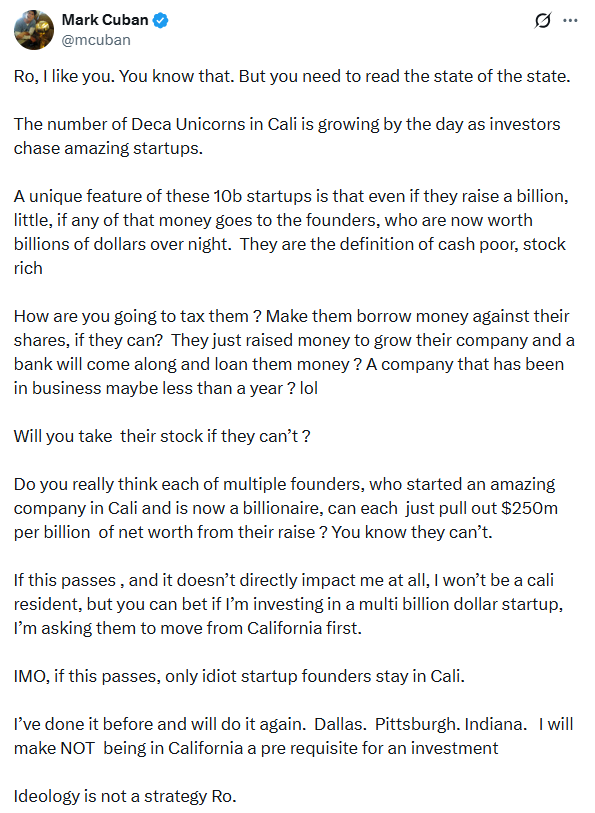
Mark Cuban Torches Ro Khanna, Threatens California Investment Exodus Over Billionaire Tax [WATCH]

Mark Cuban delivered a blunt business lesson to Rep. Ro Khanna after the California Democrat defended a proposed 5% wealth tax on billionaires.

Cuban warned that the measure could chase entrepreneurs, investors, and valuable companies straight out of the state.

The clash centered on California Proposition 40, a ballot measure that would impose a one-time tax on residents holding more than $1 billion in assets.

The California Democratic Party has endorsed the proposal, although Gov. Gavin Newsom has expressed opposition.

Khanna argued in a video posted to X that the tax would preserve health care services for working-class Californians.

He also accused the Sacramento political establishment and lobbyists fighting the measure of being out of touch with ordinary voters.

WATCH:

Cuban responded by pointing to a basic financial reality that tax-hungry politicians often ignore.

Startup founders can become billionaires on paper because their company shares rise in value, even though they may have nowhere near enough available cash to cover a massive tax bill.

“They are the definition of cash poor, stock rich,” Cuban wrote on X.

His point was simple: A valuable ownership stake is not the same thing as hundreds of millions of dollars sitting in a checking account.

Cuban warned that the proposal would give founders and investors a powerful reason to abandon California before the tax collector arrives.

“If this passes, only idiot startup founders stay in Cali,” he wrote.

The billionaire investor also made clear that the measure could change his own investment decisions.

“I will make NOT being in California a pre requisite for an investment,” Cuban continued, raising the prospect that promising California businesses could lose access to his capital.

Khanna attempted to answer the liquidity problem by proposing government loans for founders whose fortunes are trapped in private company shares.

“Why not a non recourse loan for pledged stock as collateral for this situation?” Khanna wrote.

Under Khanna’s idea, founders could pledge company shares to California as collateral, receive a government loan, and then use that money to pay the state tax.

The loan could remain outstanding for about 10 years before being repaid with cash or surrendered shares.

Cuban quickly identified the circular logic.

California would lend money to a founder, who would immediately return that same money to California as a tax payment, producing no new cash from that taxpayer when the transaction occurred.

The arrangement could also leave California holding ownership stakes in private companies if founders could not repay their loans.

Cuban mocked the possibility of government becoming an involuntary venture capital operation, writing, “Cali, You make it. We take it!”

Khanna insisted that the state would still receive money from wealthy residents with liquid holdings.

“The government would still collect from the vast majority of billionaires who are not illiquid,” he wrote, claiming that 72% of billionaire wealth is held in publicly traded stock.

Khanna then appealed to public resentment of wealthy Americans rather than Cuban’s concerns about investment and company formation.

“Mark, come on a road trip with me around California, Pennsylvania and the country and ask ordinary Americans how they feel about a billionaire tax,” Khanna wrote.

“Most say, I promise you, why only 5 percent?”

Cuban answered with the sort of directness rarely heard in Washington. “You don’t understand business Ro.”

He explained that a successful founder could spend a decade building a company, employing thousands of people, and paying enormous federal and state tax bills without ever holding $250 million in liquid assets.

Forcing that founder to sell shares could weaken control of the company and punish years of reinvestment.

“Is that what you want your state to be?” Cuban asked.

Khanna continued arguing that most of California’s roughly 250 billionaires would not face the liquidity challenge Cuban described.

Cuban’s sharpest criticism focused on what the tax would signal to entrepreneurs who pour their resources back into growing businesses.

Rather than rewarding job creation and risk, California Democrats would treat rising company value as an invitation for government confiscation.

The dispute exposes the central flaw in wealth taxes.

Politicians see a large valuation and imagine a pile of cash ready for Sacramento, while business owners see ownership, payroll, expansion, research, and years of risk.

California already struggles with residents and companies seeking friendlier tax climates elsewhere.

If Proposition 40 passes, Cuban’s warning suggests the state could accelerate that exodus and discover that successful people are perfectly capable of moving before Sacramento sends the bill.

News

Kentucky Concert Bloodshed Leaves One Dead and Four Wounded, Including Two Children [WATCH]

A deadly burst of gunfire tore through an outdoor concert in Lexington, Kentucky, on Saturday evening, leaving one person dead and four others wounded, including two children.

The mass shooting unfolded at Charles Young Park as people gathered for music in the heart of the city.

Authorities said the victims were shot at approximately 6:45 p.m. in the downtown park.

Two adults, a 14 year old, and a 4 year old were transported to a local hospital with injuries that were not considered life threatening.

One person was pronounced dead following the shooting, although officials did not immediately release the identity of the victim.

Information about the conditions of the surviving victims also remained limited as police worked to determine exactly what happened.

WATCH:

An outdoor concert was underway in Charles Young Park when the violence erupted, according to the Lexington Herald Leader.

What should have been a routine Saturday evening gathering instead became another chaotic crime scene filled with emergency crews, frightened families, and unanswered questions.

The shooting occurred a little more than a mile from the Hyatt Regency, where Kentucky Governor Andy Beshear was speaking at the Kentucky Democratic Party’s Moving Forward Together dinner.

Beshear interrupted his remarks to inform those attending the political event about the bloodshed unfolding nearby.

“Before I continue, I do need to let y’all know we do have some tough news tonight,” Beshear said.

“About a mile and a half from here, we’ve had a shooting actually since we started this dinner,” he continued.

“We have five people that I think received injuries and probably have one deceased.”

The proximity of the shooting to the governor’s appearance gave the tragedy an immediate political backdrop, but the focus remained on the victims and the hunt for answers.

Violence did not pause for speeches, dinners, or carefully planned party messaging.

A Lexington Police Department spokesperson told the Daily Mail that the investigation remained active at about 10 p.m. local time.

Detectives had been working for several hours by that point, but authorities were not prepared to provide additional information to the public.

“No further details are available at this time,” the department said.

Police did not immediately announce an arrest, identify a possible suspect, or disclose what may have triggered the shooting.

Officials also did not say whether investigators believed the attack was targeted or whether the victims had any connection to the gunman.

WATCH:

Lexington Police Chief Lawrence Weathers used a press conference to appeal directly to residents who may know someone capable of committing violence.

His message focused on reporting warning signs before another weapon is drawn and more innocent people are placed in danger.

“If you know somebody who might be inclined to use a weapon, please do anything you can do to let us know before something happens. Please let us know,” Chief Weathers said at a press conference.

The appeal reflected the difficult reality facing law enforcement officers who are often called after bullets have already started flying.

Police can investigate, gather evidence, and chase suspects, but information delivered before an attack can make the difference between prevention and another grim news conference.

The Charles Young Park attack came during a particularly violent Saturday that also included shootings in Michigan, Virginia, and Chicago.

The string of incidents placed several American communities under the familiar strain of police tape, hospital runs, frightened witnesses, and families waiting for word about loved ones.

Investigators in Lexington were expected to examine witness accounts, available surveillance footage, and physical evidence recovered from the park.

With a crowded public event underway, detectives may have numerous people to interview as they reconstruct the moments before and after the first shots.

The shooting left Lexington confronting the brutal consequences of violence in a public gathering place where children were present.

Residents now await an arrest and a clear explanation, while the families affected face consequences that no political dinner or official statement can erase.

News

Federal Judge Clears Path for Trump Administration to End Somali TPS [WATCH]

A federal judge has cleared the way for the Trump administration to terminate Temporary Protected Status for Somali nationals.

The decision removes a major legal obstacle as the White House pushes to restore firmer limits across the immigration system.

At issue is a federal program intended to provide temporary protection when conditions in a foreign country make returning dangerous.

TPS can shield qualifying foreign nationals from removal while also allowing them to obtain work authorization in the United States.

US Citizenship and Immigration Services has said that 2,471 Somali nationals are currently in the United States under TPS.

Another 1,383 Somali nationals have applications pending, putting thousands of cases within reach of the administration’s decision.

Those numbers are not merely abstract figures buried in another Washington spreadsheet.

They represent a sizable group whose ability to remain under this specific protection depends on whether the Somali designation continues.

TPS was designed as a temporary response to war, natural disaster, or other extraordinary conditions abroad.

It is not citizenship, permanent residency, or a promise that every designation must continue regardless of changing conditions or presidential policy.

Yet temporary programs in Washington have a familiar habit of sticking around far longer than advertised.

Once government protection is granted, activists often treat any attempt to end it as unthinkable, even when the word temporary is right there in the name.

The Trump administration has taken a much different approach, arguing that immigration protections should follow the limits established by law.

Supporters see the move as another necessary correction after years of policies that encouraged broad executive discretion with little meaningful restraint.

The federal court ruling gives the administration room to proceed with ending the Somali designation.

Although separate administrative steps may still be required, the judge’s action means the White House is no longer blocked by this particular legal challenge.

The ruling also carries broader significance because immigration policy has repeatedly been dragged into federal court.

Presidents possess substantial authority over immigration enforcement, but nearly every serious restriction now triggers another lawsuit from progressive groups and immigration advocates.

Critics of ending TPS are expected to argue that conditions in Somalia remain unstable and that returning nationals could create hardship.

But policy disagreements do not automatically grant courts the power to convert temporary immigration protection into a permanent arrangement.

Ending TPS also does not mean that every affected person will face the same immediate outcome.

WATCH:

Individual cases can involve other applications, legal claims, or immigration statuses that federal officials must review under existing law.

That distinction matters because political rhetoric frequently erases the difference between ending a broad designation and ignoring individual legal rights.

The administration can enforce the law while federal agencies process each case according to the applicable rules.

The central policy question is whether the executive branch can determine when a temporary designation has run its course.

Trump has consistently argued that elected leaders, not activist organizations or permanent bureaucrats, should make those decisions within the authority granted by Congress.

For the administration, the ruling marks another opening to carry out the immigration agenda voters endorsed.

It also puts pressure on federal agencies to move deliberately, explain their procedures, and avoid allowing another supposedly temporary program to become open ended by default.

The USCIS figures show why the case matters beyond legal theory, with 3,854 Somali nationals either protected or awaiting decisions.

The administration now has a clearer path to act, and the permanent Washington immigration lobby has one less courtroom barrier to hide behind.

News

‘You Can’t Sow Snoop Dogg and Reap The Cosby Show’: Delano Squires Nukes the War on Marriage [WATCH]

Author Delano Squires argued that rebuilding marriage and strengthening families should become a national priority, saying cultural, political and institutional changes are necessary to improve outcomes for children and communities.

During a discussion with Glenn Beck about Squires’ book The Vanishing Black Family, the two examined the cultural pressures surrounding marriage, particularly among young adults, and discussed what Squires described as the need for a broader “family reconstruction” movement.

Beck opened the conversation by describing what he sees as a cultural environment that discourages young people from marrying early in adulthood.

“The culture today is pushes against, Wait, you’re in college and you’re going to get married? What is wrong with you? I mean, that is such a big boulder to push out of the way.”

Squires responded by pointing to several colleges where he believes marriage and long-term relationships are viewed more positively.

“It is. Now, I could think of, you talked about BYU, I know graduates from Hillsdale, Liberty University.”

He also described a recent conversation with an intern at The Heritage Foundation.

“I talked to an intern at Heritage the other day. She said she estimated about 55% of her classmates are either in long-term relationships, engaged, or married by the time they finish their undergraduate studies.”

According to Squires, the intern told him that environment creates social expectations favoring marriage.

“Excellent. And she said it actually creates pressure on those who are not.”

Squires said he would welcome similar circumstances at historically Black colleges and universities.

“And I said, Oh boy, I would love that problem at at HBCUs. I would love to deal with that problem.”

He argued that strengthening marriage requires both institutional and individual efforts.

“So yeah, so it there’s an institutional response.”

Squires said one aspect of his book focuses on what he views as political barriers to increasing marriage rates.

“One of the things that makes this book different than than anything else that people have seen is that I also name the political obstacles to a marriage revival movement.”

He identified several groups that he believes oppose those efforts.

“Obviously, they include feminists, they include LGBT activists, they include abortionists because Planned Parenthood understands that close to 90% of women who seek abortions are unmarried. So, more marriage means less business for for Planned Parenthood.”

Squires also criticized what he described as a preference among some policymakers for expanding government programs instead of strengthening families.

“They they they also include big government liberals because for them the answer is not, you know, a different and stronger family structure. For them, it’s always more government spending to address issues in low-income communities.”

He also devoted part of the discussion to media and entertainment, arguing that popular culture has influenced attitudes toward relationships.

“And and then I I talk about the importance of media.”

Squires said decades of hip-hop culture have contributed to unhealthy relationship dynamics in some communities.

“But I  argue in in that chapter, this is chapter eight of The Vanishing Black Family, that you cannot sow Snoop Dogg and reap The Cosby Show, right?”

He continued by describing what he believes has been the effect of music on perceptions of relationships.

“Because I end up, I talk about the impact of 40 plus years of hip-hop culture, 40 close to 35, 40 plus years of young men in inner-city neighborhoods who most closely identify with the artists hearing the people that they look up to referring to the young women in their community as, you know, sexually promiscuous, as all types of degrading names and terms, those things are not healthy for or are not good for healthy relationship bonds, marital relationships, or they don’t create the types of environments where where couples can thrive and and children can benefit from both parents.”

Squires said lasting cultural change will require both institutional reforms and personal responsibility.

“So, it’s an institutional response. There’s an individual response.”

He concluded by arguing that discussions about family should focus primarily on children rather than adults.

“But the biggest thing that I that I argue is that we have to reframe the issue of family reconstruction, and this goes for Americans across the board, not just in the black community.”

Squires explained that his proposed framework centers on children’s needs.

“But we have to reframe the issue of family reconstruction away from the desires of adults and towards the rights and needs of children, specifically the idea that children have a right to the affection, protection, connection, correction, and direction of the one man and one woman that created them, and that that right is best exercised in a loving, low-conflict home.”

He said that message should become the foundation for broader cultural efforts.

“So, so it’s about reframing the issue and then giving that message to the most important institutions needed to drive cultural change.”

WATCH:

News

Hundreds of Noncitizens in Michigan Jury Pools Under Jocelyn Benson, Dozens Linked to Voter Rolls [WATCH]

Rep. John James criticized Michigan Secretary of State Jocelyn Benson during a recent interview, accusing her of mismanaging election-related matters and arguing that his background in military service, business and Congress makes him better suited to serve as Michigan’s next governor.

Appearing with Fox News host Kayleigh McEnany, James responded after McEnany suggested Benson was attempting to claim credit for election integrity efforts.

“Election integrity, but she’s trying to take some credit here.”

James rejected that characterization and accused Benson of overseeing election-related controversies during her tenure as secretary of state.

“Exactly the opposite. You’re exactly right, Kayleigh.”

He continued by criticizing Benson’s dual role as secretary of state while seeking higher office.

“This is the exact same woman who’s presiding over her own election for governor.”

James also referenced litigation involving Benson’s office.

“The same woman who’s lost five lawsuits due to her malfeasance in elections, not the least of which was putting her thumb on the scale in 2020 in the state of Michigan.”

He further alleged that coordination between state and local officials had been inadequate regarding election administration.

“She is actually not coordinating with feds and not coordinating with local county officials.”

James then turned to concerns involving jury duty rolls and voting records.

“But the fact they’ve let hundreds of illegals on our jury duty rolls, and there are over a dozen that we found who voted in our elections.”

According to James, those issues warrant additional explanation from Benson.

“Jocelyn Benson has a lot of explaining to do.”

He also questioned Benson about what he described as her past involvement with the Southern Poverty Law Center.

“Again, also what her role was on the SPLC board when they gave money to the KKK.”

James summarized his criticisms by arguing that Benson lacks the qualifications needed to lead Michigan.

“She is the least transparent, least cooperative, and least qualified human being to possibly be governor of the state of Michigan.”

He then contrasted Benson’s record with his own experience.

“Which is why I’m excited to bring my experience as a combat veteran fighting after 9/11 in Iraq.”

James also highlighted his business background.

“A business leader who’s created jobs in Detroit.”

He concluded by pointing to his current role in Congress and his work with the Trump administration.

“And someone who’s in Congress working with the president to actually bring resources back to the state of Michigan to make Michigan great again.”

McEnany closed the interview by thanking James for joining the program.

“Congressman John James, we are watching.”

WATCH:


Throughout the interview, James argued that Michigan voters should compare his military service, private-sector experience and congressional record with Benson’s tenure as secretary of state.

He maintained that his focus would be on working with the federal government to secure additional resources for Michigan while promoting economic growth and improving state government.

James also reiterated his concerns about election administration under Benson’s leadership, saying voters deserve answers regarding the issues he raised as Michigan prepares for the next gubernatorial election.


Scroll to Top