Author name: Common Defense

News

Marines Lead Fierce Race to Save Lives in Venezuela Quake Zone

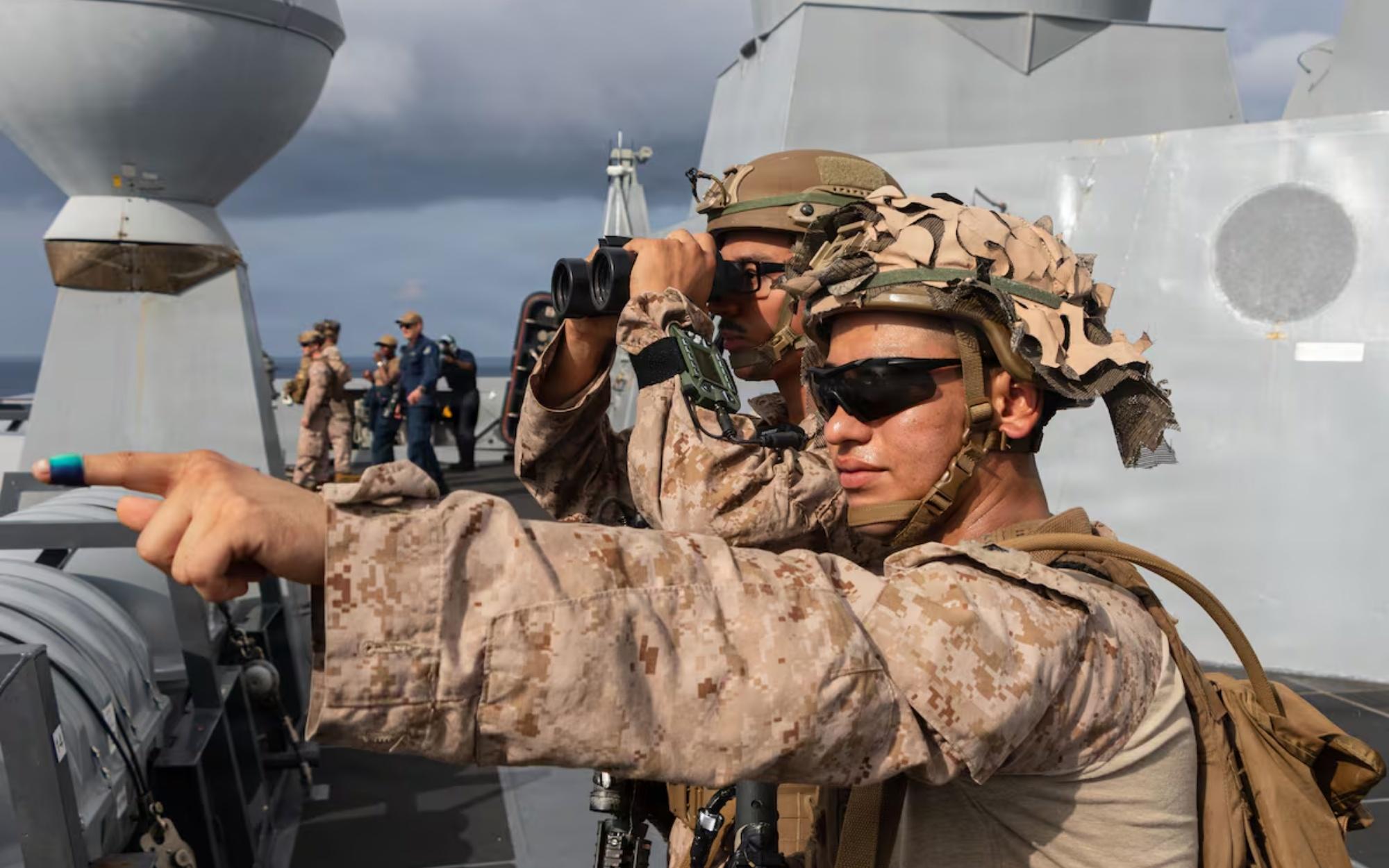
U.S. Marines are grinding through mountains of collapsed concrete and rebar in northern Venezuela, working shoulder to shoulder with local rescue teams to find survivors of last week’s devastating earthquakes.

The work is grueling, hazardous, and urgent. “We’re racing against the clock,” said U.S. Southern Command, which oversees the mission.

The back-to-back quakes struck on June 24, pounding Yaracuy state west of Caracas with staggering magnitudes of 7.2 and 7.5. Within seconds, whole blocks were flattened, leaving more than 1,450 people confirmed dead and thousands still unaccounted for.

The devastation is severe enough that U.S. forces deployed immediately, with Marines, sailors, and airmen forming the core of an expanding international effort to search the wreckage.

The Marines are operating in coordination with Venezuelan emergency responders, who have publicly thanked the U.S. teams for their speed and toughness.

Working day and night, American and allied personnel are crawling through unstable debris, using thermal imaging and acoustic sensors to detect faint signs of life.

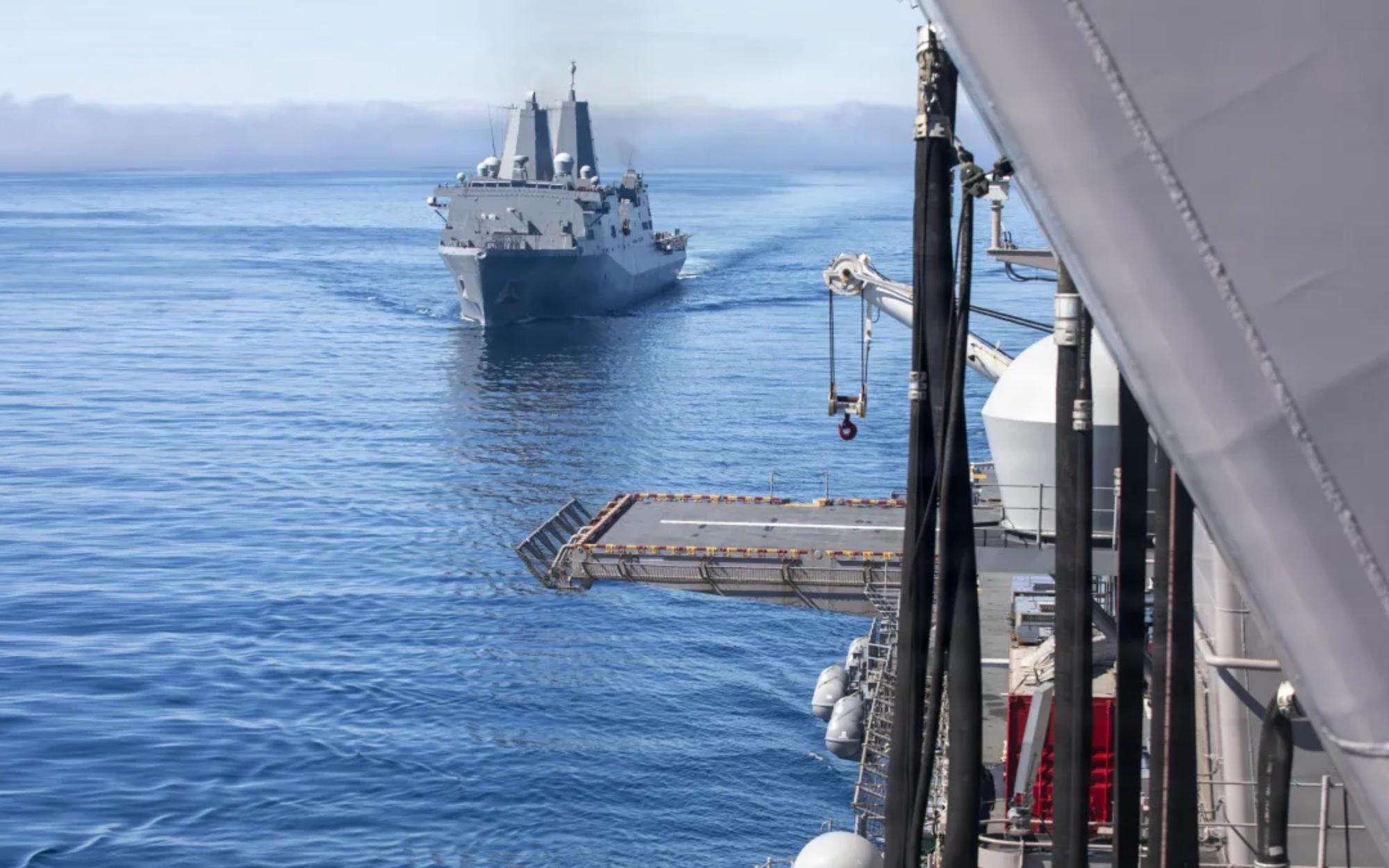
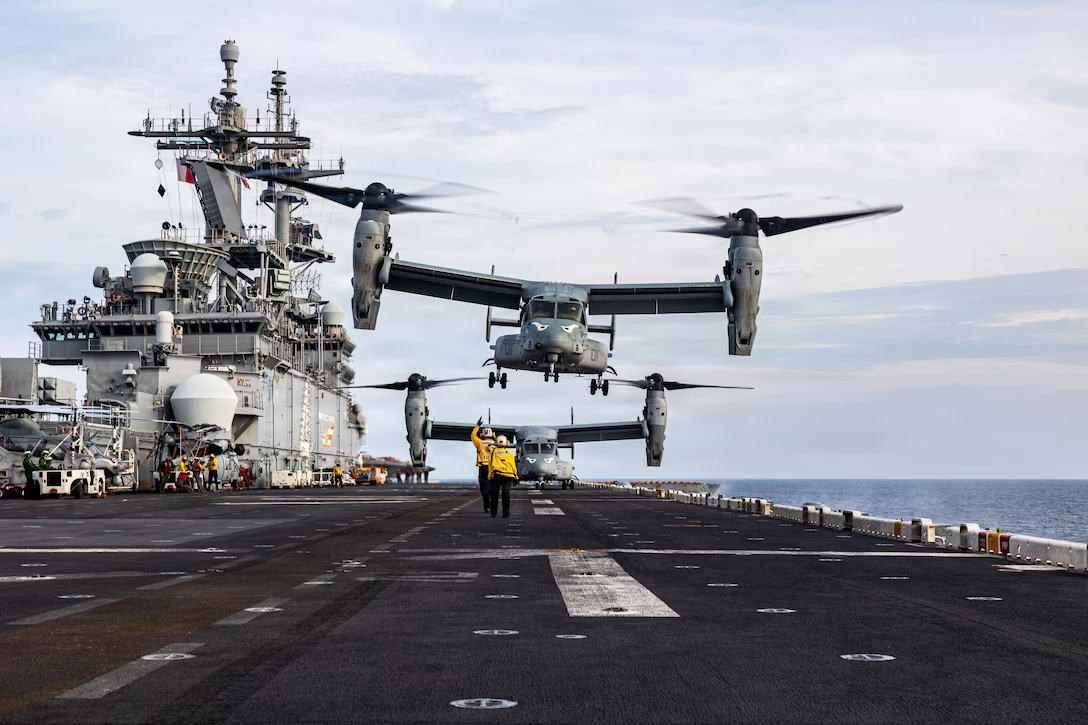
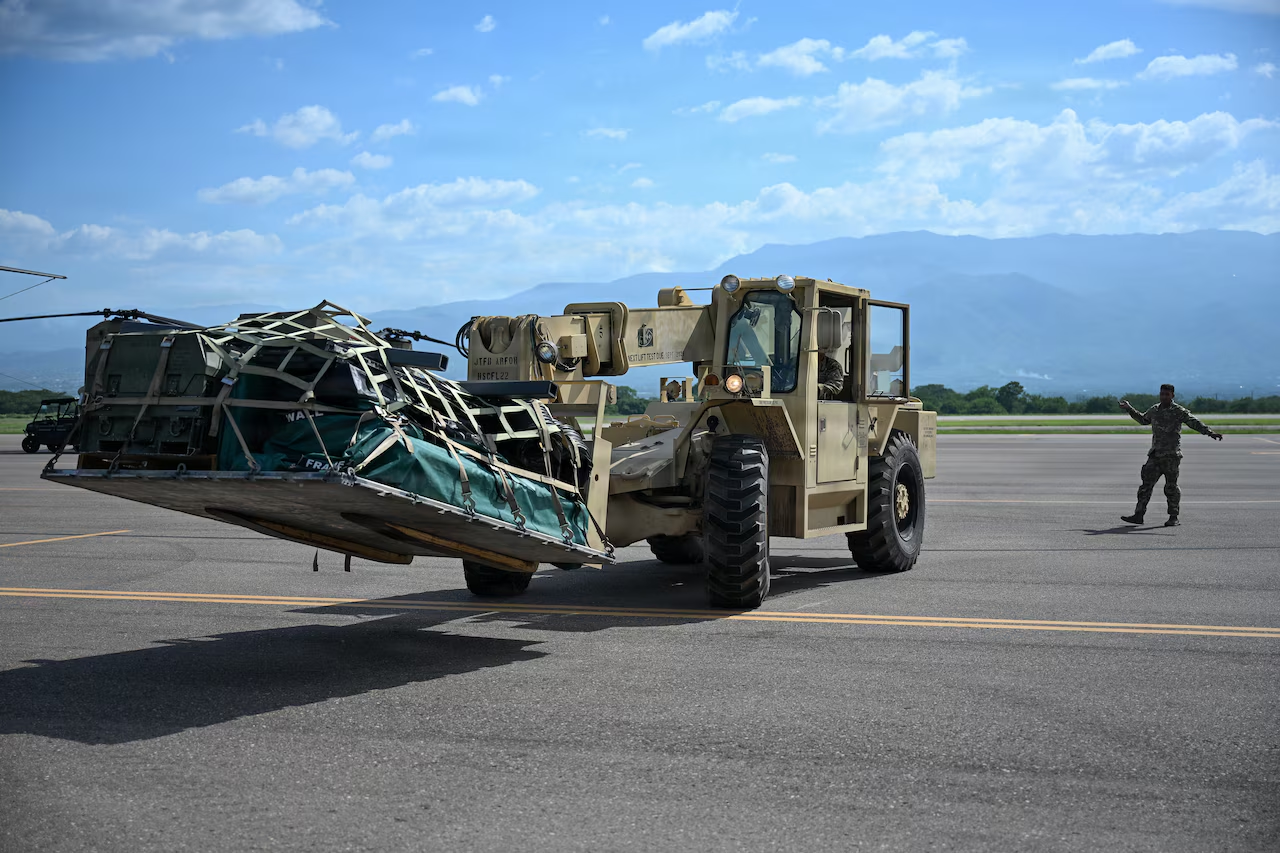
U.S. Air Force C-17 and C-130 transport aircraft have been ferrying in supplies and personnel, while Marine MV-22 Ospreys shuttle teams between impact zones. Meanwhile, Army CH-47 Chinooks and U.S. Navy ships stationed off the coast provide additional lift and logistics.
Marines Lead Fierce Race to Save Lives in Venezuela Quake Zone
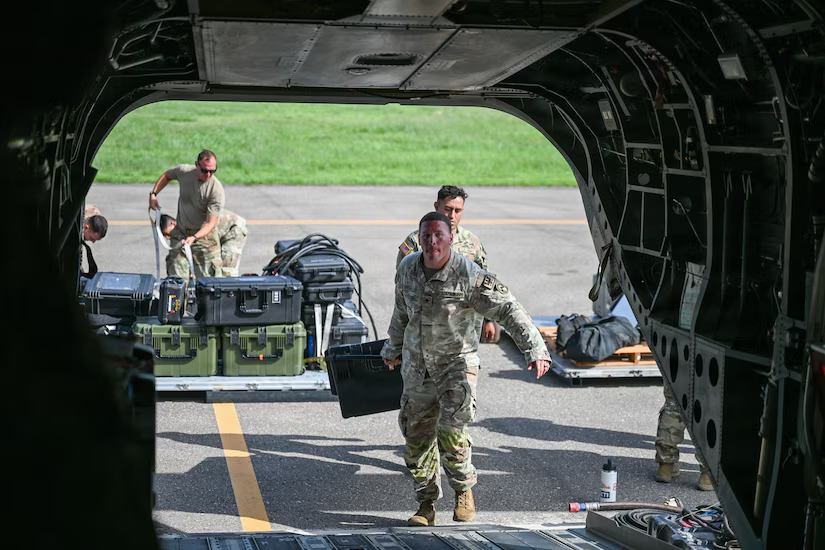
Two men wearing camouflage military uniforms load a case into the back of a military cargo aircraft. Other men in camouflage military uniforms pack supplies onto a pallet.
Joint Task Force Bravo members load equipment into a CH-47 Chinook helicopter in preparation for potential support to Venezuela’s disaster relief response at Soto Cano Air Base, Honduras, June 25, 2026.

The War Department stressed that the operation is entirely self-sustaining, with troops relying on their own food, fuel, and medical resources.

Images released by U.S. Southern Command show Marines covered in gray dust beside Venezuelan police officers, pausing briefly between shifts before digging again.

One photo shows a Venezuelan rescuer gripping a U.S. Marine’s hand as they push through a narrow gap in the rubble—a powerful reminder of how disaster strips away politics when lives hang in the balance.

Major General Kevin Jarrard of the U.S. Marine Corps arrived on site soon after the earthquakes to guide the American response.

According to SOUTHCOM, Jarrard and his forward team are coordinating directly with Venezuela’s interim government led by Delcy Rodriguez, who requested U.S. assistance after years of strained relations under former dictator Nicolas Maduro.

That cooperation itself is a major shift. In January, U.S. special operations forces successfully captured Maduro and his wife during a daring nighttime raid, ending his long tenure of socialist misrule.

Since that mission, Venezuela has been tentatively rebuilding institutional stability—and this earthquake has become the first major test of the new leadership’s willingness to work with Washington.

So far, the coordination has been remarkably smooth. The Marines’ arrival was met with visible gratitude from civilians and overwhelmed first responders who had been digging with shovels and bare hands. One Venezuelan volunteer described the Marines’ effort simply: “They don’t stop.”
Marines Lead Fierce Race to Save Lives in Venezuela Quake Zone

The mission has also become a striking demonstration of what American might looks like when used for good. The same precision, logistics, and discipline that dominate the battlefield have been redirected toward saving lives in one of the worst natural disasters in South American history.

Despite that humanitarian focus, safety remains a challenge. The terrain is unstable, aftershocks continue, and temperatures soar during the day.

“Every move we make has to be deliberate,” one Marine engineer officer said. “There are whole sections of collapsed structures that could shift at any second.”

Military analysts have noted that operations like this highlight why a robust American military presence matters far beyond conflict zones.

Without the airlift capacity, logistics, and command coordination that the War Department can mobilize, such large-scale rescues would be nearly impossible. When crisis strikes, humanitarian rhetoric doesn’t save lives—boots, muscle, and organization do.

As Marines pull back debris piece by piece, the broader mission continues to grow. U.S. Navy divers are expected to assist in coastal regions where fishing towns were washed out by quake-triggered waves.

Medical teams are setting up mobile field hospitals, and combat engineers are beginning to assess long-term rebuilding needs.

For now, though, the mission remains singular. The search continues through shattered buildings and broken neighborhoods as U.S. Marines, Venezuelan responders, and international volunteers fight exhaustion and fading hope.

In the chaos, America’s warriors once again prove they’re not just the best at fighting wars—they’re the best at saving lives when the world collapses.

News

Kim Jong Un Flaunts New Missile Tests On Korean War Anniversary as Tensions Rise

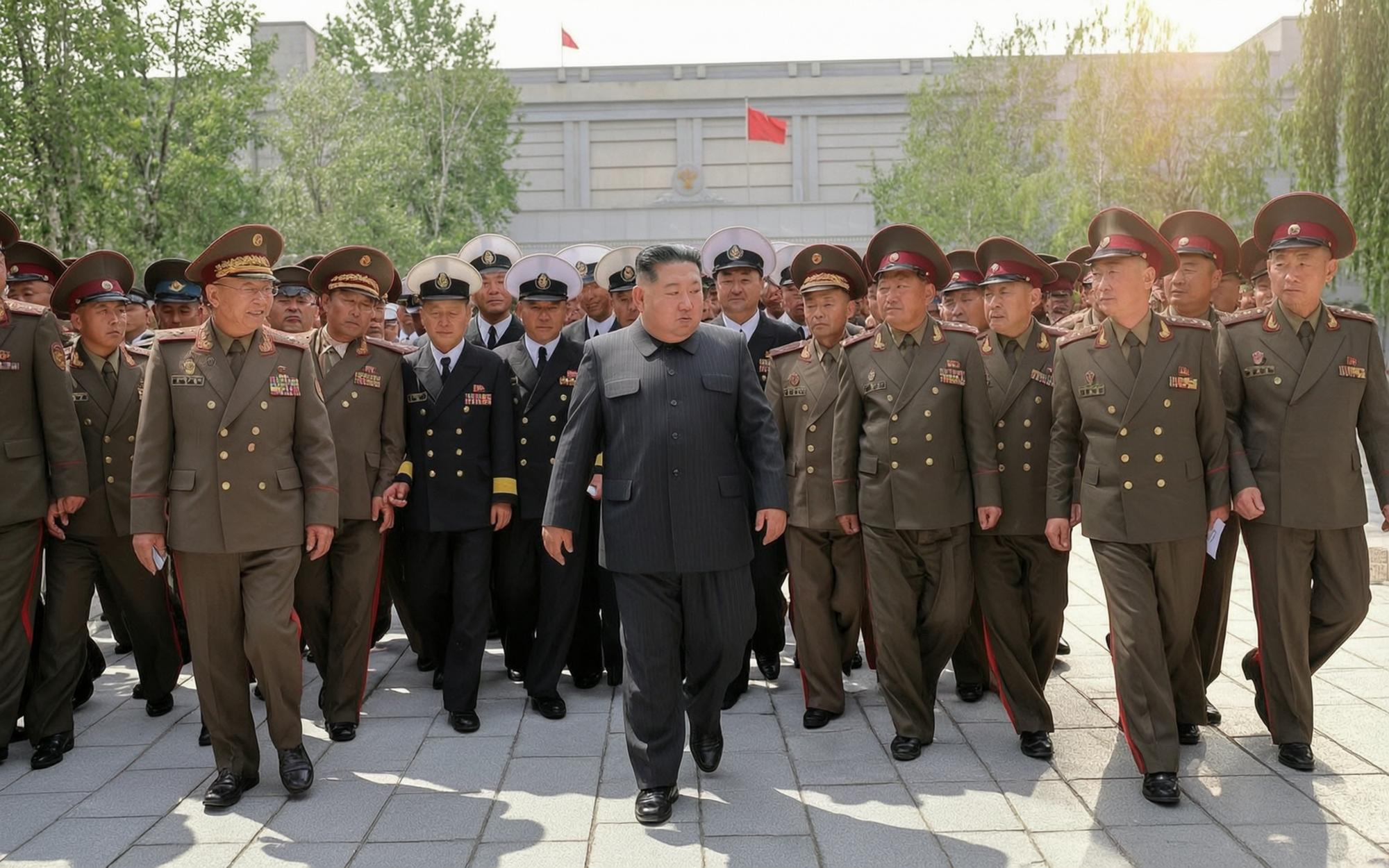
North Korea’s dictator Kim Jong Un marked the 75th anniversary of the Korean War with what he called a “modernization showcase,” personally overseeing a series of missile and artillery tests aimed squarely at unnerving both Seoul and Washington.

According to the regime’s own mouthpiece, KCNA, Kim’s test lineup included an upgraded 240mm multiple rocket launcher system, a tactical ballistic missile warhead, and a 155mm self-propelled howitzer.

The state’s report bragged that the new rocket launcher’s range is extending to 56 miles, while the howitzer achieved a roughly 40-mile reach—figures designed to send chills across the Korean Peninsula.

Kim proudly claimed the launches were proof that his drive to expand and automate North Korea’s arsenal is paying off.

Kim declared that “firepower improvement” remains at the core of his so-called national defense plan and insisted the advances were part of a policy to outmatch world powers.

“Automation, precision, and extended reach,” said Kim, are the way forward for his military buildup.

South Korean officials verified that the regime launched multiple projectiles between 7:27 and 8:20 a.m., immediately detecting and tracking them in coordination with U.S. assets.

Lee Kyung-ho, deputy spokesman for South Korea’s Ministry of National Defense, said extra analysis would determine full details, describing the weapons as “tactical-level systems.”

Lee also took a strangely defensive tone toward reporters, telling them to avoid “politically interpreting and disparaging the contributions of South Korean and U.S. service members.”

His remarks came after South Korean daily Chosun Ilbo blasted the ministry for failing to promptly reveal details of the launches—a rare cover-your-tracks moment by Seoul’s leadership.

The controversy erupted because the War Ministry typically alerts local press immediately after a North Korean launch. Chosun Ilbo questioned whether officials delayed disclosure out of incompetence or to downplay the tests ahead of national political events.

A Stronger, Smarter Presence: Trump-Era Vision Strengthens South Korea Force with Longer Deployments
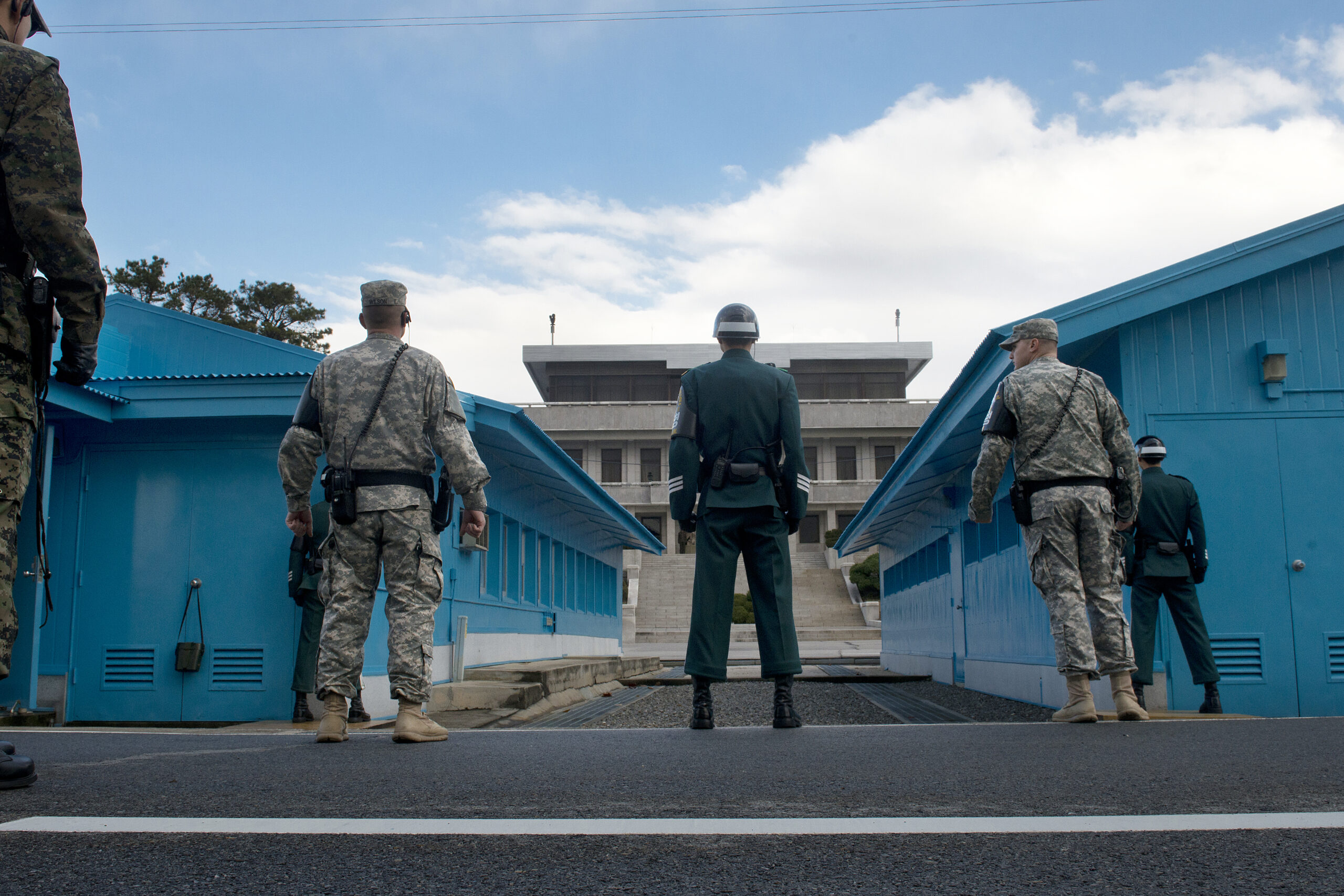
Republic of Korea and U.S. Soldiers at the demilitarized zone in South Korea facing North Korea on Nov. 11, 2012. DoW photo by D. Myles Cullen

That’s not a good look when Pyongyang’s routinely making threats and South Koreans are increasingly skeptical of their own government’s backbone.

Lee attempted to smooth things over by claiming that the government had monitored the launch “in real time” but needed “further verification” before making any statement. Many observers aren’t buying it.

With North Korea growing bolder and China lurking in the background, perception matters—and Seoul’s hesitation sends the wrong signal.

The tests continue a relentless pace this year, with April’s salvos focused on surface-to-surface Hwasong-11 Ra missiles and cluster bomb–equipped versions of tactical ballistic missiles.

For a regime that routinely struggles to feed its people, North Korea has no trouble pouring every available resource into weapons factories.

Kim has grander ambitions too. Just weeks earlier, he pledged to further expand the nation’s nuclear stockpile and accelerate construction of a 10,000-ton missile cruiser—essentially a floating launch platform for regional intimidation. His instruction to his generals was to fortify national defense “without pause,” vowing to “overtake the world.”

A Stronger, Smarter Presence: Trump-Era Vision Strengthens South Korea Force with Longer Deployments

The bluster is typical, but observers note the progress in North Korea’s missile program is real and troubling.

Last week, President Donald Trump signed an extension of the long-standing national emergency over North Korea for another year, calling Pyongyang’s weapons program an “unusual and extraordinary threat” to U.S. national security and global stability.

The decision, filed June 22 and published two days later, ensures continued sanctions and vigilance against the Hermit Kingdom’s war machine.

That emergency order, first issued in 2008, has been renewed annually by successive administrations, but under Trump, it carries renewed clarity: deterrence through strength, not platitudes.

Kim Jong Un Orders North Korean Army To Fortify Border Into ‘Warproof Wall’

The White House message is clear—peace through power, and no illusions about Pyongyang’s intent.

While the Biden liberals once downplayed North Korean provocations and mumbled about “engagement,” Trump and Secretary of War Pete Hegseth have reaffirmed real deterrence through readiness, missile defense modernization, and joint military drills. North Korea understands muscle, not meekness.

As Pyongyang doubles down on its ambition and Seoul fumbles for composure, the U.S. remains the indispensable backbone of deterrence across the Indo-Pacific. The anniversary of the Korean War reminds the world why eternal vigilance is not optional—it’s survival.

News

Army Unites Classic Bayonet Division with Cutting-Edge Multi-Domain Force to Form New Pacific Powerhouse

The U.S. Army is fusing its historic grit with 21st-century technology in a bold restructuring that carries both symbolic and strategic weight.

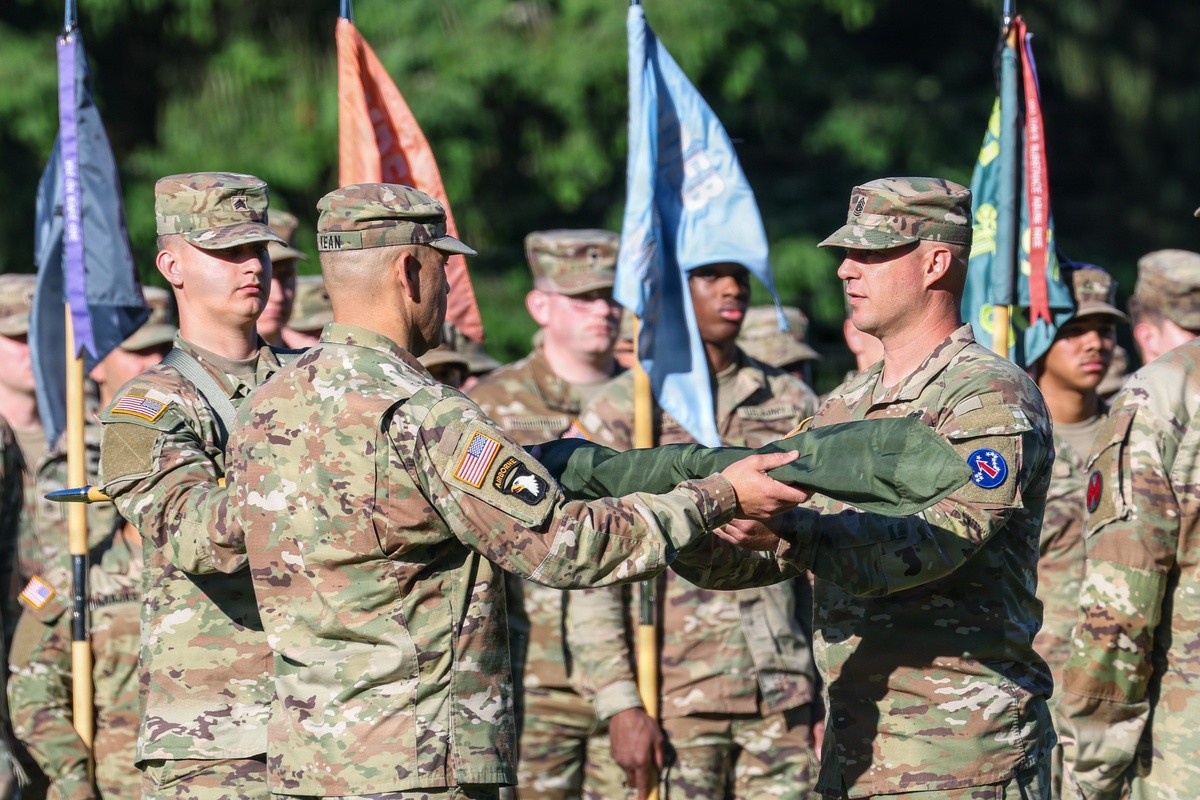
Amid cannon salutes and rousing brass, the ceremony at Joint Base Lewis-McChord marked the rebirth of the legendary 7th Infantry Division—now officially the 7th Infantry Division (Multi-Domain Command-Pacific).

For over a century, the “Bayonet Division” has been synonymous with American resolve, from the trenches of France to the battlefields of Korea and the mountains of Afghanistan.

But on this June morning, Army leaders made clear that the next battlefield may not be fought purely on land. Space, cyber, electronic warfare, and hypersonic weapons are now part of the modern arsenal—and the new 7th Infantry Division will command them in the Pacific theater.

Maj. Gen. Bernard J. Harrington explained that combining the traditional 7th Infantry Division with the 1st Multi-Domain Task Force represents more than administrative reshuffling.

“We merged a traditional ground force with new and emerging capabilities like space, electronic warfare, and cyber information,” Harrington said. The goal, he added, is to ensure American combat dominance “as the character of war is moving forward.”

The unit, now totaling approximately 12,000 soldiers, remains based at Joint Base Lewis-McChord—positioned strategically to project power across the Pacific Rim. That geographic focus is no accident.

With rising tensions in the South China Sea and growing Chinese aggression threatening regional stability, the U.S. Army is clearly placing its newest formation where it may one day be needed most.

Gen. Ronald P. Clark, commander of U.S. Army Pacific, underscored how the redesignation connected past valor with future readiness. “This ceremony is not simply symbolic,” Clark stated.

“It honors the sacrifices of those who came before us while affirming our readiness for the challenges ahead.” His message was crystal clear: the 7th Infantry Division’s history is a foundation, not a museum piece.

The division’s combat lineage stretches deep into America’s hardest fights—World War I, Okinawa, Korea’s Pork Chop Hill, and Panama’s Operation Just Cause.

That record of service now meets a technological transformation that would be unrecognizable to those World War II dogfaces who carried the division’s double-triangle patch through the Pacific campaign.

Army Unites Classic Bayonet Division with Cutting-Edge Multi-Domain Force to Form New Pacific Powerhouse
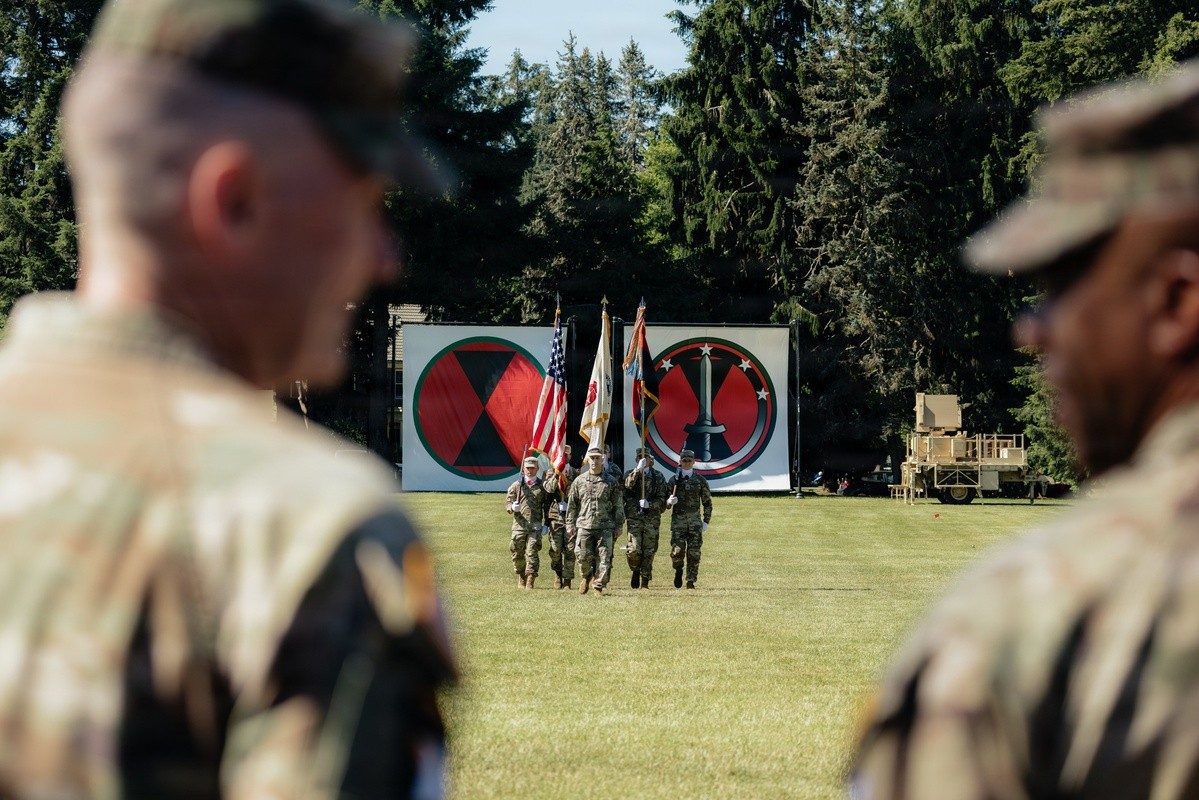
Maj. Gen. Bernard Harrington, 7th Infantry Division (Multi-Domain Command – Pacific) Commanding General (left), and Gen. Ronald Clark, U.S. Army Pacific Commanding General (right), look on as Col. Andrew Gallo, 7th Infantry Division (Multi-Domain Command – Pacific) Chief of Staff (center), marches the color guard during the 7th ID (MDC-PAC) redesignation ceremony at Joint Base Lewis-McChord, Wash., June 18, 2026. The redesignation honors the Bayonet Division’s legacy while establishing 7th ID (MDC-PAC) as the Army’s newest theater-enabling command, built to integrate maneuver, fires, air defense, cyber, space, electronic warfare, intelligence, unmanned systems, sustainment, and command and control in support of the Joint Force across the Pacific. (U.S. Army photo by Staff Sgt. Cayce Watson) (Photo Credit: Staff Sgt. Cayce Watson)

Adding a sharp edge to the day’s symbolism, Clark floated a new nickname: “The Hypersonic Bayonet Division.”

The title reflects the Army’s confidence in its cutting-edge Long-Range Hypersonic Weapon, known as Dark Eagle, which will soon be fielded by this very unit. The weapon can reportedly strike targets more than 1,700 miles away at five times the speed of sound—an arsenal worthy of both respect and deterrence.

If the 7th Infantry Division once represented the grit of the U.S. fighting man, its updated version fuses that heritage with the technological punch needed to face modern threats.

The combination of kinetic and non-kinetic warfare tools—alongside traditional infantry expertise—means adversaries in the Indo-Pacific will now face an American force that can see, strike, and disrupt across multiple domains.

Even as the ceremony unfolded with fresh insignias, marching formations, and a patch-switching ritual between the units, soldiers on the ground seemed unmoved by the bureaucratic changes.

“It’s nothing different,” said Staff Sgt. Jerald Everett of a HIMARS rocket battery. “It’s just a change in who’s paying our bills and who tells us where to go. We just have to do our jobs and do them well.” That grounded attitude remains a hallmark of American warriors—mission first, politics last.

Maj. Gen. Harrington emphasized that this redesignation is not about fancy titles—it’s about preparing for how future wars will be fought. “It is our soldiers’ sense of purpose,” he said.

“Being experts at that mission, still within the same organization, but optimizing for the joint force moving forward.” His statement resonated with the idea that victory in future conflicts will hinge not just on courage and numbers, but on the fusion of information, precision, and relentless readiness.

The brass band may have played for the crowd, but in truth the music marked the march of U.S. Army evolution—an institution that honors its traditions while adapting aggressively to new wartime realities.

With America refocusing attention on the Pacific under strong leadership in Washington, the creation of this multi-domain powerhouse signals that deterrence remains alive and well.

Under a reinvigorated War Department and leadership like War Secretary Pete Hegseth, the message to Beijing and beyond could not be clearer: the United States is not retreating from its role as the Pacific’s guardian force.

The new 7th Infantry Division (Multi-Domain Command-Pacific) is built to fight and win in the most complex battlefields on Earth—and its presence will ensure that America’s enemies think twice before testing its resolve.

At Joint Base Lewis-McChord, under the sharp Washington sky, the Bayonet Division’s rebirth represented more than a change of name. It stood as a pledge that American soldiers, armed with both valor and advanced weaponry, remain the vanguard of freedom in the Indo-Pacific and beyond.

News

Marines and Japanese Forces Unleash Fierce Firepower in Island Warfare Drills

At the Hijyudai Maneuver Area in Oita, Japan, American Marines and Japanese soldiers have been putting serious steel on target during this year’s “Resolute Dragon” exercise.

The operation is part of a growing focus on how allied forces would capture and defend contested islands in the Pacific, a region that’s increasingly in the crosshairs of China’s ambitions.

Fighting shoulder to shoulder, ninety U.S. Marines from the 12th Littoral Combat Team joined about 300 troops from Japan’s 8th Division in an intense live-fire event that lasted roughly an hour and a half.

Mortars, rifles, and heavy vehicles all roared across the rugged Kyushu training ground in a scene that could easily mirror the start of a real island campaign.

Watching intently from the sidelines were troops and officers from the United Kingdom, France, Australia, and the Philippines—all nations watching China’s growing naval reach with more than a little concern.

The live-fire sequence wasn’t just for show. It was a textbook run of the new expeditionary warfare tactics that the Marine Corps and its Japanese partners have refined through multiple iterations of this annual drill.

According to 1st Lt. Owen Hitchcock, spokesman for III Marine Expeditionary Force, the focus was on mastering “command and control” under simulated battlefield chaos while integrating “joint fires capabilities.”

Marines and Japanese Forces Unleash Fierce Firepower in Island Warfare Drills
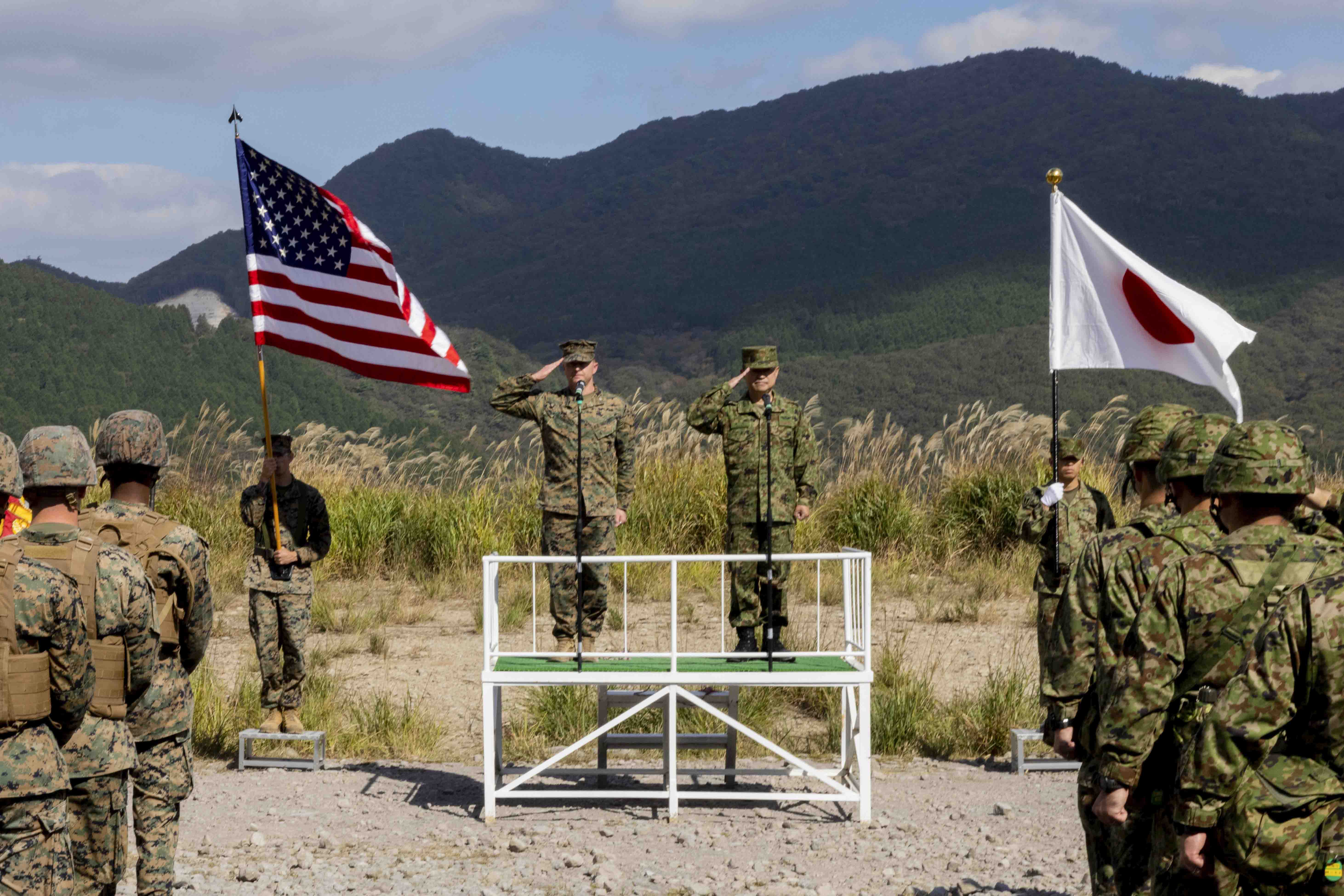
U.S. Marine Corps Col. Peter Eltringham, left, commanding officer of 12th Marine Regiment, 3d Marine Division, and Japan Ground Self-Defense Force Lt. Gen. Shinichi Aoki, commanding general of 8th Division, Western Army, render a salute during an opening ceremony for the field training exercise portion of Resolute Dragon 23 at Hijyudai Maneuver Area, Oita, Japan, Oct. 17, 2023. RD 23 is an annual bilateral exercise in Japan that strengthens the command, control, and multi-domain maneuver capabilities of Marines in III Marine Expeditionary Force and allied Japan Self-Defense Force personnel. (U.S. Marine Corps photo by Cpl. Paley Fenner)

That means small, mobile units fighting smart, staying spread out, and hitting targets before the enemy even sees them. As Hitchcock put it, the sprawling Hijyudai range “offers a lot of great areas for us to practice what really matters.”

The exercise centered on what the Marines call Expeditionary Advanced Base Operations—a core part of the Corps’ Force Design overhaul that puts the emphasis on fast, lethal, island-hopping teams instead of lumbering conventional formations.

These units are trained to slip inside the range of enemy missiles, seize strategic islands, and deny access to rival navies. It’s a modern throwback to the World War II island campaigns—leaner, meaner, and built for the high-tech battlefield of tomorrow.

Resolute Dragon, now in its sixth year, wrapped up its ten-day run with live-fire confidence and joint precision that both sides say is improving with each rotation.

The 12th Marine Littoral Regiment, established in late 2023, is the spearhead of this new approach and has taken part in the drill since its formation.

Expectations for the littoral units are high. They’re meant to move light and fast, seize and hold key ground, and work seamlessly with air and naval assets to crush any enemy approach.

Lieutenant Ellen Sullivan, the regiment’s spokeswoman, said this year’s event proved that each iteration with their Japanese counterparts only strengthens the operational bond and “that human connection” critical to real battlefield effectiveness.

Marines and Japanese Forces Unleash Fierce Firepower in Island Warfare Drills
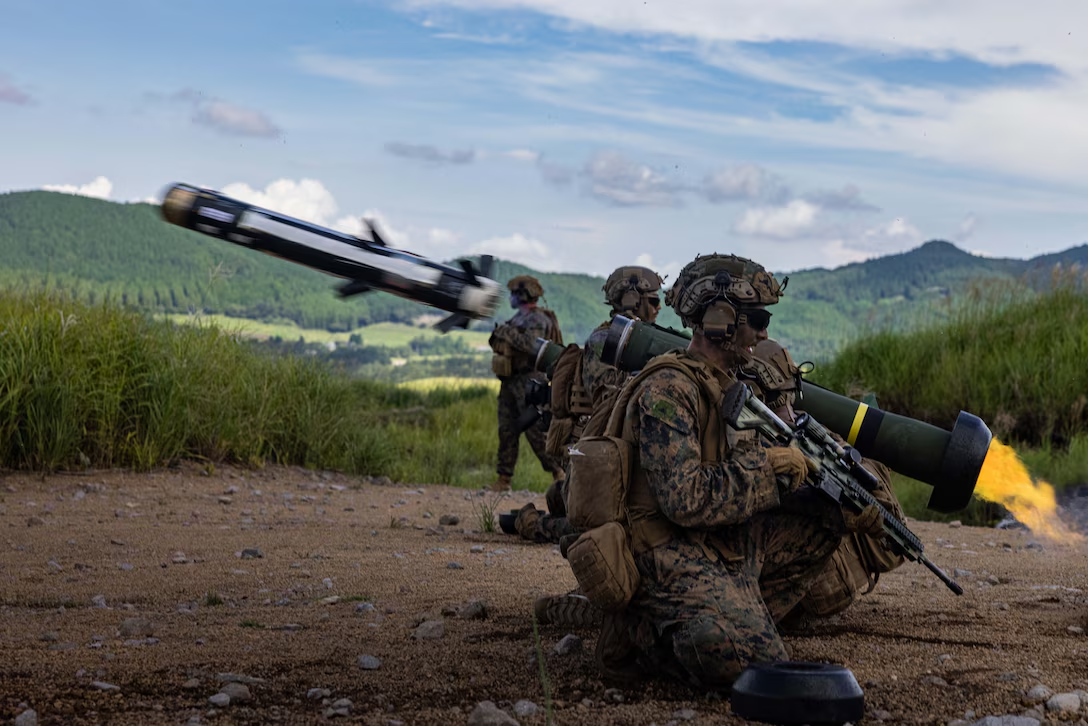
Marines fire an FGM-148 Javelin during Resolute Dragon 25 at Hijudai Maneuver Area, Japan, Sept. 15, 2025. The U.S.-Japan exercise strengthens the countries’ command, control and multidomain maneuver capabilities in key maritime terrain.

The simulated battle opened with a booming show of firepower from Japan’s Type 19 self-propelled howitzers, lobbing 155mm shells onto the target zone.

Japanese Type 16 Maneuver Combat Vehicles followed, rolling through the smoky terrain as the combined forces advanced. This is precisely the type of joint precision operation that would be needed if China ever turned up the heat near Japan’s southern islands or Taiwan.

Hitchcock explained that the artillery barrage was essential to “set conditions for ground troops” to move up safely through enemy fire zones, creating what he called “that overhead column” of suppressive power.

Once the guns fell silent, Marines charged forward beside Japanese armored carriers, working methodically through flanking positions and simulated territorial counterattacks.

Tech played a major supporting role as well. Drones crisscrossed the skies—some small, nimble, and controlled through first-person view, while a larger Stalker VXE30 soared above everything, feeding live tactical data to the ground units. Corporal James Ciccone described how the Stalker’s infrared sensor allows detection of “enemies at night.”

He explained that the drone can drop a virtual reference point on a mortar impact and another on a target, helping mortarmen make ultra-fast corrections for pinpoint accuracy.

It’s the kind of seamless tactical integration the War Department has been pushing for—unit-level awareness combined with precise joint fire that can hit, move, and hit again before the enemy can mount a serious response.

That’s the future Secretary of War Pete Hegseth and President Trump’s revitalized national defense strategy have envisioned: U.S. and allied forces building unmatched readiness in the Indo-Pacific to deter aggression before it starts.

Marines and Japanese Forces Unleash Fierce Firepower in Island Warfare Drills
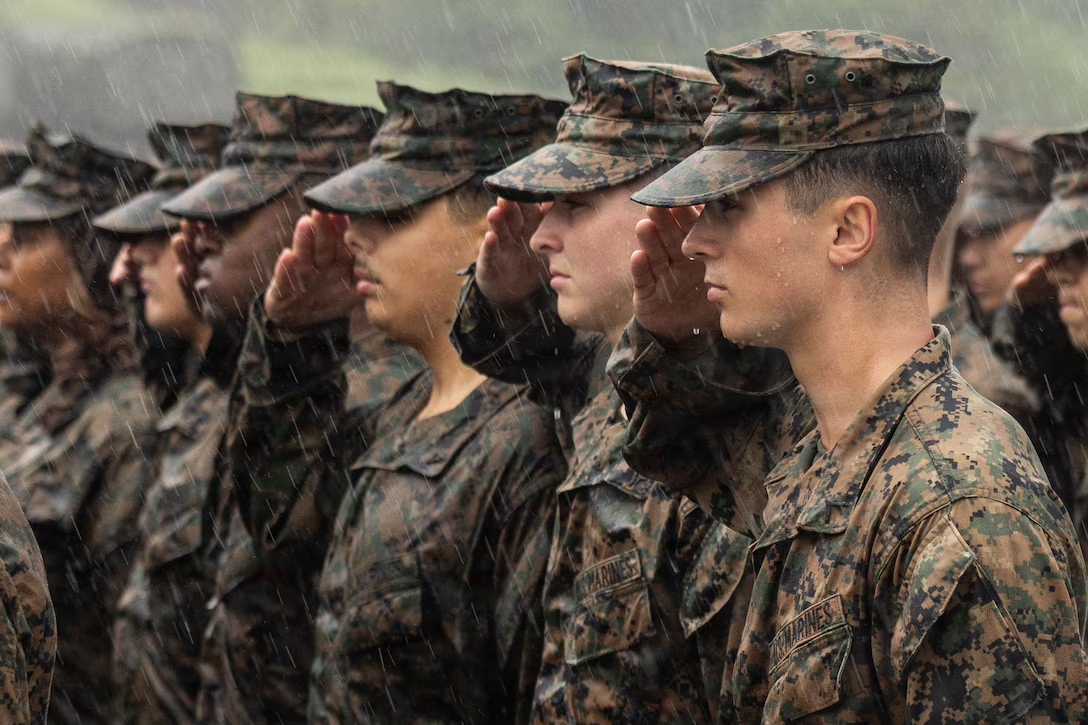
Marines salute during the opening ceremony of Resolute Dragon 26 in Oita Prefecture, Japan, June 19, 2026. Resolute Dragon is an annual bilateral exercise in Japan that strengthens the command, control, and multidomain maneuver capabilities of III Marine Expeditionary Force Marines and Japan Self-Defense Forces personnel, with a focus on controlling and defending key maritime terrain.

While the Biden years saw military leadership tied up in cultural distractions, the Marines and their Japanese teammates are showing what real readiness looks like—focused, lethal, and disciplined.

Exercises like Resolute Dragon send a clear message: the Pacific will not be surrendered, and America’s warriors, alongside Japan’s, are ready to hold the line.

News

Navy Shifts from Rescue to Recovery in Search for Missing Marine Off California Coast

The Navy has moved from search and rescue to recovery operations for a Marine who went missing off the USS Anchorage during a training exercise off the Southern California coast.

The shift came after nearly two full days of nonstop searching across a wide swath of the Pacific Ocean, as crews faced the grim reality that the Marine may not have survived.

The missing Marine was part of the 13th Marine Expeditionary Unit (MEU), operating alongside the Makin Island Amphibious Ready Group (ARG) during a scheduled exercise.

The incident occurred early Thursday morning, a stark reminder that even training missions at sea carry real risk and demand unrelenting vigilance from every sailor and Marine aboard.

According to a statement from the Navy’s 3rd Fleet, the service launched immediate search and rescue operations when the Marine was first reported missing at 1:21 a.m. Pacific Time.

Over the course of the next 43 hours, an extraordinary coordinated effort came together involving the Navy, Marine Corps, Coast Guard, and Air Force. In total, three ships and 12 aircraft scoured nearly 2,400 square miles of ocean in the effort to locate the fallen Marine.

Despite the size and speed of the operation, no trace of the Marine has yet been found. Late Saturday, the Navy acknowledged that the mission had now shifted to a recovery effort, an indication that hopes of finding the Marine alive have diminished.

Marines Plot Bold Airpower Upgrade To Smash Enemy Chokepoints At Sea
Low altitude air defense gunners aboard the USS Portland in the Balabac Strait, May 4, 2026. (MCS Adam Bishop/U.S. Navy)

The Navy did not identify the service member, adhering to policy that next of kin must be notified before releasing a name.

The USS Anchorage, a San Antonio-class amphibious transport dock, serves as part of the Makin Island ARG, a vital amphibious warfare group that deploys Marines globally.

These ships train for rapid crisis response, humanitarian relief, and combat operations wherever America’s national security demands it. Exercises like the one off California are routine but essential, testing coordination between sea, air, and land forces.

The 13th Marine Expeditionary Unit, based at Marine Corps Base Camp Pendleton, is roughly 2,200 strong. Its deployments often involve complex amphibious operations, making it one of the most relied-upon fighting units in the Pacific theater.

Training missions like this prepare Marines for any contingency, though they always carry risks, particularly at sea where conditions can change rapidly and small missteps become deadly.

While the details of how the Marine vanished remain unclear, the Navy’s swift reaction underscores the seriousness with which the military treats every missing service member.

The combined resources of multiple branches show that camaraderie still runs deep across America’s armed forces, even in peacetime.

Maritime training environments are inherently dangerous, and those who serve know that danger better than anyone. From rough seas to heavy machinery, the job demands constant discipline.

Marines Overhaul Recon Training to Fast Track Elite Scouts
Two Marines in the Basic Reconnaissance Course at Naval Amphibious Base Coronado, California. Marine Corps photo by Lance Cpl. Andrew Cortez.

When accidents happen, the entire military community feels it. These Marines and sailors live and work side by side for months at a time, often forming bonds closer than family.

The ongoing recovery effort remains active as the Navy works to bring closure to the Marine’s family and unit. Recovery teams will continue to search both the surface and subsurface areas near where the Marine was last seen, using sonar, aircraft, and surface ships to pinpoint any signs of wreckage or debris. Every inch of ocean will be scoured until a full accounting is made.

Even as families wait anxiously for word, there’s a resolute pride in the courage and professionalism of those conducting the search. It’s a potent reminder that America’s warriors never leave one of their own behind, no matter how long the odds or how deep the waters.

In times like this, it’s worth remembering that service comes with sacrifice. This Marine was part of a broader mission to maintain readiness, protect freedom, and keep the nation’s enemies at bay.

The quiet heroism of those who serve on the frontlines of training and conflict alike continues to strengthen America’s resolve, even in tragedy.

The men and women aboard the USS Anchorage and the Makin Island ARG will press on with their duties, because that’s what Marines do. Duty, honor, and country come first.

As the search continues, the nation stands behind them—with gratitude, respect, and a profound sense of loss for a warrior who may have given his life preparing to defend America.

News

Air Force Special Ops Skyraider Crashes After Rookie Pilot Cuts Fuel Mid-Flight

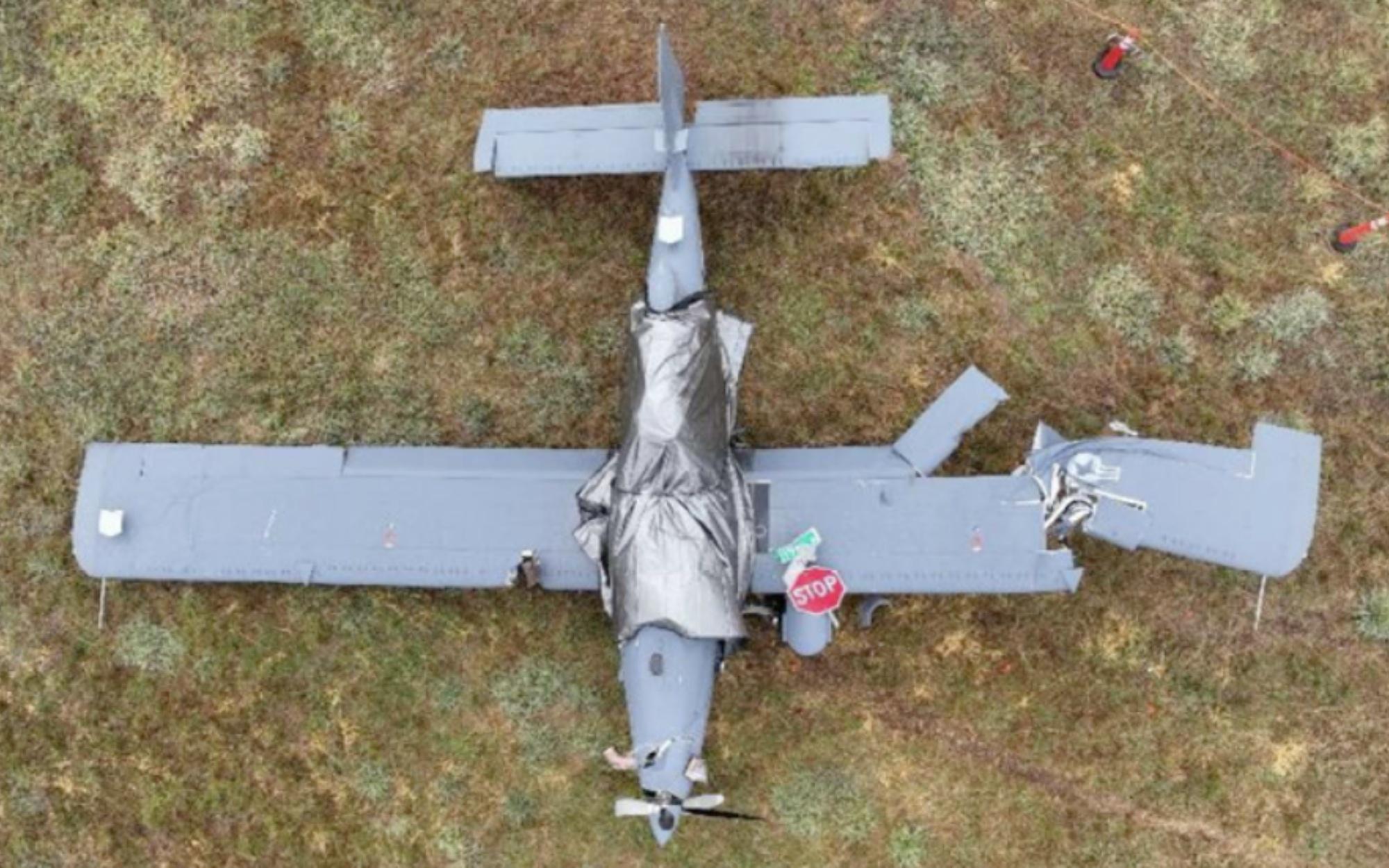
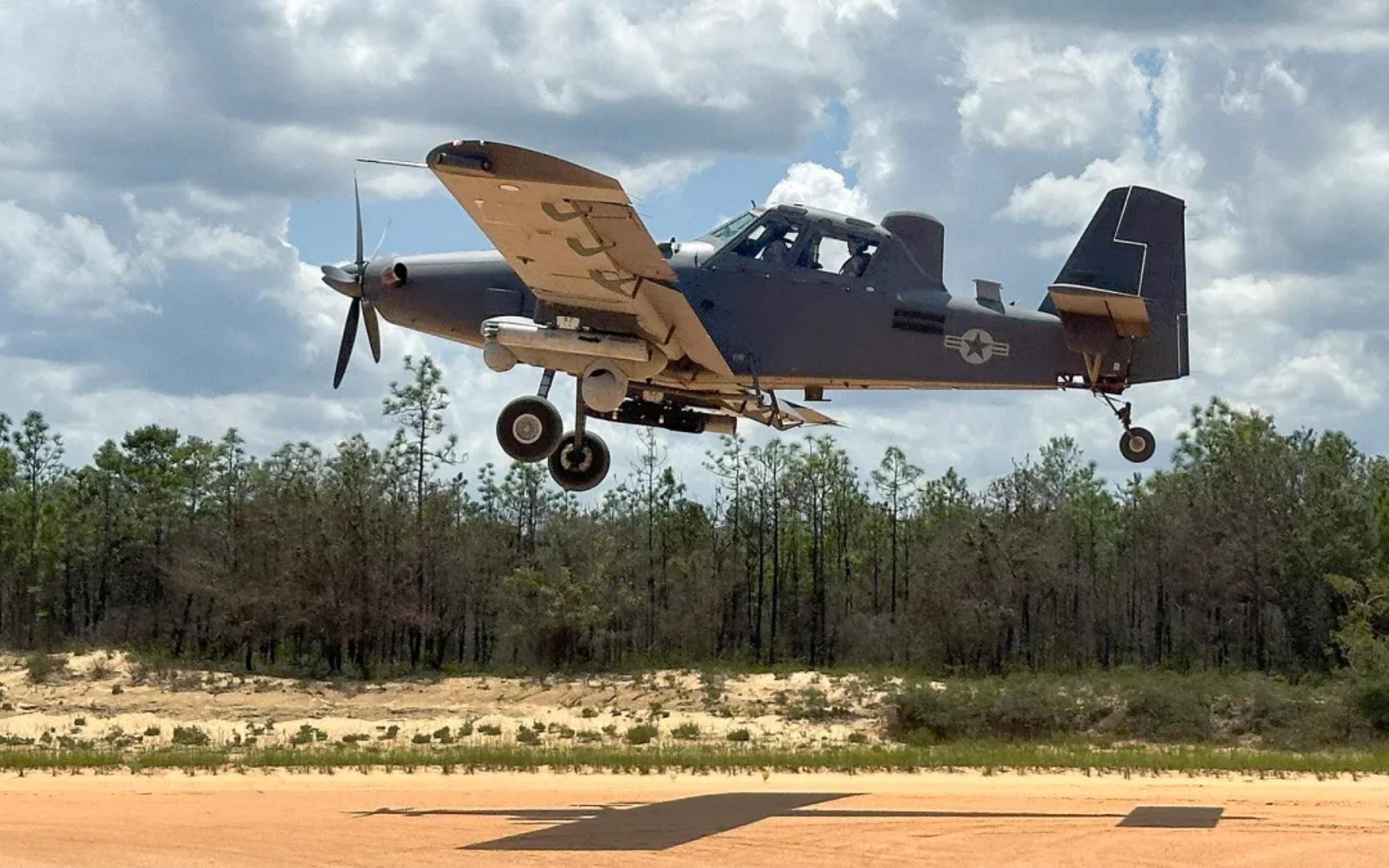
An Air Force special operations Skyraider II prop plane ended up wrecked in a rural Oklahoma field when a student pilot accidentally shut off its fuel supply mid-flight, forcing a harrowing emergency landing and leaving a $17 million aircraft totaled.

The October 2025 accident investigation reveals a simple but costly error — a pilot trying to manage cockpit controls mistakenly turned the fuel valve the wrong way, starving the engine at 2,300 feet. The mishap report points to pilot error, communication breakdowns, and a rushed emergency response as the main culprits.

The incident happened during what was supposed to be a routine familiarization flight for the Air Force Special Operations Command’s cutting-edge single-engine OA-1K Skyraider II — a new turboprop that the War Department touts as a “Swiss Army Knife” for future smaller, precise strike and reconnaissance missions.

According to the report, the pilot took off from Will Rogers Air National Guard Base under the callsign Zorro 75 around 2:30 p.m. The flight was smooth and clear of any mechanical or weather challenges. But the peace didn’t last long.

The U.S. Air Force’s newest plane, the Skyraider II, honors a legendary aircraft

As the Skyraider climbed to a comfortable cruising altitude of 2,300 feet, the inexperienced trainee pilot tried to adjust his helmet’s intercom volume.

During the process, he accidentally pulled a fuel shutoff lever clockwise, cutting off the engine’s fuel supply. Within seconds, the aircraft’s engine lost power, forcing a textbook demonstration of Murphy’s Law at altitude.

Fortunately, the instructor pilot riding in the back seat managed to take control as the plane stalled. He guided it toward an emergency road landing — a gutsy move that ultimately saved two lives.

The aircraft skidded to a stop in a nearby empty field outside Oklahoma City, gouging the earth and collecting an unlucky souvenir: a stop sign lodged in its wing.

Neither pilot was injured in the ordeal, a blessing considering the circumstances. The aircraft, however, wasn’t as lucky.

The once-proud $17 million Skyraider II was declared a complete loss — a bitter blow to a program still trying to prove itself as a reliable platform for special operations.

Colonel Joshua W. Petry, who led the accident investigation board, laid out the sequence of errors in clear terms.

“The unintended activation of the fuel shutoff valve caused the mishap, which isolated the fuel supply from the aircraft firewall, starving the engine of fuel in flight,” his final report stated.

Petry cited three key contributing factors: task saturation in the cockpit, lack of clear communication between the pilots, and poor prioritization by the instructor during the emergency. Essentially, human error stacked up like dominoes until gravity handled the rest.

Air Force Expands Fleet With 18 New Skyraider II 'Swiss Army Knife' Attack Planes Ready for Global Action
An OA-1K Skyraider II comes in for a landing on a dirt path July 10, 2025, at Eglin Air Force Base, Florida. Air Force photo courtesy of the 96th Test Wing.

The investigation also revealed that the student pilot, while highly experienced overall with more than 2,300 flight hours — including hundreds instructing on the U-28 reconnaissance plane — was “unqualified” in the Skyraider II.

He’d logged only 37 hours across 19 flights in the new platform. It’s yet another reminder that familiarity with one aircraft doesn’t always translate seamlessly to another, especially when the controls vary.

The Skyraider II’s design is far from a hobby aircraft. Roughly the size of a civilian crop duster, it has the versatility to conduct armed reconnaissance, close air support, and precision strikes.

It can carry laser-guided rockets like the Advanced Precision Kill Weapon System and may soon equip the Red Wolf cruise missile, giving it serious teeth for low-cost, small-footprint missions.

Air Force Special Operations Command has taken delivery of 18 of these aircraft so far, basing their pilot training program at Will Rogers. Officials emphasize that such mishaps, though costly, shed light on the unique training challenges these hybrid prop-aircraft bring to the modern battlefield.

Still, the accident serves as a harsh reminder that cutting-edge systems require cutting-edge attention to procedure.

The warfighters who train in them carry an enormous responsibility both to national security and to taxpayer-funded equipment. Mistakes like this, even innocent ones, can cost millions — and worse, could someday cost lives.

While the Air Force notes no widespread mechanical or systemic issues with the Skyraider II, expect scrutiny and tightened checklists moving forward. The War Department won’t tolerate preventable mishaps, especially in a weapons platform that’s supposed to prove America’s ability to innovate in irregular warfare.

A single wrong switch, a single moment of distraction, and one of the Air Force’s most promising special ops aircraft became a cautionary tale on wheels — literally, since it ended its flight rolling down a country road with a stop sign as its new hood ornament.

News

DC Pays Out Over ‘Star Wars’ Tune Played at National Guard Patrol

Only in Washington could a man playing “Star Wars” music for National Guard troops end up in handcuffs—and then get a payout for it.

The capital is at it again, proving that when it comes to the so-called guardians of free speech, selective enforcement is the name of the game.

Sam O’Hara, a D.C. resident, has reportedly reached a settlement with the District of Columbia after claiming he was wrongly detained by police for playing the “Imperial March” from “Star Wars” as a group of Ohio National Guardsmen patrolled city streets.

The settlement amount remains undisclosed, but one thing’s clear: D.C. taxpayers are once again footing the bill for bureaucratic overreach.

The American Civil Liberties Union (ACLU) backed O’Hara’s case, arguing that he was illegally detained in violation of his First and Fourth Amendment rights.

O’Hara’s lawsuit, filed last October, names Sgt. Devon Beck, multiple officers with the Metropolitan Police Department, and the District of Columbia itself.

According to the complaint, O’Hara was stopped on September 11, 2025, after he repeatedly followed a National Guard patrol and played the dramatic “Imperial March”—a tune famously associated with Darth Vader and his army of stormtroopers. It’s safe to say the sergeant in question didn’t appreciate the cinematic soundtrack.

National Guard’s DC Presence Slammed by Critics as ‘Ineffective’ Despite Visible Results

“Hey man, if you’re going to keep following us, we can contact Metro PD and they can come handle you if that’s what you want to do.

Is that what you want to do?” the sergeant reportedly told O’Hara, according to the court filing.

Police were called, and O’Hara was detained for roughly twenty minutes before being released without charges.

Still, the brief stint in handcuffs was enough for the activist to claim his rights had been violated—and apparently enough for D.C. to decide a quiet payout was the easiest way forward.

After the settlement was announced, O’Hara took his victory lap, declaring, “The government’s efforts to silence me ultimately backfired and brought more attention to the unjust deployment of the National Guard in Washington, D.C. This settlement serves as a reminder that constitutional freedoms are worth defending, especially when those in power would prefer we stay quiet.”

Guardsmen Honored for Their Heroic Stand Against DC Gunman
Two guardsman deployed to Washington, D.C., were awarded the Soldier’s Medal and Airman’s Medal for their response to a shooting that killed a fellow West Virginia guardsman. National Guard photo by Master Sgt. William Blankenship.

It’s a statement steeped in irony, given that O’Hara’s “protest” involved mocking soldiers who have been working tirelessly under Title 32 orders to restore order in a city overrun by crime and chaos.

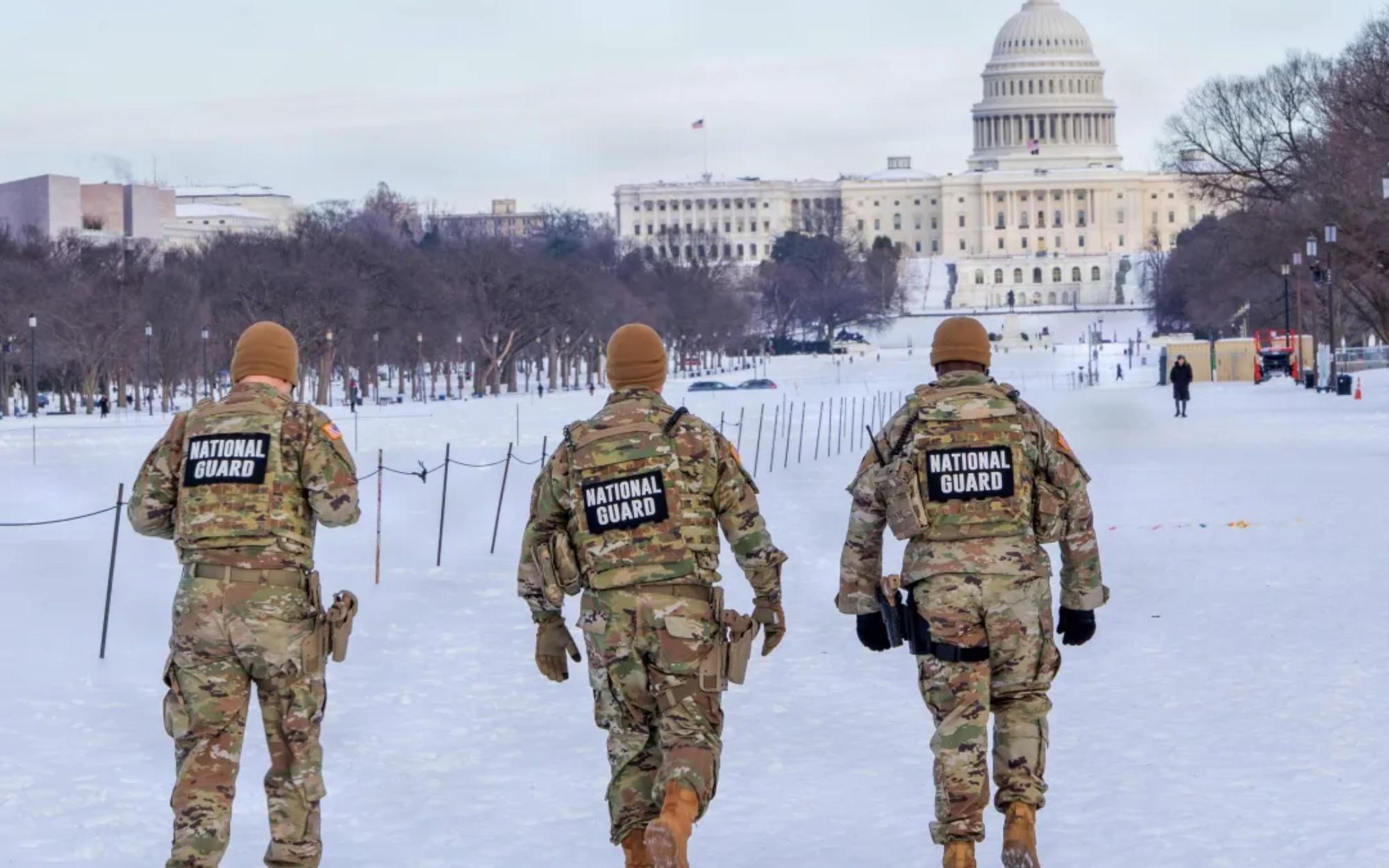
Many in the capital may roll their eyes at the sight of National Guard patrols, but after years of out-of-control street violence, residents finally saw a visible effort to secure neighborhoods.

Since their deployment last August, the National Guard has become a common sight in the District, as have vocal critics like O’Hara who see troops in the streets as an intimidation tactic.

Others, however, see reality: the Guard was called in to stabilize a dangerous environment after local law enforcement struggled to contain rising violent crime.

Trump Sends National Guard to New Orleans as He Backs Swamp Sweep Immigration Crackdown
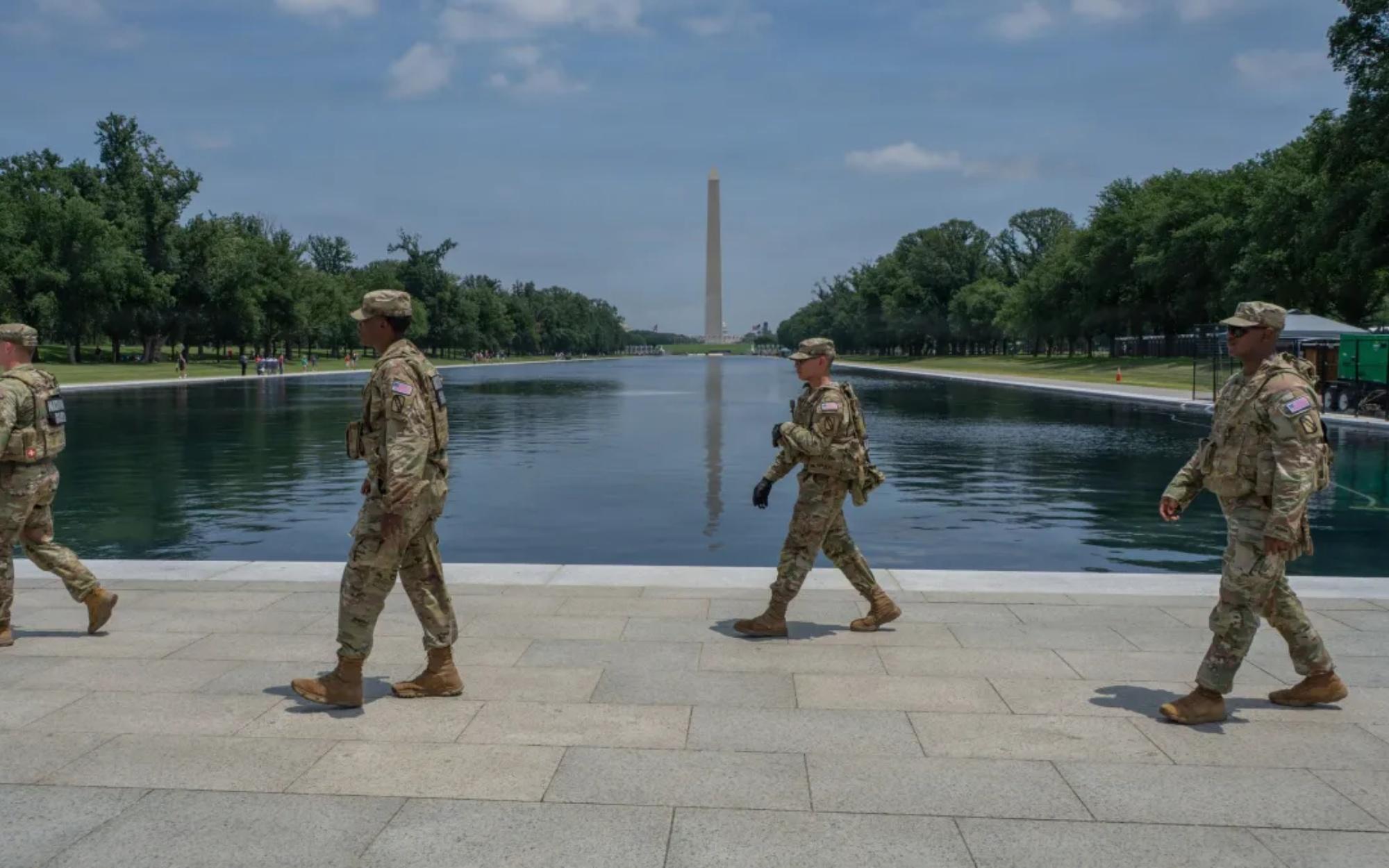
Army National Guardsmen patrol a walkway in Washington, Nov. 21, 2025. About 2,400 guardsmen are supporting the D.C. Safe and Beautiful Task Force mission, helping law enforcement and community partners strengthen public safety, resilience and quality of life in the nation’s capital.

Despite one think tank’s claim that the Guard hasn’t “impacted violent crime rates,” the military presence has had one undeniable effect—it’s deterred outrage mobs and opportunistic agitators. Yet, instead of supporting the troops, activists like O’Hara resort to cheap theatrics and viral stunts to undermine order.

The settlement doesn’t cover the portion of O’Hara’s lawsuit aimed personally at Sgt. Beck, so the legal saga might not be over just yet. Still, the District’s willingness to pay up sends a loud message that you can poke at soldiers, throw a tantrum about civil liberties, and get rewarded for it.

It’s not exactly the kind of accountability most Americans are looking for in their capital city.

America’s Cities at a Crossroads: Fear, Perception, and the Push for Order
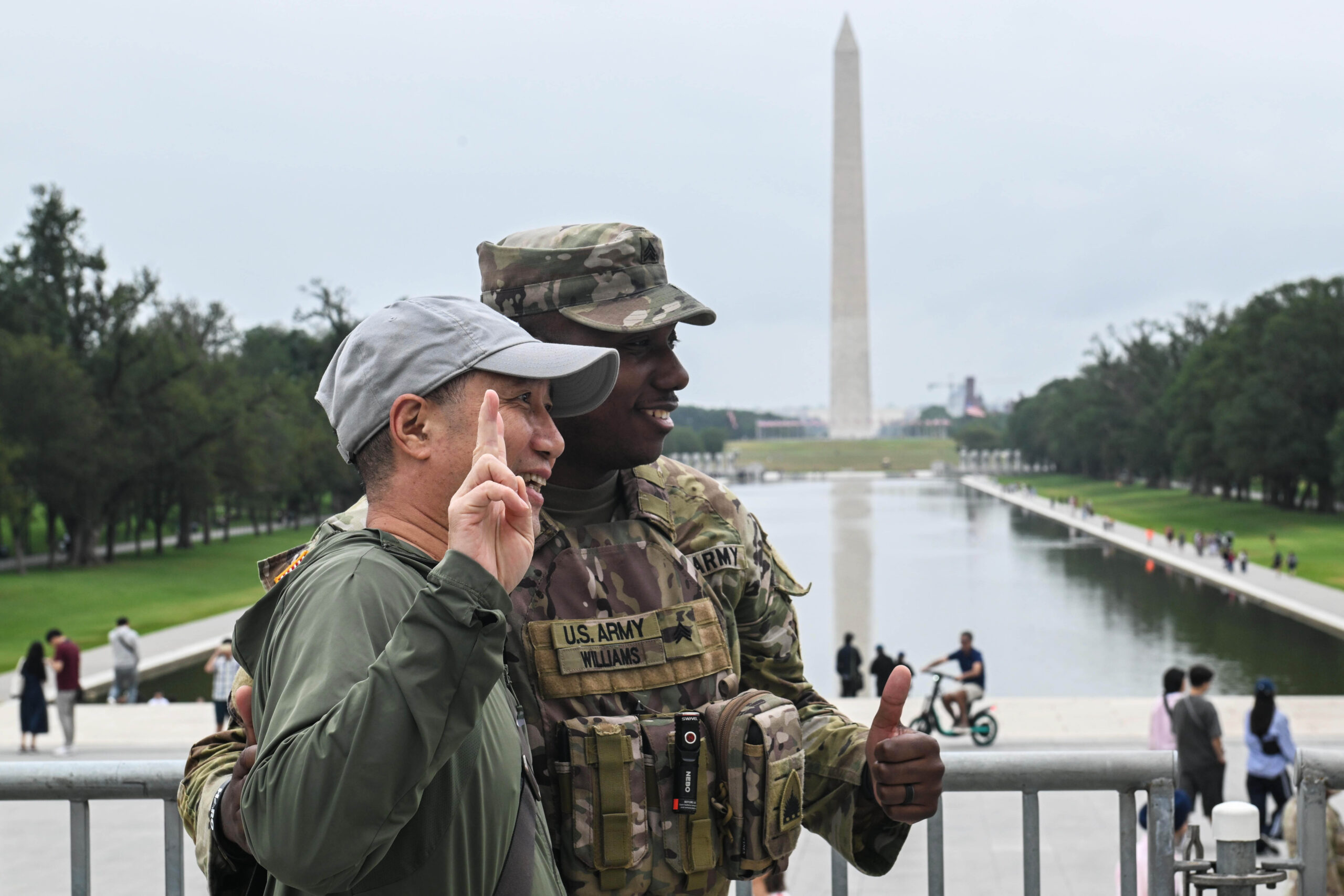
U.S. Army Soldiers from the District of Columbia National Guard, activated in support of D.C. Safe and Beautiful Task Force, at the National Mall, Washington, D.C., Aug. 18, 2025. President Donald J. Trump activated the D.C. National Guard under Title 32 to assist Federal and Washington, D.C. law enforcement within the nation’s capital, Aug. 11, 2025. (U.S. Army photo by Nina Cortez)

Instead, this episode feels like another entry in the long-running saga of D.C. dysfunction—where the government punishes those trying to keep the peace while appeasing those who ridicule them.

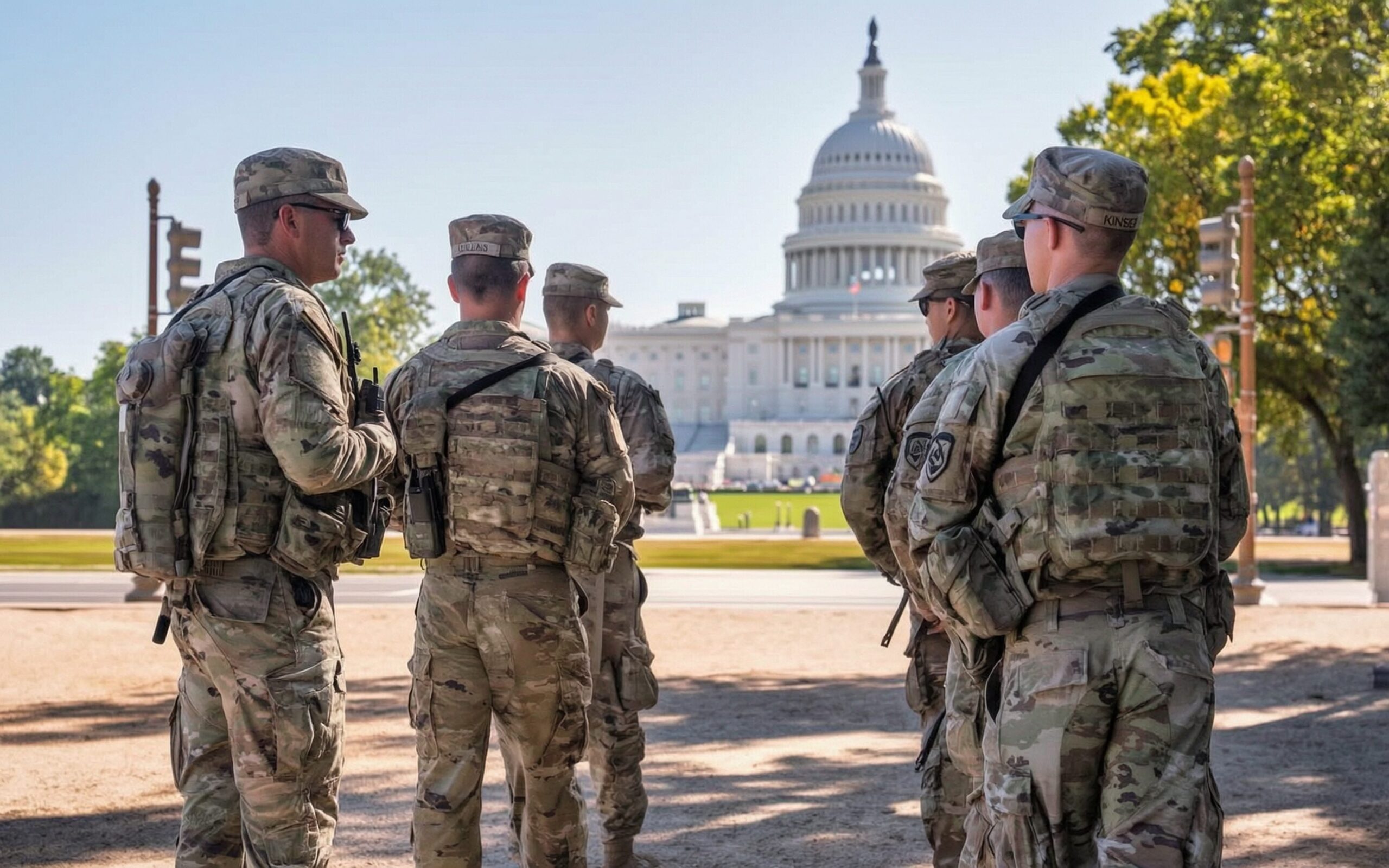
More than 4,000 National Guard troops are currently assigned to Joint Task Force–District of Columbia, with numbers expected to rise leading up to Independence Day.

While the Guard provides needed support to the War Department and local agencies, their mission continues to draw fire from activists and left-leaning groups who see “militarization” behind every corner.

For America’s warfighters—whether posted abroad or in the capital—the priority remains simple: protect and serve with discipline, no matter how much political noise fills the background. Unfortunately, in Washington these days, even a “Star Wars” theme can spark a courtroom battle.

News

House Showdown Over Women in Combat Sparks New NDAA Fight

The Washington establishment is once again at war with itself, and this time the battleground is over whether America’s military should lower standards in the name of political correctness.

Tucked inside the latest National Defense Authorization Act fight, two failed amendments exposed a broader debate simmering inside the halls of Congress: whether women should serve in ground combat roles, and whether the Pentagon will finally stop bending standards to appease social activists.

During a marathon markup session on the Fiscal 2027 NDAA, lawmakers faced off over proposals from Rep. Chrissy Houlahan, a Pennsylvania Democrat, and Rep. Clay Higgins, a Louisiana Republican.

At the center of it all was Secretary of War Pete Hegseth’s move toward gender-neutral standards—a push that has triggered familiar anxieties among Democrats who believe military readiness should take a backseat to “diversity.”

Houlahan’s amendment sought to block the War Department from enforcing gender-neutral standards and bar any personnel changes that supposedly “discriminate” based on sex. In short, the amendment was designed to tie Hegseth’s hands and keep the door open for partial standards.

Her text would also forbid any modification of military fitness requirements without what she called “scientific findings,” language that appeared crafted to stall or reverse Hegseth’s order requiring combat units to meet the highest male standards.

Hegseth, who has never been shy about prioritizing lethality over liberal appeasement, made his position clear last year at Quantico.

“Every requirement for every combat MOS must return to the highest male standard only,” he said, emphasizing that combat is life or death—not a social experiment.

He argued that too much has been sacrificed in the name of equality, and it’s time to make the military a fighting force again.

$10 Billion Price Tag and Bureaucratic Battles Loom Over Plans for Separate U.S. Cyber Force
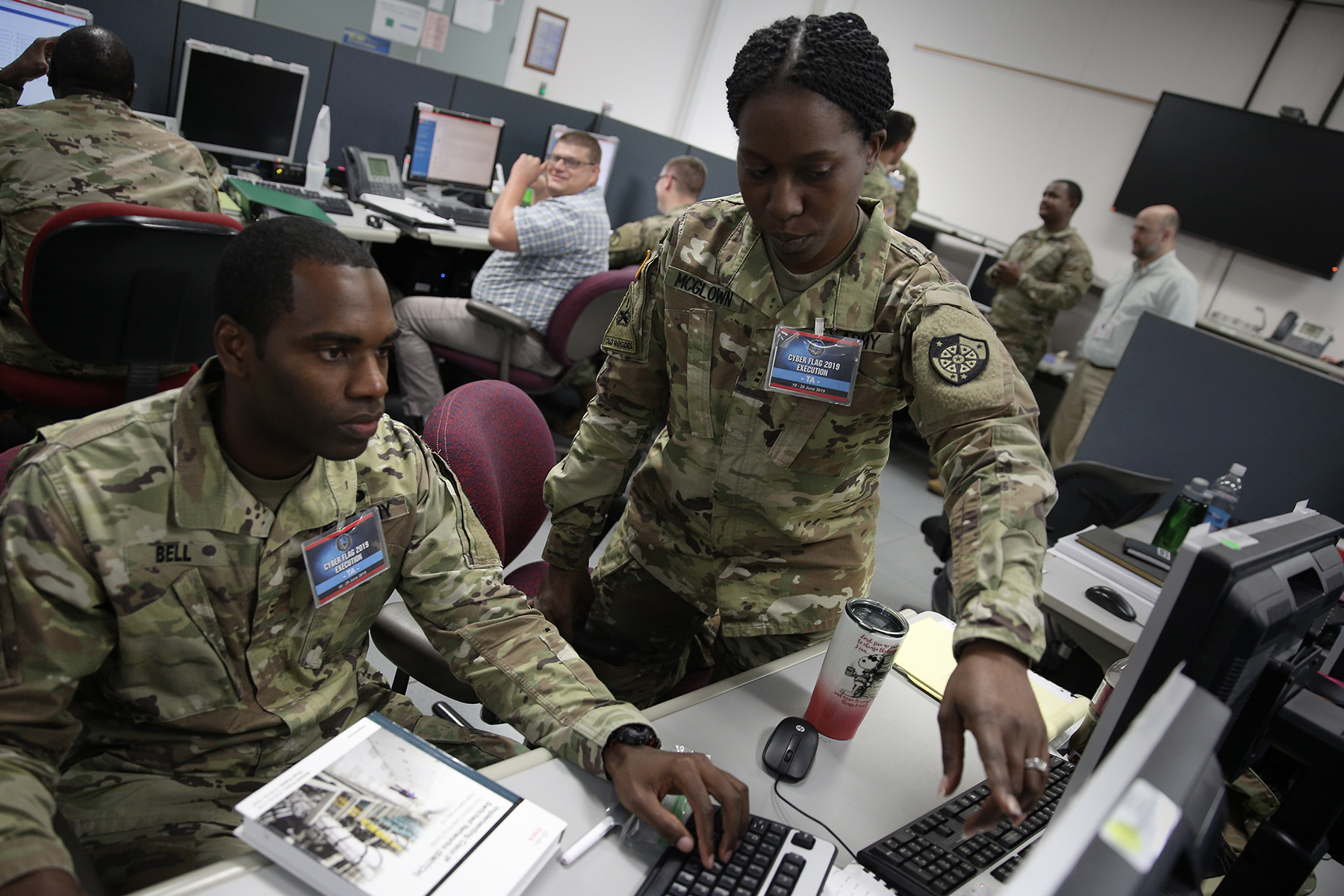
U.S. service members and civilians, as well as partner nation military personnel, participated in the Cyber Flag 19-1 exercise, June 21-28, in Suffolk, Virginia. The tactical-level exercise focused on the continued building of a community of defensive cyber operators and the improvement of the overall capability of the U.S. and partner nations.

Houlahan, however, repeated her refrain that it’s a “slippery slope” that could leave women behind. She cited the Secretary’s review of women in combat roles and warned that it signals a backslide to “policies of the past.” She called for Congress to “stop this uncertain future” before Hegseth could move any further on restoring tough combat standards.

Higgins, a National Guard veteran himself, took a different approach. His amendment supported age-based adjustments across the services but demanded higher, combat-appropriate physical benchmarks for those in ground fighting units.

In his view, equality means everyone earns their place under the same expectations. “If you can pass the standards the team establishes, you’re on the team,” he said plainly. To conservatives, that’s not exclusion—it’s merit.

Still, in an odd twist, retired Air Force Brigadier General Don Bacon, a Republican from Nebraska, sided with Houlahan.

Heroic Army Doctor Led Life-Saving Response After Tower 22 Drone Attack
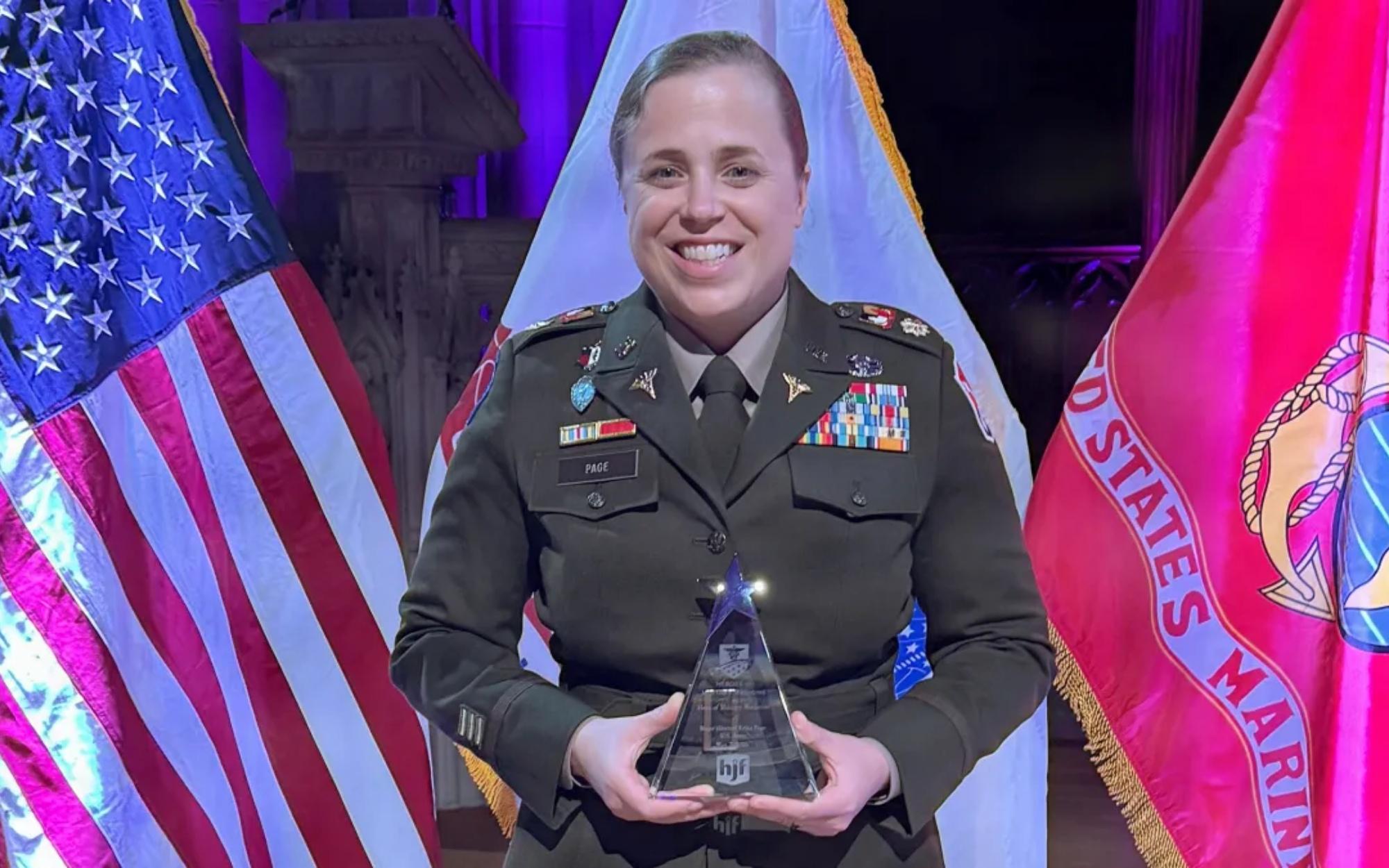
Dr. Erika Page, a major in the Arizona National Guard, receives the Hero of Military Medicine Award with Brig. Gen. Lance Raney, the Army deputy surgeon general. Photo by Army Spc. Deliah Cottle.

Bacon argued that pure equality in fitness scoring would disqualify too many women. That position underscored the deep divide even within the GOP on whether to pursue excellence or equity.

Both amendments ultimately failed—the result of razor-thin committee votes that revealed bipartisan fatigue over resurrecting old culture wars. Houlahan’s attempt died in a 28-28 tie, while Higgins’s stricter approach was defeated 29-25.

Those failures didn’t stop the talking heads from jumping on social media to bash Hegseth, tagging his effort as misogynistic—a tired smear for anyone who prioritizes mission over identity politics.

NASA astronaut Christina Koch on the flight deck of the San Antonio Class amphibious transport dock USS John P. Murtha after returning from space on Apr. 10, 2026. Navy photo by Mass Communication Specialist 2nd Class August Clawson.

Undersecretary of War for Personnel and Readiness Anthony Tata, working under Hegseth, has already ordered a comprehensive review of women’s performance in ground combat positions.

The study was initially given to the Center for Defense Analyses, but to the irritation of progressives, it’s now in the hands of the Johns Hopkins University Applied Physics Laboratory. That transfer drew new claims from Democrats that Hegseth was “picking” sympathetic analysts.

Meanwhile, Rep. Jennifer Kiggans, a Republican Navy veteran who once flew helicopters, stood with Hegseth’s approach. She reminded colleagues that gender-neutral standards for combat roles have existed for a decade, and the current policy already allows any servicemember to try for any specialty.

Six Pilots Survive Kuwait Ejection, Underscoring Training and Teamwork
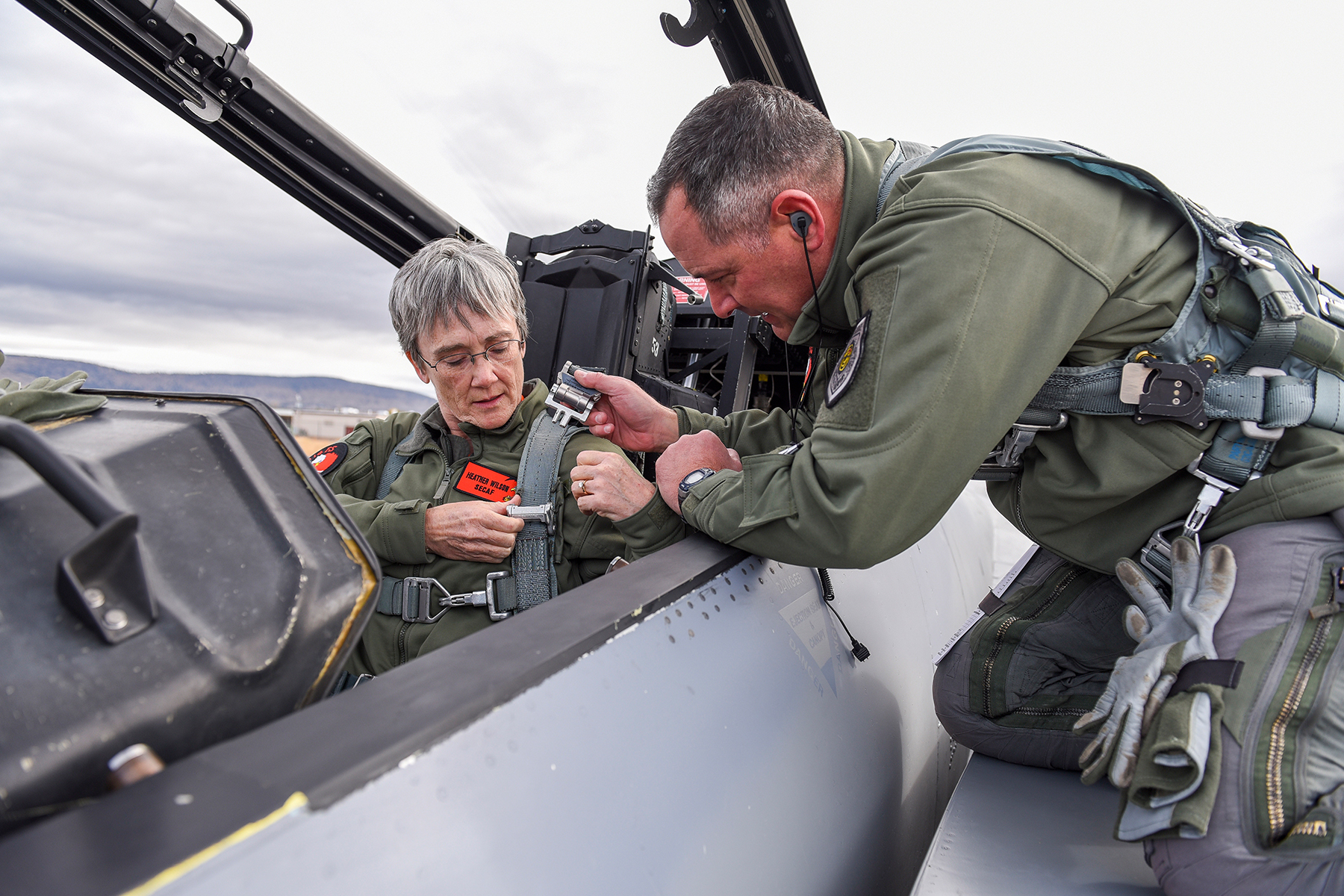
Air Force Col. Jeff Smith, 173rd Fighter Wing commander, helps Air Force Secretary Heather Wilson strap into an F-15D Eagle before a familiarization flight at Kingsley Field in Klamath Falls, Ore., Nov. 4, 2018.

“The bar hasn’t changed,” Kiggans said, cutting through the partisan noise. Her “No” vote against Houlahan’s amendment was decisive.

The Senate has its own version of this fight brewing. Iowa’s Joni Ernst, an Army veteran and generally a pragmatic conservative, introduced language codifying sex-neutral standards for combat jobs only—a nod to maintaining fairness while keeping the mission first. That version has better odds of surviving the full chamber vote.

Even as Democrats warn of “slippery slopes,” the War Department continues enforcing Hegseth’s guidance: raising the bar to meet combat realities rather than lowering it to match political dreams.

The review on women’s combat performance is slated to finish early next year, feeding right into what could be another NDAA showdown in 2025.

A Life of Service: Air Force Veteran Becomes a Rare Two-Time Living Organ Donor
Lindsay Gutierrez pictured while stationed at Royal Air Force Lakenheath in Suffolk, England. (Lindsay Gutierrez)

The stakes are simple: Does the United States want the strongest, most lethal fighting force on the planet, or a gender-balanced classroom exercise that folds the moment bullets start flying? For now, thanks to voices like Pete Hegseth, merit and readiness are still holding the line.

News

U.S. Launches Retaliatory Strikes On Iranian Missile and Drone Sites After Strait of Hormuz Attack

Precision counterstrikes rang out across Iran late Friday as the United States targeted Iranian missile, drone, and radar sites following Tehran’s latest act of aggression in the Strait of Hormuz.

According to U.S. Central Command, the strikes came in direct response to Iran’s attack on the Singapore-flagged cargo ship M/V Ever Lovely, which was hit by a one-way drone while sailing along the coast of Oman on Thursday.

This latest escalation followed what many analysts already warned—a ceasefire agreement that Iran never intended to honor.

The War Department confirmed that Iran’s assault on a civilian vessel violated the two-month ceasefire accord inked just last week, which was meant to reopen the vital shipping route for global trade.

Military sources said the American response was swift and targeted, striking precisely at the Iranian facilities responsible for coordinating and launching attack drones and missiles.

“We met hostility with strength,” a senior U.S. official said, emphasizing that deterrence requires clarity and power, not indulgence and appeasement.

Officials confirmed that the strikes included command-and-control infrastructure, radar installations supporting drone tracking, and missile stockpiles positioned near the southern Iranian coast.

CENTCOM described the operation as “a proportional but decisive response designed to safeguard international maritime flow.”

The Strait of Hormuz, long a flashpoint for Iranian provocations, remains a nerve center for global energy transport. Nearly a fifth of the world’s oil supply transits through this narrow chokepoint, making any conflict there a direct threat to the global economy—and to American interests.

USS Truman Conducted Largest Airstrike in Navy History, Dropping 124,000 lbs of Bombs in Less Than 2 Minutes

With Iran’s Revolutionary Guard Corps (IRGC) operating fast-attack boats, drones, and shore-based missiles in the area, stability has always hinged on the willingness of the U.S. military to stand firm.

Friday’s action sends an unmistakable message: the United States will not sit idle while Tehran tries to destabilize international trade or challenge freedom of navigation.

Despite Iran’s signature on a ceasefire document just days ago, the pattern of deception and intimidation remains alive and well in Tehran’s corridors of power.

Critics of previous U.S. administrations point out that years of half-measured policies gave Iran space to test and push boundaries. That era appears to have run its course.

Under the current leadership, Washington’s posture has shifted decisively toward unapologetic deterrence backed by credible force projection—a return to peace through strength.

Sources familiar with the operation say the strikes were planned with careful coordination to minimize civilian risk while maximizing the impact on Iranian military assets.

Initial assessments from reconnaissance drones and naval aircraft showed multiple successful hits, with several facilities reportedly engulfed in secondary explosions.

Iranian state-run media quickly attempted to downplay the damage, claiming “minor impacts” and asserting that “operations continue as normal.”

USS Truman Conducted Largest Airstrike in Navy History, Dropping 124,000 lbs of Bombs in Less Than 2 Minutes

However, analysts familiar with regional intelligence indicate that at least three radar locations and multiple drone launch facilities were damaged beyond immediate repair.

Maritime insurance rates in the Gulf have steadily risen since the attack on the Ever Lovely, and several shipping companies temporarily rerouted vessels pending full restoration of security in the strait.

The War Department reaffirmed that U.S. naval assets in the region—led by carrier-based aircraft and guided missile destroyers—remain on alert and capable of engaging any further threats.

Regional allies welcomed the show of force. Leaders in Bahrain and the United Arab Emirates privately expressed support, viewing America’s action as essential to preserving regional stability.

“Iran’s aggression cannot go unanswered,” one Gulf official commented anonymously. “U.S. strength protects not only freedom of commerce but the peace we all rely on.”

As of Saturday morning, Iranian military officials had not announced any formal retaliation, though defense analysts caution that Iran’s pattern of proxy operations—particularly through militias in Iraq, Syria, and Yemen—could signal asymmetrical responses in the weeks ahead. U.S. forces across the region have reportedly increased alert levels accordingly.

The Biden-era restraint that many saw as indecision is being replaced by a higher tempo of operational readiness, precision retaliation, and strategic clarity.

The new War Secretary Pete Hegseth’s firm stance on American deterrence appears to be resonating across the ranks, reinforcing that rogue states will face real consequences when they endanger global stability.

With this latest strike, the message is clear: attacks on international shipping and disregard for ceasefires will be met not with empty words but with the unmistakable reach of American firepower. Iran picked the wrong fight—again.

News

Recruits Surge Past Goals But Training Bottlenecks Still Slow Mission Readiness

The Pentagon is bragging about a major win for military recruiting, announcing that all five active-duty services crushed their 2025 enlistment goals.

According to the War Department, this is the strongest recruiting performance seen in fifteen years, with every branch filling or exceeding its manpower targets. After years of struggle under weak leadership and cultural confusion, the numbers spell a long-awaited turnaround.

The Army led the way, signing contracts with 62,050 recruits—just over 101% of its objective.

The Navy brought in more than 44,000 new sailors, overshooting its goal by 8%.

The Air Force signed up over 30,000 new airmen, while the Space Force added 819 Guardians to its ranks.

The Marine Corps, as usual, delivered right on target with 26,600 recruits.

Combined, that’s 103% of the overall active-duty mission.

It’s a welcome change after years of missed goals that embarrassed Pentagon leadership and worried patriotic Americans.

Air Force Trainer Faces Court-Martial Over Trainees’ Personal Relationships, Sparking Calls for Stricter Oversight
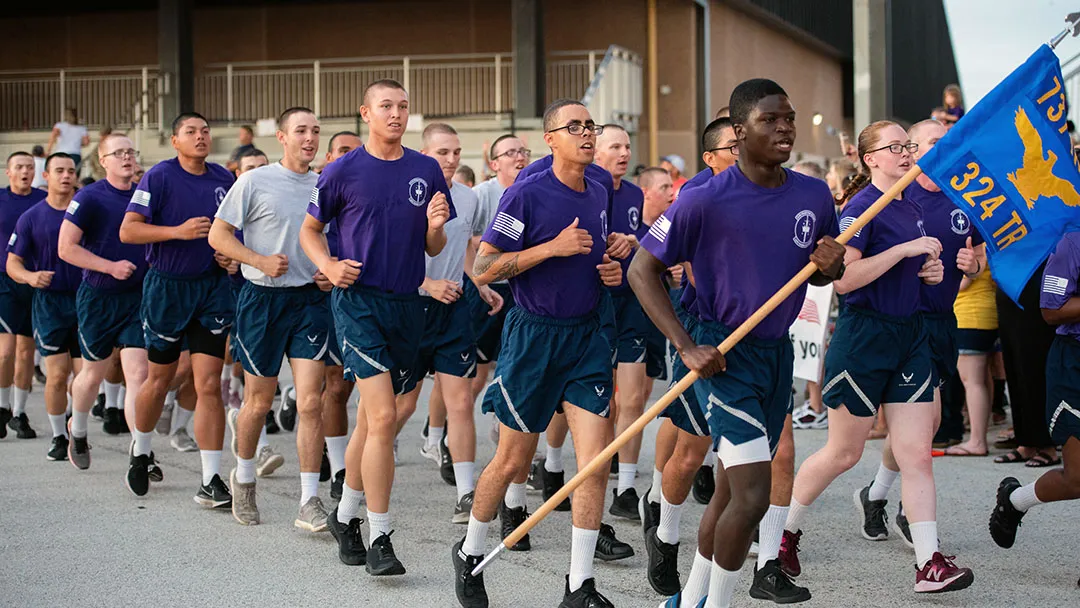
Recruits assigned to the 324th Training Squadron take part in Basic litary Training at Joint Base San Antonio-Lackland, in 2022. Air Force photo by C Arce.

The turnaround suggests that service branches may finally be getting their recruiting messages right—likely something to do with backing off some of the woke nonsense that had been alienating traditional recruits.

But the real question remains: how quickly will these recruits actually become mission ready?

In other words, how long before these men and women finish training, earn their qualifications, and join fully operational units? The Department of War doesn’t seem eager to answer that.

Despite all the numbers and talking points, the Pentagon still can’t produce a simple, transparent metric showing how long it takes from signing day to operational deployment.

Each service trains differently, and timelines can stretch for months, even years, depending on the specialty. An infantry recruit might hit the field in half a year, while cyber, intelligence, or nuclear tech specialists can spend over a year in the pipeline before joining their units.

Air Force and Space Force Surpass 2026 Recruitment Goals Ahead of Schedule
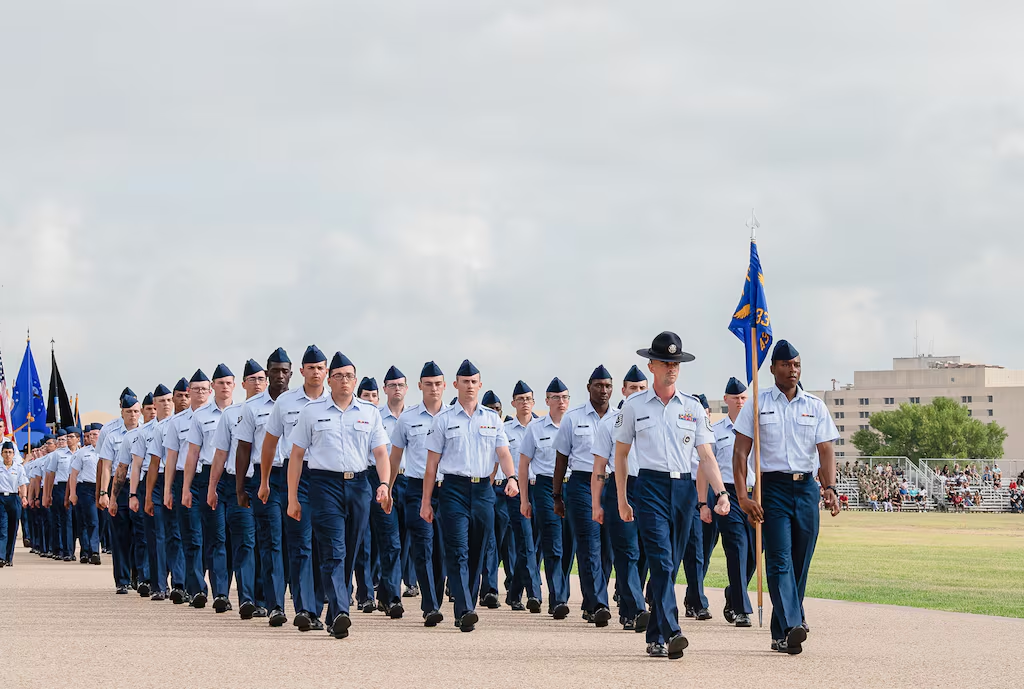
Air Force recruits graduate from basic military training. (U.S. Air Force)

Special operations candidates might spend several years in training before they’re cleared for a real mission.

The Government Accountability Office has reviewed these readiness systems and confirmed that the War Department uses tools like the Defense Readiness Reporting System and the Chairman’s Readiness System to gauge preparedness.

But those systems focus largely on things like equipment and personnel numbers, not how long it takes to train fresh recruits into combat-ready troops. That gap—ignored for years—leaves commanders and Congress guessing how fast new recruits can actually boost the operational force.

According to Navy Capt. Candice Tresch, there’s really no strict timeline for turning a civilian into a proficient sailor. She emphasized that the process depends on job specialty, command needs, and how quickly an individual can demonstrate proficiency. “It’s not really time-based,” she explained.

Marines Roll Out Huge Bonuses to Attract High Tech Talent and Bolster Readiness
Marine Corps recruits move as a fire team through events during the Crucible, the final challenge of recruit training, at Marine Corps Recruit Depot Parris Island, S.C., Dec. 3, 2020.

“[It’s] can you do the mission?” That’s a fair philosophy—but one that provides little grounding for lawmakers tracking readiness or for families asking just how fast the military is replenishing its force.

From training bottlenecks to background check delays, the time to get troops fully ready varies wildly. Cyber and nuclear job training can last many months, while Marines, with their famously brutal boot camps, may continue on to multiple specialty schools before setting foot in an operational unit.

Even then, advanced qualifications, field drills, and command certifications can stretch timelines further.

Under federal law, the Secretary of War must maintain a readiness reporting system that objectively measures the force’s ability to carry out missions.

However, nowhere in that system is there a requirement to track how long individual recruits take to become battle-ready warfighters. That missing data may seem bureaucratic, but it makes a big difference when planning deployments or gauging whether the services can sustain prolonged operations.

Trump-Era Push Elevates Army Recruiting Command to Three-Star Headquarters
Drill sergeants welcome a new class of recruits prior to executing the ‘First 100 Yards’ at Fort Moore, Georgia, January 2024. (Capt. Stephanie Snyder/Army)

The Marine Corps, Army, Navy, and Air Force were all contacted for comment on these readiness benchmarks, but as of publication, most haven’t provided a clear answer.

The Navy alone states that readiness should be measured by proven performance, not by ticking off a clock. Admirable in principle, but in practice, it keeps the process opaque.

Meanwhile, the GAO continues to call out systemic flaws—schoolhouse limitations, instructor shortages, and maintenance backlogs.

These problems delay the very readiness the Pentagon loves to boast about. Even with higher enlistments, if the training system can’t absorb recruits efficiently, the readiness boom could stall before it translates into boots on the ground.

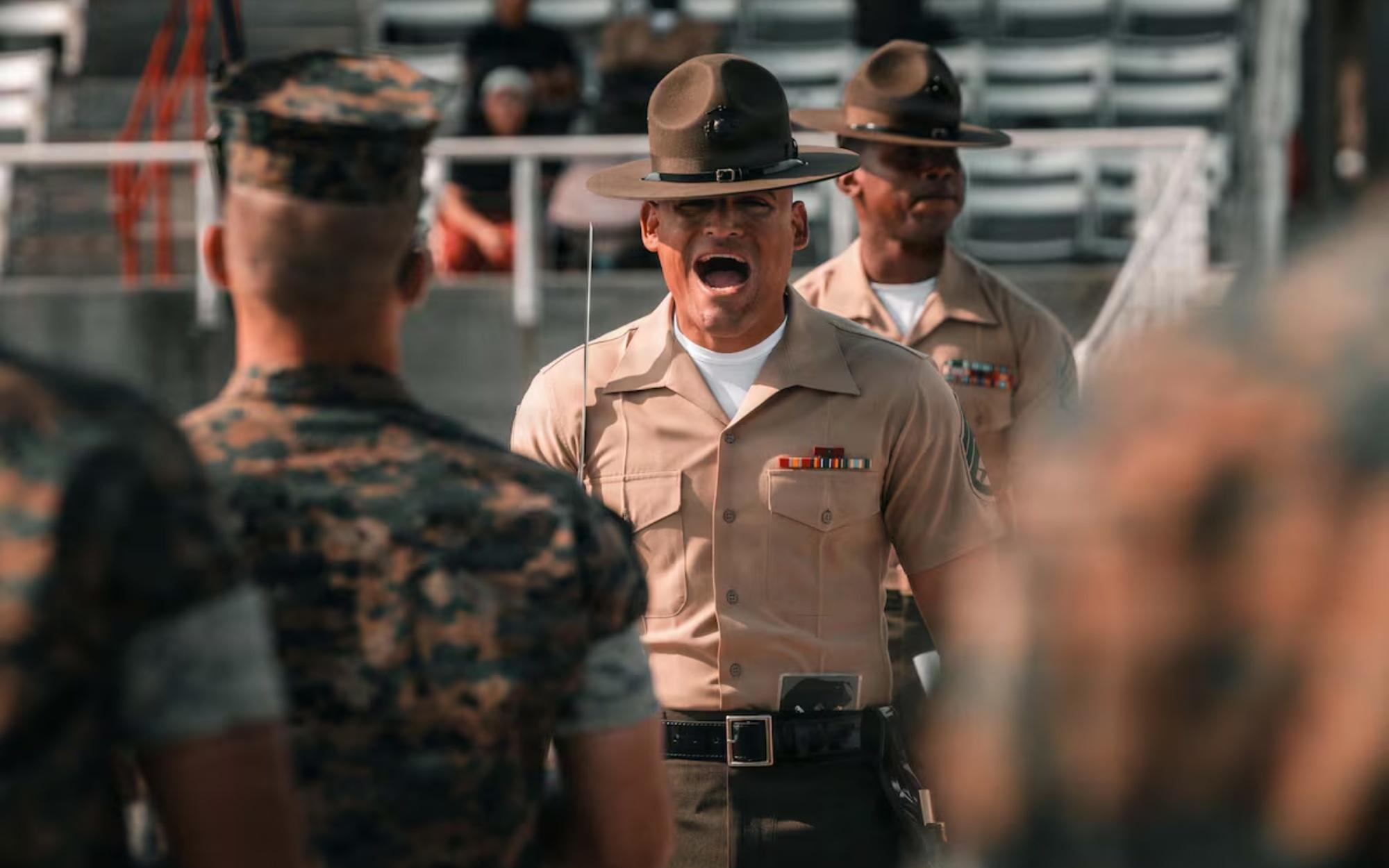
Former Marine Drill Instructor Arrested After Early Release in Hazing Death Case
A drill instructor from India Company, 3rd Recruit Training Battalion, commands her recruits during initial drill inspection on Marine Corps Recruit Depot Parris Island, S.C., Sept. 26, 2022. Initial Drill is the first marker of the recruits’ discipline and unit cohesion. (U.S. Marine Corps photo by Lance Cpl. Bradley Williams)

After years of decline, America’s military is clearly regaining strength in numbers. That’s good news for a nation that’s been hamstrung by recruiting shortfalls and a demoralizing drift into politically correct distractions.

But until the War Department can prove it’s speeding up training pipelines and turning promising recruits into capable warriors, the recruiting surge is only half the story. When it comes to restoring full-spectrum readiness, results in the field will matter more than numbers in a spreadsheet.


Scroll to Top