Author name: Common Defense

News

Free ER Suicide Crisis Care Has Already Reached Nearly 50,000 Veterans

Nearly 50,000 veterans have already used a little known emergency suicide crisis benefit that allows eligible veterans and some former service members to walk into any VA or community emergency room and receive VA funded care, even if they are not enrolled in VA health care.

The benefit comes through the COMPACT Act, a law signed during President Trump’s first term that was meant to cut through the usual paperwork swamp when a veteran is standing at the edge. For once, Washington created something that can actually meet a crisis before the bureaucracy finds a clipboard.

Retired Navy Master Chief David Hull learned about the benefit only after his life had collapsed during the 2025 government shutdown. He had struggled after leaving the military, rebuilt his footing, then lost his job and suddenly could not provide for his three children.

“I didn’t always consider taking my own life,” Hull said. “It wasn’t until I felt like I had no one and nowhere to go.”

“It’s easy to sink into feeling nothingness when you can’t see your value anymore or you become disconnected from your purpose,” he said.

One night, after putting his children to bed, Hull searched online for combinations of pills he believed would end his life. As he poured medication into one bottle, he knocked an empty container onto the floor, drawing the attention of his daughter.

“She looked up at me with her big brown eyes,” Hull recalled, his voice breaking. “It cracked me wide open.”

Hull left his children with a neighbor and drove to Garrett Regional Medical Center in Oakland, Maryland. He was not enrolled in VA health care, had no health insurance and had never heard that eligible veterans could receive emergency suicide crisis care at a community hospital with VA covering the bill.

“I just needed someone to help clear my head and get me straight again,” Hull said. “I was circling the drain. On the precipice of having no home, no food, no money and no job with a promise of a better tomorrow. Nothing.”

About 40 minutes after arriving, Hull was evaluated by an emergency physician who told him he would be cared for. A hospital social worker later explained that the VA would cover both his emergency treatment and the care that followed.

“I was shocked to find out that I could be seen for free after they identified me as a veteran,” Hull said.

The Emergency Suicide Crisis Benefit was created under the Commander John Scott Hannon Veterans Mental Health Care Improvement Act, known as the COMPACT Act. It covers emergency evaluation, treatment, inpatient or crisis residential care when clinically appropriate and up to 90 days of outpatient follow up care.

VA data provided to Military Times shows 49,341 veterans have received the benefit since fiscal 2023. That includes just over 10,000 in fiscal 2023, 14,666 in fiscal 2024, 15,218 in fiscal 2025 and 9,434 during the first half of fiscal 2026.

“The number of Veterans receiving the COMPACT Act’s Emergent Suicide Crisis Benefit has grown steadily since its inception in FY23,” VA Press Secretary Quinn Slaven said.

VA spent nearly $110 million on acute suicide crisis care in fiscal 2025, the highest total yet. Slaven said VA reviews eligible cases, educates veterans and community emergency staff and works with providers so veterans do not get blindsided by surprise medical bills after seeking help.

According to VA, 72 percent of veterans who have used the benefit later enrolled in VA health care. That matters because a crisis visit can become the first real doorway into longer term care.

Still, veteran advocates say the program remains far too obscure. “DAV believes awareness of the safety net created by the COMPACT Act remains lower than it should be,” Jon Retzer, DAV’s national legislative director, said.

Retzer said many veterans wrongly believe they must already be enrolled in VA health care, have a service connected disability rating or report to a VA medical center for the benefit to apply. “Many veterans remain uncertain whether an emergency room visit will generate medical debt or whether VA will ultimately cover the care,” Retzer said. “That uncertainty can discourage veterans from seeking treatment during a crisis when immediate intervention is critical.”

Army Reserve Prevention Integrator David Arthur said the same confusion shows up often, especially among older veterans and those living far from VA hospitals. Rural veterans may live more than an hour from a VA medical center, while nearby outpatient clinics usually do not handle emergencies.

“When they are in a crisis, in my experience with suicidal soldiers and vets, they are not even thinking about that,” Arthur said. “But those thoughts are huge barriers, especially the cost.”

“I want every vet to know they can go to any ER or hospital,” Arthur continued.

Hull used the full 90 days of follow up care before enrolling in VA health care. “I don’t know if I could have afforded the treatment I received after that night without the VA,” Hull said. “And I don’t know that I’d be enrolled with the VA now without the care I experienced.”

“I wish so many of my brothers and sisters knew that this was an option,” Hull said. “It doesn’t matter if you have insurance. It doesn’t matter if you’re a patient in the VA system. None of that matters. There are no strings attached. No barriers to being seen. This is a gift that every veteran needs to know they’re eligible for.”

News

Texas Medical Barracks Disaster Forces 5,200 Enlisted Students to Relocate

More than 5,000 enlisted medical students at Joint Base San Antonio Fort Sam Houston are being uprooted from their barracks after officials determined the buildings are plagued by foundational construction defects that cannot be fixed with routine repairs.

Around 5,200 Army, Navy and Air Force students assigned to the Medical Education and Training Campus, known as METC, are being shifted into temporary housing elsewhere on the base. Local reporting first surfaced the relocation, and military officials have since confirmed the scale of the problem.

The barracks are not being cleared because of ordinary age, wear or a few maintenance headaches. A base spokesperson said the facilities are suffering from systemic infrastructure failures tied to the way they were built.

Those failures include persistent problems with climate control systems, along with structural defects that officials say cannot be permanently corrected through patchwork maintenance. In plain English, this is not a case of changing filters and tightening bolts.

“It has been determined that a complete teardown and transition to traditionally built facilities is the most responsible course of action,” the spokesperson said.

The affected METC dormitories were completed in 2014 using modular construction methods intended to speed up timelines and reduce labor demands at the site. That may have looked efficient on a spreadsheet, but a decade later, the bill is coming due in a very expensive way.

The original project reportedly cost $140 million for each 1,200 person dormitory. Five large barracks were completed for METC, meaning taxpayers paid heavily for facilities that now face demolition and replacement.

The relocation is already underway in phases. Roughly 2,000 students have been moved since July 11, though officials have not provided a firm date for when all affected students will be out of the problem buildings.

Construction on replacement facilities is expected to begin by the end of 2026. Until then, the base is using existing housing and transportation networks to keep students moving through their training schedules.

That part matters because METC is not some casual campus operation. It is a major medical training pipeline for enlisted troops who will eventually support military readiness across the force.

Rep. Joaquin Castro, a Texas Democrat whose district includes Joint Base San Antonio Lackland and parts of Fort Sam Houston, said the Department of War told his office that five barracks will be replaced because of mold, humidity and construction problems. Even Democrats can spot a mess when the mold is bad enough.

Castro said demolition is set for September, and the overall project is expected to cost more than $1.4 billion across fiscal years 2027 and 2028. That is a staggering price tag for correcting construction mistakes that should never have been allowed to take root in the first place.

“It’s critical that the Pentagon not repeat the construction mistakes of the past and provide quality housing that meets the needs of our servicemembers,” he said in the statement.

The push to replace these barracks follows the October 2025 creation of the Barracks Task Force by Secretary of War Pete Hegseth. That effort was designed to improve living conditions and quality of life for service members, a basic responsibility that too often got buried under bureaucratic excuses in prior years.

A base spokesperson said the Pentagon is investing more than $1.2 billion immediately into improving the METC barracks situation. That figure matches the initial amount being pushed across the services to overhaul barracks conditions, along with more than $400 million for local commanders to address immediate needs and more than $800 million for critical barracks renovations.

The Government Accountability Office warned in a 2023 report that poor military housing and barracks management have been problems for decades. The report pointed to serious safety risks such as sewage overflow, broken fire systems and unreliable Department of War information about how bad living conditions affect morale.

“Our primary focus is ensuring every service member has a clean, comfortable, and safe living space so that they can focus on their training and mission,” the spokesperson said. “This relocation will allow the medical training pipeline to continue without compromise.”

Students are expected to return to campus once reconstruction is complete. Until then, the move is another reminder that taking care of troops is not a slogan, it is a standard, and the Pentagon had better make sure the next set of barracks is built to last.

News

Selective Service Wants to Battle Test the Draft Before Auto Registration Hits

The Selective Service System is preparing to test whether America’s draft machinery can still move at wartime speed, and the agency is not exactly radiating confidence about the condition of its old playbook.

The agency wants vendors to build a new computer model called the “Readiness Simulation,” a tool designed to stress test national mobilization scenarios before a major change arrives in the draft registration system.

Since 1940, men in a designated age bracket have been required to register with Selective Service. Under a proposed rule, however, men ages 18 to 26 would be automatically registered beginning Dec. 19, 2026.

That means the system would no longer depend primarily on young men filling out registration paperwork themselves. Instead, Selective Service would pull information from other federal databases, because apparently Washington has finally discovered it already collects mountains of data on Americans.

The shift may sound simple on paper, but the agency’s own language suggests the machinery behind the curtain is creaky. In a Request for Quote, Selective Service warned, “SSS currently relies on manual analysis, legacy modeling approaches, outdated assumptions, and historical datasets that do not fully reflect modern demographics, communications channels, throughput constraints, or operational readiness conditions.”

That is bureaucratic speak for a system that may not be ready for the pressure of a real national emergency. The agency is now asking contractors to submit proposals by Aug. 14 for simulation models that can show what breaks first when the process is pushed hard.

Marines Roll Out Huge Bonuses to Attract High Tech Talent and Bolster Readiness
Marine Corps recruits move as a fire team through events during the Crucible, the final challenge of recruit training, at Marine Corps Recruit Depot Parris Island, S.C., Dec. 3, 2020.
Air Force and Space Force Surpass 2026 Recruitment Goals Ahead of Schedule
Air Force recruits graduate from basic military training. (U.S. Air Force)

The new simulation would examine staffing and resource demands, mobilization scenarios, police scenarios, and the impact of surge conditions. It would also “identify throughput risks, delays, and bottlenecks” while helping senior officials with planning and reporting obligations.

The stated goal is to create a system that “models the full end-to-end SSS mobilization pipeline, supports configurable scenarios, and provides decision-support analytics necessary for leadership, planners, and operators.” In plain English, Selective Service wants to see the entire draft process on a digital battlefield before it has to rely on it in the real world.

Air Force Trainer Faces Court-Martial Over Trainees’ Personal Relationships, Sparking Calls for Stricter Oversight
Recruits assigned to the 324th Training Squadron take part in Basic litary Training at Joint Base San Antonio-Lackland, in 2022. Air Force photo by C Arce.

The scenarios would cover registration, selection, notification, delivery, and classification. They would also include the Alternative Service Program, which handles options such as community service and conscientious objector cases.

The model would have to account for the military entry pipeline as well. According to the Request for Quote, computer models will “represent MEPS [Military Entrance Processing Stations] throughput, no-shows, medical disqualification rates, claims processing, and ASP diversion.”

Marines Overhaul Combat Arms PFT as Sex-Neutral Standards Take Effect
Marine recruits conduct an initial strength assessment at Marine Corps Recruit Depot San Diego, California, Sept. 6, 2025. (Cpl. Sarah M. Grawcock/U.S. Marine Corps)

Those details matter because a draft is not just a list of names. It is a massive national intake operation involving notifications, medical checks, legal claims, classification decisions, transportation, and the unpleasant reality that not everyone called will show up or qualify.

Contractors are also being told to build the tool with some humility about the data. The agency said vendors must be ready to operate the Readiness Simulation while “recognizing that legacy SSS draft data may be outdated or unreliable.”

Recruits Surge Past Goals But Training Bottlenecks Still Slow Mission Readiness
A drill instructor with Charlie Company, 1st Recruit Training Battalion, Recruit Training Regiment, conducts final drill aboard Marine Corps Recruit Depot Parris Island, South Carolina, April 18, 2026. (Cpl. Jordy Morales/Marine Corps)

That admission is significant, because any serious mobilization plan depends on accurate numbers. If the government is planning around stale assumptions and old demographic models, the result could be confusion at precisely the moment the country can least afford it.

The automatic registration plan also raises obvious privacy questions. A draft system built from information compiled by other federal agencies may be efficient, but Americans are right to ask exactly what data is being used, how it is being protected, and who gets access to it.

Trump-Era Push Elevates Army Recruiting Command to Three-Star Headquarters
Drill sergeants welcome a new class of recruits prior to executing the ‘First 100 Yards’ at Fort Moore, Georgia, January 2024. (Capt. Stephanie Snyder/Army)

Selective Service says the simulation “shall operate within an SSS-designated cloud environment, use anonymized aggregate data, and support complete Government ownership and sustainment.” The agency also says the system must comply with multiple privacy regulations.

That may reassure some people, but plenty of Americans have watched federal data promises age about as well as milk in July. When Washington combines national mobilization with interagency data sharing, the public deserves more than soothing paperwork and a few compliance boxes.

The broader issue is readiness. In a world where great power conflict is no longer some think tank parlor game, the United States cannot afford a mobilization system based on dusty assumptions and manual analysis.

Navy Recruiting Tech Experts as Officers to Supercharge Innovation Unit
Recruits take the Naturalization Oath of Allegiance to the United States of America during a naturalization ceremony on May 28, 2026. (U.S. Navy photo by Mass Communication Specialist 2nd Class Stuart Posada)

The Department of War, the services, and national security planners need reliable answers before a crisis hits. Selective Service now appears to be acknowledging that the draft system needs a serious shakedown before the automatic registration era begins.

Whether the simulation exposes manageable gaps or a deeper readiness problem remains to be seen. Either way, the agency is preparing to wargame the draft, and that alone tells Americans the old system may not be as ready as everyone assumed.

News

America Faces Another Asymmetric Test in Middle East Conflict with Iran

The United States has once again found itself confronting an adversary that prefers unconventional tactics over traditional military engagements, a reality that echoes many of the lessons learned during the post 9/11 wars.

While American forces have achieved significant battlefield successes against Iran’s conventional military assets, analysts say the broader conflict highlights the enduring challenge of asymmetric warfare.

Unlike conventional conflicts that often measure success by destroyed equipment and captured territory, asymmetric warfare revolves around imposing long term costs, creating political pressure, and outlasting a more powerful opponent.

That distinction is increasingly shaping the current confrontation with Iran.

According to Jonathan Schroden, an irregular warfare expert with CNA, the United States is primarily pursuing a conventional military campaign while Iran continues relying on a very different strategy.

Those differing approaches could influence how each side measures success as the conflict continues.

“So, what you’re seeing right now is the U.S. is fighting a conventional war against Iran,” Schroden said.

“We believe that if we strike enough targets in Iran, cause enough damage, destroy enough capability, that they will capitulate. Iran’s theory of success in this war is to impose costs and to outlast the U.S. in time. And so, their theory really centers on economic aspects and time aspects, which translate into politics.”

US Forces Hammer Iranian Targets After Drone Shootdown, Intercept Missiles Over Kuwait
An F/A-18F Super Hornet lands on the flight deck of Nimitz-class aircraft carrier USS George H.W. Bush while sailing in the Arabian Sea, May 26, 2026. (U.S. Navy)

American military operations have reportedly devastated much of Iran’s conventional navy, reducing its ability to fight traditional naval battles.

However, analysts note that the Islamic Revolutionary Guard Corps remains a separate force that specializes in unconventional operations.

That organization continues to control many of Iran’s fast attack boats, drones, sea mines, and missile systems.

Those capabilities allow Tehran to threaten shipping and military targets without depending on large conventional formations that would be vulnerable to American firepower.

Iran Rescue Spurs Urgent Upgrade to Rescue Helicopters as MANPADS Risk Grows
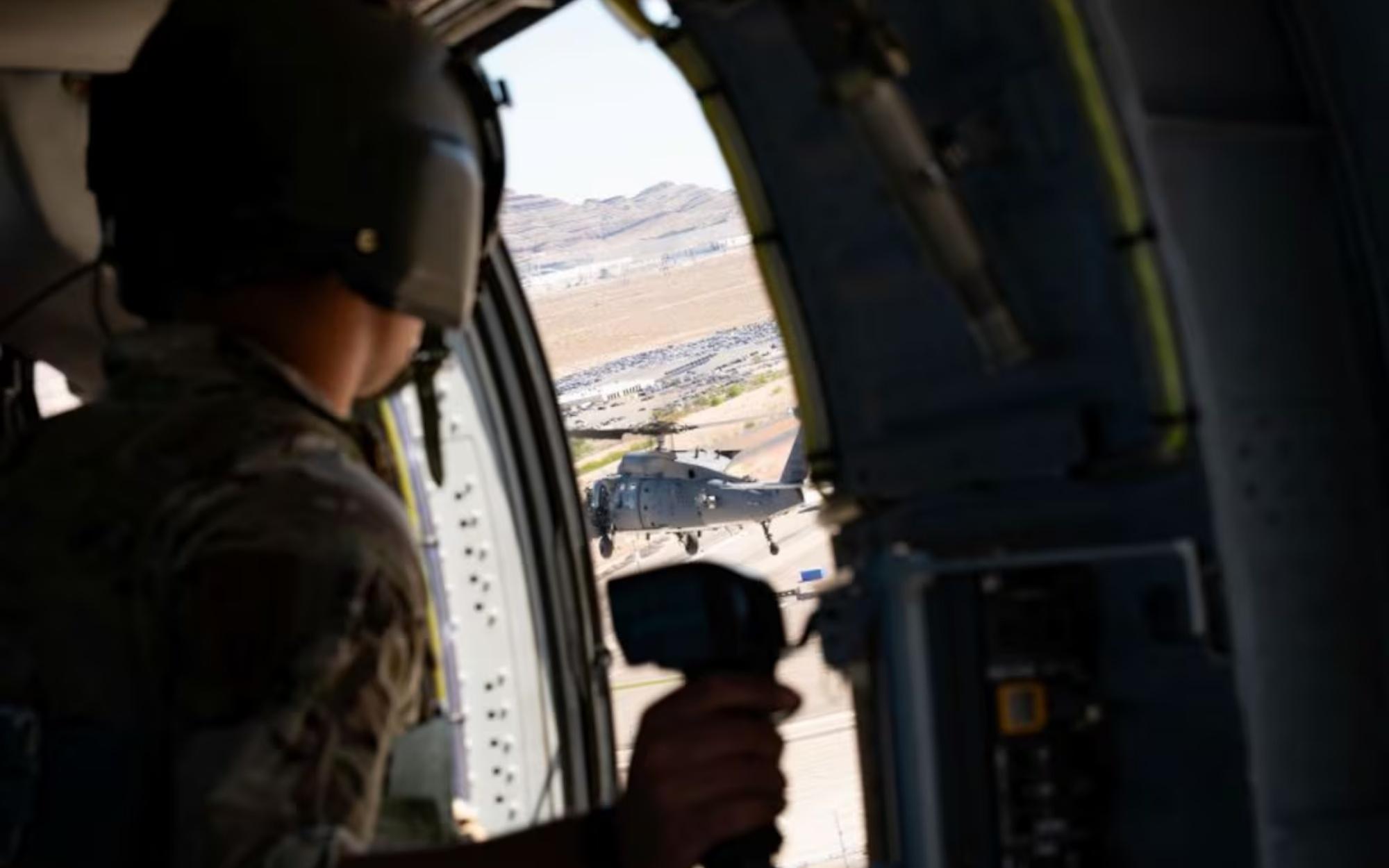
In the wake of the Iran rescue, the Air Force is looking at new countermeasures for its mainstay rescue helicopter. Air Force photo by Airman Bre Lewis.

Even without deploying U.S. ground forces into Iran or fighting a classic insurgency, Schroden argued that familiar patterns from Iraq and Afghanistan are becoming visible.

The struggle is less about defeating large military formations and more about countering an opponent determined to stretch the conflict and increase its political and economic costs.

“Even though the U.S. military does not have troops deployed to Iran, nor are American service members fighting an insurgency, ‘there are strong echoes of our experience with fighting asymmetric enemies conventionally in Iraq, in Afghanistan,’” Schroden said.

He also argued that Iran’s strategy includes attempting to inflict casualties on American personnel to generate political pressure on President Donald Trump.

Names on Bombs Aboard Lincoln Sign Bold Tradition as Readiness Rises
Sailors on the U.S. aircraft carrier appeared to have signed their names on munitions being loaded on planes in the first days of the Iran war. Navy photo.

Rather than matching U.S. military power directly, the objective would be to raise the costs of continued military operations.

“What are we trying to do to Iran? We’re trying to impose pain,” Schroden said. “What is Iran trying to do to us? They’re trying to impose costs. Those are two different things.”

A War Department official declined to discuss whether Iran is specifically employing asymmetric tactics against American forces. The official said, “We do not discuss intelligence assessments for operational security reasons.”

The Strait of Hormuz has emerged as the central battleground in the conflict because of its enormous importance to global energy markets.

Before the fighting, roughly one fifth of the world’s oil shipments moved through the narrow waterway, making any disruption economically significant.

Iran has sharply curtailed commercial shipping through the strait while the United States has reimposed a blockade on Iranian ports. President Trump also warned that American forces would target Iranian bridges and power infrastructure if attacks on commercial vessels continue.

Trump Backed U.S. Retaliation After Iranian Drone Attack Kills Four Reserve Soldiers

War Secretary Pete Hegseth told lawmakers that destroying Iran’s conventional navy was an early military objective intended to protect freedom of navigation. He also acknowledged that eliminating every fast attack craft and coastal missile launcher is not realistically possible.

Hegseth further accused Iran of escalating the conflict through attacks on commercial shipping. He said Iran had “decided to become a terror state” and added that “one side weaponized the strait.”

Brian Carter of the American Enterprise Institute said Iran has spent years preparing for exactly this type of conflict.

Rather than trying to match the United States ship for ship or aircraft for aircraft, Tehran invested heavily in missiles, drones, and other lower cost capabilities designed to exploit vulnerable maritime chokepoints.

“At no point did Iran decide it would rely exclusively on conventional means — by which I mean modern combat aircraft, large surface vessels, etc — to challenge the United States,” Carter said.

“It was always clear that in a fight involving the U.S Navy, the larger Iranian surface vessels were as good as sunk as soon as the first shots were fired.”

Carter said even occasional successful strikes against commercial vessels could discourage shipping companies from entering the Strait of Hormuz. That would allow Iran to create significant economic disruption without winning a conventional military contest.

“The key to stopping the fire will be to make Iran unwilling to do so, but it is unclear to me how the present pattern of strikes will render Iran willing to stop,” Carter said.

“The Iranians are now dead set on achieving control of the Strait of Hormuz, and they show no signs that the current strikes are giving them cause for concern.”

News

Colonel Christine Littlejohn Becomes First Woman to Command Nevada’s 99th Air Base Wing

For the first time in the history of the 99th Air Base Wing at Nellis Air Force Base in Nevada, a woman has assumed command of the unit.

Col. Christine Littlejohn officially took command during a ceremony held on July 17, marking a milestone for the organization while taking responsibility for one of the Air Force’s key installation support wings.

Littlejohn now leads 12 squadrons and two groups responsible for providing essential support for base operations.

Her new role places her in charge of the organization that helps keep one of the military’s premier combat aviation installations operating on a daily basis.

According to information released by Nellis Air Force Base, Littlejohn succeeds Col. Jason Glynn, who served as commander for the previous two years.

The transition took place during a formal change of command ceremony attended by military personnel and leadership.

Military Times asked base officials about the historic nature of the appointment.

While officials did not specifically comment on Littlejohn becoming the first woman to lead the wing, they did provide a list of previous commanders showing that all 16 of her predecessors were men.

A spokesperson for Nellis emphasized that leadership selections are based on qualifications rather than demographic factors. “The Air Force selects its commanders strictly on merit,” a Nellis spokesperson said.

“Col. Littlejohn has experience at various levels of command, ensuring the 99th Air Base Wing continues to maintain the highest standards of mission readiness and combat capability.”

Before arriving at Nellis, Littlejohn served as commander of the 502nd Installation Support Group at Joint Base San Antonio in Texas.

Colonel Christine Littlejohn Becomes First Woman to Command Nevada’s 99th Air Base Wing
U.S. Air Force Col. Christine Littlejohn, 99th Air Base Wing commander, gives a speech during a change of command ceremony at Nellis Air Force Base, Nevada, July 17, 2026. The wing consists of 12 squadrons aligned under the 99th Mission Support Group, 99th Medical Group, and 99th Comptroller Squadron. (U.S. Air Force photo by Airman 1st Class Heather Amador Paulino)

In that position, she oversaw installation support functions for one of the military’s largest joint bases, giving her experience managing complex operations involving multiple organizations.

Throughout her military career, Littlejohn has held both strategic and operational assignments across several major commands as well as positions at Air Force headquarters.

Those assignments provided experience in planning, leadership, and support operations that prepared her for command of the 99th Air Base Wing.

Her record also includes support for several major combat operations conducted by the United States military.

According to the official announcement, Littlejohn provided critical support to deployments connected to Operation Iraqi Freedom, Operation Enduring Freedom, and Operation Inherent Resolve.

Littlejohn replaces Glynn following a period that included several significant challenges at Nellis.

During his tenure, the base navigated a federal government shutdown and restructuring involving the civilian workforce while continuing day to day operations.

The official statement also credited Glynn with leading recovery efforts following an F 16C Fighting Falcon aircraft incident.

In addition, base leadership highlighted work to address security threats affecting the installation’s main gate, along with other accomplishments during his command.

Colonel Christine Littlejohn Becomes First Woman to Command Nevada’s 99th Air Base Wing
The Nellis Air Force Base Honor Guard presents the colors during the 99th Air Base Wing change of command ceremony at Nellis Air Force Base, Nevada, July 17, 2026. The wing consists of 12 squadrons aligned under the 99th Mission Support Group, 99th Medical Group, and 99th Comptroller Squadron. (U.S. Air Force photo by Airman 1st Class Heather Amador Paulino)

The 99th Air Base Wing performs a broad range of installation support missions that enable operations across Nellis Air Force Base.

The organization supports more than 10,000 personnel assigned to the Air Force Warfare Center, five wings, and 52 tenant units located on the installation.

Its responsibilities include maintaining the infrastructure and services needed for operational testing, tactics development, and training across the air, space, and cyberspace domains.

Those missions help ensure units stationed at Nellis can conduct advanced training and readiness activities.

Nellis Air Force Base remains one of the Air Force’s most important training locations for combat aviation.

The installation is home to a wide variety of aircraft, including fighter jets, bombers, aerial refueling aircraft, and transport platforms that support advanced exercises and operational preparation.

Overall, approximately 14,000 military members and civilian personnel work at the base.

With Littlejohn now in command of the 99th Air Base Wing, she assumes responsibility for the installation support organization that helps sustain those missions while maintaining readiness for current and future operations.

News

Marine Drill Instructor Found Dead at Parris Island as Second Tragic Loss in Two Months

A Marine Corps drill instructor assigned to Marine Corps Recruit Depot Parris Island was found dead in her apartment on July 17, marking the second death involving a Parris Island drill instructor in just two months.

The Marine Corps confirmed the death while emphasizing that the investigation remains ongoing.

Sgt. Darilyn C. Duong was discovered in her apartment in Port Royal, South Carolina, just north of the famed recruit training installation.

She was 25 years old and served as a drill instructor with the 3rd Recruit Training Battalion.

Officials have not released a cause of death, and Marine Corps representatives say investigators are still working to determine exactly what happened.

Until that process is complete, the service is withholding additional details.

Marine spokesperson 2nd Lt. Joshua Hartley addressed the loss in a statement released after Duong’s death was confirmed.

The service also asked for privacy for her family and fellow Marines during the investigation.

“The Marine Corps extends its deepest condolences to the family, friends and fellow Marines affected by this loss,” Hartley said.

“At this time, it would be premature to speculate on the circumstances or results of the investigation. … Out of respect for the Marine’s family and loved ones, no additional details will be released at this time.”

Duong was originally from Winnebago, Nebraska, and built her Marine Corps career after first enlisting as a Food Service Specialist.

She later earned the demanding role of drill instructor, one of the Corps’ most respected and challenging leadership positions.

As a drill instructor, Duong was responsible for shaping new Marines during the demanding recruit training process at Parris Island.

The assignment requires long hours, strict discipline, and a significant commitment to developing the next generation of Marines.

Her military record included several notable awards recognizing both her service and conduct.

Among them were the Global War on Terrorism Service Medal, the Navy Meritorious Unit Commendation, two Sea Service Deployment Ribbons, two Good Conduct Medals, and the National Defense Service Medal.

The tragedy comes only weeks after another Parris Island drill instructor was found dead under separate circumstances. That earlier incident also remains a recent reminder of the losses that have affected the installation.

On May 30, Sgt. Albert Haynes II, 24, was found dead in a hotel room in Starke, Florida. He had been staying there while attending a poolee event with U.S. Marine Corps Recruiting Station Jacksonville.

The deaths of two drill instructors within such a short period have drawn attention because of their timing, although Marine Corps officials have not indicated that the cases are connected.

At present, each incident is being handled according to its own investigative process.

Duong was single and had no dependents, according to information released by the Marine Corps. Beyond confirming her identity, service history, and awards, officials have declined to release further personal details out of respect for her loved ones.

As investigators continue their work, the Marine Corps has maintained that speculation would be inappropriate until the facts are established.

For now, the service is focused on supporting those affected by the loss while awaiting the results of the official investigation.

News

Medical Student Dorms for 5,200 Troops Set for Demolition After Serious Construction Failures

Thousands of enlisted medical students assigned to one of the military’s premier healthcare training centers are being forced out of their dormitories after officials determined the buildings suffer from major construction flaws that cannot be repaired through ordinary maintenance.

The affected troops are assigned to the Medical Education and Training Campus at Joint Base San Antonio Fort Sam Houston in Texas, where roughly 16,500 enlisted service members from the Army, Navy, and Air Force complete medical specialty training each year.

What was supposed to be a reliable home during their education has instead become another example of the military’s long running struggle with deteriorating living conditions.

KSAT TV first reported the situation involving the dormitories. Base officials later confirmed that widespread infrastructure problems are forcing a major relocation effort.

According to a spokesperson for Joint Base San Antonio, approximately 2,000 students have already been moved from the dormitories since July 11 because of persistent problems involving the buildings’ climate control systems.

The relocation effort will eventually affect about 5,200 enlisted medical students.

While the spokesperson did not detail the exact mechanical failures, both KSAT TV and the San Antonio Express News reported that mold concerns and poor construction played significant roles in the decision to evacuate the facilities.

Officials ultimately concluded that the structures suffer from foundational defects that cannot be corrected through routine repairs. Rather than continue spending money on temporary fixes, the buildings will be demolished and replaced.

“Students will move back onto the campus once the facilities have been replaced,” the spokesperson said. “Coordination is ongoing to minimize the timeline for the construction while also ensuring the facilities are built to the standards required.”

For now, students are being transferred into temporary lodging located on the installation. Base leaders hope construction on replacement facilities can begin before the end of the year, although no completion timeline has been announced.

The situation highlights a broader quality of life problem that has frustrated troops across the services for years. Aging barracks, deferred maintenance, and questionable construction have repeatedly surfaced as concerns at military installations throughout the country.

A 2023 Government Accountability Office report documented numerous problems at barracks across 10 military installations.

Inspectors found issues ranging from mold and pest infestations to sewage concerns, rodents, bed bugs, cockroaches, and water quality problems, raising questions about the condition of housing provided to many junior enlisted personnel.

The Department of War has requested $57 billion in the next fiscal year for military facilities, with a significant share intended to improve barracks conditions.

Separately, a Pentagon barracks task force has been investing $1.2 billion in projects designed to modernize enlisted housing across the services.

Housing is only one piece of the quality of life challenge facing service members. Access to dependable dining facilities has also become an issue at several installations, creating additional hardships for troops who depend on those facilities for daily meals.

Junior enlisted personnel living in barracks typically rely on installation chow halls because part of their pay is withheld to support dining facility operations.

When those facilities close because of maintenance or sanitation problems, service members are left scrambling for alternatives.

The latest example emerged at Fort Hood, Texas, where a dining facility was shut down after video spread across social media showing cockroaches crawling along the walls of a food preparation area.

Stars and Stripes reported that installation officials closed the facility after becoming aware of the footage.

The problems in Texas underscore the continuing need for military infrastructure that meets the standards expected by the men and women serving in uniform.

As officials prepare to demolish and rebuild the medical student dormitories, thousands of enlisted troops will continue their training while waiting for replacement facilities that are expected to finally correct the failures built into the original structures.

News

BRRRRT Act Takes Aim at Air Force’s Warthog Retirement Plan

Congress isn’t finished fighting for the A-10 Thunderbolt II — the iconic Warthog — and this time, lawmakers are blowing the whistle on the Air Force’s long-running plan to scrap a plane that’s saved more American troops than bureaucrats in the Pentagon have likely ever flown with.

This week, Rep. Abe Hamadeh of Arizona introduced the BRRRRT Act, a bill aimed squarely at halting the Air Force’s big-budget push to retire its A-10 fleet.

The legislation, officially titled the Bolstering Recognition, Resurgence, Retention, and Remembrance of the Thunderbolt Act, demands that the Air Force keep at least 126 fully operational Warthogs ready for battle — a major jump from the 103-plane floor currently mandated by Congress.

The name “BRRRRT” pays homage to the thunderous growl of the A-10’s 30mm GAU‑8 cannon, a sound that has become music to friendly troops on the ground and a nightmare for America’s enemies.

The bill’s message is simple: stop killing off a proven warfighter before a legitimate replacement exists.

“This plane has repeatedly proven itself on the battlefield, saving American lives and delivering unmatched close air support when our troops need it most,” Hamadeh said after filing the bill.

“The BRRRRT Act ensures we do not retire a proven weapons system before a certified replacement exists.”

Hamadeh’s effort is bipartisan — a rare thing in Washington these days. Joining him is Rep. Don Davis of North Carolina, a Democrat who happens to share Hamadeh’s views on the Air Force’s aggressive attempts to push the Warthog into early retirement.

Both lawmakers sit on the Armed Services subcommittee that shapes America’s fighter force structure.

The new bill doesn’t just tell the Air Force to keep the A-10s flying; it orders the service to reverse the hollowing out of the Warthog’s critical ecosystem. That includes reactivating maintenance depots, restoring pilot training pipelines, and keeping the weapons school active.

Years of bureaucratic “planning for divestment” have already shuttered the depot line at Hill Air Force Base in Utah. The final class of new A-10 pilots graduated this spring, and the elite Weapons School course at Nellis Air Force Base is now winding down.

All of that would have to be restarted under the BRRRRT Act. The Air Force would have just 90 days after the bill’s passage to lay out exactly how it intends to bring the Warthog’s training, sustainment, depot maintenance, and test operations back online.

Senate Proposes Bill to Keep Some A-10 Warthogs Flying and Revive Key Air Force Programs

That means reopening facilities, hiring back mechanics and instructors, and pulling aircraft back from the boneyard at Davis‑Monthan Air Force Base in Arizona.

For years, the Air Force has justified phasing out the A-10 by claiming that newer aircraft like the F‑35, F‑15E, or even the F‑16 can perform its close air support and rescue roles.

But the people actually doing the fighting — the troops who depend on the Warthog’s precision firepower — know better. None of those replacements can loiter over the battlefield, soak up damage, and deliver devastating low-level fire like the A‑10.

The service currently has 162 A‑10s, and it’s been working toward full retirement. Congress has repeatedly said no, setting a bare‑minimum floor for keeping the fleet airborne.

Trump Backed Force Keeps A-10 Thunderbolt Spirit Alive as Crew Honors Dragons Patch
An Air Force A-10C Thunderbolt II aircraft receives fuel from a KC-135 Stratotanker over the Atlantic Ocean, Feb. 28, 2023, while returning to Moody Air Force Base, Ga., from Operation Forward Tiger. The exercise conducted with Dominican and Jamaican forces is designed to increase combat readiness.

But the Air Force has refused to take the hint, continuing to dismantle its A‑10 infrastructure piece by piece, hoping to make the program unsustainable.

Now, Hamadeh’s bill adds some steel to the spine of oversight. It would make it much harder for the Air Force to retire even a single Warthog without ironclad certification from multiple military leaders.

Before any more jets could be taken offline, the War Secretary would have to certify — in writing — that a fielded, fully operational replacement platform is already in service. That certification must also be endorsed by the Army Secretary, the Marine Corps Commandant, and the head of U.S. Special Operations Command.

Col. Mark Anderson, 188th Fighter Wing commander, and Maj. Doug Davis, 188th Detachment 1 commander, conduct a training mission Dec. 30, 2013, over Razorback Range, located at Fort Chaffee Maneuver Training Center, Arkansas. (Senior Airman Matthew Bruch/Air Force)

The bill even specifies that a mission cannot be considered “replaced” if another aircraft only picks it up as a secondary task.

The unresolved question remains: if not the A‑10, what will ensure American troops have air cover when they’re deep in the fight? The Air Force has yet to give a clear answer.

It’s worth noting that support for the A‑10 remains strong in states like Georgia and Missouri, where bases at Moody and Whiteman keep several squadrons flying.

Those installations recently saw their missions extended through 2029 and 2030, partly in recognition of the aircraft’s proven role during operations in the Middle East and Iran, including the recovery of downed F‑15E aircrew.

If passed, the BRRRRT Act would all but guarantee the Warthog’s battlefield legacy continues for the next generation of airmen — at least until the military can produce something equally deadly, durable, and loyal to the ground troops it protects.

Air Force Trains to Fight from Isolated Bases in Future Conflict Drill
Airmen perform maintenance on an A-10C Thunderbolt II during exercise Mosaic Tiger 26-1 at Moody Air Force Base, Ga., Nov. 17, 2025. The exercise strengthens Agile Combat Employment capabilities by training maintainers to sustain aircraft operations with limited resources in contested environments. (SrA Iain Stanley/Air Force)

If the standalone bill doesn’t advance, lawmakers could still embed its provisions into the annual war authorization package, the same legislative path that previously set the 103-plane minimum.

Hamadeh has already placed two A‑10-related provisions into the House’s authorization draft that mirror the BRRRRT Act’s intent.

The fight to save the A‑10 has always been a fight between those who understand what works in combat and those who fixate on futuristic PowerPoint slides.

The BRRRRT Act might just be the loud wake‑up call the Air Force needs — and maybe the only thing standing between the troops on the ground and an empty sky.

News

Pentagon Overhauls Troop Brain Testing with Next-Gen Technology

The Pentagon is rolling out a sweeping overhaul of how it measures the cognitive performance of America’s troops, launching what it calls a “next-generation” testing program aimed at catching brain injuries earlier and improving battlefield readiness.

The move replaces an outdated system first developed during the Cold War era, reflecting the War Department’s renewed focus on warrior resilience and mental sharpness in modern warfare.

A memo signed by Under Secretary of War for Personnel and Readiness Anthony Tata laid out the plan to transition from the long-standing Automated Neuropsychological Assessment Metrics (ANAM) to a more advanced, military-wide monitoring capability. Implementation is effective immediately, though the rollout will occur in stages across the force.

According to the memo, the new system will enable commanders to make faster, data-driven decisions regarding the cognitive health of their troops.

By providing near real-time feedback and trend analysis, the technology will allow medical staff to identify performance changes early and keep military units fully mission capable.

Tata noted in the statement that “while ANAM provided an early foundation for cognitive baseline collection, the operational requirements, and technological landscape have advanced significantly.”

Those advances now justify what he described as a “modern, scalable, and operationally aligned solution” that fits the realities of today’s complex battlespaces.

The ANAM test, a 20 to 30-minute assessment measuring memory and reaction times, was made mandatory by Congress in 2008 for all War Department personnel prior to deployment.

At the time, traumatic brain injuries (TBI) had become the most common combat injury as U.S. troops faced constant exposure to explosive devices in Iraq and Afghanistan.

Since 2000, more than half a million troops have sustained some form of TBI, with the majority classified as mild concussions. While most recover within days, the more severe cases can lead to long-term or permanent disability.

Despite this, TBI treatment funding from Congress has plummeted in recent years—a cut that critics call short-sighted given what troops continue to face in training and combat zones.

Pentagon officials said the upgraded testing regime will include the latest neurobiological advances and digital assessment tools capable of spotting subtle changes long before symptoms worsen. The initiative is also meant to strengthen early detection among deployed service members, those preparing for missions, and high-risk War Department civilians.

The decision underscores how battlefield medicine continues to evolve beyond traditional physical metrics. Today’s wars are not just about muscle; they’re about mental resilience, reaction times, and the capacity to process information in high-pressure environments.

Protecting the brain is now as vital as protecting body armor—and the Pentagon finally seems to recognize that.

The shift also aims to support the work of the Defense Health Agency’s Warfighter Readiness, Performance, and Brain Health team, which has been testing new battlefield diagnostic tools.

Among them is the handheld i-STAT Alinity device, recently deployed to certain Army air defense units. In just 15 minutes, the device can detect brain injury through a simple blood test, a major step toward rapid injury management during combat operations.

But the rollout of this new cognitive assessment program comes at a time when funding for brain injury research has been inconsistent. While Congress allocated $175 million for TBI studies in fiscal 2024, that number astonishingly dropped to zero in 2025 before a partial rebound to $40.5 million in 2026.

Despite Pentagon pledges of “unwavering” commitment to brain health, some skeptics fear bureaucratic slow-walking and budget cuts could undermine the scale of this modernization effort.

The phased implementation begins with deployed troops, then expands to pre-deployment screenings and post-mission evaluations. ANAM will remain in use temporarily as the transition progresses over the next year. Officials stressed that modernization will not disrupt mandatory testing or readiness requirements during the interim.

Tata’s memo makes clear that the War Department views brain health as an essential factor of operational dominance, writing that modernization “reflects evolving science, operational needs, and our responsibility to protect those who defend our great nation.”

It’s a statement that resonates strongly with troops who have long known the unseen costs of brain injuries often dismissed in civilian politics.

As the Pentagon continues working to field new diagnostic and monitoring technologies, the move offers a cautious but meaningful step toward ensuring every service member’s mental performance receives the same level of attention as physical training.

For the War Department, this is not about bureaucracy—it’s about lethality. And for America’s fighters, it’s about making sure that every cognitive edge on the battlefield is protected, honed, and preserved.

News

House Approves Massive $1.15 Trillion War Budget in Tight Party-Line Battle

The House of Representatives has narrowly approved a colossal $1.15 trillion war policy bill, clearing the latest version of the National Defense Authorization Act for fiscal year 2027 in a heated 216 to 212 vote.

While Republicans hailed the bill as vital to maintaining U.S. strength and dominance in the face of growing global threats, Democrats used the occasion to rail against President Trump and his campaign to end Iran’s nuclear ambitions.

At the core of Wednesday night’s vote lies one undeniable fact: the party divide in Washington is alive and well. Of the 216 votes in favor, 209 came from Republicans, leaving Democrats nearly unified in opposition.

The pitch of the argument was unmistakably partisan, with left-wing lawmakers painting the budget hike as irresponsible, even as the world grows more unstable by the day.

The $1.15 trillion plan represents a major jump from last year’s $900.6 billion authorization — an increase Republican leaders argued is long overdue.

House Budget Committee Chairman Rep. Jodey Arrington of Texas defended the figure, calling it “an investment in America’s strength, deterrence, and security,” while accusing Democrats of “weaponizing procedure to undermine our troops and the Commander-in-Chief.”

Arrington blasted Democrats for their continued obstruction, recalling their move just last week to block the Senate’s version of the NDAA in protest of Trump’s wartime policies against Iran’s radical regime.

“The Democrats have gone on time and time again with this unprecedented obstruction,” Arrington said. “They blocked the NDAA to protest President Trump and our troops’ efforts to stop this terrorist regime from acquiring nuclear weapons.”

Democrats, however, stuck to their familiar playbook — condemning the cost while offering no coherent alternative.

House Budget Committee Ranking Member Rep. Brendan Boyle of Pennsylvania called the Iran war “reckless,” while claiming the funding surge had “no plan for victory.” Typical Beltway double-talk from a party that prefers hand-wringing over action.

“This bill shows nothing but more spending on what is, to them, the most unpopular war in American history,” Boyle said.

What he failed to acknowledge, of course, is that the War Department’s mission in Iran is rooted in preventing a nuclear-armed, terror-exporting regime from threatening the United States and its allies.

War Secretary Pete Hegseth, in testimony before the Senate this week, confirmed that the Iran operations have cost $37.5 billion to date.

The Trump administration has requested an additional $67.1 billion in supplemental funds — a fraction of what it costs to sustain freedom and deter nuclear escalation across the Middle East. Hegseth reminded lawmakers that “deterrence is expensive, but surrender is even costlier.”

The NDAA has long been a “must-pass” piece of legislation that historically transcended partisanship. For 65 straight years, it has become law, supported by lawmakers from both sides who understood that national security isn’t a political favor, but a responsibility.

Yet, under the current Democrat leadership, even this bedrock of bipartisan agreement has become a political football.

The 2027 version faces its toughest road yet, as progressive factions in both chambers continue to protest not just funding levels, but U.S. involvement in allied defense efforts including support for Israel and Ukraine.

That hesitation, many conservatives argue, sends the wrong message — one of weakness in a world that only respects power.

The procedural next steps for the NDAA mirror past years. The Senate will pass its own version, and then both chambers will convene through the Armed Services Committee to craft a finished product before it hits Trump’s desk.

Lawmakers are already anticipating that Democrats in the upper chamber, eager to appease their activist base, will push for severe cuts that could jeopardize the bill’s chances of success.

Despite the high-stakes political theater, the underlying reality is straightforward: the world is dangerous, U.S. adversaries are emboldened, and the nation’s armed forces cannot afford a funding gap.

From the South China Sea to Tehran, the United States must project power or invite aggression — a truth that some on the left still seem unwilling to grasp.

Republicans have made clear that the $1.15 trillion allocation is not just about fighting today’s battles but preparing for tomorrow’s. Investments in missile defense, cyber warfare capabilities, intelligence operations, and new-generation weapons systems are all integral to keeping America ahead of rising global competitors.

Meanwhile, Democrats remain fixated on “cost,” ignoring the price of vulnerability. With threats from Iran, China, and rogue states increasing simultaneously, cutting the War Department’s funding would all but invite disaster. Conservatives in the House continue to make that case forcefully, insisting that “national defense is not an optional expense.”

House Speaker allies expect that the final compromise bill will reach the White House within weeks. President Trump has signaled that he’ll sign a version that meets strategic military needs while maintaining accountability to taxpayers.

After all, as Trump himself has often said, peace is achieved through strength — not by pandering to America’s enemies.

Whether the final NDAA passes intact will depend entirely on whether Senate Democrats decide to side with America’s national security or their own political theater.

For now, the House vote stands as another example of conservatives doing what’s necessary to keep the country safe, even as the other side plays politics with the world’s most powerful military.


Scroll to Top