
Acting Navy Secretary Hung Cao delivered a blunt message to Marine officers and senior enlisted leaders at Camp Lejeune in North Carolina: Preventing suicide begins with leaders knowing their people.
The appearance was Cao’s first public event since President Donald Trump formally nominated him Tuesday to lead the Navy.
Cao traveled to the installation Wednesday alongside Marine Corps Commandant Gen. Eric Smith and several other senior officials.
They spent nearly two hours holding two town halls centered on suicide prevention, mental health, and the responsibilities carried by frontline leaders.
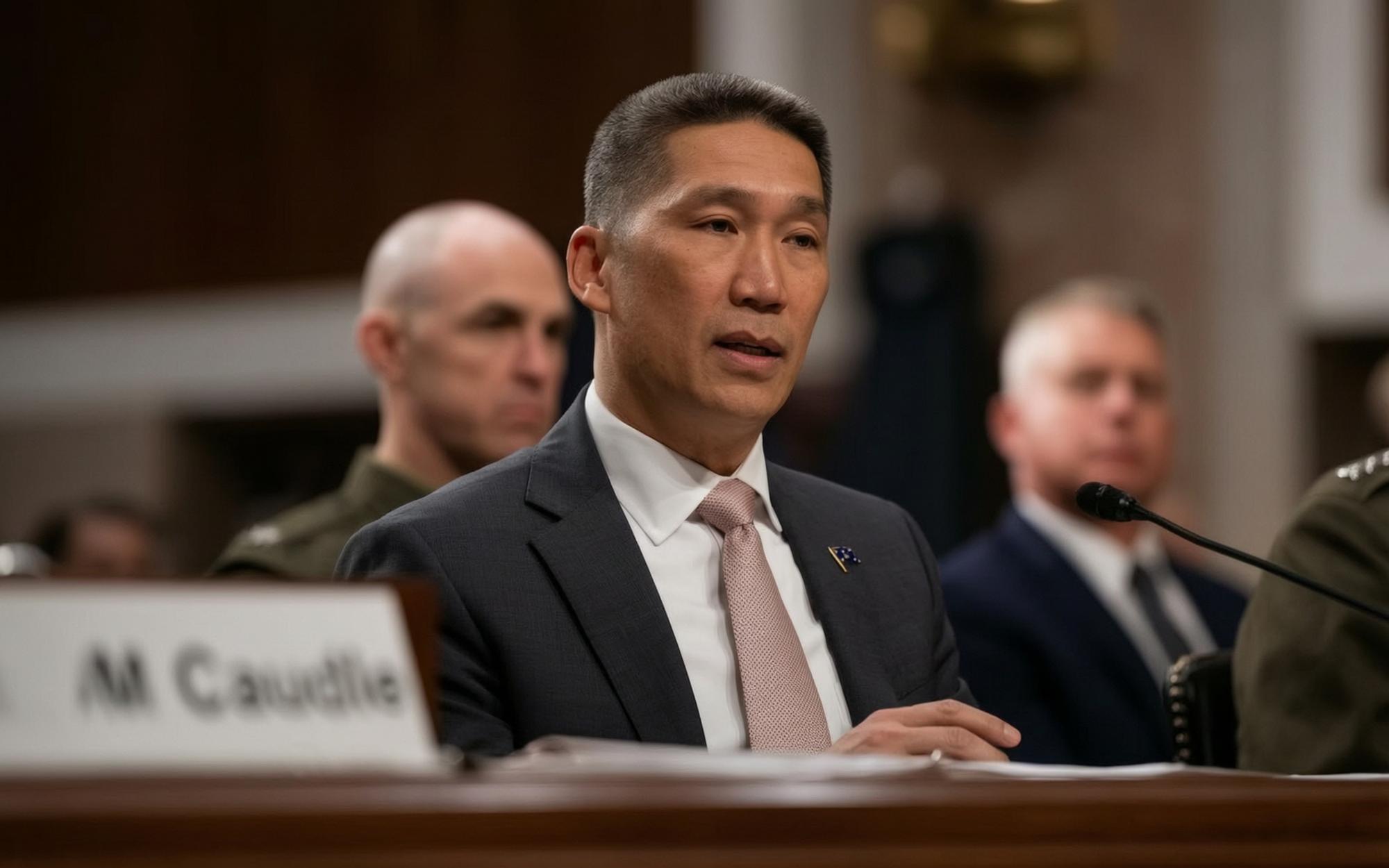
“It’s a leadership issue, and I’m not blaming you for anything. I’m saying you need to know your Marines really well,” Cao told several hundred Marines.
His point was direct: Leadership requires more than reviewing reports, circulating phone numbers, and checking bureaucratic boxes.
“I need for you guys to know your Marines so well that you know how they smell, when they breathe, and when they walk up, you can hear them behind you.
But also when they’re hurting, to be able to pull aside and say, ‘Come here, Marine. Let’s walk for a second here,’” Cao said.
Smith, Sergeant Major of the Marine Corps Carlos Ruiz, Medal of Honor recipient Dakota Meyer, and Cao’s senior mental health adviser also attended.
Cao intends to conduct similar meetings at major Navy and Marine Corps installations in the coming months.
The urgency is backed by troubling numbers. Although military suicides declined during 2024, the broader rate has moved upward since 2011, and War Department officials reported that 472 service members died by suicide in 2024.
The official 2025 report is expected this fall. However, data from the final months of that year indicated increases among active duty and Reserve sailors and Marines compared with the previous year.
Smith urged officers and noncommissioned officers to practice more “intrusive leadership.”
He told them to learn about their Marines’ spouses, children, finances, personal histories, and major stressors rather than waiting for a crisis to announce itself.
“No one is going to fault you for being intrusive and getting into the lives of your Marines and your sailors. No one is going to fault you for that. If you get an [Inspector General] complaint, fine. Get an IG complaint. It will be the first of many as a leader,” Smith said.
Meyer, who also serves as a Marine Corps Reserve sergeant, called on leaders to prioritize “taking care” and “showing up for each other.”
His message challenged the increasingly impersonal approach that treats struggling troops as paperwork to be routed elsewhere.
“We have leadership problems that’s failing a generation. My NCOs took care of me. My NCOs raised me up,” Meyer said.
“They were available 24/7. They showed up to be my solution. They didn’t outsource it. They didn’t look for another program. They didn’t look for a phone number to call when I had a problem.”
The meetings came as Navy leaders face scrutiny over conditions aboard the USS Abraham Lincoln during its extended deployment.
The carrier has experienced at least one reported suicide attempt, while sailors have raised concerns about food shortages, moldy showers, delayed mail, limited port visits, and deteriorating mental health.
A sailor accused of attempting to jump overboard is now facing disciplinary action.
Navy officials initially disputed reports about conditions aboard the ship, but later deployed additional mental health resources and acknowledged that missed port calls had increased pressure on the crew.
Cao has served as acting Navy secretary since John Phelan departed in April, and Trump announced Cao’s formal nomination through social media.
Cao must still appear before the Senate for a confirmation hearing, where lawmakers are likely to question him about readiness, quality of life, and suicide prevention.
During Senate testimony in May, Cao promised to invest in sailors and Marines.
He also proposed a Suicide Prevention and Response Task Force to examine current programs, expose gaps, eliminate waste, and recommend efforts that produce measurable results.
Todd Peters, Cao’s senior adviser for mental health and suicide prevention, said the task force meets weekly. It is developing policy recommendations about which programs deserve expansion and which ones should finally be cut loose.
Officials are examining an Air Force program called Wingman Guardian Connect, which builds “peer-to-peer” relationships by having airmen work through scenarios with a facilitator.
University of Rochester experts developed the approach and later introduced it to “first-responder” organizations and predominantly Black churches.
Experts described the model as “active” prevention instead of a “passive” approach built around lectures and auditorium presentations. A War Department committee similarly criticized the stale “one-size-fits-all” method of marching troops into dark rooms for another PowerPoint briefing.
Studies found that the program reduced “suicide-risk” scores, depression symptoms, and “work-related” stressors. Researchers also found that it “counteracted standard drift towards disconnection” among airmen considered “at-risk.”
“It’s the only program that had 10 years of research data points to prove that it worked. The Air Force used it, and it drastically reduced the numbers. It’s measurable,” Peters said. “There’s two gentlemen for the Navy and the Marines. Their job is to make it fit the Marine Corps language and the Navy language.”
Peters is also pressing the Navy to expand its chaplain corps, with 25 additional positions approved for the next fiscal year.
The retired Navy SEAL and pastor has submitted a recruiting proposal aimed at putting more trusted spiritual counselors near sailors and Marines.
“What I’ve learned from every Marine and sailor so far is they all love chaplains, and they wish they had more. And when I looked at the numbers, the Army has twice the number of chaplains.
They have 1,800 to our 980, and we have more people to serve and care for,” Peters said. “I put a package together because, again, I’m fluent in that world as a pastor. Well, let’s go recruit.”
Anyone considering suicide, concerned about someone else, or seeking emotional support can call or text 988 to reach the National Suicide Prevention Lifeline. Trained counselors are available across the United States 24 hours a day.
