
The U.S. Navy is putting a more accurate name on 19 planned Virginia class submarines, and for once the label actually matches the lethality taxpayers are buying.
The service announced Monday that submarines equipped with the Virginia Payload Module will be reclassified from fast attack submarines to guided missile submarines, a shift that reflects a major jump in strike capacity.
That means these boats will carry the SSGN designation, signaling that they are not merely hunters lurking beneath the waves, but heavily armed strike platforms built to hit targets far inland without much warning.
In plain English, the Navy is acknowledging that the next wave of Virginia class boats will bring a much larger missile punch than earlier versions with a smaller munitions package.
“Reclassifying Virginia Payload Module-equipped submarines as SSGNs accurately reflects the extraordinary strike capacity, operational flexibility, and global reach these platforms bring to the fleet,” said Chief of Naval Operations Adm. Daryl Caudle. “These submarines will provide our nation with a powerful and persistent deterrent, expand options for our combatant commanders, and ensure the Navy remains ready to fight and win whenever and wherever called upon.”
The Virginia Payload Module adds four large diameter payload tubes to each submarine. Each tube can carry seven Tomahawk cruise missiles, giving every equipped boat 28 additional missiles.
That is not a minor paperwork adjustment. It is the difference between a stealthy attack boat and a submerged arsenal that can deliver serious consequences before an adversary even knows it is in range.
The first submarine slated to receive the added Virginia Payload Module capability is the USS Arizona, the second Block V Virginia class submarine. The Navy expects delivery of that boat in fiscal year 2029.
The reclassification applies to planned Block V and Block VI submarines, with deliveries expected to continue through 2038. That timeline matters because the undersea fight is becoming more central as China expands its navy and hostile regimes keep testing American patience.
The announcement also comes right after the Navy awarded $42.1 billion to General Dynamics Electric Boat and Huntington Ingalls Industries Newport News Shipbuilding. That massive contract covers construction of nine Virginia class Block VI submarines.
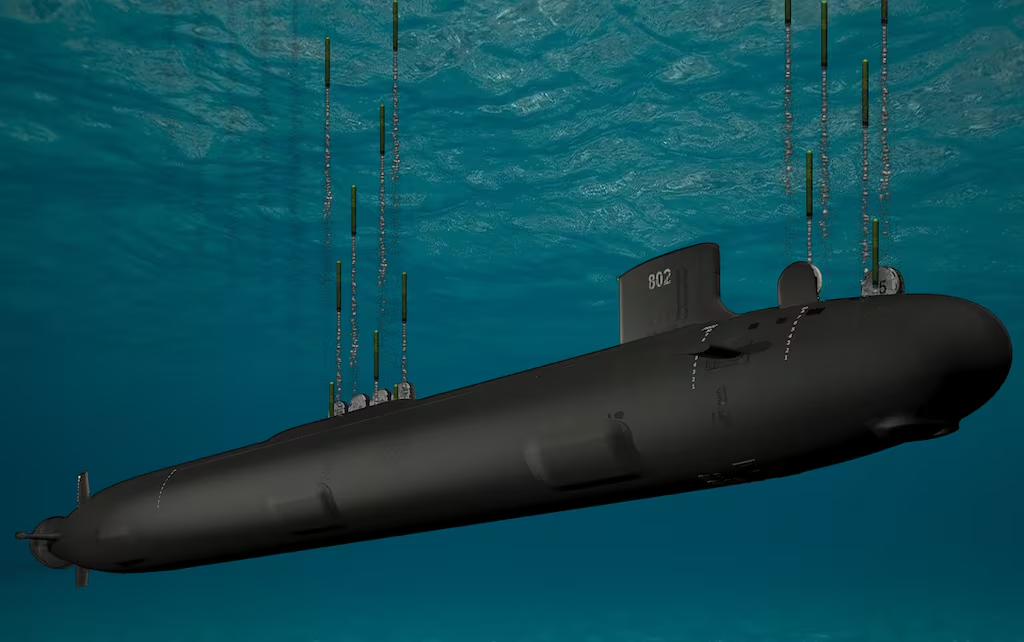
On top of those boats, 10 Block V Virginia class submarines will also incorporate the Virginia Payload Module, according to the Navy. Together, that accounts for the 19 submarines being moved into the guided missile submarine category.
There are currently 26 active Virginia class submarines in the fleet, with 23 more planned for construction. The class is organized by blocks, with each block bringing upgrades in technology, design, weapons capacity, and overall combat value.
“The submarine force is defined by our ability to operate undetected and strike without warning,” said Vice Adm. Rick Seif, Commander, Submarine Forces. “By integrating high-volume precision strike capabilities into these stealth platforms, these SSGNs serve as the ultimate enabler for Distributed Maritime Operations, giving our warfighters the overwhelming, flexible firepower required to win decisively in any theater.”
That is the kind of sentence that should make America’s enemies sit up straight. It also happens to be the kind of hard power signal that fits the moment, especially as President Trump and Secretary of War Pete Hegseth push a military posture built around winning wars instead of winning approval from think tank cocktail hours.
The value of these boats is not just the number of missiles they carry. It is the fact that they can move quietly, remain hidden, and give commanders options without putting a surface fleet in plain view.
Tomahawk missiles launched from submarines give the United States the ability to strike command centers, air defenses, logistics hubs, and other high value targets from the shadows. For combatant commanders, that means more flexibility and less begging for permission from fragile foreign basing arrangements.
The Navy’s move also sends a message about deterrence. A guided missile submarine that can disappear into the ocean and carry a heavier load of precision weapons forces adversaries to plan around a threat they cannot easily track.
That is exactly why undersea warfare remains one of America’s strongest advantages. While politicians in Washington often find ways to waste money on pet projects and bureaucratic nonsense, investments in stealth, firepower, and survivability are the real business of national security.
The reclassification may sound administrative, but it reflects a bigger strategic reality. The Virginia class fleet is evolving from a premier attack submarine force into a deeper strike arm for the nation, and that is good news for commanders who may one day need to bring overwhelming force to bear quickly.
For the sailors who will operate these submarines, the mission remains brutally simple. Stay hidden, stay ready, and if ordered, hit hard enough that the enemy never forgets who owns the deep.
