
Hundreds of relatives of American troops and veterans remain caught in a grinding immigration backlog at Camp As Sayliyah in Qatar, according to AfghanEvac.
The holding facility is scheduled to close Sept. 30, yet residents reportedly have received no formal explanation of what happens next.
Among those waiting is the brother of former Marine Corps Gunnery Sgt. Sean Jamshidi.
His brother worked for the U.S. government during the Afghanistan war and has spent nearly two years at the camp while awaiting permission to enter the United States.
Jamshidi served America in some of the Marine Corps’ most respected assignments, including as an embassy security guard detachment commander and in psychological operations.
Despite that record, he now finds himself virtually powerless against the federal immigration machinery holding his brother in limbo.
AfghanEvac estimates that roughly 150 relatives of U.S. service members and veterans are stranded at Camp As Sayliyah.
Organization leaders remain uncertain whether the government will actually close the facility in September, but that uncertainty offers little comfort to families already worn down by years of waiting.
Jamshidi was born in Afghanistan and moved to the United States with his family when he was about five years old. He later joined the Marine Corps because he understood, from personal experience, what American freedom means and what life looks like when those protections do not exist.
“My mother, her dying wish is to see her son before she goes … so we’re trying to keep her healthy until my brother gets there,” Jamshidi said. “I want to continue shining a light on this crisis so the American people can hear these stories and demand change … This is not a partisan issue; it’s an American obligation.”
AfghanEvac leaders say the wider visa freeze is affecting approximately 3,000 relatives of American military personnel. Many applicants, including Jamshidi’s brother, have already secured Chief of Mission approval, completed required interviews and cleared major procedural hurdles, leaving only the final paperwork.
As America marks five years since the disastrous withdrawal from Afghanistan, refugee assistance organizations are pushing Congress to pass the Afghanistan TPS Act. The bipartisan legislation would establish temporary protected status for Afghan refugees and restart visa processing for eligible applicants.
Nebraska Republican Rep. Don Bacon, a retired Air Force brigadier general and bill cosponsor, supports using a discharge petition to force the measure out of committee and onto the House floor. “Most Americans want a decent, I would call it a Christian policy here, and that’s not what we’re getting,” Bacon said.
Bacon described himself as an “old Ronald Reagan-type Republican.” He added, “We have a moral obligation to those we serve with in Afghanistan, who served by our side, helping us out.”
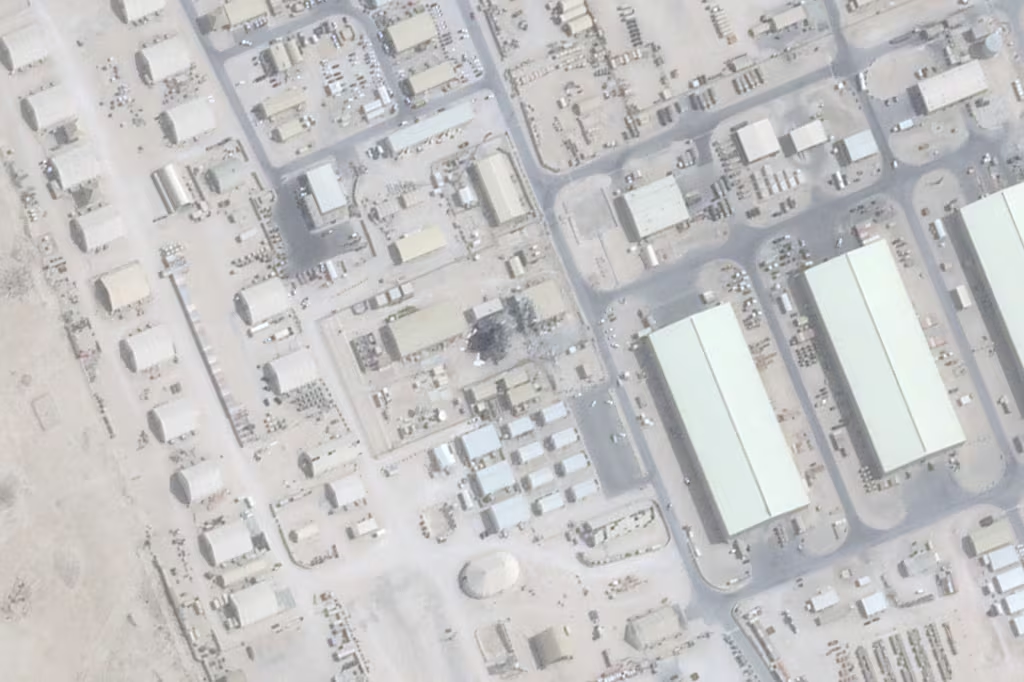
Camp As Sayliyah became an extended waypoint for Afghans evacuated by the United States in 2021 and has received more than 1,000 refugees. Residents face restricted movement, difficult conditions and growing mental health problems after years of uncertainty.
The Iranian conflict has added another layer of fear, with missiles flying overhead and debris reportedly reaching residential areas. “There’s missile fragments falling on people’s homes; there’s loud noises and uncertainty,” Jamshidi said.
One White House proposal would send the refugees from Qatar to the Democratic Republic of the Congo, effectively leaving them to rebuild their lives there. Jamshidi served at the U.S. Embassy in Kinshasa in 2018 and knows firsthand why that idea is hardly a serious answer.
“I know the conditions there, and it’s even worse than some areas in Afghanistan,” he said. Shipping people to another unstable environment would not resolve America’s unfinished obligation to properly vetted partners and military families.
Bacon and Texas Democratic Rep. Julie Johnson said a discharge petition would be filed “soon,” although neither offered a firm timeline. Both lawmakers said the ultimate objective remains permanent American resettlement for Afghan allies who meet eligibility requirements.
Jamshidi belongs to a group chat involving troops and veterans whose relatives remain at Camp As Sayliyah. He said the conversation has largely fallen silent as frustration and fading hope replace the expectation that Washington will finally keep its word.
“As a Marine, I understand what it means to keep your promise and to stand by our coalition, our partners who served us and who supported us, who sacrificed their life for us, and how important that is,” Jamshidi said. “So I’m going to continue fighting for that.”
