
The U.S. Air Force’s decision to permanently relocate its RQ-4 Global Hawk reconnaissance drones from Guam to Yokota Air Base just outside Tokyo is being hailed by national security experts as a smart, overdue move that plants American eyes and ears firmly on the Pacific’s front lines.
The move underscores the growing significance of Japan’s role as a forward operating partner while giving U.S. commanders greater agility in monitoring hotspots like Taiwan and the South China Sea.
The shift involves three Global Hawk aircraft and roughly 150 personnel from the 4th Reconnaissance Squadron, 319th Operations Group.
Japan’s Defense and Foreign Ministries jointly announced the relocation in late May, calling it a tangible sign of the alliance’s continued strength and shared deterrence posture in the Pacific.
Though the public announcement came only recently, analysts like Ralph Cossa, former president of the Pacific Forum think tank in Hawaii, said the only surprise was that this strategic repositioning took so long.
In his words, “This sends a signal of U.S. commitment to Japan and also increases U.S. ability to respond to Taiwan contingencies.”
In other words, America’s modernization of its Pacific presence continues at full throttle.
For years, the Global Hawks have operated out of Andersen Air Force Base, Guam — a crucial but weather-beaten hub. Guam’s location places it in the crosshairs of nearly every typhoon season.
Those destructive storms aren’t just an operational inconvenience; they’re a direct threat to America’s billion-dollar hardware and mission tempo. Squadron commander Lt. Col. Adam Otten put it plainly: “It has an impact on operations. For the RQ-4, this is the right place to be.”
That argument makes sense. Typhoon Mawar in 2023, for example, battered Guam so severely that repairs dragged on for years. By basing the Global Hawks further north, the Air Force avoids repeated interruptions and ensures predictable operational readiness year-round. In tactical terms, Yokota simply makes sense.
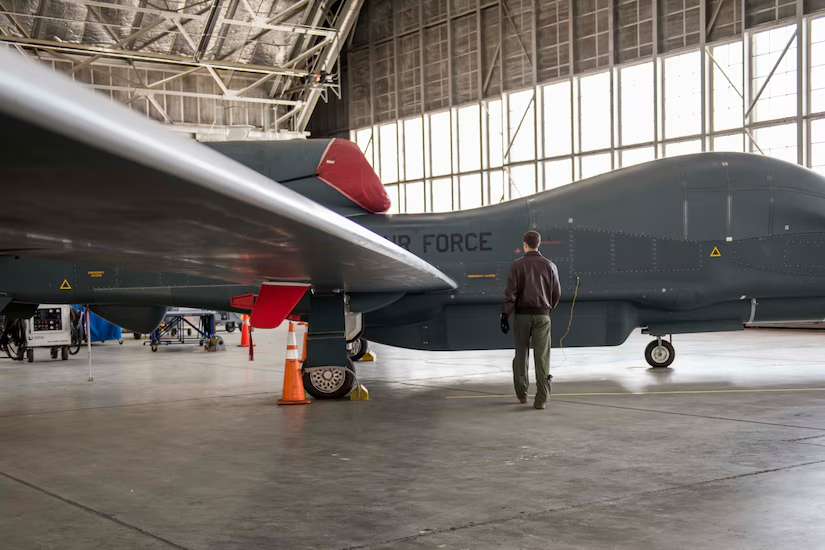
The Global Hawk Block 40 is a workhorse of modern intelligence gathering — capable of long-endurance, high-altitude surveillance that delivers detailed imagery and signals intelligence over vast distances.
From their new home in Tokyo, these drones can cover the East China Sea, the Taiwan Strait, and even the South China Sea almost as effectively as they could from Guam, according to Leland Bettis of the Pacific Center for Island Security. Geography is destiny, and Tokyo now sits in the sweet spot for near-instant response.
The new positioning also complements broader reorganizations within U.S. Forces Japan.
Analysts like Grant Newsham of the Japan Forum for Strategic Studies point to a major push to transform U.S. command structure in Japan into a real warfighting command, capable of seamless coordination across air, sea, and cyber domains.
“It simplifies operations and makes them more efficient and also tends to create an important level of familiarity between all parts of the command,” Newsham said.
That operational synergy is vital, particularly with China expanding its naval presence and air patrols in the region.
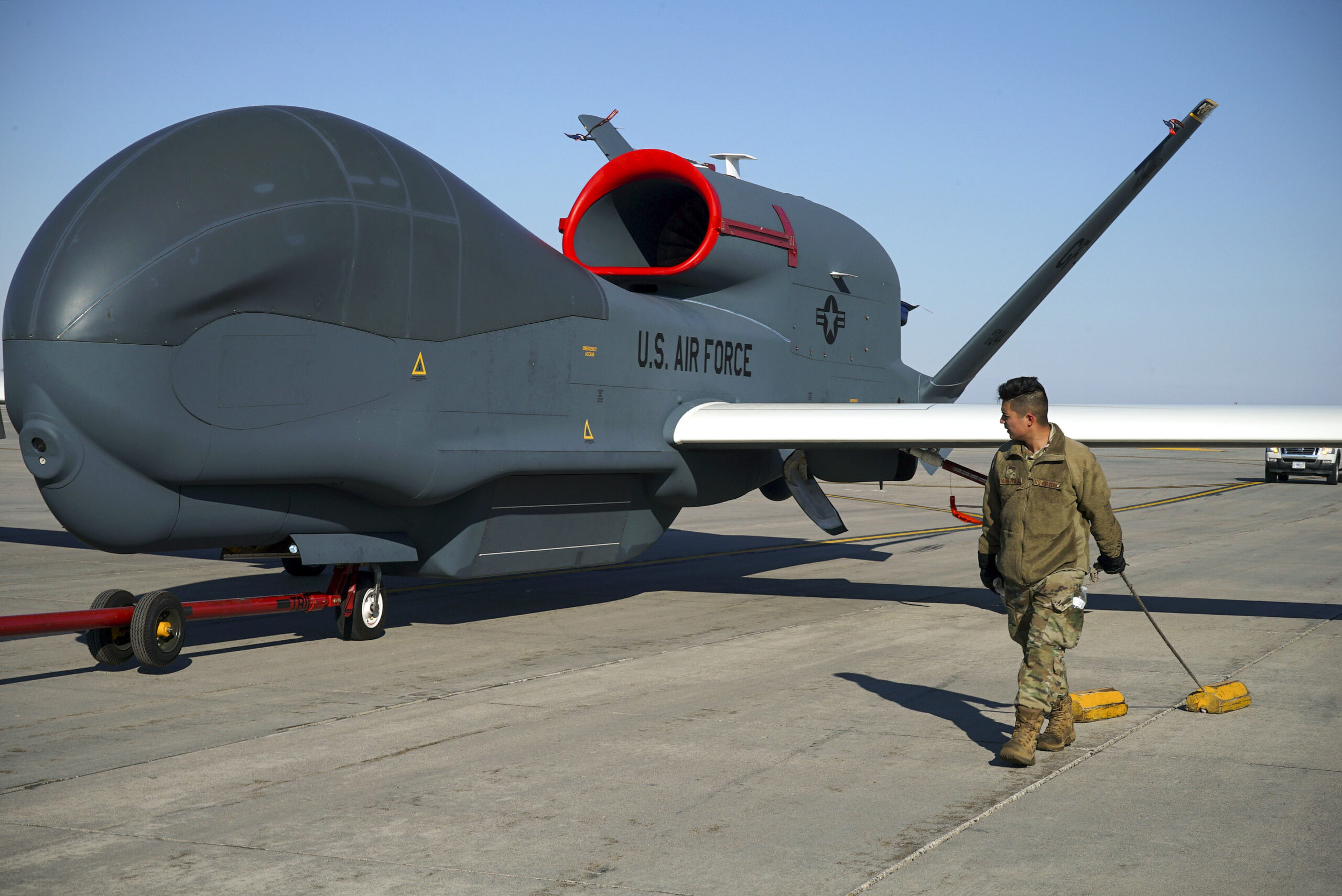
Beijing’s aggressive posturing around Taiwan continues to raise alarms among America’s allies, and having Globally integrated ISR (intelligence, surveillance, reconnaissance) assets like the Global Hawks closer to the action dramatically improves situational awareness.
The drones are now stationed on Yokota’s east side, alongside the newly opened U.S. Space Force Japan headquarters and near hangars soon to host CV-22 Osprey aircraft.
That kind of joint basing isn’t just convenient — it’s a powerful symbol of unified combat capability across services. From orbit to ocean, the Pacific is under a sharper watch.
Critics in Japan who worry about safety and noise have little to stand on. The RQ-4 is not some booming jet engine tearing across the sky but a quiet, unmanned intelligence platform.
“We have very well-trained personnel that operate one of the safest airframes in the Air Force inventory,” Lt. Col. Otten assured.
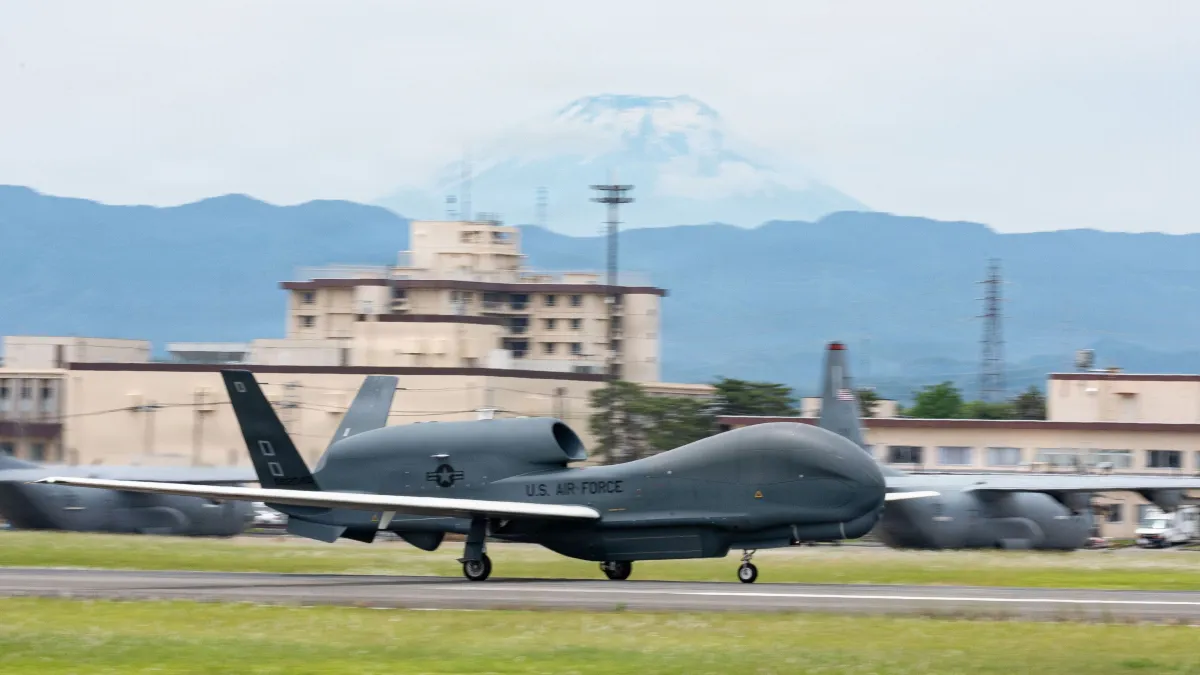
Years of temporary deployments to Japan since 2014 have already helped calm public nerves and demonstrate the drones’ minimal impact.
From a strategic perspective, this relocation sends a clear message not only to Japan’s citizens but also to America’s adversaries.
The United States isn’t retreating or shrinking back. It’s doubling down — tightening its operational mesh across the Indo-Pacific with America’s most advanced reconnaissance technology and aligning its command structures to be faster, smarter, and closer to potential conflict zones.
For allies like Japan and Taiwan, this signals reassurance. For China, it’s a flashing warning light: the U.S. presence is growing more integrated, more permanent, and better positioned than ever before.
Drones might not win wars alone, but in this new Pacific chess match, the Global Hawks have just claimed a front-row seat.
