News

News

Marines Lead Fierce Race to Save Lives in Venezuela Quake Zone

U.S. Marines are grinding through mountains of collapsed concrete and rebar in northern Venezuela, working shoulder to shoulder with local rescue teams to find survivors of last week’s devastating earthquakes.

The work is grueling, hazardous, and urgent. “We’re racing against the clock,” said U.S. Southern Command, which oversees the mission.

The back-to-back quakes struck on June 24, pounding Yaracuy state west of Caracas with staggering magnitudes of 7.2 and 7.5. Within seconds, whole blocks were flattened, leaving more than 1,450 people confirmed dead and thousands still unaccounted for.

The devastation is severe enough that U.S. forces deployed immediately, with Marines, sailors, and airmen forming the core of an expanding international effort to search the wreckage.

The Marines are operating in coordination with Venezuelan emergency responders, who have publicly thanked the U.S. teams for their speed and toughness.

Working day and night, American and allied personnel are crawling through unstable debris, using thermal imaging and acoustic sensors to detect faint signs of life.

U.S. Air Force C-17 and C-130 transport aircraft have been ferrying in supplies and personnel, while Marine MV-22 Ospreys shuttle teams between impact zones. Meanwhile, Army CH-47 Chinooks and U.S. Navy ships stationed off the coast provide additional lift and logistics.
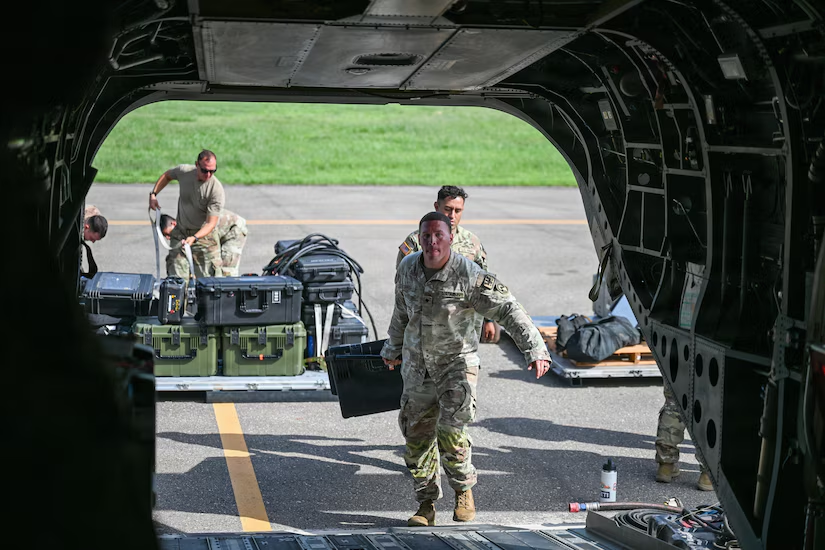
Marines Lead Fierce Race to Save Lives in Venezuela Quake Zone
Two men wearing camouflage military uniforms load a case into the back of a military cargo aircraft. Other men in camouflage military uniforms pack supplies onto a pallet.
Joint Task Force Bravo members load equipment into a CH-47 Chinook helicopter in preparation for potential support to Venezuela’s disaster relief response at Soto Cano Air Base, Honduras, June 25, 2026.

The War Department stressed that the operation is entirely self-sustaining, with troops relying on their own food, fuel, and medical resources.

Images released by U.S. Southern Command show Marines covered in gray dust beside Venezuelan police officers, pausing briefly between shifts before digging again.

One photo shows a Venezuelan rescuer gripping a U.S. Marine’s hand as they push through a narrow gap in the rubble—a powerful reminder of how disaster strips away politics when lives hang in the balance.

Major General Kevin Jarrard of the U.S. Marine Corps arrived on site soon after the earthquakes to guide the American response.

According to SOUTHCOM, Jarrard and his forward team are coordinating directly with Venezuela’s interim government led by Delcy Rodriguez, who requested U.S. assistance after years of strained relations under former dictator Nicolas Maduro.

That cooperation itself is a major shift. In January, U.S. special operations forces successfully captured Maduro and his wife during a daring nighttime raid, ending his long tenure of socialist misrule.

Since that mission, Venezuela has been tentatively rebuilding institutional stability—and this earthquake has become the first major test of the new leadership’s willingness to work with Washington.

So far, the coordination has been remarkably smooth. The Marines’ arrival was met with visible gratitude from civilians and overwhelmed first responders who had been digging with shovels and bare hands. One Venezuelan volunteer described the Marines’ effort simply: “They don’t stop.”

Marines Lead Fierce Race to Save Lives in Venezuela Quake Zone

The mission has also become a striking demonstration of what American might looks like when used for good. The same precision, logistics, and discipline that dominate the battlefield have been redirected toward saving lives in one of the worst natural disasters in South American history.

Despite that humanitarian focus, safety remains a challenge. The terrain is unstable, aftershocks continue, and temperatures soar during the day.

“Every move we make has to be deliberate,” one Marine engineer officer said. “There are whole sections of collapsed structures that could shift at any second.”

Military analysts have noted that operations like this highlight why a robust American military presence matters far beyond conflict zones.

Without the airlift capacity, logistics, and command coordination that the War Department can mobilize, such large-scale rescues would be nearly impossible. When crisis strikes, humanitarian rhetoric doesn’t save lives—boots, muscle, and organization do.

As Marines pull back debris piece by piece, the broader mission continues to grow. U.S. Navy divers are expected to assist in coastal regions where fishing towns were washed out by quake-triggered waves.

Medical teams are setting up mobile field hospitals, and combat engineers are beginning to assess long-term rebuilding needs.

For now, though, the mission remains singular. The search continues through shattered buildings and broken neighborhoods as U.S. Marines, Venezuelan responders, and international volunteers fight exhaustion and fading hope.

In the chaos, America’s warriors once again prove they’re not just the best at fighting wars—they’re the best at saving lives when the world collapses.

News

Former Ohio Gov. John Kasich Whines as President Trump Finally Ends the Haitian Invasion of Ohio [WATCH]

Former Ohio Gov. John Kasich is urging Congress to extend Temporary Protected Status (TPS) protections for Haitian nationals after the U.S. Supreme Court ruled that the Trump administration may move forward with ending the designation, as reported by Townhall.

Kasich commented on the issue in a post on X after the Court issued its decision, arguing that Congress should intervene to continue the humanitarian protections.

“The Supreme Court has allowed TPS for Haitians to end, putting families in Springfield and communities across the country at risk of being sent back to a country in chaos. Congress can and should extend these protections.”

The Supreme Court’s decision allows the Department of Homeland Security to proceed with terminating TPS protections for Haitian nationals after lower court orders blocking the action were overturned.

Temporary Protected Status is a humanitarian program established by Congress in 1990 that allows eligible nationals of designated countries experiencing armed conflict, natural disasters, or other extraordinary conditions to remain and work in the United States for limited periods.

Haiti first received the designation in January 2010 following a devastating earthquake.

James Percival, identified in the source as DHS General Counsel, also commented on the history of Haiti’s TPS designation in a post on X.

“This is how the Obama Administration sold Haiti TPS to the American people in 2010. It was controversial at the time because it rewarded people who came here illegally. Democrats’ promise of 18 months turned into 16 years.”

Although TPS is designed as a temporary form of humanitarian relief, successive administrations have repeatedly renewed Haiti’s designation.

According to figures cited in the source material, more than 300,000 Haitian nationals currently reside in the United States under Temporary Protected Status.

The discussion surrounding the ruling has also focused on Springfield, Ohio, where approximately 15,000 Haitian migrants are reported to be living. The source states that roughly 30 percent of those residents have obtained mortgages on homes in the community.

Andrew Kolvet shared comments on X highlighting the number of TPS recipients living in Springfield.

“So of the 350,000 Haitians in the United States with TPS, a little over 10,000, close to 15,000 live here in Springfield, the population of Springfield is about 58,000. So with this decision from the Supreme Court, 20% of this community in…”

The Supreme Court’s ruling has renewed debate over how long TPS protections should remain in place for countries that have received repeated extensions over many years.

Supporters of extending TPS argue that recipients have established lives and families in the United States and that conditions in Haiti remain unstable.

Those supporting the administration’s position argue that the program was created as a temporary humanitarian measure and should not become a permanent immigration status.

The Court’s decision does not immediately remove TPS recipients from the country. Current protections remain in effect until the Department of Homeland Security finalizes termination dates and implements the process established under federal law.

The ruling affects hundreds of thousands of Haitian nationals currently residing in the United States under TPS and marks another significant development in the ongoing national debate over immigration policy and the future of temporary humanitarian programs.

News

Kim Jong Un Flaunts New Missile Tests On Korean War Anniversary as Tensions Rise

North Korea’s dictator Kim Jong Un marked the 75th anniversary of the Korean War with what he called a “modernization showcase,” personally overseeing a series of missile and artillery tests aimed squarely at unnerving both Seoul and Washington.

According to the regime’s own mouthpiece, KCNA, Kim’s test lineup included an upgraded 240mm multiple rocket launcher system, a tactical ballistic missile warhead, and a 155mm self-propelled howitzer.

The state’s report bragged that the new rocket launcher’s range is extending to 56 miles, while the howitzer achieved a roughly 40-mile reach—figures designed to send chills across the Korean Peninsula.

Kim proudly claimed the launches were proof that his drive to expand and automate North Korea’s arsenal is paying off.

Kim declared that “firepower improvement” remains at the core of his so-called national defense plan and insisted the advances were part of a policy to outmatch world powers.

“Automation, precision, and extended reach,” said Kim, are the way forward for his military buildup.

South Korean officials verified that the regime launched multiple projectiles between 7:27 and 8:20 a.m., immediately detecting and tracking them in coordination with U.S. assets.

Lee Kyung-ho, deputy spokesman for South Korea’s Ministry of National Defense, said extra analysis would determine full details, describing the weapons as “tactical-level systems.”

Lee also took a strangely defensive tone toward reporters, telling them to avoid “politically interpreting and disparaging the contributions of South Korean and U.S. service members.”

His remarks came after South Korean daily Chosun Ilbo blasted the ministry for failing to promptly reveal details of the launches—a rare cover-your-tracks moment by Seoul’s leadership.

The controversy erupted because the War Ministry typically alerts local press immediately after a North Korean launch. Chosun Ilbo questioned whether officials delayed disclosure out of incompetence or to downplay the tests ahead of national political events.

A Stronger, Smarter Presence: Trump-Era Vision Strengthens South Korea Force with Longer Deployments
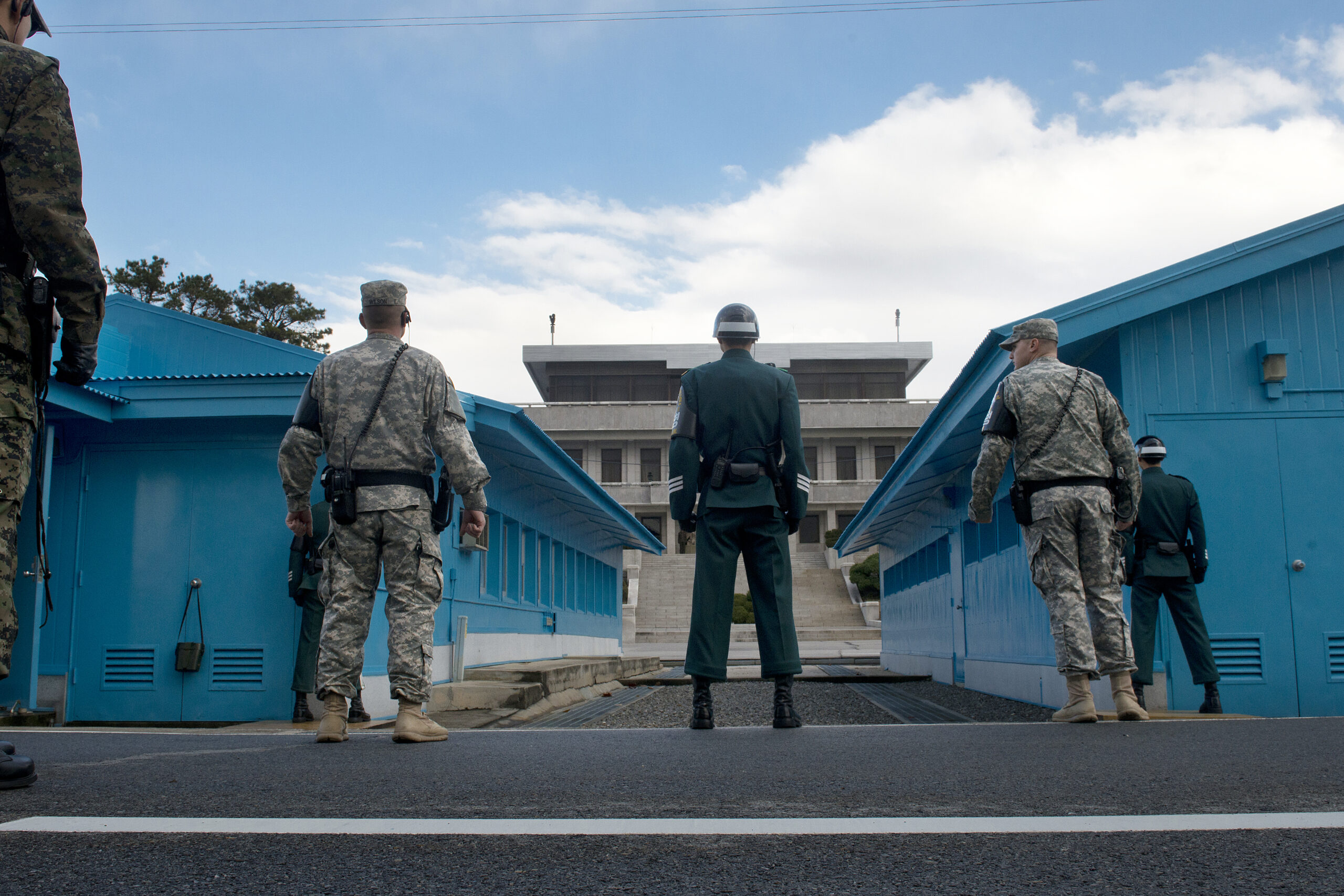
Republic of Korea and U.S. Soldiers at the demilitarized zone in South Korea facing North Korea on Nov. 11, 2012. DoW photo by D. Myles Cullen

That’s not a good look when Pyongyang’s routinely making threats and South Koreans are increasingly skeptical of their own government’s backbone.

Lee attempted to smooth things over by claiming that the government had monitored the launch “in real time” but needed “further verification” before making any statement. Many observers aren’t buying it.

With North Korea growing bolder and China lurking in the background, perception matters—and Seoul’s hesitation sends the wrong signal.

The tests continue a relentless pace this year, with April’s salvos focused on surface-to-surface Hwasong-11 Ra missiles and cluster bomb–equipped versions of tactical ballistic missiles.

For a regime that routinely struggles to feed its people, North Korea has no trouble pouring every available resource into weapons factories.

Kim has grander ambitions too. Just weeks earlier, he pledged to further expand the nation’s nuclear stockpile and accelerate construction of a 10,000-ton missile cruiser—essentially a floating launch platform for regional intimidation. His instruction to his generals was to fortify national defense “without pause,” vowing to “overtake the world.”

A Stronger, Smarter Presence: Trump-Era Vision Strengthens South Korea Force with Longer Deployments

The bluster is typical, but observers note the progress in North Korea’s missile program is real and troubling.

Last week, President Donald Trump signed an extension of the long-standing national emergency over North Korea for another year, calling Pyongyang’s weapons program an “unusual and extraordinary threat” to U.S. national security and global stability.

The decision, filed June 22 and published two days later, ensures continued sanctions and vigilance against the Hermit Kingdom’s war machine.

That emergency order, first issued in 2008, has been renewed annually by successive administrations, but under Trump, it carries renewed clarity: deterrence through strength, not platitudes.

Kim Jong Un Orders North Korean Army To Fortify Border Into ‘Warproof Wall’

The White House message is clear—peace through power, and no illusions about Pyongyang’s intent.

While the Biden liberals once downplayed North Korean provocations and mumbled about “engagement,” Trump and Secretary of War Pete Hegseth have reaffirmed real deterrence through readiness, missile defense modernization, and joint military drills. North Korea understands muscle, not meekness.

As Pyongyang doubles down on its ambition and Seoul fumbles for composure, the U.S. remains the indispensable backbone of deterrence across the Indo-Pacific. The anniversary of the Korean War reminds the world why eternal vigilance is not optional—it’s survival.

News

Army Unites Classic Bayonet Division with Cutting-Edge Multi-Domain Force to Form New Pacific Powerhouse

The U.S. Army is fusing its historic grit with 21st-century technology in a bold restructuring that carries both symbolic and strategic weight.

Amid cannon salutes and rousing brass, the ceremony at Joint Base Lewis-McChord marked the rebirth of the legendary 7th Infantry Division—now officially the 7th Infantry Division (Multi-Domain Command-Pacific).

For over a century, the “Bayonet Division” has been synonymous with American resolve, from the trenches of France to the battlefields of Korea and the mountains of Afghanistan.

But on this June morning, Army leaders made clear that the next battlefield may not be fought purely on land. Space, cyber, electronic warfare, and hypersonic weapons are now part of the modern arsenal—and the new 7th Infantry Division will command them in the Pacific theater.

Maj. Gen. Bernard J. Harrington explained that combining the traditional 7th Infantry Division with the 1st Multi-Domain Task Force represents more than administrative reshuffling.

“We merged a traditional ground force with new and emerging capabilities like space, electronic warfare, and cyber information,” Harrington said. The goal, he added, is to ensure American combat dominance “as the character of war is moving forward.”

The unit, now totaling approximately 12,000 soldiers, remains based at Joint Base Lewis-McChord—positioned strategically to project power across the Pacific Rim. That geographic focus is no accident.

With rising tensions in the South China Sea and growing Chinese aggression threatening regional stability, the U.S. Army is clearly placing its newest formation where it may one day be needed most.

Gen. Ronald P. Clark, commander of U.S. Army Pacific, underscored how the redesignation connected past valor with future readiness. “This ceremony is not simply symbolic,” Clark stated.

“It honors the sacrifices of those who came before us while affirming our readiness for the challenges ahead.” His message was crystal clear: the 7th Infantry Division’s history is a foundation, not a museum piece.

The division’s combat lineage stretches deep into America’s hardest fights—World War I, Okinawa, Korea’s Pork Chop Hill, and Panama’s Operation Just Cause.

That record of service now meets a technological transformation that would be unrecognizable to those World War II dogfaces who carried the division’s double-triangle patch through the Pacific campaign.

Army Unites Classic Bayonet Division with Cutting-Edge Multi-Domain Force to Form New Pacific Powerhouse
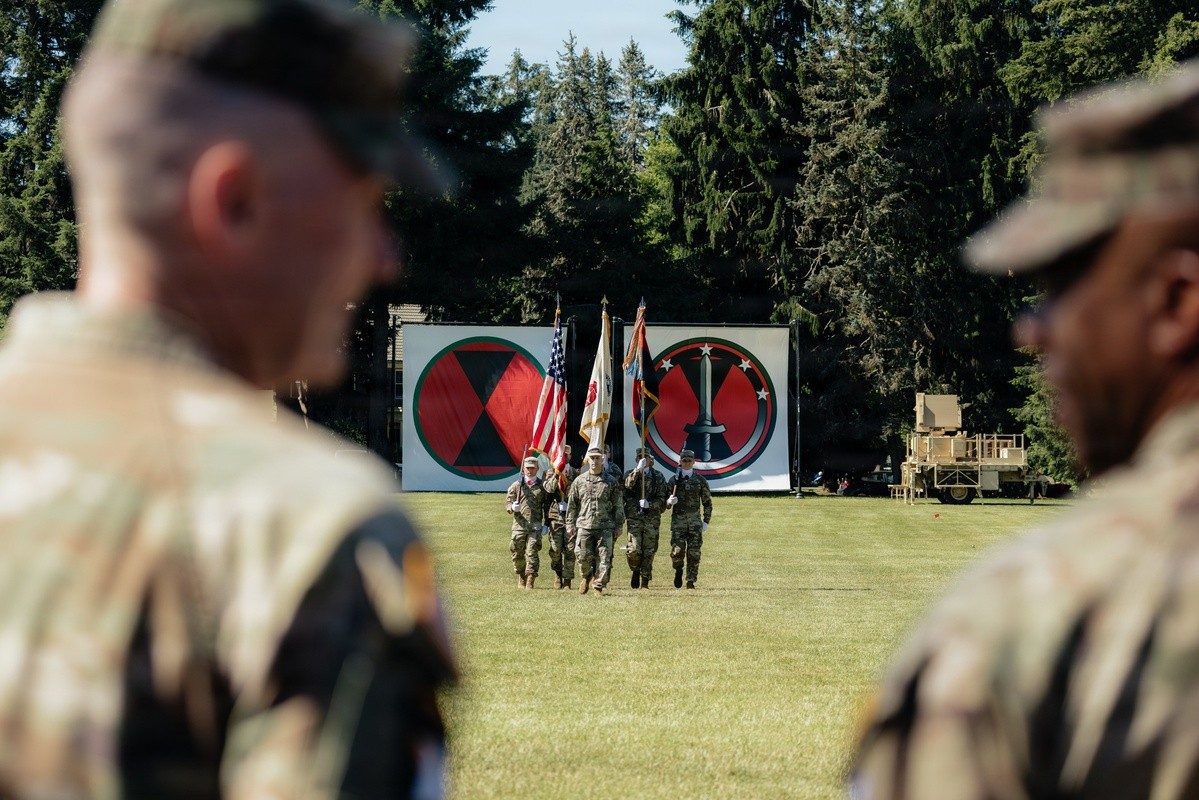
Maj. Gen. Bernard Harrington, 7th Infantry Division (Multi-Domain Command – Pacific) Commanding General (left), and Gen. Ronald Clark, U.S. Army Pacific Commanding General (right), look on as Col. Andrew Gallo, 7th Infantry Division (Multi-Domain Command – Pacific) Chief of Staff (center), marches the color guard during the 7th ID (MDC-PAC) redesignation ceremony at Joint Base Lewis-McChord, Wash., June 18, 2026. The redesignation honors the Bayonet Division’s legacy while establishing 7th ID (MDC-PAC) as the Army’s newest theater-enabling command, built to integrate maneuver, fires, air defense, cyber, space, electronic warfare, intelligence, unmanned systems, sustainment, and command and control in support of the Joint Force across the Pacific. (U.S. Army photo by Staff Sgt. Cayce Watson) (Photo Credit: Staff Sgt. Cayce Watson)

Adding a sharp edge to the day’s symbolism, Clark floated a new nickname: “The Hypersonic Bayonet Division.”

The title reflects the Army’s confidence in its cutting-edge Long-Range Hypersonic Weapon, known as Dark Eagle, which will soon be fielded by this very unit. The weapon can reportedly strike targets more than 1,700 miles away at five times the speed of sound—an arsenal worthy of both respect and deterrence.

If the 7th Infantry Division once represented the grit of the U.S. fighting man, its updated version fuses that heritage with the technological punch needed to face modern threats.

The combination of kinetic and non-kinetic warfare tools—alongside traditional infantry expertise—means adversaries in the Indo-Pacific will now face an American force that can see, strike, and disrupt across multiple domains.

Even as the ceremony unfolded with fresh insignias, marching formations, and a patch-switching ritual between the units, soldiers on the ground seemed unmoved by the bureaucratic changes.

“It’s nothing different,” said Staff Sgt. Jerald Everett of a HIMARS rocket battery. “It’s just a change in who’s paying our bills and who tells us where to go. We just have to do our jobs and do them well.” That grounded attitude remains a hallmark of American warriors—mission first, politics last.

Maj. Gen. Harrington emphasized that this redesignation is not about fancy titles—it’s about preparing for how future wars will be fought. “It is our soldiers’ sense of purpose,” he said.

“Being experts at that mission, still within the same organization, but optimizing for the joint force moving forward.” His statement resonated with the idea that victory in future conflicts will hinge not just on courage and numbers, but on the fusion of information, precision, and relentless readiness.

The brass band may have played for the crowd, but in truth the music marked the march of U.S. Army evolution—an institution that honors its traditions while adapting aggressively to new wartime realities.

With America refocusing attention on the Pacific under strong leadership in Washington, the creation of this multi-domain powerhouse signals that deterrence remains alive and well.

Under a reinvigorated War Department and leadership like War Secretary Pete Hegseth, the message to Beijing and beyond could not be clearer: the United States is not retreating from its role as the Pacific’s guardian force.

The new 7th Infantry Division (Multi-Domain Command-Pacific) is built to fight and win in the most complex battlefields on Earth—and its presence will ensure that America’s enemies think twice before testing its resolve.

At Joint Base Lewis-McChord, under the sharp Washington sky, the Bayonet Division’s rebirth represented more than a change of name. It stood as a pledge that American soldiers, armed with both valor and advanced weaponry, remain the vanguard of freedom in the Indo-Pacific and beyond.

News

Jacob Frey Applauds Somali Community While Fraud Investigations Grip Minnesota [WATCH]

Minneapolis Mayor Jacob Frey praised the city’s Somali community during a Somali Independence Day celebration over the weekend, describing its members as part of the city’s family while Minnesota continues to face scrutiny over several high-profile fraud investigations, as reported by Fox News.

Frey delivered the remarks on Saturday during a public event marking Somali Independence Day.

The speech came weeks after a Republican-led House Oversight Committee released a report alleging that the administration of Minnesota Gov. Tim Walz failed to respond to repeated warnings about fraud involving state social services programs.

Addressing attendees, Frey spoke about the Somali community’s place in Minneapolis and referenced what he described as challenges the community has faced.

“Through the most difficult of times and through Operation Metro surge, we all saw that they tried to come for some of us,” Frey said. “And when that happens, we say that you’re coming for all of us.”

The mayor continued by emphasizing what he said was the city’s support for Somali residents.

“In Minneapolis, we loved our neighbors. In Minneapolis, we do not see you as immigrants. We see you as our family,” he said. “You are our brothers. You’re our sisters. You have done so much for this incredible city, and for that, we stand with you.”

Frey appeared to reference Operation Metro Surge, an immigration and public safety initiative carried out by the Trump administration in Minnesota.

The operation concluded in February after Border Czar Tom Homan announced that more than 4,000 people had been arrested in the Minneapolis-St. Paul area. Homan said the operation reduced public safety threats in the region.

Following the event, Frey shared a video of his remarks on X along with a message recognizing the holiday.

“Happy Somali Independence Day,” Frey wrote.

“Here in Minnesota, home to one of the largest Somali communities in the United States, we celebrate the resilience, culture, and leadership that continue to enrich our city and community,” he added.

The mayor’s comments came as Minnesota remains the subject of multiple fraud investigations involving state-funded programs.

Earlier this month, the Republican-led House Oversight Committee released a report alleging that the Walz administration repeatedly failed to act on warnings about fraud involving state social services programs, including the Feeding Our Future case.

According to the committee, more than 110 people have been charged in connection with various fraud schemes in Minnesota.

The report stated that many of the defendants were identified as members of Minnesota’s Somali immigrant community.

The committee further alleged that concerns over potential racial discrimination claims contributed to delays in addressing suspected fraud.

It is also estimated that approximately $300 million in federal child nutrition funds intended for pandemic-era meal programs was stolen.

The Feeding Our Future investigation has become one of the largest fraud cases connected to pandemic relief programs in the state.

Walz administration officials have disputed the findings and conclusions contained in the House Oversight Committee report.

The investigations remain ongoing, while state and federal officials continue to examine allegations involving Minnesota’s social services programs.

At the same time, Frey’s remarks highlighted his administration’s support for the Somali community during the annual Somali Independence Day celebration in Minneapolis.

News

Marines and Japanese Forces Unleash Fierce Firepower in Island Warfare Drills

At the Hijyudai Maneuver Area in Oita, Japan, American Marines and Japanese soldiers have been putting serious steel on target during this year’s “Resolute Dragon” exercise.

The operation is part of a growing focus on how allied forces would capture and defend contested islands in the Pacific, a region that’s increasingly in the crosshairs of China’s ambitions.

Fighting shoulder to shoulder, ninety U.S. Marines from the 12th Littoral Combat Team joined about 300 troops from Japan’s 8th Division in an intense live-fire event that lasted roughly an hour and a half.

Mortars, rifles, and heavy vehicles all roared across the rugged Kyushu training ground in a scene that could easily mirror the start of a real island campaign.

Watching intently from the sidelines were troops and officers from the United Kingdom, France, Australia, and the Philippines—all nations watching China’s growing naval reach with more than a little concern.

The live-fire sequence wasn’t just for show. It was a textbook run of the new expeditionary warfare tactics that the Marine Corps and its Japanese partners have refined through multiple iterations of this annual drill.

According to 1st Lt. Owen Hitchcock, spokesman for III Marine Expeditionary Force, the focus was on mastering “command and control” under simulated battlefield chaos while integrating “joint fires capabilities.”

Marines and Japanese Forces Unleash Fierce Firepower in Island Warfare Drills
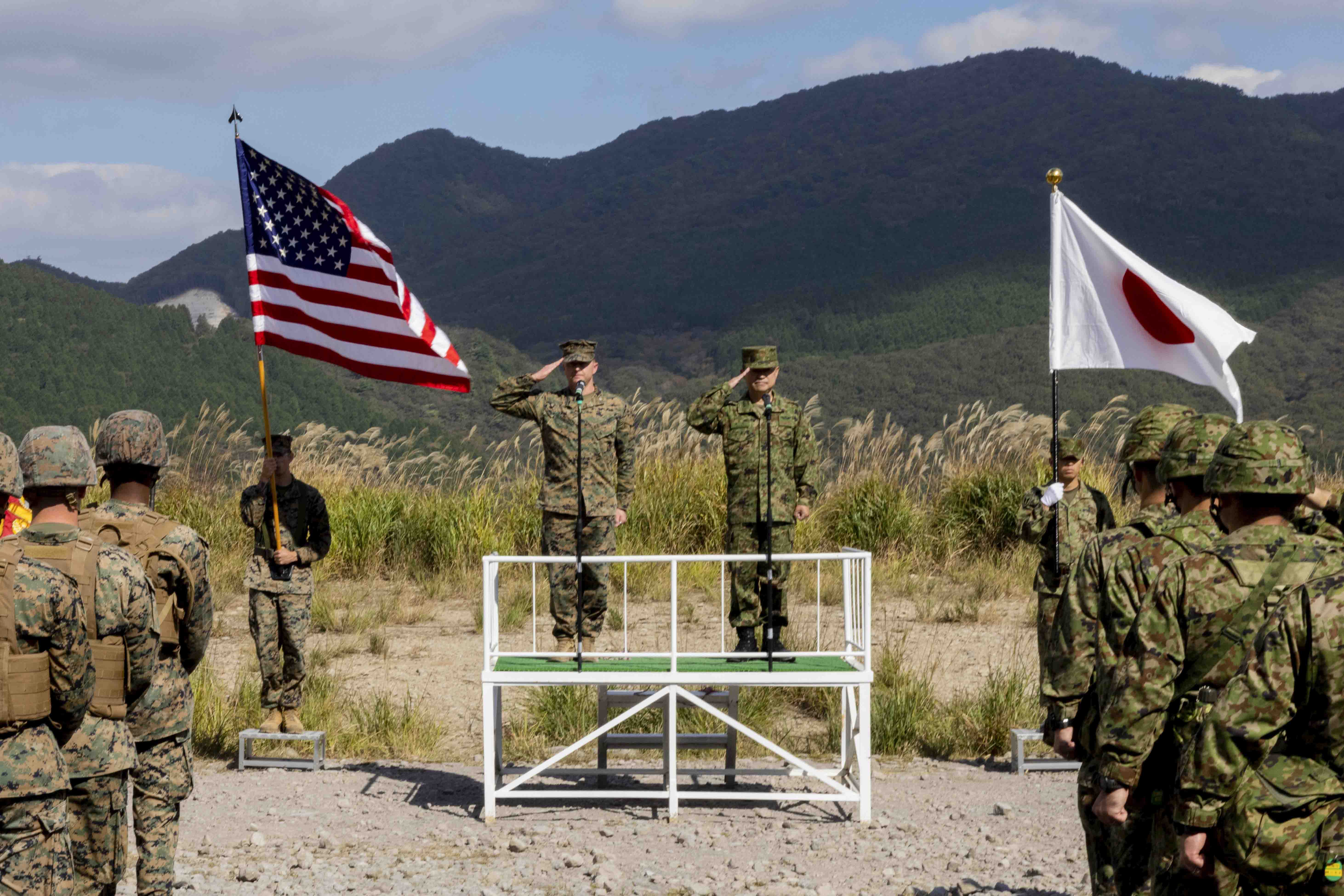
U.S. Marine Corps Col. Peter Eltringham, left, commanding officer of 12th Marine Regiment, 3d Marine Division, and Japan Ground Self-Defense Force Lt. Gen. Shinichi Aoki, commanding general of 8th Division, Western Army, render a salute during an opening ceremony for the field training exercise portion of Resolute Dragon 23 at Hijyudai Maneuver Area, Oita, Japan, Oct. 17, 2023. RD 23 is an annual bilateral exercise in Japan that strengthens the command, control, and multi-domain maneuver capabilities of Marines in III Marine Expeditionary Force and allied Japan Self-Defense Force personnel. (U.S. Marine Corps photo by Cpl. Paley Fenner)

That means small, mobile units fighting smart, staying spread out, and hitting targets before the enemy even sees them. As Hitchcock put it, the sprawling Hijyudai range “offers a lot of great areas for us to practice what really matters.”

The exercise centered on what the Marines call Expeditionary Advanced Base Operations—a core part of the Corps’ Force Design overhaul that puts the emphasis on fast, lethal, island-hopping teams instead of lumbering conventional formations.

These units are trained to slip inside the range of enemy missiles, seize strategic islands, and deny access to rival navies. It’s a modern throwback to the World War II island campaigns—leaner, meaner, and built for the high-tech battlefield of tomorrow.

Resolute Dragon, now in its sixth year, wrapped up its ten-day run with live-fire confidence and joint precision that both sides say is improving with each rotation.

The 12th Marine Littoral Regiment, established in late 2023, is the spearhead of this new approach and has taken part in the drill since its formation.

Expectations for the littoral units are high. They’re meant to move light and fast, seize and hold key ground, and work seamlessly with air and naval assets to crush any enemy approach.

Lieutenant Ellen Sullivan, the regiment’s spokeswoman, said this year’s event proved that each iteration with their Japanese counterparts only strengthens the operational bond and “that human connection” critical to real battlefield effectiveness.

Marines and Japanese Forces Unleash Fierce Firepower in Island Warfare Drills
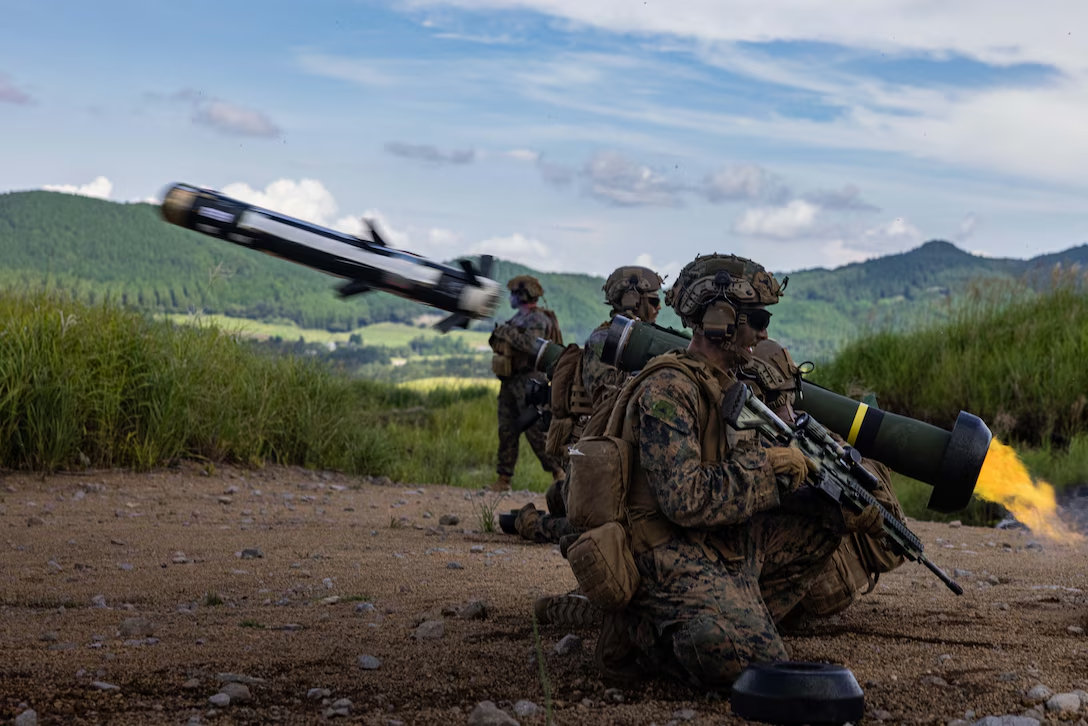
Marines fire an FGM-148 Javelin during Resolute Dragon 25 at Hijudai Maneuver Area, Japan, Sept. 15, 2025. The U.S.-Japan exercise strengthens the countries’ command, control and multidomain maneuver capabilities in key maritime terrain.

The simulated battle opened with a booming show of firepower from Japan’s Type 19 self-propelled howitzers, lobbing 155mm shells onto the target zone.

Japanese Type 16 Maneuver Combat Vehicles followed, rolling through the smoky terrain as the combined forces advanced. This is precisely the type of joint precision operation that would be needed if China ever turned up the heat near Japan’s southern islands or Taiwan.

Hitchcock explained that the artillery barrage was essential to “set conditions for ground troops” to move up safely through enemy fire zones, creating what he called “that overhead column” of suppressive power.

Once the guns fell silent, Marines charged forward beside Japanese armored carriers, working methodically through flanking positions and simulated territorial counterattacks.

Tech played a major supporting role as well. Drones crisscrossed the skies—some small, nimble, and controlled through first-person view, while a larger Stalker VXE30 soared above everything, feeding live tactical data to the ground units. Corporal James Ciccone described how the Stalker’s infrared sensor allows detection of “enemies at night.”

He explained that the drone can drop a virtual reference point on a mortar impact and another on a target, helping mortarmen make ultra-fast corrections for pinpoint accuracy.

It’s the kind of seamless tactical integration the War Department has been pushing for—unit-level awareness combined with precise joint fire that can hit, move, and hit again before the enemy can mount a serious response.

That’s the future Secretary of War Pete Hegseth and President Trump’s revitalized national defense strategy have envisioned: U.S. and allied forces building unmatched readiness in the Indo-Pacific to deter aggression before it starts.

Marines and Japanese Forces Unleash Fierce Firepower in Island Warfare Drills
Marines salute during the opening ceremony of Resolute Dragon 26 in Oita Prefecture, Japan, June 19, 2026. Resolute Dragon is an annual bilateral exercise in Japan that strengthens the command, control, and multidomain maneuver capabilities of III Marine Expeditionary Force Marines and Japan Self-Defense Forces personnel, with a focus on controlling and defending key maritime terrain.

While the Biden years saw military leadership tied up in cultural distractions, the Marines and their Japanese teammates are showing what real readiness looks like—focused, lethal, and disciplined.

Exercises like Resolute Dragon send a clear message: the Pacific will not be surrendered, and America’s warriors, alongside Japan’s, are ready to hold the line.

News

Mamdani Tries to Sugarcoat Socialist Surge as a “Vision” for America [WATCH]

New York City mayoral candidate Zohran Mamdani discussed the growing influence of socialist candidates within the Democratic Party during an interview with ABC News’ Jon Karl following several Democratic primary victories by candidates he endorsed, as reported by Red State.

The interview came after three candidates backed by Mamdani, including two who identify as socialists, won Democratic primary contests in New York City.

During the interview, Karl questioned Mamdani on a range of topics, including Israel, the direction of the Democratic Party, criminal justice, immigration, and the policy positions of candidates he has supported.

Karl first asked Mamdani about Israel’s identity as a Jewish state.

Karl: “Israel is a Jewish state. That’s in the charter. Do you support that?”

Mamdani responded, “I’ve said time and again that I support the state of Israel as a state with equal rights.”

Karl then asked, “As a Jewish state?”

Mamdani replied, “I believe that any state that privileges one religion over another is…”

The interview also focused on whether the recent success of socialist candidates represented a broader direction for the Democratic Party.

Mamdani said the candidates he supports are advancing a political agenda that extends beyond upcoming election cycles.

“What these candidates offer is a vision that extends beyond the midterms, that extends beyond 2028…”

Karl also asked Mamdani about comments made by New York City Democratic candidate Darializa Avila Chevalier, who has previously discussed abolishing prisons and borders and has opposed deportations.

When asked about those remarks, Mamdani replied:

“What I saw from Darializa was a focus on what she describes as a ‘politics of life.'”

Karl continued by questioning whether those positions would be broadly accepted by Democratic voters nationwide.

“ABC: Abolishing prisons, having open borders…most of Americans won’t go along with that.”

Mamdani responded, “We can have disagreements on policy positions.”

Karl then asked, “We can disagree on something as basic as we should have prisons?”

“There are prisons,” Mamdani replied.

The interview also revisited remarks Mamdani made in August 2020 regarding incarceration.

“Frankly, what purpose do they serve?”

Karl concluded by asking whether differing ideological factions could continue to coexist within the Democratic Party.

“Is there room in the party for both of these views?” Karl asked.

Mamdani answered, “Yes…I think what makes our party a beautiful party is the fact that it’s a big tent.”

The interview aired as Democratic leaders continue to debate the party’s ideological direction following recent primary elections.

The broader discussion has also included comments from Democratic congressional candidate Melat Kiros of Colorado, who advocated for expanding support for Medicare for All.

“The only way we get Medicare for all passed is by getting rid of the Democrats that are actively standing in that way.”

The interview and related reactions highlighted continuing debate within Democratic politics over issues including Israel, criminal justice, immigration, health care, and the party’s future direction following the recent primary contests.

News

Texas Sisters Mock Police With Grins After Allegedly Killing Mom Of Five [WATCH]

Three women have been charged with murder following the death of a 32-year-old Texas mother of five after an attack in Del Rio, according to local authorities, as reported by The New York Post.

The Del Rio Police Department said sisters Amaya “Cookie” Diaz, 19, and Kitty Mia Diaz, 21, along with 21-year-old Kyandra Renee Faz, were taken into custody Thursday in connection with the death of Caroline “Caro” Peña.

Police have not publicly disclosed a motive in the case.

The arrests came just hours after investigators say Peña was attacked in broad daylight in Del Rio, a city near the Texas-Mexico border with a population of approximately 35,000.

Video recorded outside the Diaz sisters’ residence showed officers escorting the suspects into patrol vehicles following their arrests.

In the footage, Kitty Diaz, who was barefoot and wearing black shorts and a black halter top, briefly smiled while officers walked her to a police cruiser. Her younger sister, Amaya Diaz, was also taken into custody outside the home.

Michael Elizondo, an independent journalist based in Del Rio, said he arrived at the residence after hearing reports of significant police activity in the neighborhood.

“I didn’t know what was going on, but I knew it must be serious” because of the number of police vehicles at the scene, Elizondo said.

He said he initially did not realize what the women had been arrested for.

“I saw the first girl going into the car, and I thought, ‘Whatever.’ … But the second one caught my eye.”

Elizondo described the demeanor of one of the suspects as officers completed the arrests.

“That girl was in a happy mood. … She was all smiling, goofing off like nothing happened,” he said.

He also recalled another moment after one of the suspects had been placed inside a patrol vehicle.

“All of the sudden I see the window go down, and the girl was sticking out her face, sticking out her tongue and goofing off,” Elizondo said.

According to Elizondo, a nearby resident later told him the sisters had been seen “driving recklessly” through the neighborhood earlier that day.

Authorities have not commented publicly on that account.

Investigators believe the attack occurred outside a Sonic Drive-In restaurant in Del Rio. Video reportedly captured Peña confronting three women before she was critically injured.

Peña was transported to a hospital in San Antonio, where she died at approximately 9 p.m.

Police said officers responding to the hospital traced the incident back to the Del Rio location, where the attack allegedly occurred.

Following their arrests, Amaya Diaz, Kitty Diaz, and Faz were each charged with murder and booked into a local jail, according to the Del Rio Police Department.

The department has not released additional information regarding the investigation and did not respond to media inquiries seeking further comment.

Peña’s death has drawn attention throughout the Del Rio community. She is survived by five children.

Social media posts attributed to Kitty Diaz indicate she is the mother of a young son. Earlier this month, she shared a TikTok video featuring the child and wrote, “My son is about to be 4 years old and still a only child.”

The murder investigation remains ongoing as authorities continue working to determine the circumstances surrounding the fatal attack.

Police have not announced any additional arrests or released further details about what led to the confrontation.

News

DHS Rolls Out New Self Deportation Plan After Landmark Supreme Court Decision [WATCH]

The Department of Homeland Security has announced a voluntary departure assistance program for Haitian and Syrian nationals affected by a recent Supreme Court decision allowing the Trump administration to move forward with ending Temporary Protected Status (TPS) for those countries, as reported by Trending Politics News.

The announcement follows the U.S. Supreme Court’s June 25 decision in Mullin v. Doe, in which the justices ruled 6-3 that the Temporary Protected Status statute generally prevents courts from reviewing decisions by the Secretary of Homeland Security to designate or terminate TPS for individual countries.

The ruling overturned lower court orders that had blocked the administration from ending TPS protections for Haitian and Syrian nationals.

Temporary Protected Status was established by Congress in 1990 as a humanitarian immigration program administered by the Department of Homeland Security.

The program allows eligible nationals of designated countries who are already present in the United States to remain in the country temporarily and receive work authorization for a specified period.

TPS designations are made when the Secretary of Homeland Security determines that conditions in a foreign country, including armed conflict, environmental disasters, or other extraordinary and temporary circumstances, make it unsafe for nationals to return or prevent the country from adequately receiving returning citizens.

The protections are temporary and generally last between six and eighteen months before being reviewed for possible extension.

TPS protects recipients from deportation during the designated period but does not provide lawful permanent resident status or a direct path to U.S. citizenship.

Justice Samuel Alito, writing for the majority, stated that the administration had offered a race-neutral explanation for ending the TPS designations and noted its consistent position regarding the program’s prior implementation.

Following the Supreme Court’s decision, Homeland Security Secretary Markwayne Mullin outlined a voluntary departure program for individuals whose TPS protections will be terminated.

During an appearance on CNN’s “State Of The Union,” Mullin encouraged affected individuals to pursue permanent legal status if they qualify or participate in the department’s voluntary return program.

“Either try to fill out the paperwork and be here underneath a permanent status or we’ll help you get back to your country. We’ll actually give you a plane ticket, plus roughly $2,100 to help you re-establish when you get there, but temporary protective status, according to the courts and in its name itself, is not permanent status,” he said.

According to DHS, the program includes a one-way airline ticket to the recipient’s home country along with approximately $2,100 in financial assistance per person to help with re-establishment after arrival.

Department officials said the assistance is available to individuals who voluntarily choose to depart the United States rather than remain after their TPS protections expire.

The Supreme Court’s ruling affects approximately 350,000 Haitian nationals and about 6,100 Syrian nationals who currently reside in the United States under Temporary Protected Status.

DHS said implementation of the program will proceed in accordance with the legal timeline established following the court’s decision. Current TPS protections remain in effect until the official termination dates are finalized and take effect.

Individuals who qualify for another form of immigration relief may still pursue those options independently of the voluntary departure program.

Those who neither obtain another lawful immigration status nor participate in voluntary departure could become subject to standard immigration enforcement proceedings after their TPS protections expire.

The Supreme Court’s decision represents a significant development in the administration’s broader immigration policy and restores the Department of Homeland Security’s authority to move forward with terminating TPS designations that had previously been blocked by lower court rulings.

News

Brandon Gill Exposes Democrat Plot to Transform Red States Through Migrant Influx [WATCH]

Rep. Brandon Gill, R-Texas, argued that the federal Temporary Protected Status (TPS) program has been used to relocate migrants into communities across the United States following a recent Supreme Court ruling that favored the Trump administration’s authority to remove TPS protections for certain groups, including Haitians and Syrians, as reported by PJ Media.

The Supreme Court decision prompted reactions from lawmakers and commentators on both sides of the immigration debate.

Supporters of the ruling argued it reinforces the executive branch’s authority to administer immigration programs, while critics expressed concern about the potential impact on individuals who have lived in the United States under TPS protections.

TPS is a humanitarian immigration program that allows nationals of designated countries experiencing armed conflict, natural disasters, or other extraordinary conditions to remain and work temporarily in the United States.

Haiti and Syria received TPS designations more than a decade ago following crises in their respective countries.

Following the ruling, Gill posted comments on X criticizing the expansion of the program during the Biden administration and arguing that many beneficiaries had not traveled directly from their home countries.

“By the way, many of the Haitians who were given TPS under Joe Biden did not come from Haiti. They were living in nations like Brazil and Chile and came here to take advantage of Biden’s open border. They were sent, not to Martha’s Vineyard or Sherman Oaks, but to blue-collar, midwestern towns like Springfield, Ohio. And the people there were called racist for objecting to the culture of the town they built being fundamentally changed overnight.”

Gill also argued that asylum and TPS programs are susceptible to fraud and questioned how the programs have been administered in recent years.

Fox News correspondent Bill Melugin responded to Gill’s post by citing his own reporting from the southern border during the 2021 migrant surge in Del Rio, Texas.

“When I was at the Del Rio, [Texas,] Haitian bridge camp in 2021, many of the Haitians told me they had been living in Chile & Brazil for years before coming to the US illegally for economic (not safety) reasons,” Melugin wrote.

“The Haitians were dumping & tearing up their Chilean documents at the river’s edge hide this fact from the US so it wouldn’t hurt their fraudulent asylum claims.”

Melugin added additional comments regarding migrants he encountered while covering the border.

“The idea that all these Haitians came directly from Haiti after an earthquake or assassination is false. Many of them were living happily and safely for years in South America until Biden’s open border policies became too attractive to pass up. Others also flew into the US via Biden’s CHNV [Cubans, Haitians, Nicaraguans, and Venezuelans] mass parole program, which was supposed to be for only 2-year humanitarian parole grants. Of course, most never left.”

The CHNV parole initiative allowed eligible nationals from Cuba, Haiti, Nicaragua, and Venezuela to apply for temporary humanitarian parole into the United States under specified conditions.

Gill’s comments also referenced broader debates over immigration policy and congressional representation.

He argued that counting all state residents during the U.S. Census, regardless of immigration status, could affect congressional apportionment and Electoral College representation.

Those issues have remained part of ongoing political and legal debates surrounding immigration enforcement, census methodology, and federal immigration policy.

Supporters of the Supreme Court ruling have said the decision restores greater authority to the executive branch to determine when temporary humanitarian protections should end.

Opponents have argued that ending TPS protections could disrupt the lives of individuals who have lived and worked in the United States for years.

The administration’s implementation of TPS and related immigration programs continues to face legal challenges as federal courts consider additional cases involving humanitarian protections and executive immigration authority.


Scroll to Top