
Air Force Global Strike Command has ordered personnel at F.E. Warren Air Force Base in Wyoming to stop using an aging communications test kit after inspectors discovered potential residue from a carcinogenic chemical.
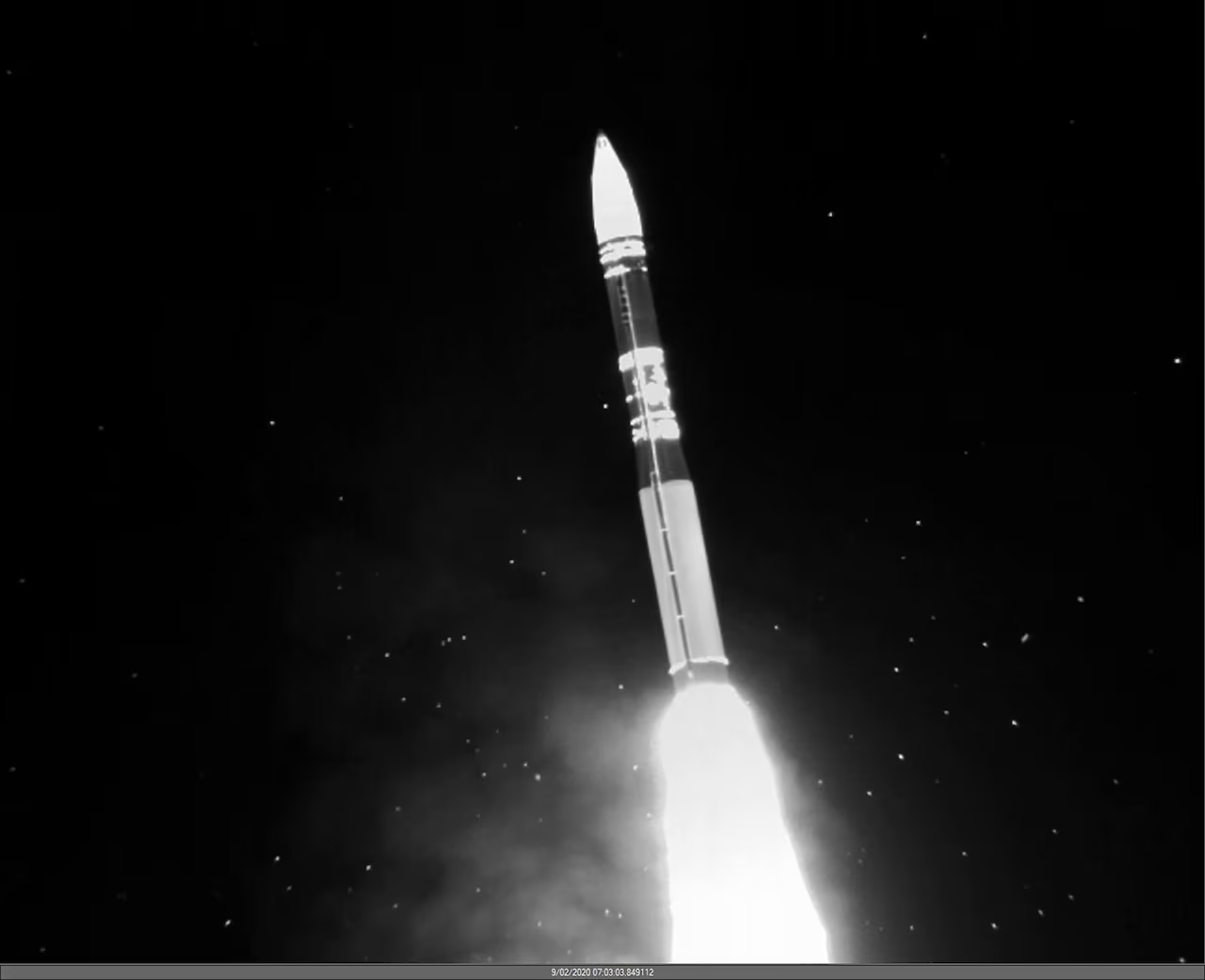
The order affects equipment supporting the Minuteman III intercontinental ballistic missile mission.
The command announced Friday that units must cease using the AN/PRM 10 test oscillator set because polychlorinated biphenyls, commonly called PCBs, may be present inside the equipment.
The 20th Air Force is “immediately” ending use of the affected systems at F.E. Warren.
The review began after an airman reported being exposed to suspected PCB residue while inspecting one of the communications kits.
Medical personnel examined the airman and found no negative health effects following the incident.
That report prompted the 20th Air Force to inspect its inventory rather than wait around for another exposure.
Teams identified potential residue on roughly three quarters of the communications test kits, although final laboratory results remain pending.
Global Strike Command said personnel at F.E. Warren are moving away from the older test systems and transitioning to a modern replacement.
That is the right response when decades old hardware begins presenting possible health hazards to the airmen responsible for America’s nuclear deterrent.
“We remain vigilant for issues like these and will continue to aggressively and immediately take the appropriate actions,” Gen. S.L. Davis, commander of Air Force Global Strike Command, said in a statement.
The command is also working to dispose of the older communications kits safely.
PCBs are toxic industrial chemicals once widely used in electrical systems and other equipment because of their insulating qualities.
The Environmental Protection Agency warns that they can have “potential carcinogenic and non-carcinogenic effects.”
Federal authorities banned PCB production in the United States during the 1970s, but the chemicals did not magically disappear from older military infrastructure.
Traces have continued to surface in aging electronics, buildings, and equipment at installations that have operated for generations.
F.E. Warren is one of three Air Force bases supporting the land based ICBM force. The others are Minot Air Force Base in North Dakota and Malmstrom Air Force Base in Montana.
Those installations remain central to the nation’s nuclear triad, but many facilities and systems trace their roots to the Cold War.

That history creates an obvious maintenance challenge because old equipment can contain materials that would never be accepted in newly manufactured systems.
PCB contamination has been a recurring concern across the ICBM enterprise, particularly inside launch control facilities.
Air Force records have documented reported leaks and possible exposures at nuclear missile sites for years, raising questions about how thoroughly legacy hazards were identified and removed.
The current action does not affect the ability of missile crews to perform their strategic mission, according to Global Strike Command. Missileers will continue maintaining the readiness of the Minuteman III force while replacement test equipment is brought into service.
That distinction matters because the United States cannot afford interruptions to nuclear readiness while China expands its arsenal and Russia continues waving its nuclear saber.
Protecting airmen and preserving the mission are not competing goals, regardless of what the bureaucracy may have tolerated in years past.
The Air Force launched a broader study in 2023 to examine cancer risks among personnel who worked around ICBM installations.
Researchers from the Air Force School of Aerospace Medicine evaluated environmental hazards at the bases, including possible PCB exposure.

Findings released earlier this year showed increased rates of Hodgkin lymphoma and testicular cancer among certain personnel connected to the missile community.
The research does not automatically prove that PCBs caused those illnesses, but it adds urgency to efforts to identify and eliminate potential exposure sources.
The swift halt at F.E. Warren shows the command is treating the latest discovery seriously instead of burying it beneath another stack of paperwork.
Airmen entrusted with America’s most powerful weapons deserve modern tools, safe working conditions, and commanders willing to act the moment a credible hazard appears.
